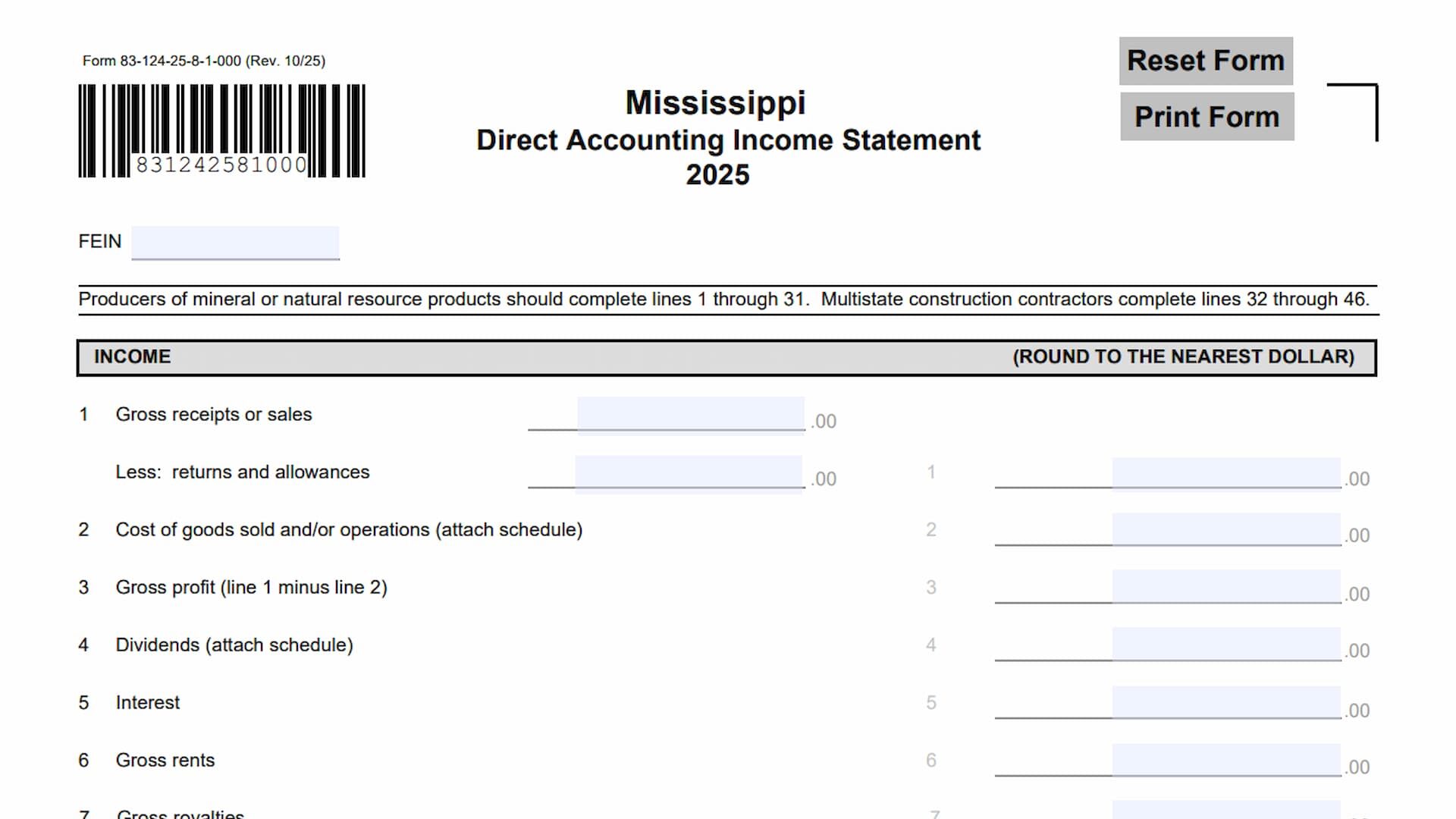
Form 83-124, Mississippi Direct Accounting Income Statement, is a business tax form used to report income, deductions, and net income or loss for the 2025 tax year. It provides a structured way for qualifying businesses to calculate their Mississippi income using direct accounting information and, where applicable, allocation methods based on sales and direct costs.
The form is divided into two main reporting sections based on the type of business completing it. Producers of mineral or natural resource products must complete lines 1 through 31. These lines cover gross receipts, cost of goods sold, other business income, deductions, and the calculation of net income or loss. Multistate construction contractors complete lines 32 through 46, which calculate Mississippi gross profit and determine the appropriate amounts of non-allocable business income and general and administrative expenses attributable to Mississippi.
Form 83-124 collects the business’s Federal Employer Identification Number (FEIN), gross receipts or sales, returns and allowances, operating costs, income from various sources, depreciation, employee-related expenses, and other deductions. Depending on the applicable reporting section, it also requires information about total company sales, Mississippi sales, direct costs, and allocation ratios.
Completing the form accurately is important because its calculations determine the net income or loss reported on Form 83-122, line 23. Businesses must use the appropriate section, report amounts accurately, and provide supporting schedules wherever the form requests them. The form also requires amounts to be rounded to the nearest whole dollar.
How To File Form 83-124
Form 83-124 is designed to provide the direct accounting income information used in completing Form 83-122. The final calculated amount from Form 83-124 must be transferred to line 23 of Form 83-122.
The appropriate final line depends on the type of business completing the statement:
- Producers of mineral or natural resource products: Enter the amount from Form 83-124, line 31, on Form 83-122, line 23.
- Multistate construction contractors: Enter the amount from Form 83-124, line 46, on Form 83-122, line 23.
Before completing the form, gather the following business records and financial information:
- Your business’s Federal Employer Identification Number (FEIN).
- Gross receipts or sales records for the applicable reporting period.
- Records of returns and allowances.
- Cost of goods sold and operating expense information.
- Dividend, interest, rental, and royalty income records.
- Capital gains, net gains or losses, and other income documentation.
- Business deduction records, including compensation, wages, repairs, taxes, interest, and contributions.
- Depreciation and depletion calculations.
- Pension, profit-sharing, and employee benefit expense information.
- Supporting schedules for amounts reported on lines marked as requiring an attachment.
- For multistate construction contractors, Mississippi job revenue, total company sales, direct costs, and non-allocable business income and expense records.
The form does not provide a separate mailing address or detailed submission method. Refer to the applicable Form 83-122 filing instructions for information about submitting the completed return and its supporting documents.

How To Complete Form 83-124
Form 83-124 contains three pages. The first page covers income and deductions for mineral and natural resource product producers, the second page continues the deduction and net income calculations and introduces the construction contractor section, and the third page completes the construction contractor calculations.
Follow the reporting instructions for your business type and complete the applicable fields.
Business Identification
FEIN: Federal Employer Identification Number
Enter the business’s Federal Employer Identification Number in the designated field at the top of the form.
Use the same FEIN throughout all three pages. This information identifies the business associated with the income statement.
Income
The Income section appears on page 1 and is used by producers of mineral or natural resource products. All amounts must be rounded to the nearest whole dollar.
Line 1: Gross Receipts or Sales
Enter the business’s total gross receipts or sales before subtracting returns and allowances. The form provides a separate entry field for returns and allowances below the gross receipts amount.
Subtract returns and allowances from gross receipts or sales. Enter the resulting net amount in the final amount field for line 1.
Line 2: Cost of Goods Sold and/or Operations
Enter the total cost of goods sold and/or operating costs associated with the business.
Attach a supporting schedule showing the applicable costs included in this amount.
Line 3: Gross Profit
Subtract the amount on line 2 from the amount on line 1.
Enter the difference on line 3. This represents the gross profit remaining after accounting for cost of goods sold and/or operations.
Line 4: Dividends
Enter the business’s dividend income.
Attach a supporting schedule providing the details of the dividends included in this amount.
Line 5: Interest
Report the interest income received by the business during the applicable reporting period.
Enter the total interest amount on this line.
Line 6: Gross Rents
Enter the business’s gross rental income.
Report the total amount before any rental-related expenses are deducted elsewhere on the form.
Line 7: Gross Royalties
Enter the total gross royalty income received by the business.
Include the applicable royalty income in the amount reported on this line.
Line 8: Allocable Capital Gain
Enter the capital gain amount allocated to the business’s Mississippi income calculation.
Attach a supporting schedule showing the capital gain calculation and the amount reported.
Line 9: Allocable Net Gain (Loss)
Enter the applicable allocable net gain or loss.
Attach a supporting schedule explaining the amount included on this line.
Line 10: Other Income (Loss)
Report any other business income or loss that is not separately identified on the preceding income lines.
Attach a supporting schedule describing the amounts included in this category.
Line 11: Total Income
Add the amounts reported on lines 3 through 10.
Enter the combined total on line 11. This represents the total income used in the subsequent deduction and net income calculations.
Deductions
The Deductions section begins on page 1 and continues onto page 2. It covers business expenses, employee-related costs, depreciation, and other allowable deduction categories reported on the statement.
Line 12: Compensation of Officers
Enter the compensation paid to business officers during the applicable reporting period.
Include the officer compensation amount in the total deductions calculation.
Line 13: Salaries and Wages
Enter the total salaries and wages paid to employees.
Report the applicable employee compensation expenses on this line.
Line 14: Repairs
Enter the business expenses associated with repairs.
Report the total repair costs included in the business’s deductions.
Line 15: Bad Debts
Enter the amount of bad debts reported by the business.
Include the applicable bad debt amount in the deductions section.
Line 16: Rents
Enter the rental expenses paid or incurred by the business.
This line concerns rent paid as a business expense, rather than gross rental income reported on line 6.
Line 17: Taxes
Enter the applicable business tax expenses.
Attach a supporting schedule showing the taxes included in the reported amount.
Line 18: Interest
Report the interest expenses incurred by the business.
Enter the total applicable interest expense on this line.
Line 19: Contributions
Enter the business contributions included in its deductions.
Report the applicable contribution amount on this line.
Line 20a: Total Depreciation
Enter the total depreciation amount calculated for the business.
This line records the overall depreciation figure before accounting for the amount of depreciation claimed on the return.
Line 20b: Depreciation Claimed on Return
Enter the amount of depreciation already claimed on the business’s tax return.
Use the applicable depreciation figure from the return to complete this field.
Line 21: Depreciation Balance Claimed
Subtract line 20b from line 20a.
Enter the remaining depreciation balance on line 21. This calculation determines the difference between total depreciation and the depreciation already claimed on the return.
Line 22: Depletion
Enter the business’s depletion expense.
Report the applicable depletion amount in the designated field.
Line 23: Advertising
Enter the total advertising expenses incurred by the business.
Include the applicable advertising costs in the deductions calculation.
Line 24: Pension, Profit-Sharing, Plans, etc.
Enter the expenses associated with pension plans, profit-sharing arrangements, and other plans included in this category.
Report the applicable business expense on this line.
Line 25: Employee Benefit Programs
Enter the expenses associated with employee benefit programs.
Include the applicable employee benefit costs in the total deductions calculation.
Line 26: Other Deductions
Enter other business deductions that are not separately identified on the preceding lines.
Attach a supporting schedule describing the additional deductions and the amounts included.
Line 27: Total Deductions
Add the amounts reported on lines 12 through 19 and lines 21 through 26.
Do not include lines 20a and 20b separately in this calculation. The depreciation balance is already accounted for on line 21.
Enter the resulting total on line 27.
Net Income
The Net Income section appears on page 2. It uses the income and deduction totals to calculate the business’s net income or loss. This section also accounts for certain non-allocable business income and general and administrative expenses apportioned to Mississippi.
Line 28: Net Direct Income (Loss)
Subtract the total deductions on line 27 from the total income on line 11.
Enter the resulting amount on line 28. This figure represents the business’s net direct income or loss before the adjustments reported on lines 29 and 30.
Line 29: Non-Allocable Business Income (Loss)
Enter the applicable non-allocable business income or loss.
This line also includes ordinary income and capital gains apportioned to Mississippi using a sales-to-sales ratio. Attach a supporting schedule showing the business income or loss and the applicable allocation calculation.
Line 30: Non-Allocable General and Administrative Expenses
Enter the non-allocable general and administrative expenses apportioned to Mississippi using a sales-to-sales ratio.
Attach a supporting schedule showing the expenses and the calculation used to determine the Mississippi portion.
Line 31: Net Income (Loss)
Add line 28 and line 29, then subtract line 30.
Enter the resulting net income or loss on line 31. Transfer this amount to Form 83-122, line 23.
This completes the reporting section for producers of mineral or natural resource products.
Gross Profit for Multistate Construction Contractors
The following section appears on page 2 and is specifically intended for multistate construction contractors. The form instructs only multistate construction contractors to complete lines 32 through 46.
These lines calculate Mississippi gross profit from construction jobs and determine the portions of non-allocable business income and general and administrative expenses attributable to Mississippi.
Line 32: Gross Receipts or Gross Sales from Jobs in Mississippi
Enter the total gross receipts or gross sales generated by construction jobs performed in Mississippi.
Report the applicable Mississippi job revenue on this line.
Line 33: Adjustments
Enter the adjustments applicable to the gross receipts or gross sales reported for Mississippi construction jobs.
Attach a supporting schedule identifying the adjustments and explaining the amounts included.
Line 34: Direct Cost from Jobs in Mississippi
Enter the total direct costs associated with construction jobs in Mississippi.
Report the applicable direct job costs used to calculate Mississippi gross profit.
Line 35: Mississippi Gross Profit
Add line 32 and line 33, then subtract line 34.
Enter the resulting Mississippi gross profit on line 35. This amount represents the gross profit from Mississippi construction activities before adding non-allocable business income and deducting the applicable general and administrative expenses.
Add: Non-Allocable Business Income
This section determines the portion of the company’s non-allocable business income attributable to Mississippi. It uses total company income and Mississippi sales to calculate an allocation ratio.
Line 36: Total Company Non-Allocable Business Income
Enter the company’s total non-allocable business income.
Attach a supporting schedule showing the total amount included in this calculation.
Line 37: Total Mississippi Sales
Enter the total Mississippi sales by adding line 32 to other Mississippi business income.
This amount represents the Mississippi sales figure used to determine the allocation ratio on line 39.
Line 38: Total Company Sales
Enter the company’s total sales from construction jobs and other business income.
Include the applicable sales from all business locations, not just Mississippi activities.
Line 39: Ratio
Divide the amount on line 37 by the amount on line 38.
Enter the resulting ratio as a percentage. This figure represents the proportion of total company sales attributable to Mississippi.
Line 40: Mississippi Non-Allocable Business Income
Multiply the total non-allocable business income on line 36 by the allocation ratio on line 39.
Enter the resulting Mississippi portion of non-allocable business income on line 40.
Deduct: Non-Allocable General and Administrative Expenses
This section appears on page 3 and determines how much of the company’s non-allocable general and administrative expenses should be attributed to Mississippi.
The calculation uses Mississippi direct costs and total company direct costs to establish an allocation ratio.
Line 41: Total Company Non-Allocable General and Administrative Expenses
Enter the company’s total non-allocable general and administrative expenses.
Attach a supporting schedule showing the expenses included in this total.
Line 42: Mississippi Direct Cost
Enter the total direct costs attributable to Mississippi construction activities.
Use the applicable Mississippi direct cost amount for the allocation calculation.
Line 43: Total Company Direct Cost
Enter the total direct costs for the entire company.
Include the applicable direct costs from all company operations used in the allocation calculation.
Line 44: Ratio
Divide the amount on line 42 by the amount on line 43.
Enter the resulting ratio as a percentage. This figure represents the proportion of total company direct costs attributable to Mississippi.
Line 45: Mississippi Non-Allocable General and Administrative Expenses
Multiply the company’s total non-allocable general and administrative expenses on line 41 by the allocation ratio on line 44.
Enter the resulting Mississippi portion of these expenses on line 45.
Line 46: Net Income (Loss)
Add the Mississippi gross profit on line 35 to the Mississippi non-allocable business income on line 40, then subtract the Mississippi non-allocable general and administrative expenses on line 45.
Enter the resulting net income or loss on line 46.
Transfer this amount to Form 83-122, line 23. This completes the reporting section for multistate construction contractors.
Final Review Before Filing
Before submitting Form 83-124 with the applicable tax return, review the following items to make sure the required information and calculations are complete.
- Correct tax year: Confirm that you are completing the 2025 Mississippi Direct Accounting Income Statement.
- FEIN: Verify that the Federal Employer Identification Number is accurate and consistent across all three pages.
- Business classification: Confirm that you are completing the appropriate section for your business type.
- Income reporting: Review gross receipts, returns and allowances, cost of goods sold, and all other income entries.
- Line 11: Make sure total income correctly adds lines 3 through 10.
- Deductions: Verify compensation, salaries, repairs, bad debts, rents, taxes, interest, and contributions.
- Depreciation: Check that lines 20a, 20b, and 21 are completed accurately and that line 21 reflects the difference between lines 20a and 20b.
- Line 27: Confirm that total deductions correctly include lines 12 through 19 and lines 21 through 26.
- Net income calculation: Verify the calculations on lines 28 through 31, where applicable.
- Supporting schedules: Attach the required schedules for all applicable income, deduction, adjustment, and allocation entries.
- Construction contractor section: If applicable, verify Mississippi job receipts, adjustments, direct costs, total company sales, and allocation ratios on lines 32 through 46.
- Allocation ratios: Confirm that line 39 uses line 37 divided by line 38 and line 44 uses line 42 divided by line 43.
- Line 40: Check that Mississippi non-allocable business income equals line 36 multiplied by line 39.
- Line 45: Check that Mississippi non-allocable general and administrative expenses equal line 41 multiplied by line 44.
- Final amount: Confirm that line 31 or line 46, depending on the applicable business section, reflects the correct net income or loss.
- Form 83-122: Transfer the applicable final amount to Form 83-122, line 23.
- Rounding: Make sure reported dollar amounts are rounded to the nearest whole dollar.
Review all entries, supporting schedules, and calculations before completing the related tax return. Ensuring that the correct reporting section is used and that all amounts are properly calculated helps maintain accurate Mississippi business income reporting.