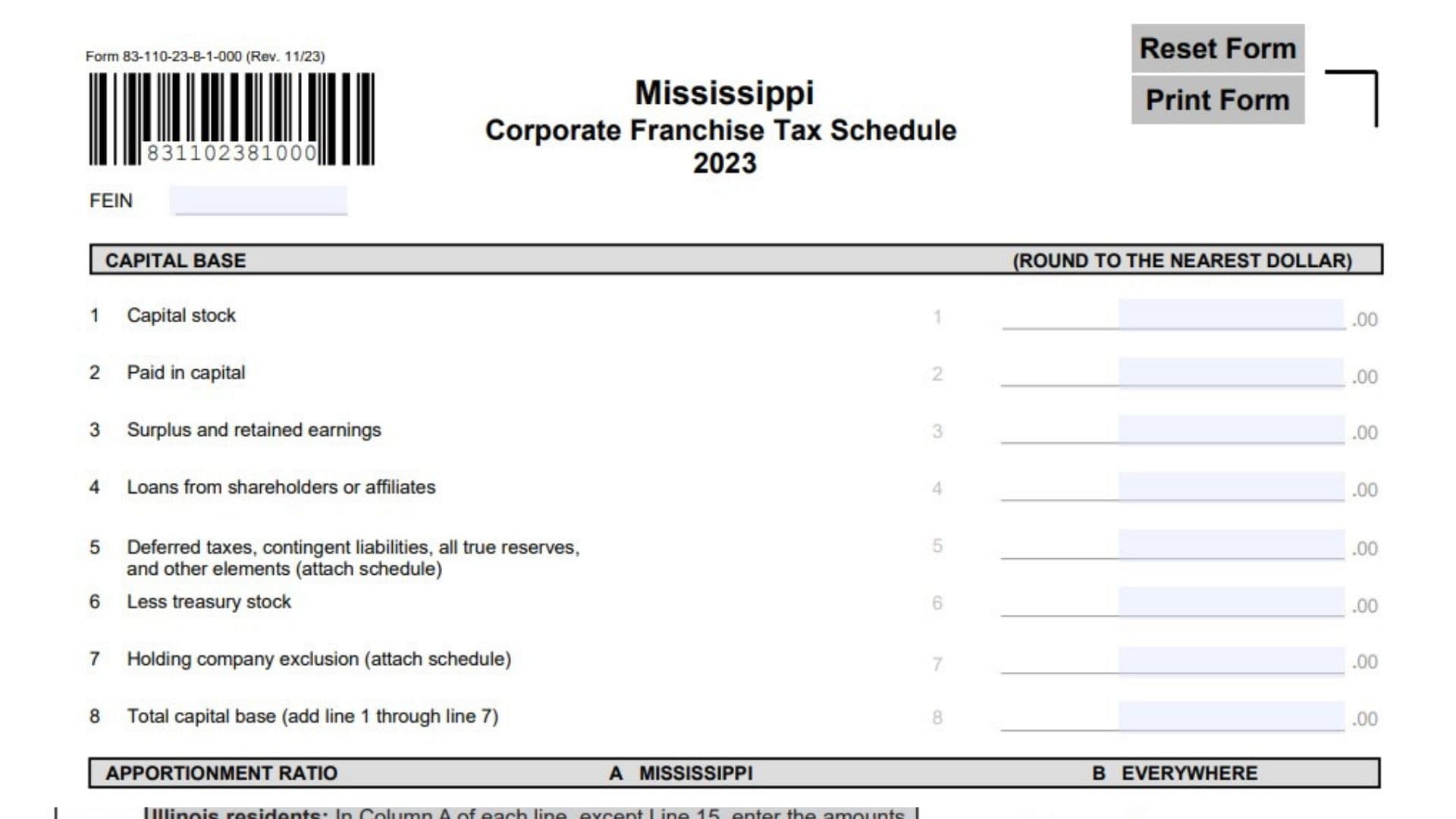
Mississippi Form 83-110, Corporate Franchise Tax Schedule, is a tax document used to calculate a corporation’s taxable capital for Mississippi franchise tax purposes. The form helps determine the portion of a corporation’s capital that is subject to Mississippi franchise tax based on its financial position, business activities, and property located within the state. It collects information about capital stock, paid-in capital, surplus and retained earnings, shareholder loans, deferred taxes, treasury stock, and applicable holding company exclusions. It also calculates the corporation’s Mississippi apportionment ratio using real and tangible personal property owned at year-end and gross receipts from Mississippi and everywhere else. The schedule includes a separate section for reporting the assessed value of real and personal property located in Mississippi counties. These calculations establish the corporation’s taxable capital, including any required adjustments for short tax periods and applicable capital exemptions. Corporations use the completed schedule to determine the final taxable capital amount that must be transferred to Form 83-105, line 1. Completing Form 83-110 accurately is important because the reported capital, apportionment percentage, property assessments, and exemptions directly affect the corporation’s Mississippi franchise tax calculation.
How To File Form 83-110
Form 83-110 is a supporting schedule used in calculating Mississippi corporate franchise tax. Its final calculation is transferred to Form 83-105, line 1.
Where To Submit Form 83-110
Use the completed Form 83-110 with the applicable Mississippi corporate franchise tax filing. The final taxable capital calculated on line 18 must be entered on Form 83-105, line 1.
Follow the filing and submission instructions applicable to Form 83-105 when submitting the corporate franchise tax return.
Information To Prepare Before Completing Form 83-110
Gather the following financial and business information before completing the schedule:
- Your corporation’s Federal Employer Identification Number (FEIN).
- Capital stock information.
- Paid-in capital balances.
- Surplus and retained earnings.
- Loans from shareholders or affiliates.
- Deferred taxes and contingent liabilities.
- Information about true reserves and other capital elements.
- Treasury stock balances.
- Holding company exclusion information, if applicable.
- Year-end net book value of real and tangible personal property.
- Gross receipts from Mississippi.
- Gross receipts from everywhere.
- Mississippi property assessment information by county.
- The number of months covered by the tax return, if the reporting period is shorter than twelve months.
- Applicable capital exemption information.

You should also prepare supporting schedules for items that require additional documentation, including deferred taxes, holding company exclusions, total Mississippi property assessments, and capital exemptions.
How To Complete Form 83-110
The Mississippi Corporate Franchise Tax Schedule is divided into four main sections:
- Capital Base
- Apportionment Ratio
- Assessed Value of Mississippi Property
- Taxable Capital
Complete each section in order because the amounts calculated in earlier sections are used in later calculations.
Taxpayer Identification Information
Before completing the financial sections, enter the corporation’s identification information.
FEIN
Enter the corporation’s Federal Employer Identification Number (FEIN).
Make sure the number matches the corporation’s official federal tax identification records.
Tax Year
The form is designated for 2023. Make sure the schedule corresponds to the correct reporting period.
Capital Base
The Capital Base section calculates the corporation’s total capital before applying the Mississippi apportionment ratio and other taxable capital adjustments.
All amounts in this section must be rounded to the nearest dollar.
Line 1: Capital Stock
Enter the corporation’s capital stock amount.
Use the applicable capital stock balance reported in the corporation’s financial records. This amount represents the capital stock included in the corporation’s capital base calculation.
Line 2: Paid-In Capital
Enter the corporation’s paid-in capital amount.
Paid-in capital represents amounts contributed to the corporation by shareholders in exchange for ownership interests, beyond the applicable capital stock amount.
Use the amount reflected in the corporation’s financial records.
Line 3: Surplus and Retained Earnings
Enter the corporation’s surplus and retained earnings.
Use the applicable balances from the corporation’s financial statements or accounting records.
This line accounts for accumulated earnings and surplus included in the corporation’s capital base.
Line 4: Loans From Shareholders or Affiliates
Enter the amount of loans received from shareholders or affiliated entities.
Include the applicable outstanding loan balances that must be considered when calculating the corporation’s capital base.
Use the corporation’s financial records to determine the correct amount.
Line 5: Deferred Taxes, Contingent Liabilities, All True Reserves, and Other Elements
Enter the applicable amounts for deferred taxes, contingent liabilities, true reserves, and other capital elements.
These items are included in the capital base calculation as directed by the applicable tax instructions.
Attach a separate supporting schedule explaining the amounts reported on this line.
Line 6: Less Treasury Stock
Enter the amount of treasury stock to be deducted from the capital base.
Treasury stock represents the corporation’s own shares that it has reacquired.
This amount is subtracted when calculating total capital base.
Line 7: Holding Company Exclusion
Enter the applicable holding company exclusion amount, if the corporation qualifies.
This line allows an eligible holding company to report the applicable exclusion from its capital base.
Attach a supporting schedule explaining the exclusion and the amount being claimed.
If no holding company exclusion applies, follow the applicable instructions for this line.
Line 8: Total Capital Base
Add the amounts reported on lines 1 through 7.
The calculation is:
Line 8 = Line 1 + Line 2 + Line 3 + Line 4 + Line 5 − Line 6 − Line 7
This amount represents the corporation’s total capital base before applying the Mississippi apportionment ratio.
Use the result in the calculation on line 13.
Apportionment Ratio
The Apportionment Ratio section determines the percentage of the corporation’s capital attributable to Mississippi.
The calculation compares the corporation’s Mississippi property and gross receipts with its corresponding property and gross receipts everywhere.
There are two columns:
- Column A – Mississippi: Amounts attributable to Mississippi.
- Column B – Everywhere: Amounts attributable to all locations.
Complete both columns using the applicable reporting information.
Line 9A: Mississippi Real and Tangible Personal Property Owned at Year-End
Enter the net book value of the corporation’s real and tangible personal property located in Mississippi at the end of the tax year.
Use the year-end net book value rather than automatically entering the property’s original purchase price.
Line 9B: Real and Tangible Personal Property Owned at Year-End Everywhere
Enter the net book value of all the corporation’s real and tangible personal property owned everywhere at year-end.
Include the applicable property located both inside and outside Mississippi.
Line 10A: Mississippi Gross Receipts
Enter the corporation’s gross receipts attributable to Mississippi.
Use the amount determined under the applicable Mississippi apportionment rules.
Line 10B: Gross Receipts Everywhere
Enter the corporation’s total gross receipts from everywhere.
This amount includes the applicable gross receipts from Mississippi and other locations.
Line 11A: Total Mississippi Amount
Add line 9A and line 10A.
The calculation is:
Line 11A = Line 9A + Line 10A
This amount represents the combined Mississippi property and gross receipts figures used in the apportionment calculation.
Line 11B: Total Amount Everywhere
Add line 9B and line 10B.
The calculation is:
Line 11B = Line 9B + Line 10B
This amount represents the combined property and gross receipts figures for all locations.
Line 12: Mississippi Ratio
Divide the amount on line 11A by the amount on line 11B.
The calculation is:
Line 12 = Line 11A ÷ Line 11B
Enter the resulting percentage in the space provided.
For example, if the Mississippi total is $300,000 and the everywhere total is $1,000,000, the ratio is 30%.
This percentage determines the portion of the corporation’s capital base attributable to Mississippi.
Line 13: Taxable Capital Apportioned to Mississippi
Multiply the total capital base on line 8 by the Mississippi ratio on line 12.
The calculation is:
Line 13 = Line 8 × Line 12
If the corporation is 100% attributable to Mississippi, enter the amount from line 8 instead of applying a lower apportionment percentage.
This calculation establishes the corporation’s capital apportioned to Mississippi before considering the assessed value of Mississippi property.
Assessed Value of Mississippi Property
This section collects information about the assessed value of the corporation’s real and personal property located in Mississippi.
The form provides a table with three columns:
- Mississippi County
- Mississippi Assessed Value of Real Property
- Mississippi Assessed Value of Personal Property
List the applicable Mississippi counties in which the corporation owns reportable property.
Mississippi County
Enter the name of each Mississippi county where the corporation owns applicable real or personal property.
If the corporation owns property in multiple counties, list each county separately.
Mississippi Assessed Value of Real Property
Enter the assessed value of the corporation’s applicable real property in each listed county.
Use the assessed values applicable to the reporting period.
Mississippi Assessed Value of Personal Property
Enter the assessed value of the corporation’s applicable personal property in each listed county.
Report the appropriate assessed values for each county where applicable.
If additional space is needed to report all Mississippi property, attach an additional schedule as required by the form.
Taxable Capital
The Taxable Capital section combines the results of the apportionment calculation and Mississippi property assessments to determine the corporation’s final taxable capital.
The amount calculated in this section is ultimately transferred to Form 83-105, line 1.
Line 14: Total Assessed Value of Mississippi Property
Enter the total assessed value of the corporation’s Mississippi property.
Combine the applicable assessed values of real and personal property reported in the county table.
If additional space or calculations are necessary, attach a supporting schedule.
Line 15: Taxable Capital
Enter the larger of the amounts reported on line 13 or line 14.
The calculation is:
Line 15 = Greater of Line 13 or Line 14
Compare the capital apportioned to Mississippi on line 13 with the total assessed value of Mississippi property on line 14.
Use whichever amount is greater.
This amount establishes the taxable capital before any applicable short-period proration or capital exemption.
Line 16: Prorated Taxable Capital
Calculate the prorated taxable capital when the corporation’s reporting period is shorter than twelve months.
The form provides an exception for an initial return.
For a reporting period of fewer than twelve months, multiply line 15 by the number of months covered by the return and divide the result by twelve.
The calculation is:
Line 16 = Line 15 × Number of Months Covered by Return ÷ 12
For example, if line 15 is $600,000 and the reporting period covers six months:
$600,000 × 6 ÷ 12 = $300,000.
Enter $300,000 on line 16.
If the reporting period covers twelve months, no short-period reduction is necessary.
For an initial return, follow the exception stated on the form and do not apply the proration calculation.
Line 17: Capital Exemption
Enter the applicable capital exemption amount.
This amount represents the exemption that can be deducted from taxable capital under the applicable Mississippi franchise tax requirements.
Attach a supporting schedule explaining the exemption and the amount claimed.
If no capital exemption applies, follow the applicable filing instructions.
Line 18: Final Taxable Capital
Calculate the corporation’s final taxable capital by subtracting line 17 from the applicable amount on line 15 or line 16.
Use line 15 or line 16 according to the reporting-period requirements described above.
The calculation is:
Line 18 = Applicable Amount From Line 15 or Line 16 − Line 17
After completing the subtraction, round the amount up to the next highest $1,000.
For example, if the calculated amount is $425,250, round it up to $426,000.
If the result is negative, enter zero on Form 83-105, line 1.
Transfer the final rounded amount to Form 83-105, line 1.
This is the final taxable capital amount calculated using the information reported throughout Form 83-110.
Understanding the Form 83-110 Calculation
The schedule follows a sequence of calculations to determine the corporation’s final Mississippi taxable capital.
Step 1: Calculate Total Capital
Add capital stock, paid-in capital, surplus and retained earnings, shareholder or affiliate loans, and other applicable capital elements.
Then subtract treasury stock and any applicable holding company exclusion.
The result is reported on line 8.
Step 2: Calculate the Mississippi Apportionment Ratio
Add Mississippi property and gross receipts to calculate line 11A.
Add property and gross receipts everywhere to calculate line 11B.
Divide line 11A by line 11B to determine the Mississippi ratio on line 12.
Step 3: Determine Mississippi-Apportioned Capital
Multiply the total capital base on line 8 by the Mississippi ratio on line 12.
Enter the result on line 13.
If the corporation is entirely attributable to Mississippi, use the amount from line 8.
Step 4: Compare Capital With Mississippi Property Assessments
Calculate the total assessed value of Mississippi real and personal property on line 14.
Compare this amount with the Mississippi-apportioned capital on line 13.
Enter the larger amount on line 15.
Step 5: Apply Proration and Capital Exemption
If the return covers fewer than twelve months and the initial-return exception does not apply, calculate the prorated amount on line 16.
Subtract the applicable capital exemption on line 17.
Step 6: Calculate Final Taxable Capital
Complete line 18 by subtracting the capital exemption from the applicable amount on line 15 or line 16.
Round the result up to the next highest $1,000.
Transfer the final amount to Form 83-105, line 1. If the result is negative, enter zero on Form 83-105, line 1.
Final Review Before Filing
Before submitting Form 83-110 with the applicable Mississippi corporate franchise tax filing, review the following items:
- Confirm that you are using the correct Form 83-110 for the 2023 tax year.
- Enter the corporation’s correct FEIN.
- Round capital base amounts to the nearest dollar.
- Verify the capital stock amount on line 1.
- Confirm paid-in capital on line 2.
- Verify surplus and retained earnings on line 3.
- Include applicable shareholder and affiliate loans on line 4.
- Attach the required supporting schedule for line 5.
- Deduct treasury stock on line 6.
- Attach supporting documentation for the holding company exclusion on line 7, if applicable.
- Confirm that line 8 reflects the total capital base.
- Verify Mississippi property values in line 9A.
- Verify property values everywhere in line 9B.
- Confirm Mississippi gross receipts on line 10A.
- Confirm gross receipts everywhere on line 10B.
- Check the calculations for lines 11A and 11B.
- Calculate the Mississippi apportionment ratio correctly on line 12.
- Verify the apportioned capital amount on line 13.
- List the applicable Mississippi counties in the property assessment table.
- Report the assessed value of real and personal property for each applicable county.
- Attach an additional property schedule if necessary.
- Enter the correct total assessed value on line 14.
- Confirm that line 15 contains the larger amount from line 13 or line 14.
- Apply the appropriate short-period proration on line 16, if required.
- Attach supporting documentation for the capital exemption on line 17, if applicable.
- Calculate the final taxable capital on line 18.
- Round the final amount up to the next highest $1,000.
- If the result is negative, enter zero on Form 83-105, line 1.
- Transfer the final taxable capital amount from line 18 to Form 83-105, line 1.
- Review all supporting schedules and calculations before submitting the corporate franchise tax filing.
Completing Form 83-110 accurately helps establish the corporation’s Mississippi taxable capital and ensures that the appropriate amount is transferred to Form 83-105. Keep copies of the completed schedule and supporting documentation with your corporate tax records.