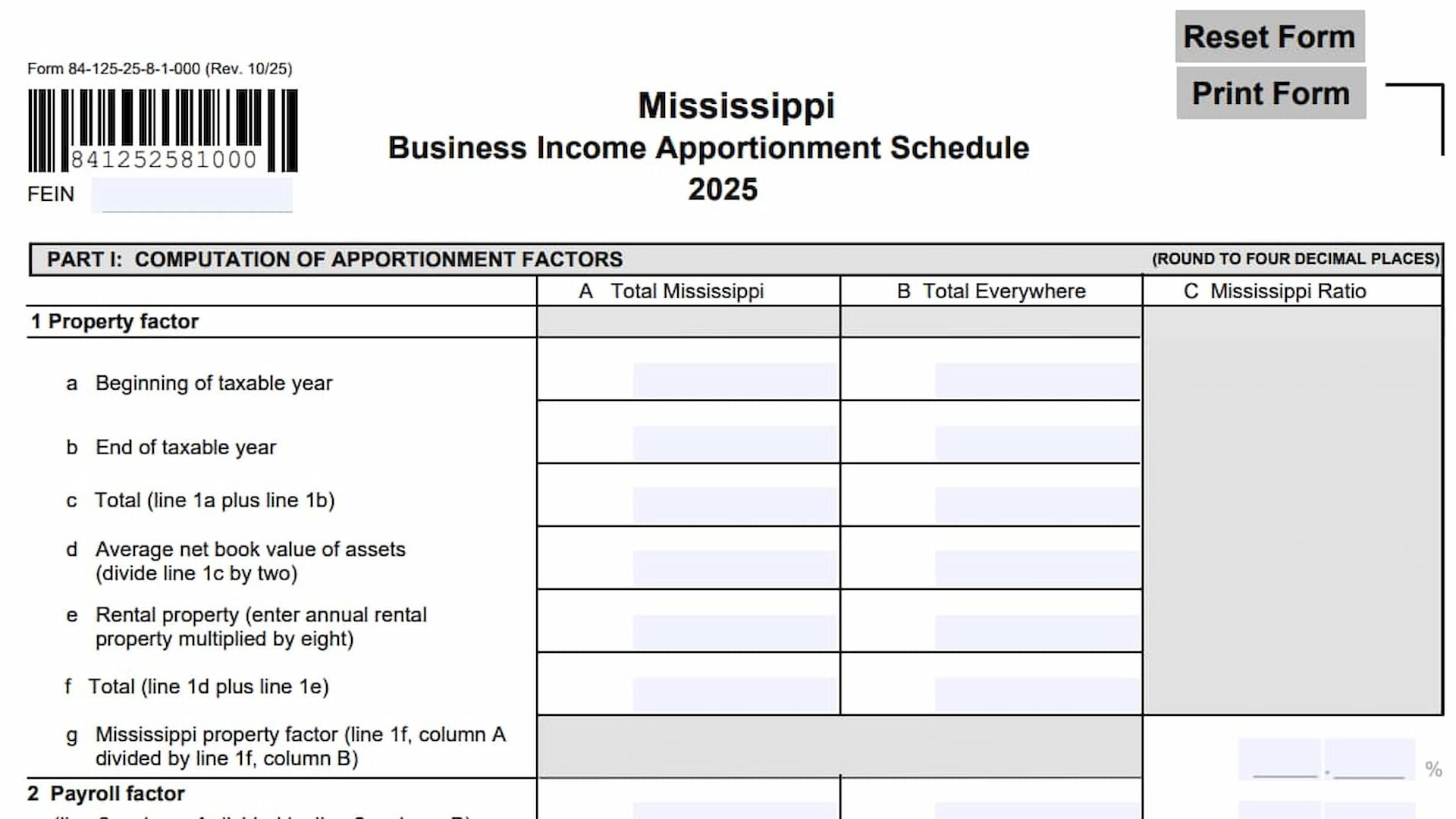
Form 84-125, Mississippi Business Income Apportionment Schedule, is a state tax form used by businesses to calculate the portion of their business income attributable to Mississippi. It uses property, payroll, and sales information to determine an apportionment ratio that is reported on Mississippi Form 84-122, line 21.
The form is designed for businesses that must apportion income between Mississippi and other locations. Depending on the type of business, different apportionment methods apply. Retailing, renting, servicing, merchandising, and wholesaling businesses use the sales factor. Manufacturers that sell principally at retail use a combination of property, payroll, and sales factors. Financial institutions, pipelines, and manufacturers that sell principally at wholesale use a three-factor calculation. Airlines, motor carriers, express companies, and telephone and telegraph companies must use a special formula.
Form 84-125 collects the business’s Federal Employer Identification Number (FEIN), property information, payroll figures, and sales amounts for Mississippi and the business’s operations everywhere. These figures are used to calculate the applicable ratios and determine the percentage of business activity attributable to Mississippi.
The form contains two main parts. Part I calculates the property, payroll, and sales apportionment factors. Part II applies the appropriate factors based on the taxpayer’s business classification and calculates the final apportionment ratio.
Completing Form 84-125 correctly is important because the resulting ratio is transferred to Form 84-122, line 21. Businesses must select the correct apportionment method, report their Mississippi and total company figures accurately, and follow the calculation requirements for their industry. The form also requires calculations to be rounded to four decimal places.
How To File Form 84-125
Form 84-125 is used in connection with Mississippi Form 84-122, Business Income Tax Return. The completed apportionment calculation produces the ratio entered on Form 84-122, line 21.
The specific calculation depends on the business classification selected in Part II. Only one of the available classifications should be selected.
Before completing the schedule, gather the following business records and financial information:
- Your business’s Federal Employer Identification Number (FEIN).
- Property information at the beginning and end of the taxable year.
- Net book value information for business assets.
- Annual rental property amounts, if applicable.
- Payroll records for Mississippi operations and the entire company.
- Sales records for Mississippi operations and the entire company.
- Information needed to calculate the appropriate apportionment factors.
- Supporting calculations for the applicable property, payroll, and sales ratios.
- Additional industry-specific calculations and schedules, if required.
Businesses should also review the instructions applicable to their industry before selecting an apportionment method. In particular, major medical or pharmaceutical suppliers should consult Form 84-100, as specifically indicated in Part II of Form 84-125.

How To Complete Form 84-125
Form 84-125 is a one-page schedule divided into two parts. Part I calculates the three basic apportionment factors, while Part II determines which calculation method applies to the business.
Enter the business’s identifying information first, then complete the applicable calculations in order.
Business Identification
FEIN: Federal Employer Identification Number
Enter the business’s nine-digit Federal Employer Identification Number in the designated field at the top of the form.
Use the FEIN associated with the business filing the Mississippi income tax return. This information identifies the business throughout the apportionment schedule.
Part I: Computation of Apportionment Factors
Part I calculates the property, payroll, and sales factors used to determine the portion of business activity attributable to Mississippi.
The section contains three columns:
- Column A: Total Mississippi – Enter the applicable figures attributable to Mississippi.
- Column B: Total Everywhere – Enter the corresponding figures for the business’s total operations in all locations.
- Column C: Mississippi Ratio – Calculate the ratio by comparing the Mississippi amount with the corresponding total amount.
All applicable calculations must be rounded to four decimal places, as instructed at the top of the form.
Line 1: Property Factor
The property factor compares the business’s property in Mississippi with its total property everywhere. The calculation considers property values at the beginning and end of the taxable year, average net book value, and rental property.
Line 1a: Beginning of Taxable Year
Enter the value of the business property at the beginning of the taxable year.
Report the Mississippi property amount in Column A and the total property amount everywhere in Column B.
Use the applicable property records to determine the values for both columns.
Line 1b: End of Taxable Year
Enter the value of the business property at the end of the taxable year.
As with Line 1a, report the Mississippi amount in Column A and the total company amount in Column B.
Use the property information applicable to the end of the reporting period.
Line 1c: Total
Add the amounts on Lines 1a and 1b separately for each applicable column.
Calculate the total for Mississippi in Column A and the total everywhere in Column B.
Line 1d: Average Net Book Value of Assets
Divide the amount on Line 1c by two.
Perform the calculation separately for Column A and Column B to determine the average net book value of assets for Mississippi and the entire company.
Line 1e: Rental Property
Enter the applicable rental property amount.
The form instructs taxpayers to calculate this figure by multiplying annual rental property by eight.
Enter the resulting amount in the appropriate columns for Mississippi and total company operations.
Line 1f: Total
Add the amount on Line 1d to the amount on Line 1e.
Calculate the combined amount separately for Column A and Column B.
This produces the final property amounts used to determine the Mississippi property factor.
Line 1g: Mississippi Property Factor
Divide the amount on Line 1f, Column A, by the amount on Line 1f, Column B.
Enter the resulting Mississippi property ratio in Column C as a percentage.
This figure represents the proportion of the business’s property factor attributable to Mississippi. It is used later in Part II for applicable business classifications.
Line 2: Payroll Factor
The payroll factor compares payroll attributable to Mississippi with the business’s total payroll everywhere.
Line 2: Mississippi Payroll Factor
Enter the applicable payroll amounts in Column A and Column B.
Report total Mississippi payroll in Column A and total company payroll everywhere in Column B.
Divide the amount in Column A by the amount in Column B and enter the resulting Mississippi payroll ratio in Column C as a percentage.
This factor is used in Part II when calculating the apportionment ratio for manufacturers that sell principally at retail and certain other business classifications.
Line 3: Sales Factor
The sales factor compares the business’s Mississippi sales with its total sales everywhere.
Line 3: Mississippi Sales Factor
Enter total Mississippi sales in Column A and total sales everywhere in Column B.
Divide the Mississippi amount in Column A by the total amount in Column B.
Enter the resulting Mississippi sales ratio in Column C as a percentage.
This factor is used directly for certain businesses and is also included in the calculations for manufacturers and other applicable industries in Part II.
Part II: Application of Apportionment Factors
Part II determines how the property, payroll, and sales factors calculated in Part I are applied to the business’s income apportionment calculation.
The form provides four business classifications. Check only one option that corresponds to your business activity.
Depending on the selected classification, complete the corresponding calculation and transfer the resulting percentage to Form 84-122, line 21.
Retailing, Renting, Servicing, Merchandising or Wholesaling
Businesses engaged in retailing, renting, servicing, merchandising, or wholesaling use the sales factor to determine their Mississippi apportionment ratio.
Line 4: Sales Factor
Enter the sales factor calculated in Part I, Line 3, Column C.
This is the Mississippi sales ratio obtained by dividing total Mississippi sales by total sales everywhere.
Enter the resulting ratio on Form 84-122, line 21.
Manufacturers That Sell Principally at Retail
Manufacturers that sell principally at retail use a calculation combining the property, payroll, and sales factors.
This method first averages the property and payroll factors, then combines that result with the sales factor to determine the weighted average.
Line 5a: Property Factor
Enter the Mississippi property factor from Part I, Line 1g, Column C.
Use the percentage calculated from the Mississippi property amount divided by the total property amount everywhere.
Line 5b: Payroll Factor
Enter the Mississippi payroll factor from Part I, Line 2, Column C.
Use the percentage calculated from Mississippi payroll divided by total company payroll.
Line 5c: Subtotal
Add the amounts entered on Lines 5a and 5b.
Enter the combined property and payroll factor percentage on Line 5c.
Line 5d: Average
Divide the amount on Line 5c by two.
Enter the resulting average on Line 5d. This represents the average of the property and payroll factors.
Line 5e: Sales Factor
Enter the Mississippi sales factor from Part I, Line 3, Column C.
Use the ratio calculated by dividing Mississippi sales by total sales everywhere.
Line 5f: Total
Add the amount on Line 5d to the amount on Line 5e.
Enter the combined result on Line 5f.
Line 5g: Weighted Average
Divide the amount on Line 5f by two.
Enter the resulting weighted average on Line 5g.
This is the final apportionment ratio for manufacturers that sell principally at retail. Transfer this percentage to Form 84-122, line 21.
Financial Institutions, Pipelines or Manufacturers That Sell Principally at Wholesale
Financial institutions, pipelines, and manufacturers that sell principally at wholesale use a calculation based on all three apportionment factors: property, payroll, and sales.
The form instructs businesses in this category to calculate the total of the three factors and divide the result by three to determine the average.
Major medical or pharmaceutical suppliers should consult the instructions for Form 84-100, as specifically indicated on the schedule.
Line 6a: Property Factor
Enter the Mississippi property factor from Part I, Line 1g, Column C.
Use the property ratio calculated in Part I.
Line 6b: Payroll Factor
Enter the Mississippi payroll factor from Part I, Line 2, Column C.
Use the payroll ratio calculated in Part I.
Line 6c: Sales Factor
Enter the Mississippi sales factor from Part I, Line 3, Column C.
Use the sales ratio calculated in Part I.
Line 6d: Total
Add the amounts reported on Lines 6a, 6b, and 6c.
Enter the combined total on Line 6d.
Line 6e: Average
Divide the amount on Line 6d by three.
Enter the resulting average on Line 6e.
This is the final apportionment ratio for the businesses using this three-factor method. Transfer the percentage on Line 6e to Form 84-122, line 21.
Airlines, Motor Carriers, Express Companies, Telephone and Telegraph Companies
The final classification applies to airlines, motor carriers, express companies, and telephone and telegraph companies.
These businesses must use a special apportionment formula rather than the standard calculations provided in the preceding categories.
Line 7: Special Formula Required
Select this classification if your business operates as an airline, motor carrier, express company, telephone company, or telegraph company.
A special formula is required to determine the appropriate Mississippi apportionment ratio.
Attach a supporting schedule showing the special calculation and enter the resulting ratio on Line 7.
Transfer this percentage to Form 84-122, line 21.
The special formula is not detailed on Form 84-125 itself. Consult the applicable instructions for your industry when preparing the supporting calculation.
Final Review Before Filing
Before completing the Mississippi business income tax return, review the following checklist to make sure Form 84-125 contains the correct business information and apportionment calculations.
- Correct tax year: Confirm that you are completing the 2025 Mississippi Business Income Apportionment Schedule.
- FEIN: Verify that the business’s Federal Employer Identification Number is entered correctly.
- Part I, Column A: Make sure the figures represent the applicable Mississippi property, payroll, and sales amounts.
- Part I, Column B: Confirm that the corresponding total company amounts include operations everywhere.
- Line 1a: Verify property amounts at the beginning of the taxable year.
- Line 1b: Verify property amounts at the end of the taxable year.
- Line 1c: Check that the amounts on Lines 1a and 1b are added correctly.
- Line 1d: Confirm that Line 1c is divided by two.
- Line 1e: Verify that annual rental property is multiplied by eight.
- Line 1f: Check that Lines 1d and 1e are added correctly.
- Line 1g: Confirm that the Mississippi property factor is calculated using Column A divided by Column B.
- Line 2: Verify that the Mississippi payroll factor uses Column A divided by Column B.
- Line 3: Confirm that the Mississippi sales factor uses Column A divided by Column B.
- Rounding: Make sure applicable calculations are rounded to four decimal places.
- Business classification: Select only one appropriate option in Part II.
- Line 4: For retailing, renting, servicing, merchandising, or wholesaling businesses, use the sales factor from Part I, Line 3, Column C.
- Lines 5a through 5g: For manufacturers that sell principally at retail, verify the property, payroll, subtotal, average, sales, total, and weighted average calculations.
- Lines 6a through 6e: For financial institutions, pipelines, and manufacturers that sell principally at wholesale, verify all three factors and the final average.
- Major medical or pharmaceutical suppliers: Consult Form 84-100 instructions where applicable.
- Line 7: For airlines, motor carriers, express companies, and telephone and telegraph companies, attach the required special formula calculation.
- Form 84-122: Transfer the final applicable apportionment ratio to Form 84-122, line 21.
- Supporting schedules: Make sure any required additional calculations are documented and attached as applicable.
- Final review: Check all amounts, ratios, business classifications, and transferred figures before completing the return.
Review the calculations and confirm that the correct apportionment method has been selected for your business. The final percentage must accurately reflect the applicable Mississippi property, payroll, and sales factors or the required industry-specific formula. Make sure the resulting ratio is reported on Form 84-122, line 21.