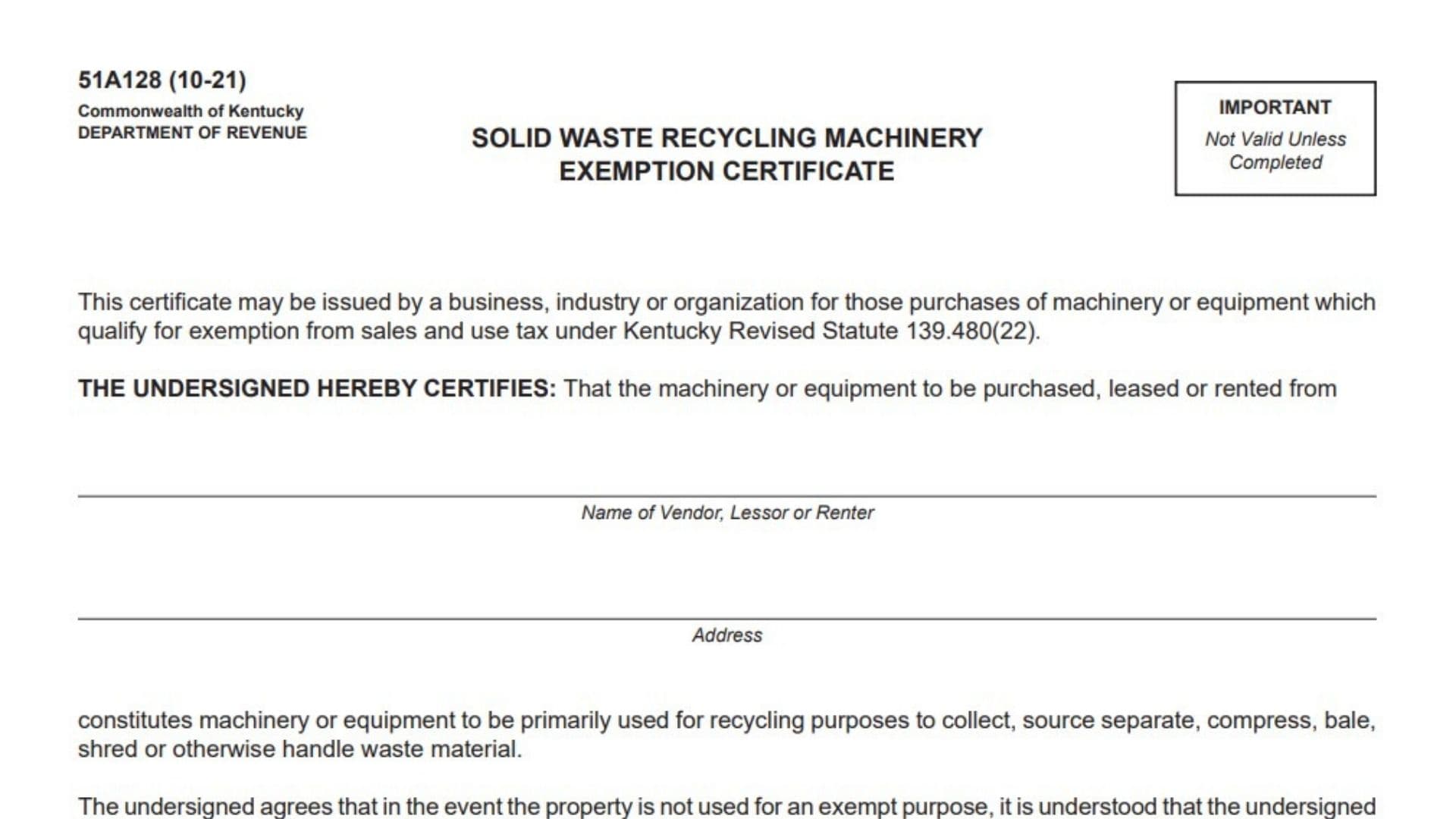
The Kentucky Solid Waste Recycling Machinery Exemption Certificate, Form 51A128, is used by an eligible business, industry, or organization to claim a Kentucky sales and use tax exemption when purchasing, leasing, or renting qualifying machinery or equipment that will be used primarily for recycling purposes. Covered machinery or equipment may be used to collect waste, separate recyclable materials at the source, compress materials, create bales, shred waste, or otherwise handle waste material as part of a recycling operation. The certificate identifies the business or organization claiming the exemption, the vendor or equipment provider, and any contractor or subcontractor involved in the transaction. It also records the purchaser’s sales tax permit number, exemption number, or federal employer identification number. By signing the certificate, the purchaser confirms that the property will be used mainly for an exempt recycling purpose. If the machinery or equipment is later used for a nonqualifying purpose, the purchaser may become responsible for Kentucky sales or use tax measured by the property’s purchase price, along with any applicable penalties. The certificate must be completed before it can support an exempt transaction, and the seller must retain it for at least four years as evidence explaining why tax was not collected.
Who Can Use This Exemption Certificate?
The certificate may be issued by a qualifying:
- Business
- Industrial operation
- Organization
The purchaser must be buying, leasing, or renting machinery or equipment that qualifies for the Kentucky recycling machinery exemption.
The certificate should not be used merely because the business performs some recycling. The specific machinery or equipment covered by the certificate must be used primarily for a qualifying recycling activity.
What Machinery Or Equipment May Qualify?
Qualifying property may include machinery or equipment primarily used to:
- Collect waste material
- Separate recyclable material at its source
- Compress waste or recyclable materials
- Bale recyclable materials
- Shred waste material
- Otherwise handle waste material for recycling purposes
The primary use of the property is important. Equipment used mainly for another business, construction, transportation, storage, maintenance, or administrative purpose may not qualify merely because it occasionally handles recyclable material.
How To File The Kentucky Recycling Machinery Exemption Certificate
This certificate is generally completed by the purchaser and given to the vendor, lessor, or rental company involved in the transaction. It is not used as a periodic sales tax return.
Complete the certificate before or at the time of the qualifying purchase, lease, or rental. Do not leave applicable fields blank because the certificate is not valid unless completed.
Before preparing the certificate, gather:
- The vendor’s complete name and address
- A description of the machinery or equipment
- Information explaining how the property will be used
- The legal name of the business or organization
- The business’s sales tax permit number, exemption number, or federal employer identification number
- The contractor’s legal name, when applicable
- The subcontractor’s legal name, when applicable
- The complete addresses of the signing parties
- The names and titles of authorized signers
The business or organization should complete its side of the certificate and sign it through an authorized representative. When a contractor is involved, complete the contractor information and obtain the appropriate contractor signature. Enter subcontractor information when applicable.
Give the completed certificate to the vendor, lessor, or renter. The seller should review the certificate for completeness and retain it in its tax records for at least four years.
The purchaser, contractor, and subcontractor should also keep copies with the purchase agreement, lease, rental contract, invoices, machinery specifications, and records showing how the equipment is used.

How To Complete The Kentucky Solid Waste Recycling Machinery Exemption Certificate
Certificate Identification And Validity
Line 1: Solid Waste Recycling Machinery Exemption Certificate: This is the title of the certificate. It identifies the document as a request for sales and use tax exemption treatment for qualifying recycling machinery or equipment.
Line 2: Form Number: The form is identified as Form 51A128.
No information must be entered on this line.
Line 3: Revision Date: The October 2021 date identifies the version of the certificate.
Nothing needs to be entered in this area.
Line 4: Commonwealth Of Kentucky: This identifies Kentucky as the jurisdiction issuing the certificate.
No entry is required.
Line 5: Department Of Revenue: This identifies the Kentucky Department of Revenue as the agency responsible for administering the exemption.
Leave this printed information unchanged.
Line 6: Important Notice: Review the certificate carefully before using it.
The notice emphasizes that the certificate must be fully completed.
Line 7: Not Valid Unless Completed: Enter all information that applies to the transaction.
An incomplete certificate may not protect the seller from sales or use tax liability.
Eligibility Statement
Line 8: Business, Industry, Or Organization: Confirm that the entity issuing the certificate is a business, industrial operation, or organization entitled to claim the exemption.
Enter the entity’s legal name later in the business information section.
Line 9: Qualifying Machinery Or Equipment: Confirm that the purchase, lease, or rental involves machinery or equipment rather than ordinary supplies, materials, or unrelated business property.
Line 10: Sales And Use Tax Exemption: Confirm that the machinery or equipment meets the requirements for exemption under the Kentucky provision identified on the certificate.
The presence of recycling activity alone does not automatically exempt every purchase.
Certification Statement
Line 11: Undersigned Certification: By signing, the authorized person certifies that the information entered on the certificate is accurate.
The signer should review the machinery’s function and intended use before completing the certification.
Line 12: Machinery Or Equipment To Be Purchased, Leased, Or Rented: Identify the property covered by the transaction.
Although there is no separate description field, the parties should attach an equipment list when the vendor’s invoice or contract does not clearly identify every item covered.
Vendor, Lessor, Or Renter Information
Line 13: Name Of Vendor, Lessor, Or Renter: Enter the complete legal or recognized business name of the company supplying the machinery or equipment.
Use the name shown on the:
- Purchase order
- Sales invoice
- Lease agreement
- Rental contract
- Equipment quotation
Do not enter the purchaser’s name unless the purchaser and vendor are legally the same entity.
Line 14: Vendor, Lessor, Or Renter Address: Enter the supplier’s complete business address.
Include:
- Street number and street name
- Suite or unit number
- City
- State
- ZIP code
For a supplier with several locations, use the location associated with the transaction or customer account.
Recycling Use Certification
Line 15: Primary Recycling Use: Confirm that the machinery or equipment will be used mainly for recycling purposes.
“Primarily” generally means the property’s principal or main use must be the qualifying recycling activity. Occasional recycling use may not be enough.
Line 16: Collection Of Waste Material: The machinery or equipment may qualify when its main function is to collect waste material for recycling.
The purchaser should keep records showing what material is collected and how it enters the recycling process.
Line 17: Source Separation: The machinery or equipment may qualify when it separates recyclable material from other waste at the source.
Examples may include equipment that separates different materials before further recycling or processing.
Line 18: Compression: The machinery or equipment may qualify when it compresses waste or recyclable material as part of recycling operations.
Record the type of material compressed and the role of the equipment in the recycling process.
Line 19: Baling: Equipment used mainly to create bales of recyclable materials may qualify.
Examples may include balers used for cardboard, paper, plastic, metals, or other recyclable materials.
Line 20: Shredding: Machinery used mainly to shred qualifying waste material for recycling may qualify.
The business should be able to explain what is shredded and what happens to the material afterward.
Line 21: Other Waste Handling: Machinery or equipment used to otherwise handle waste material may qualify when the handling activity is part of the recycling process.
Describe the equipment’s actual function in the business records when its eligibility may not be obvious.
Agreement To Pay Tax If The Property Does Not Qualify
Line 22: Nonexempt Use Agreement: Understand that the purchaser agrees to pay tax if the property is not used for a qualifying exempt purpose.
The certificate does not permanently exempt property that is used differently from the purpose certified.
Line 23: Sales And Use Tax Responsibility: If the machinery or equipment does not qualify, the responsible party must report and pay the applicable Kentucky sales or use tax.
Line 24: Tax Measured By Purchase Price: The tax will generally be based on the property’s purchase price.
Keep the sales invoice, lease agreement, rental records, and payment documents needed to establish the taxable amount.
Line 25: Applicable Penalties: Improper use of the certificate may result in penalties under Kentucky law.
The signer should not claim the exemption without sufficient information supporting the machinery’s primary recycling use.
Business Or Organization Information
Line 26: Name Of Business Or Organization: Enter the complete legal name of the entity claiming the exemption.
Use the name connected with the identification number entered below.
When the business uses a trade name, enter the legal name and trade name when space permits.
Example:
Bluegrass Recycling LLC, doing business as Bluegrass Materials Recovery
Line 27: Sales Tax Permit, Exemption, Or Federal Employer Identification Number: Enter the identification number that applies to the business or organization.
The form allows one of the following:
- Kentucky sales tax permit number
- Applicable exemption number
- Federal employer identification number
Use the number belonging to the entity named on Line 26.
Do not enter:
- The vendor’s tax number
- The contractor’s number in place of the purchaser’s number
- A personal Social Security number unless specifically authorized
- An unrelated business registration number
Contractor And Subcontractor Information
Line 28: Name Of Contractor Under Contract With The Business Or Organization: Enter the contractor’s complete legal name when a contractor is involved in the purchase, lease, rental, installation, or recycling project.
The contractor should have an actual agreement with the business or organization claiming the exemption.
When no contractor is involved, enter “None” or “N/A.”
Line 29: Name Of Subcontractor: Enter the complete legal name of the subcontractor when applicable.
When several subcontractors are involved, attach a separate list containing:
- The business or organization name
- Each subcontractor’s legal name
- Each subcontractor’s address
- A description of each subcontractor’s role
- The contract or job number, when available
When no subcontractor is involved, enter “None” or “N/A.”
Business Or Organization Signature Section
The left signature area should be completed by the business or organization claiming the exemption.
Line 30: By, Business Or Organization: An authorized representative of the business or organization must sign on the first signature line.
The signer should have authority to:
- Act for the entity
- Certify the equipment’s intended use
- Claim the exemption
- Accept responsibility for tax if the exemption is invalid
Line 31: Business Or Organization Signature: Sign the certificate using the authorized representative’s usual legal signature.
Do not submit the certificate with only a typed name when a signature is required.
Line 32: Business Or Organization Signer’s Title: Enter the signer’s official position.
Examples include:
- Owner
- President
- Vice president
- Treasurer
- Chief financial officer
- Plant manager
- Operations manager
- Tax manager
- Authorized officer
The title should show why the person is authorized to sign.
Line 33: Business Or Organization Date: Enter the date on which the authorized representative signs.
Use the complete month, day, and year.
Do not use a future date.
Line 34: Business Or Organization Address: Enter the complete business address of the entity claiming the exemption.
Include the street address, city, state, and ZIP code.
This address may differ from the location where the machinery will be installed or used.
Contractor Signature Section
The right signature area is completed when a contractor is involved.
Line 35: By, Contractor: An authorized contractor representative should sign this line when the contractor information section applies.
The contractor should verify that the machinery or equipment covered by the certificate is connected with the qualifying recycling project.
Line 36: Contractor Signature: The authorized contractor representative signs here.
Do not use the business or organization representative’s signature in both signature sections unless that person is legally authorized to represent both entities.
Line 37: Contractor Signer’s Title: Enter the contractor signer’s official position.
Examples include:
- Owner
- Partner
- President
- Vice president
- Project manager
- Authorized officer
Line 38: Contractor Date: Enter the actual date on which the contractor representative signs the certificate.
Line 39: Contractor Address: Enter the contractor’s complete business address.
Include:
- Street address
- Suite or unit number
- City
- State
- ZIP code
When no contractor is involved, mark the contractor fields “N/A” or leave them blank when that is acceptable to the seller.
Seller Caution And Record Retention
Line 40: Seller Of Tangible Personal Property: The seller, lessor, or renter should review the certificate before treating the transaction as exempt.
The seller should confirm that:
- The business or organization is identified
- The supplier information is correct
- The identification number is entered
- Contractor information is complete when applicable
- Required signatures and dates are present
- The property appears connected with a qualifying recycling purpose
Line 41: Acceptance Or Solicitation Of Certificates: A seller that accepts or requests an exemption certificate must follow the applicable recordkeeping requirements.
The seller should not accept a blank, incomplete, or obviously inconsistent certificate.
Line 42: Seller Relief From Tax: The certificate may support relief from sales and use tax liability only when the seller properly obtains and maintains it.
Possession of an incomplete certificate may not be sufficient.
Line 43: Four-Year Retention Requirement: The seller must keep the completed certificate for at least four years.
The seller should retain it with:
- Purchase invoices
- Sales orders
- Lease or rental agreements
- Equipment descriptions
- Delivery records
- Payment records
- Attached machinery schedules
- Related correspondence
Line 44: Purchaser Record Retention: Although the printed caution addresses the seller, the purchaser should also retain a copy for at least the same period or longer when required by its record-retention policy.
Keep records showing that the machinery or equipment continued to be used primarily for the qualifying recycling purpose.
How To Describe The Recycling Machinery
The certificate does not provide a dedicated machinery-description box. Attach a detailed equipment schedule when the transaction includes more than one item or when the machinery’s exempt purpose is not clear from the invoice.
The attachment should include:
- Business or organization name
- Vendor, lessor, or renter name
- Invoice, purchase order, lease, or rental number
- Machinery manufacturer
- Model number
- Serial number, when available
- Quantity
- Purchase, lease, or rental amount
- Description of the recycling function
- Location where the equipment will be used
- Estimated percentage of qualifying recycling use
Examples of clear descriptions include:
- Horizontal cardboard baler used primarily to compress corrugated material for recycling
- Industrial shredder used primarily to process plastic waste before recycling
- Conveyor and sorting system used primarily to separate recyclable materials
- Compactor used primarily to compress recyclable waste for shipment
- Collection machinery used primarily to gather recyclable material at a processing facility
Avoid descriptions such as:
- Equipment
- Machinery
- Recycling items
- Various purchases
- Industrial supplies
Calculating Primary Use
The form does not contain a percentage field, but the business should maintain evidence showing that the machinery or equipment is used primarily for recycling.
Useful records may include:
- Operating-hour logs
- Production reports
- Material-volume records
- Equipment-use schedules
- Employee activity reports
- Recycling process diagrams
- Maintenance records
- Facility procedures
- Equipment specifications
When equipment serves both exempt and nonexempt functions, calculate and document the amount of time or output connected with each use.
Final Review Checklist
Before giving the Kentucky Solid Waste Recycling Machinery Exemption Certificate to the seller, confirm that:
- The certificate is completed in full.
- The purchaser is a qualifying business, industry, or organization.
- The transaction involves machinery or equipment.
- The property will be used primarily for recycling.
- The qualifying recycling function is documented.
- The vendor, lessor, or renter’s complete name is entered.
- The vendor’s address is complete.
- The business or organization’s legal name is entered.
- The correct sales tax permit, exemption, or federal employer identification number is entered.
- The contractor is identified when applicable.
- The subcontractor is identified when applicable.
- The business or organization has signed the certificate.
- The business signer’s title and date are entered.
- The business address is complete.
- The contractor has signed when applicable.
- The contractor signer’s title and date are entered.
- The contractor address is complete.
- A detailed machinery schedule is attached when needed.
- The purchaser understands its responsibility to pay tax if the property does not qualify.
- The seller receives the completed certificate.
- The seller retains the certificate for at least four years.
- The purchaser keeps records supporting the machinery’s primary recycling use.