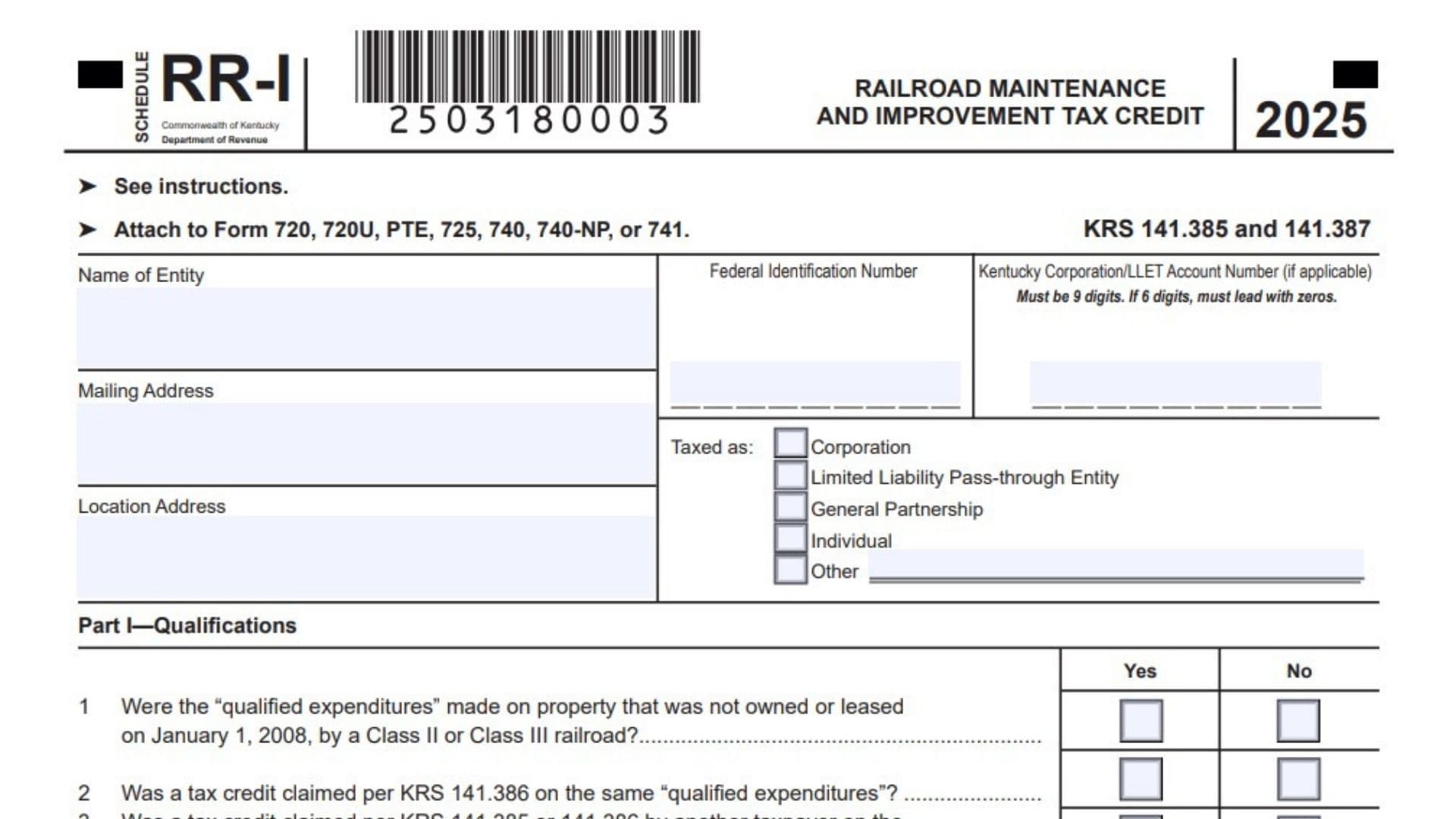
Kentucky Schedule RR-I is used to calculate and claim the Kentucky Railroad Maintenance and Improvement Tax Credit. This credit is available to eligible taxpayers connected to Class II or Class III railroad track located in Kentucky. An eligible taxpayer may be the owner of a Class II or Class III railroad in Kentucky, or a person who transports property using the rail facilities of a Class II or Class III railroad in Kentucky, or a person who provides railroad-related property or services to one of those railroads. The credit applies only to qualified expenditures used to maintain or improve qualifying Kentucky railroad property, such as railroad track, roadbeds, bridges, and related structures. In general, the credit equals 50% of qualified expenditures paid or incurred during the tax year, but it is limited by a mileage-based cap. The cap is calculated by multiplying $3,500 by the total miles of qualifying Kentucky railroad track owned, leased, or assigned to the taxpayer. This is a nonrefundable credit, which means it can reduce eligible Kentucky tax liability, but it cannot create a refund. The credit must be used for the tax year in which the qualified expenditures were made, and it cannot be carried forward to another tax year. If the same expenditure qualifies for both the railroad maintenance and improvement credit and the railroad expansion credit, the taxpayer must choose one credit and cannot claim both for the same expenditures.
How To File Kentucky Schedule RR-I
Complete Kentucky Schedule RR-I after gathering your qualified railroad maintenance or improvement expenditure records, track mileage details, and any assignment information from a Class II or Class III railroad. First, enter the taxpayer’s identifying information at the top of the schedule, including the entity name, mailing address, location address, federal identification number, Kentucky Corporation/LLET Account Number if applicable, and taxpayer classification. Next, answer the qualification questions in Part I. If you answer “Yes” to any of those questions, you do not qualify for the credit and should stop. If you answer “No” to all qualification questions, complete Part II to calculate the credit. Then complete Part III to show how much of the credit is being used against LLET, corporation income tax, or individual income tax. Attach the completed schedule to Form 720, 720U, PTE, 725, 740, 740-NP, or 741, depending on the taxpayer type and return being filed.
Before You Start Completing The Lines
Enter the taxpayer information at the top of the schedule before completing the numbered lines. Provide the name of the entity, mailing address, location address, federal identification number, and Kentucky Corporation/LLET Account Number if applicable. The Kentucky Corporation/LLET Account Number must be 9 digits. If the account number has only 6 digits, add zeros at the beginning until it becomes 9 digits. Then check the box that shows how the taxpayer is taxed, such as corporation, limited liability pass-through entity, general partnership, individual, or other. If “Other” applies, write the taxpayer type in the space provided.

How To Complete Kentucky Schedule RR-I Line By Line
Part I: Qualifications
Line 1: Answer whether the qualified expenditures were made on property that was not owned or leased on January 1, 2008, by a Class II or Class III railroad. If the answer is “Yes,” stop because the credit is not allowed. If the answer is “No,” continue to the next question.
Line 2: Answer whether a railroad expansion tax credit under KRS 141.386 was claimed on the same qualified expenditures. If the answer is “Yes,” stop because the same expenditure cannot be used for both credits. If the answer is “No,” continue.
Line 3: Answer whether another taxpayer claimed a credit under KRS 141.385 or KRS 141.386 on the same qualified expenditures. If the answer is “Yes,” stop because the same expenditures cannot be used again by another taxpayer. If the answer is “No,” continue to Part II.
Part II: Computation Of The Credit
Line 1: Enter the total qualified expenditures paid or incurred during the tax year. Include only eligible costs used to maintain or improve qualifying Kentucky railroad property.
Line 2: Multiply Line 1 by 50%. Enter the result on Line 2. This gives the expenditure-based credit amount before applying the mileage limit.
Line 3: Enter the number of miles of railroad track in Kentucky that the taxpayer owned or leased at the close of the taxable year.
Line 4: Enter the number of miles of Kentucky railroad track assigned to the taxpayer by a Class II or Class III railroad for purposes of this credit.
Line 5: Add Line 3 and Line 4. Enter the total number of qualifying Kentucky railroad track miles.
Line 6: Multiply Line 5 by $3,500. Enter the result on Line 6. This is the maximum credit allowed under the mileage-based limit.
Line 7: Compare Line 2 and Line 6. Enter the smaller amount. This is the allowable railroad maintenance and improvement tax credit before applying it to the proper tax type.
Part III: Railroad Maintenance And Improvement Credit Used By Taxpayer
Line 1: Enter the amount of the credit claimed against the limited liability entity tax. Also enter this amount on Schedule TCS, Part II, Column E. This credit cannot reduce LLET below the $175 minimum.
Line 2: Enter the amount of the credit claimed against corporation income tax. Also enter this amount on Schedule TCS, Part II, Column F.
Line 3: Enter the amount of the credit claimed against individual income tax. Report this amount on Form 740, Form 740-NP, or Form 741, depending on the return being filed.
No Carryforward Allowed
This credit must be used in the tax year connected to the qualified expenditures. Any unused amount cannot be carried forward to a later tax year. Because the credit is nonrefundable, it can reduce eligible Kentucky tax, but it cannot create a refund by itself.
Important Rules For Kentucky Schedule RR-I
Qualified expenditures must relate to railroad property located in Kentucky and must involve property owned or leased on January 1, 2008, by a Class II or Class III railroad. If the taxpayer claims this credit, the basis of the track must be reduced by the amount of credit taken. If the same expenditure could qualify for both the railroad maintenance and improvement credit and the railroad expansion credit, only one of those credits may be claimed. A pass-through entity must report each partner’s, member’s, shareholder’s, or beneficiary’s share of the approved credit on Schedule K-1.
Final Check Before Filing
Review Part I carefully because a single “Yes” answer means the taxpayer does not qualify for the credit. Confirm that qualified expenditures are supported by records, track miles are accurate, and any assigned mileage is properly documented. Recheck the Line 7 calculation to make sure the credit is the smaller of 50% of qualified expenditures or the $3,500 per mile limit. Make sure the credit is entered in the correct place for LLET, corporation income tax, or individual income tax. Attach Kentucky Schedule RR-I to the applicable Kentucky tax return before filing.