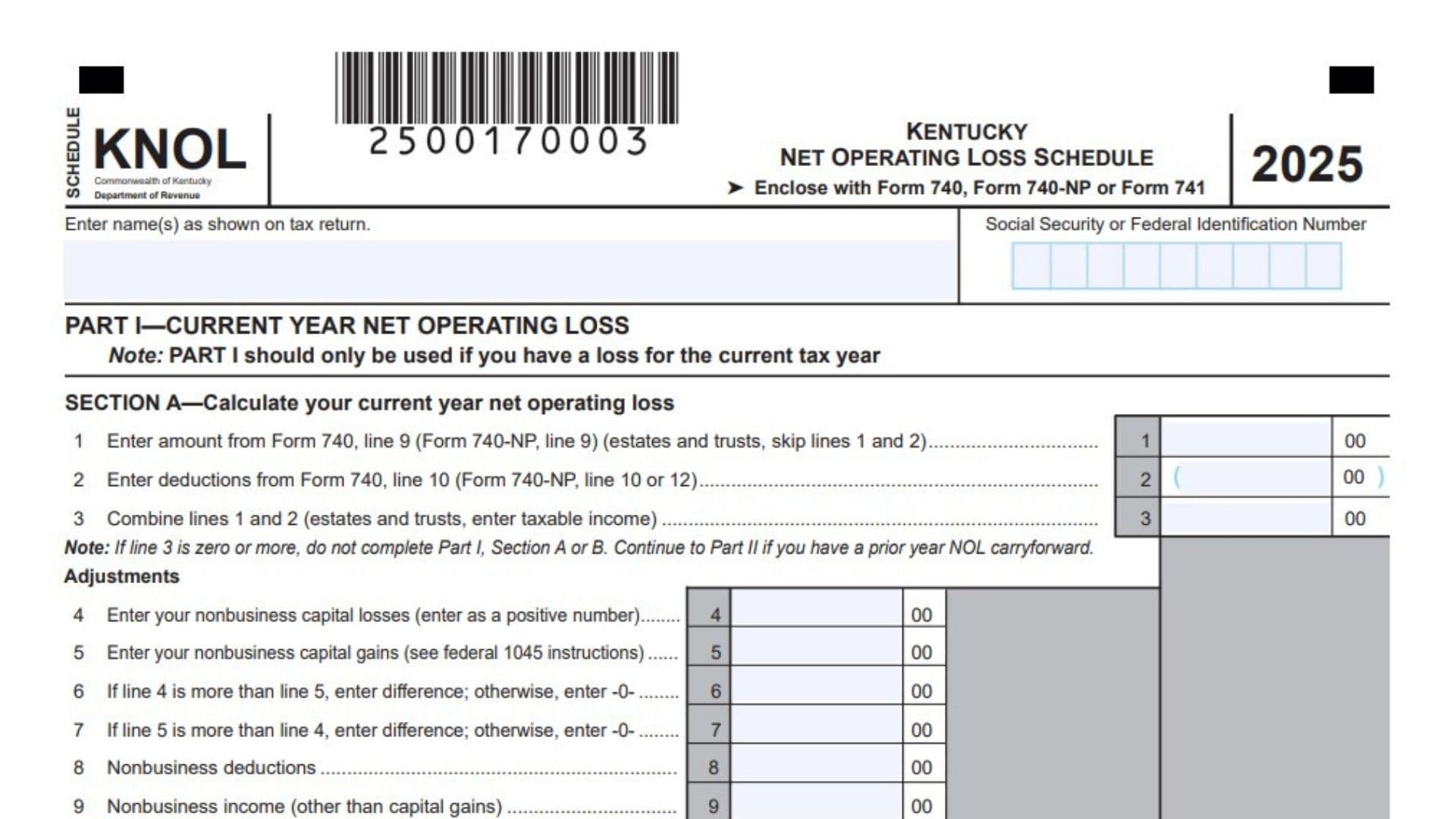
Kentucky Schedule KNOL is the state form used to calculate a Kentucky net operating loss, also called an NOL, or to claim a Kentucky net operating loss deduction from prior years. Individuals, estates, and trusts use this schedule when they either have a loss in the current year that may be carried forward, or they have taxable income in the current year and want to use an earlier Kentucky loss carryforward to reduce that income. The form separates losses into two groups, pre-2018 losses and post-2017 losses, because Kentucky applies different rules to each. Losses from years before 2018 can generally be carried forward for 20 years and are not subject to the 80 percent limit. Losses from years after 2017 may be carried forward indefinitely, but they can only offset up to 80 percent of taxable income before the post-2017 NOL deduction. Schedule KNOL helps you determine your current year loss, your allowable deduction, and your remaining carryforward amount for future years.
When To Use Schedule KNOL
Use Part I if you have a current year Kentucky net operating loss. Part I calculates the amount of the loss and the amount that will carry forward into the next year. Use Part II only if you have positive taxable income and a prior year Kentucky NOL carryforward that you want to deduct this year. Do not complete Part II if you have a current year net operating loss. If you are claiming a Kentucky NOL deduction on your return, the completed KNOL schedule should be attached to your filing.
Basic Rules To Understand First
Kentucky does not allow an NOL carryback for tax years beginning on or after January 1, 2005. That means the loss is generally moved forward, not backward. Pre-2018 Kentucky NOLs are not limited by the 80 percent rule, but they are limited to a 20-year carryforward period. Post-2017 Kentucky NOLs can be carried forward indefinitely, but they are limited to offsetting only 80 percent of taxable income before the post-2017 NOL deduction. If you are tracking losses from several years, keep careful records showing the original amount, how much was used in each year, and how much still remains.

How To Complete Schedule KNOL
Part I, Current Year Net Operating Loss
Section A, Calculate Your Current Year Net Operating Loss
Use this section only if you have a loss for the current year.
Line 1: Enter the amount from Form 740, Line 9, or from Form 740-NP, Line 9 if you are a nonresident or part-year resident filer. Estates and trusts should skip Lines 1 and 2.
Line 2: Enter deductions from Form 740, Line 10, or from Form 740-NP, Line 10 or Line 12, depending on which line applies to your return.
Line 3: Combine Lines 1 and 2. Estates and trusts should enter taxable income here instead. If this line is zero or a positive number, stop Part I, Section A and Section B because you do not have a current year net operating loss to calculate in this section. If you have a prior year NOL carryforward, go to Part II.
Adjustments
Line 4: Enter your nonbusiness capital losses as a positive number. These are capital losses not connected to a trade or business.
Line 5: Enter your nonbusiness capital gains. This includes capital gains that are not business-related.
Line 6: If Line 4 is greater than Line 5, enter the difference. If not, enter zero.
Line 7: If Line 5 is greater than Line 4, enter the difference. If not, enter zero.
Line 8: Enter your nonbusiness deductions. These are deductions not tied to a trade or business. If you took the standard deduction instead of itemizing, the standard deduction is generally included here. Most itemized deductions are also nonbusiness deductions, except for certain casualty loss deductions.
Line 9: Enter nonbusiness income other than capital gains. This generally includes income that is not from a trade or business, such as dividends, annuities, and investment interest.
Line 10: Add Lines 7 and 9.
Line 11: If Line 8 is greater than Line 10, enter the difference. If not, enter zero.
Line 12: If Line 10 is greater than Line 8, enter the difference, but do not enter more than the amount on Line 7. If not, enter zero.
Line 13: Enter your business capital losses as a positive number.
Line 14: Enter your business capital gains.
Line 15: Add Lines 12 and 14.
Line 16: If Line 13 is greater than Line 15, enter the difference. If not, enter zero.
Line 17: Add Lines 6 and 16.
Line 18: Enter the loss, if any, from federal Schedule D, Line 16. Estates and trusts should use the loss from Form 741, Schedule D, Line 17, Column 3. Enter the amount as a positive number. If there is no loss on that line and no Section 1202 exclusion applies, skip Lines 18 through 23 and enter the Line 17 amount on Line 24 instead. When preparing this amount, make any Kentucky additions or subtractions that affect the capital loss figure.
Line 19: Enter your Section 1202 exclusion as a positive number, if applicable.
Line 20: Subtract Line 19 from Line 18.
Line 21: Enter the loss from federal Schedule D, Line 21. Estates and trusts should use Form 741, Schedule D, Line 18. Enter it as a positive number.
Line 22: If Line 20 is greater than Line 21, enter the difference. If not, enter zero.
Line 23: If Line 21 is greater than Line 20, enter the difference. If not, enter zero.
Line 24: Subtract Line 22 from Line 17.
Line 25: Add Lines 11, 19, 23, and 24.
Line 26: Combine Lines 3 and 25. This is your current year Kentucky net operating loss. If the result is zero or positive, you do not have a current year net operating loss. If the result is negative, continue to Part I, Section B to determine the carryforward.
Part I, Section B, Calculate Your Net Operating Loss Carryforward
Use this section only if you have a current year net operating loss.
Line 1: Enter your pre-2018 NOL carryforward to 2026. This is the unused amount from losses that arose before January 1, 2018.
Line 2: Enter your post-2017 NOL carryforward.
Line 3: Enter the current year net operating loss from Part I, Section A, Line 26 as a positive number.
Line 4: Enter excess business losses as a positive number, if applicable. For 2025, losses from trades or businesses of noncorporate taxpayers are limited to $313,000, or $626,000 for married taxpayers. If you are subject to this limitation and do not have Kentucky and federal differences on Schedule M, use the amount from federal Form 461, Line 16. If you do have Kentucky and federal differences and are subject to the Kentucky excess business loss limitation, use the amount from Kentucky Form 461, Line 16. If that line is zero or more, enter zero here.
Line 5: Add Lines 2 through 4. This is your post-2017 NOL carryforward to 2026.
Part II, Net Operating Loss Deduction
Use Part II only if you have positive taxable income and a prior year NOL carryforward. If you have a current year NOL, do not complete Part II.
Section A, Calculate Your Net Operating Loss Deduction
Line 1: Enter your pre-2018 NOL carryforward as a positive number. This is any unused amount from losses that occurred before January 1, 2018.
Line 2: Enter your post-2017 NOL carryforward as a positive number. This is any unused amount from losses that occurred on or after January 1, 2018.
Line 3: Enter taxable income without the NOL deduction. If this amount is negative, stop here and complete Part I instead. For Form 740 filers, calculate taxable income without the NOL deduction by subtracting Schedule M, Line 15 and Form 740, Line 10 from Form 740, Line 7. For Form 740-NP filers, first determine Kentucky adjusted gross income without the NOL, divide it by federal adjusted gross income shown on the return, then apply that percentage to the relevant taxable base and subtract either the allocated deduction or the standard deduction.
Line 4: Enter the smaller of Line 3 or Line 1. This is your pre-2018 NOL deduction for the year.
Line 5: Subtract Line 4 from Line 3. This is the taxable income remaining after using the pre-2018 NOL deduction.
Line 6: Multiply Line 5 by 80 percent. This is the maximum allowable post-2017 NOL deduction.
Line 7: Enter the smaller of Line 6 or Line 2. This is your post-2017 NOL deduction.
Line 8: Add Lines 4 and 7. This is your total Kentucky net operating loss deduction for the year. Enter this amount on Schedule M, Line 16 if you file Form 740. If you file Form 740-NP, enter it on the designated line in the Kentucky column and label it as NOLD.
Section B, Calculate Prior Year Net Operating Loss Carryforward
Use this section to determine what carryforward remains after taking the current year deduction.
Line 1: Enter the amount from Part II, Section A, Line 1.
Line 2: Enter the amount from Part II, Section A, Line 4.
Line 3: Subtract Line 2 from Line 1. This is your pre-2018 NOL carryforward to 2026.
Line 4: Enter the amount from Part II, Section A, Line 2.
Line 5: Enter excess business losses as a positive number, if applicable.
Line 6: Add Lines 4 and 5. Enter the result here.
Line 7: Enter the amount from Part II, Section A, Line 7.
Line 8: Subtract Line 7 from Line 6. This is your post-2017 NOL carryforward to 2026.
How To File Schedule KNOL
Attach Schedule KNOL to Form 740, Form 740-NP, or Form 741, depending on which return you are filing. If you are claiming a Kentucky NOL deduction, include statements showing the original amount of each NOL, how much was used in each prior year, and how much remains available. If you are carrying a current year loss forward, keep a complete copy of the schedule with your tax records for future use. If your NOL involves excess business loss amounts, include the supporting Form 461 information as well.
How To Keep Good NOL Records
Because Kentucky separates older and newer losses, recordkeeping matters a lot. Track each loss by tax year, identify whether it is pre-2018 or post-2017, note how much was deducted each year, and update the remaining carryforward amount annually. If you combine years without tracking them separately, it becomes much harder to support the deduction later.
Common Errors To Avoid
Do not complete Part II when you have a current year NOL. Do not mix pre-2018 losses with post-2017 losses. Do not apply the 80 percent limit to pre-2018 losses. Do not forget to compute taxable income before the NOL deduction when completing Part II. Do not overlook excess business loss amounts when they apply. Also make sure every carryforward amount is entered as a positive number where required.
Final Filing Tip
If your return includes a Kentucky net operating loss or a Kentucky NOL deduction, take extra time to review each line because one incorrect carryforward figure can affect several tax years. A careful Schedule KNOL today makes future Kentucky filings much easier.