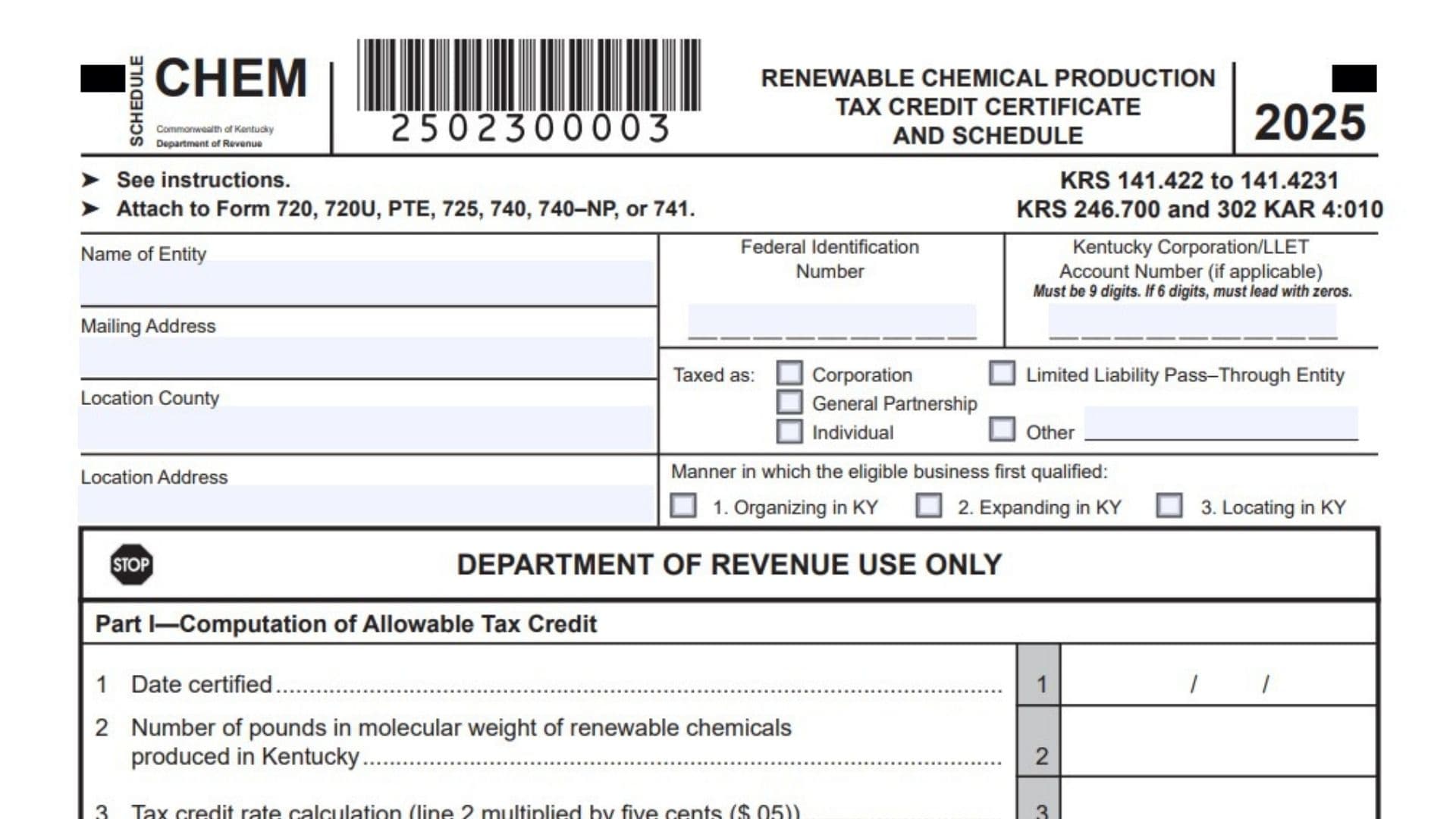
Kentucky Schedule CHEM is a state tax credit schedule used by eligible taxpayers that produce renewable chemicals in Kentucky and want to certify and claim the renewable chemical production tax credit. It works as both a credit certification schedule and a reporting form because it helps the state determine how much credit a taxpayer may receive based on the molecular weight of renewable chemicals produced in Kentucky, while also showing how much of that credit is later claimed on the taxpayer’s return. In practical terms, this schedule connects the production activity, the preliminary approval process, the final approved credit amount, and the actual tax credit claim. It may apply to corporations, limited liability pass-through entities, general partnerships, individuals, and certain other entity types if they qualify under the program. The form also includes a required reporting questionnaire about gross receipts and Kentucky employee counts, plus sections for showing how the approved credit is used and tracked over time. Because this credit is nonrefundable and nontransferable, the form must be completed carefully so the taxpayer claims the right amount in the right place. It is also important because unused credit may be carried forward for up to three years, so the schedule serves not only as a current-year filing document but also as a record for future use of remaining credit.
How To File Kentucky Schedule CHEM
Before filing this schedule, the business must first obtain preliminary approval through the required agriculture-related approval process for the prior calendar year. After that, the taxpayer files Schedule CHEM with the Kentucky Department of Revenue and attaches it to the applicable Kentucky tax return, such as Form 720, 720U, PTE, 725, 740, 740-NP, or 741, depending on the taxpayer’s filing type. The schedule should be prepared using accurate entity information, production figures, and credit usage details. If the taxpayer is a pass-through entity, it must also properly allocate the approved credit among owners and provide the required owner information electronically so each eligible owner can claim their share correctly. Once the state certifies the approved credit amount, that certified credit is then used when completing the tax return and any related credit schedules. To avoid processing issues, make sure all identifying information is complete, all applicable sections are filled in, and any extra statement needed for overflow information is included with the filing.

How To Complete Kentucky Schedule CHEM
Basic Information
Name Of Entity: Enter the full legal name of the taxpayer claiming or reporting the credit. Use the same name that appears on the related Kentucky tax return.
Federal Identification Number: Enter the taxpayer’s federal identification number. If the filer is an individual, use the Social Security number. If the filer is a business entity, use the federal employer identification number.
Kentucky Corporation/LLET Account Number, If Applicable: Enter the Kentucky account number if one applies to the entity. If the number is only six digits, add leading zeros so the entry shows nine digits.
Mailing Address: Enter the complete mailing address where the taxpayer receives official tax correspondence. Make sure it is current and readable.
Location County: Enter the Kentucky county where the eligible business location is situated. Use the county tied to the production activity being reported.
Location Address: Enter the physical address of the business location connected to the renewable chemical production activity. Do not use a mailing address here unless the production site is located there.
Taxed As, Corporation: Check this box if the entity is taxed as a corporation for Kentucky purposes.
Taxed As, Limited Liability Pass-Through Entity: Check this box if the entity is a pass-through entity and taxed that way for Kentucky purposes.
Taxed As, General Partnership: Check this box if the business is taxed as a general partnership.
Taxed As, Individual: Check this box if the credit is being reported by an individual taxpayer.
Taxed As, Other: Check this box only if none of the listed entity types fits. Then write the correct entity type in the space provided.
Manner In Which The Eligible Business First Qualified, Organizing In KY: Check this option if the business first became eligible by organizing in Kentucky.
Manner In Which The Eligible Business First Qualified, Expanding In KY: Check this option if the business first qualified by expanding its operations in Kentucky.
Manner In Which The Eligible Business First Qualified, Locating In KY: Check this option if the business first qualified by locating its operations in Kentucky.
Department Sections
The next sections titled Part I, Part II, and most of Part III include items that are used by the Department of Revenue to determine and certify the approved credit amount. Even though these lines appear on the schedule, taxpayers generally should not fill in lines that are reserved for the department unless a specific filing instruction requires otherwise.
Part I, Line 1, Date Certified: This line is for the certification date entered by the Department of Revenue.
Part I, Line 2, Number Of Pounds In Molecular Weight Of Renewable Chemicals Produced In Kentucky: This line reflects the production amount used in the credit calculation process. The department uses this information in determining the credit.
Part I, Line 3, Tax Credit Rate Calculation: This line shows the credit computation based on the production amount multiplied by five cents per molecular pound. The department uses this figure during certification.
Part II, Line 1, Preliminary Approved Credit: This line shows the renewable chemical production tax credit that was preliminarily approved by the Department of Agriculture.
Part III, Line 1(a), Requested Credit For Renewable Chemical Production: This amount represents the taxpayer’s requested credit and serves as the numerator in the approval formula when statewide requests exceed the annual cap.
Part III, Line 1(b), Total Requested Credit For All Producers: This amount represents the total requested credit for all producers and serves as the denominator in the statewide allocation formula.
Part III, Approved Credit Calculation: When the total requested credit is greater than the annual cap, the state calculates each taxpayer’s approved share by applying the taxpayer’s fraction to the annual credit limit. This part is handled as part of the certification process.
Part III, Approved Credit Signature And Date Lines: These lines are completed by the Department of Revenue as part of the credit approval and certification process.
Part IV, Part V, And Part VI Instructions
Part IV, Required Reporting Questionnaire
Line 1 (Bold): Aggregate Gross Receipts From Sales By Each Type Of Renewable Chemical Produced In This State
List each type of renewable chemical produced in Kentucky and enter the gross receipts from sales for each type on the corresponding line. If you have more product types than the space allows, attach a separate statement that continues the same information clearly.
Line 2 (Bold): Number Of Employees Located In Kentucky During The Calendar Year Immediately Preceding The Calendar Year The Entity First Applied For This Tax Credit
Enter the number of employees located in Kentucky during the calendar year just before the year in which the entity first applied for this credit. This line asks for a historical employee count, so do not use the current year unless that matches the period requested.
Line 3 (Bold): Number Of Employees Located In This State During This Calendar Year
Enter the number of employees located in Kentucky during the current calendar year covered by the schedule. Use a reasonable and supportable count based on your records.
Signature Area
Signature: The authorized person must sign the schedule to certify that the filing and any accompanying statements are true, correct, and complete to the best of that person’s knowledge.
Title: Enter the signer’s official title, such as owner, member, officer, partner, or another authorized role.
Date: Enter the date the schedule is signed.
Contact Name, If Different From Signer: Enter the name of the contact person if questions should be directed to someone other than the signer.
Email Address: Enter the email address for the signer or contact person who can respond to filing questions.
Telephone Number: Enter the best phone number for follow-up communication.
Fax Number: Enter a fax number if one is available. If the taxpayer does not use fax, follow the filer’s normal practice for leaving nonrequired contact spaces blank unless instructed otherwise.
Part V, Renewable Chemical Production Tax Credit Used By Taxpayer
Line 1 (Bold): LLET Credit
Enter the amount of approved credit claimed for the taxable year against the limited liability entity tax on Schedule TCS, Part II, Column E. Keep in mind that this credit cannot reduce the LLET below the $175 minimum.
Line 2 (Bold): Corporation Income Tax Credit
Enter the amount of approved credit claimed for the taxable year against corporation income tax on Schedule TCS, Part II, Column F. Use the amount actually being claimed for the year, not the total approved credit unless the full amount is being used.
Line 3 (Bold): Individual Income Tax Credit
Enter the amount of approved credit claimed for the taxable year on Form 740, Form 740-NP, or Form 741, whichever return applies. This line is used when the credit is being claimed at the individual or fiduciary level.
Part VI, Amount Of Credit Claimed
This section tracks how the credit is used across the allowed carryforward period. Because unused credit may be carried forward for up to three years, complete each row carefully so the remaining balance and annual usage are easy to follow.
Line 1 (Bold): Taxable Year Credit Taken, Balance Of CHEM, Amount Of Credit Used
For the first year listed, enter the taxable year in month and year format. Then enter the available balance of CHEM credit for LLET and income tax, followed by the amount of credit actually used for LLET and income tax for that year.
Line 2 (Bold): Taxable Year Credit Taken, Balance Of CHEM, Amount Of Credit Used
For the second year listed, enter the month and year for that taxable year. Then record the remaining balance available and the amount used during that year in the proper LLET and income tax columns.
Line 3 (Bold): Taxable Year Credit Taken, Balance Of CHEM, Amount Of Credit Used
For the third year listed, enter the taxable year and complete the LLET and income tax balance and usage columns. This line is especially important when tracking the final year of an available carryforward.
Special Filing Points
If the taxpayer is a pass-through entity, each owner’s share of the approved credit should be reported through the appropriate owner-level reporting, and the entity must provide the required owner information electronically in the proper format. Also remember that the amount claimed against corporation income tax and the amount claimed against LLET do not have to be the same, so allocate the credit according to the taxpayer’s actual filing position and tax liability. Finally, review every line before submission so names, identification numbers, addresses, product amounts, employee counts, and credit entries all match the taxpayer’s records and related tax forms.