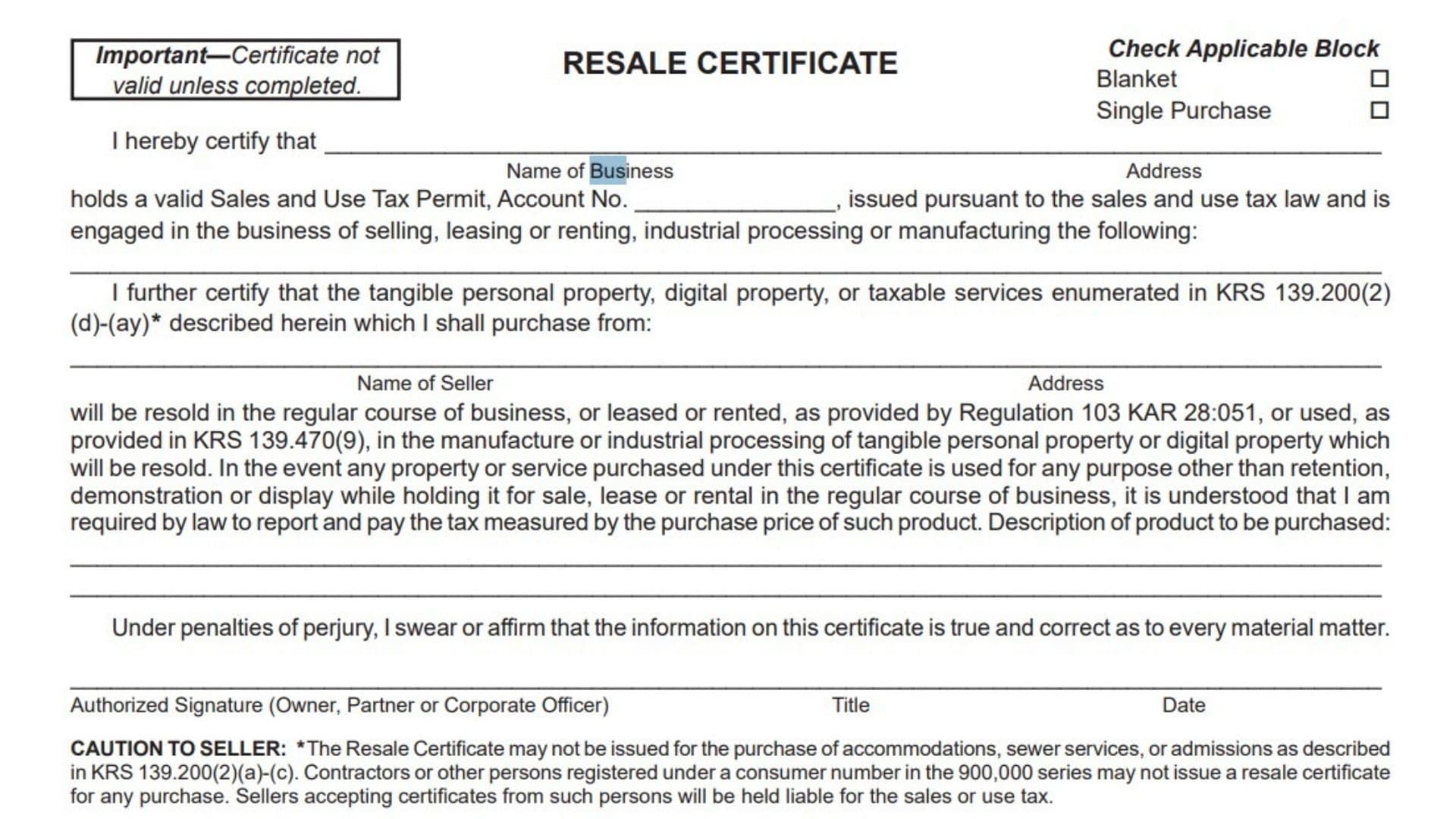
The Kentucky Resale Certificate, Form 51A105, allows an eligible business purchaser to buy qualifying tangible personal property, digital property, or taxable services without paying Kentucky sales tax at the time of purchase when the items will be resold, leased, rented, or used in qualifying manufacturing or industrial processing activities involving products that will later be sold. The certificate is completed by the purchaser and provided to the seller as support for treating the transaction as exempt from sales or use tax. A business may use the certificate only when it holds a valid Kentucky Sales and Use Tax Permit and the purchase satisfies an authorized resale, rental, leasing, manufacturing, or industrial processing purpose. The purchaser may select a blanket certificate for an ongoing purchasing relationship or a single-purchase certificate for one specific transaction. The certificate cannot be used for purchases of accommodations, sewer services, or admissions covered by the restricted categories identified on the form. Contractors and other persons registered under certain consumer account numbers in the 900,000 series are also prohibited from issuing the certificate. The person signing must be an owner, partner, or corporate officer who is authorized to certify the business’s tax status and intended use of the purchased products or services. If an item purchased tax-free is later used for a nonqualifying purpose instead of being held for resale, lease, rental, demonstration, or display, the purchaser becomes responsible for reporting and paying tax based on the purchase price. Improper use can result in civil penalties, tax assessments, interest, and possible criminal consequences, so the certificate should be completed fully and used only for purchases that meet Kentucky’s resale exemption requirements.
Who Should Use The Kentucky Resale Certificate?
A business may generally use this certificate when all of the following apply:
- The purchaser holds a valid Kentucky Sales and Use Tax Permit.
- The property or service qualifies for resale certificate treatment.
- The purchase is made for resale in the regular course of business.
- The property will be leased or rented in a qualifying business activity.
- The property will be used in qualifying manufacturing or industrial processing of tangible personal property or digital property that will be resold.
- The purchaser is not registered only under a prohibited 900,000-series consumer account.
- The purchase does not consist of prohibited accommodations, sewer services, or admissions.
The certificate should not be used merely because the purchaser is a business. The intended use of the specific purchase must qualify.
Blanket Certificate Versus Single-Purchase Certificate
Blanket Certificate
Select the blanket option when the certificate will cover repeated qualifying purchases from the same seller.
A blanket certificate can reduce the need to complete a separate certificate for every qualifying transaction. However, it should cover only the products or services described on the certificate and only purchases made for an eligible purpose.
The purchaser should provide a new certificate when important information changes, such as:
- The business name.
- The business address.
- The sales and use tax account number.
- The type of business activity.
- The products being purchased.
- The intended use of the products.
- The seller.
Single-Purchase Certificate
Select the single-purchase option when the certificate applies to one specific transaction.
The product description should clearly identify the item or service involved in that purchase. Do not use the certificate for later transactions unless another certificate is completed or the seller accepts a properly completed blanket certificate.
Purchases That Do Not Qualify
Do not use the Kentucky Resale Certificate to purchase the following restricted categories:
- Accommodations.
- Sewer services.
- Admissions covered by the applicable Kentucky sales tax provisions.
A contractor or another person registered under a consumer number in the 900,000 series may not issue the certificate for purchases.
A seller that accepts an invalid certificate from a prohibited purchaser may become responsible for the unpaid sales or use tax.
How To File The Kentucky Resale Certificate
The Kentucky Resale Certificate is provided to the seller rather than used as a sales tax return.
Complete the certificate before or at the time of the qualifying purchase. The purchaser should enter its business information, Kentucky Sales and Use Tax Permit account number, business activity, seller information, and a clear description of the products or services being purchased.
An authorized owner, partner, or corporate officer must sign and date the certificate. The completed certificate should then be delivered to the seller.
The seller should review the certificate for completeness and keep it with the transaction and sales tax records. The purchaser should also retain a copy.
Do not leave required sections blank. The certificate is not valid unless it has been completed.
Before accepting the certificate, the seller should review:
- Whether the blanket or single-purchase box is checked.
- Whether the purchaser’s business name and address are present.
- Whether a sales and use tax account number is entered.
- Whether the purchaser describes its business activity.
- Whether the seller’s name and address are correct.
- Whether the purchased products or services are described.
- Whether the certificate is signed by an authorized person.
- Whether the signer’s title and signing date are entered.
- Whether the purchaser appears prohibited from issuing a resale certificate.

How To Complete The Kentucky Resale Certificate
Certificate Completion Notice
Line 1: Certificate Completion Requirement: Complete every applicable field before giving the certificate to the seller. An incomplete certificate may not support tax-exempt treatment of the purchase.
Certificate Type
Line 2: Check Applicable Block: Select the option that describes how the certificate will be used. Check only one box unless the seller provides different instructions.
Line 3: Blanket: Check this box when the certificate will apply to multiple qualifying purchases from the named seller.
The certificate should describe the categories of products or services that the purchaser expects to buy. It should not be treated as authorization for unrelated purchases.
Line 4: Single Purchase: Check this box when the certificate applies only to one particular transaction.
Describe the product or service with enough detail to connect the certificate to that purchase.
Purchaser Identification
Line 5: Name Of Business: Enter the complete legal or registered name of the business making the purchase.
Use the name associated with the Kentucky Sales and Use Tax Permit. Do not enter only a trade name when the permit is registered under a different legal entity unless both names are clearly shown.
Examples include:
- Bluegrass Office Supply LLC.
- Smith Manufacturing Corporation.
- Johnson Retail Partners.
- Green Valley Equipment, operated by Green Valley Holdings Inc.
Line 6: Business Address: Enter the purchaser’s complete business address.
Include:
- Street number and street name.
- Suite or unit number.
- City.
- State.
- ZIP code.
Use the address associated with the purchaser’s sales and use tax account when possible.
Certification Of Business And Permit
Line 7: Certified Business Name: Enter the name of the business holding the valid Kentucky Sales and Use Tax Permit.
This entry should normally match the business name entered at the beginning of the certificate.
The certification means that the signer is confirming that the named business is properly registered and authorized to make qualifying purchases.
Line 8: Sales And Use Tax Permit Account Number: Enter the purchaser’s valid Kentucky Sales and Use Tax Permit account number.
Review the number carefully. Do not enter:
- The purchaser’s federal employer identification number unless it is also specifically requested.
- A Social Security number.
- The seller’s tax number.
- A business license number that is unrelated to the sales and use tax permit.
- A prohibited 900,000-series consumer number.
The account should be active and associated with the business issuing the certificate.
Business Activity
Line 9: Type Of Business Activity: Identify whether the business is engaged in selling, leasing, renting, industrial processing, manufacturing, or another activity covered by the certificate.
The form already provides the general categories. The purchaser must describe what the business actually sells, leases, rents, processes, or manufactures.
Line 10: Description Of Business Activity: Clearly describe the business’s products or operations.
Examples include:
- Retail sale of office furniture.
- Wholesale distribution of automotive parts.
- Rental of construction equipment.
- Manufacture of wood cabinets for resale.
- Processing of food products for wholesale sale.
- Sale of downloadable commercial software.
- Leasing of qualifying machinery.
- Manufacture of metal components sold to industrial customers.
Avoid vague descriptions such as:
- General business.
- Retail.
- Products.
- Services.
- Manufacturing.
The description should allow the seller to understand why the purchase may qualify for resale or another permitted use.
Property, Digital Property, Or Services Being Purchased
Line 11: Qualifying Purchase Certification: Confirm that the tangible personal property, digital property, or taxable services being purchased fall within the categories eligible for the intended resale, leasing, renting, manufacturing, or processing use.
The certificate should not be used for personal purchases, general operating expenses, or products that will be consumed by the business unless the specific use qualifies under the applicable tax provision.
Line 12: Tangible Personal Property: Tangible personal property generally refers to physical items that can be seen, touched, moved, stored, or delivered.
Possible examples include:
- Merchandise inventory.
- Replacement parts sold to customers.
- Furniture held for retail sale.
- Equipment purchased for qualifying rental.
- Materials incorporated into manufactured products.
- Packaging that qualifies as part of a product sold to a customer.
Do not assume that supplies used by the business qualify merely because they support business operations.
Line 13: Digital Property: Enter qualifying digital products when the purchase involves property delivered or accessed electronically and the property will be resold or used in another qualifying manner.
Describe the digital product specifically rather than entering only “digital property.”
Line 14: Taxable Services: Identify qualifying taxable services that will be resold or used in a manner permitted by the applicable Kentucky sales tax provisions.
The certificate cannot be used for prohibited accommodations, sewer services, or admissions.
Seller Information
Line 15: Purchase From: Enter the complete name of the seller from whom the qualifying products or services will be purchased.
For a blanket certificate, identify the seller that will receive and retain the certificate.
For a single purchase, the seller’s name should match the invoice, sales order, contract, or receipt.
Line 16: Name Of Seller: Enter the seller’s legal or recognized business name.
Do not enter the purchaser’s name again in this field.
Line 17: Seller Address: Enter the seller’s complete business address.
Include the street address, city, state, and ZIP code. When the seller has several locations, use the location associated with the purchasing account or transaction.
Intended Use Of Purchases
Line 18: Resale In The Regular Course Of Business: The purchaser may use this basis when the purchased product or qualifying service will be sold to a customer as part of the purchaser’s normal business operations.
Examples may include:
- A retailer purchasing merchandise for store inventory.
- A wholesaler purchasing products for sale to retailers.
- A dealer purchasing replacement parts that will be sold to customers.
- A digital product distributor purchasing qualifying digital property for resale.
The purchaser should not claim resale treatment for property that will be consumed or used internally.
Line 19: Lease Or Rental: The purchaser may use this basis when the property will be leased or rented to customers as part of the regular business activity permitted by the applicable Kentucky regulation.
The business should maintain rental or lease agreements and records showing that the property is held for that purpose.
Line 20: Manufacturing Or Industrial Processing: The purchaser may use this basis when qualifying property will be used in manufacturing or industrial processing of tangible personal property or digital property that will be sold.
The purchase must satisfy the applicable conditions for the manufacturing or industrial processing treatment. Merely operating a manufacturing business does not make every purchase tax-exempt.
Line 21: Property Produced For Resale: Confirm that the tangible personal property or digital property resulting from the manufacturing or industrial processing activity will be resold.
The certificate should not be used under this provision when the finished product is intended only for the purchaser’s internal use.
Taxable Use After Purchase
Line 22: Nonqualifying Use: Understand that property or services purchased without tax may become taxable when they are later used for a purpose that does not qualify.
A taxable use may occur when the purchaser:
- Uses inventory in its own office.
- Gives merchandise away.
- Withdraws property for personal use.
- Uses rental inventory permanently in business operations.
- Consumes materials that were purchased for resale.
- Uses a qualifying service for an unrelated internal purpose.
Line 23: Permitted Retention, Demonstration, Or Display: Property may be held for sale, lease, or rental and may be retained, demonstrated, or displayed as part of that activity without automatically losing its intended exempt status.
The activity must remain connected with holding the property for sale, lease, or rental in the regular course of business.
Line 24: Tax Reporting Obligation: When property or a service purchased under the certificate is diverted to a taxable use, the purchaser must report and pay the applicable tax.
The tax is measured using the purchase price of the product or service, subject to the applicable Kentucky rules.
The purchaser should keep records identifying:
- The item withdrawn from inventory.
- The original purchase date.
- The purchase price.
- The date of taxable use.
- The tax reported and paid.
Product Description
Line 25: Description Of Product To Be Purchased: Describe the products, digital property, or taxable services covered by the certificate.
The description should be specific enough for the seller to determine what transactions are covered.
Good descriptions include:
- Office chairs and desks purchased for retail resale.
- Automotive filters and brake components for resale.
- Industrial pumps held for lease to customers.
- Raw lumber incorporated into cabinets manufactured for resale.
- Digital design templates purchased for resale.
- Qualifying materials used in manufacturing metal parts for sale.
Avoid descriptions such as:
- All purchases.
- Miscellaneous.
- Supplies.
- Products.
- Inventory and other items.
Line 26: Additional Product Description: Use the second description line to provide more details, list additional product categories, or explain the intended use.
For a blanket certificate, list each general category that the certificate is expected to cover.
When more space is needed, attach a separate description that includes:
- The purchaser’s business name.
- The seller’s name.
- The sales and use tax account number.
- A list of covered products or services.
- A statement that the attachment is part of the resale certificate.
Perjury Declaration
Line 27: Accuracy Declaration: Read the declaration before signing.
By signing, the authorized person swears or affirms that the information provided is true and correct in every important respect.
The signer should verify:
- The business has a valid permit.
- The account number is accurate.
- The business activity is correctly described.
- The seller is correctly identified.
- The purchases qualify for the stated treatment.
- The product description is complete.
- The certificate is not being used for prohibited purchases.
Knowingly providing false information may expose the business and signer to penalties.
Signature Section
Line 28: Authorized Signature: An authorized owner, partner, or corporate officer must sign the certificate.
The signature confirms that the person has authority to act for the purchasing business.
An employee who is not an owner, partner, corporate officer, or otherwise properly authorized should not sign merely because the employee places orders.
Line 29: Owner: An individual owner may sign when the purchaser is a sole proprietorship.
Line 30: Partner: A partner may sign for a partnership when authorized to act for the business.
Line 31: Corporate Officer: A corporate officer may sign for a corporation.
Examples may include:
- President.
- Vice president.
- Treasurer.
- Secretary.
- Chief financial officer.
- Another duly authorized officer.
Line 32: Title: Enter the signer’s official position with the purchasing business.
Examples include:
- Owner.
- Partner.
- President.
- Treasurer.
- Chief financial officer.
- Corporate secretary.
The title should establish why the person is authorized to sign.
Line 33: Date: Enter the date the authorized person signs the certificate.
Use the complete month, day, and year. Do not use a future date.
For a single-purchase certificate, the signing date should be reasonably connected to the transaction.
For a blanket certificate, the signing date establishes when the certificate was issued to the seller.
Seller Caution Instructions
Restricted Purchases
Line 34: Accommodations: The certificate may not be issued for the purchase of taxable accommodations covered by the restricted category identified on the form.
A purchaser should not use the certificate simply because it intends to provide accommodation-related services to customers.
Line 35: Sewer Services: The certificate may not be issued for purchases of sewer services included in the restricted category.
Line 36: Admissions: The certificate may not be used for taxable admissions covered by the restricted category.
The seller should collect the applicable tax when a purchaser attempts to use the certificate for one of these prohibited purchases.
Prohibited Consumer Accounts
Line 37: Contractors And Other Consumer Registrants: Contractors and other persons registered under a consumer account number in the 900,000 series may not issue the certificate for purchases.
The restriction applies even when the person is making a business-related purchase.
Line 38: Consumer Number Review: The seller should review the purchaser’s account number and determine whether it appears to be a prohibited consumer number.
When the purchaser is not eligible, the seller should not accept the certificate as support for an exempt transaction.
Seller Liability
Line 39: Seller Responsibility: A seller that accepts a resale certificate from a prohibited contractor or another ineligible consumer registrant may be held responsible for the unpaid sales or use tax.
The seller should not rely on an incomplete certificate or ignore information showing that the purchaser is ineligible.
The seller should retain documents supporting why the certificate was accepted.
Improper Use Warning
Line 40: Improper Use Of Certificate: Do not use the certificate to avoid tax on property or services that do not qualify.
Improper use may include:
- Providing a false permit number.
- Claiming resale treatment for personal purchases.
- Claiming resale treatment for ordinary business supplies.
- Using the certificate for prohibited services.
- Purchasing inventory tax-free and withdrawing it without reporting tax.
- Signing without authority.
- Providing a materially false product description.
Line 41: Legal Penalties: A person who improperly uses the certificate may be subject to the penalties provided by Kentucky law.
Possible consequences can include assessment of tax, interest, civil penalties, and other enforcement measures.
Line 42: Criminal Provisions: Intentional misuse may also result in consequences under the criminal provisions identified on the certificate.
The signer should not complete the declaration unless every material statement is accurate.
Department And Form Information
Line 43: Department Of Revenue: This identifies the Kentucky Department of Revenue as the agency responsible for administering the applicable sales and use tax requirements.
No information needs to be entered on this line.
Line 44: Frankfort, Kentucky 40620: This is the department location printed on the certificate.
The resale certificate is ordinarily provided to the seller as transaction documentation rather than submitted as a sales tax return.
Line 45: Form Number And Revision Date: The certificate is identified as Form 51A105 with a January 2023 revision date.
Nothing must be entered in this area. It identifies the version of the certificate.
Final Review Checklist
Before giving the Kentucky Resale Certificate to the seller, confirm that:
- The certificate is fully completed.
- Either Blanket or Single Purchase is checked.
- The purchaser’s legal business name is entered.
- The purchaser’s complete address is entered.
- The business holds a valid Kentucky Sales and Use Tax Permit.
- The correct account number is entered.
- The account is not a prohibited 900,000-series consumer number.
- The business activity is clearly described.
- The seller’s name is entered.
- The seller’s address is entered.
- The purchased products or services qualify.
- The certificate is not being used for accommodations.
- The certificate is not being used for sewer services.
- The certificate is not being used for admissions.
- The intended resale, lease, rental, manufacturing, or processing use is accurately stated.
- The products or services are described clearly.
- The purchaser understands the obligation to report tax if the items are diverted to taxable use.
- The certificate is signed by an authorized owner, partner, or corporate officer.
- The signer’s title is entered.
- The signing date is entered.
- The purchaser retains a copy.
- The seller retains the completed certificate with its tax records.