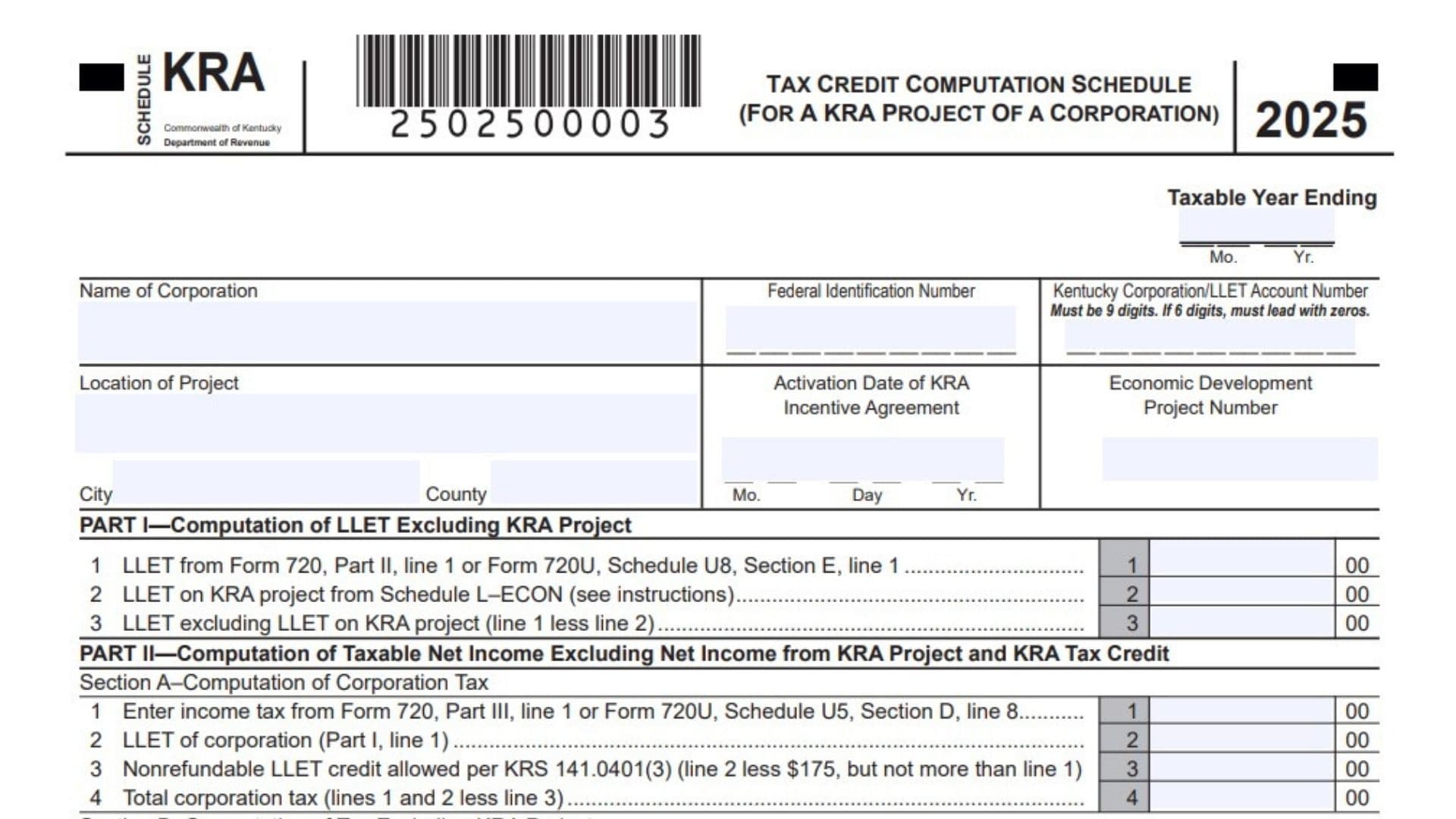
Kentucky PKG KRA is the tax credit package used by an approved business to report Kentucky Reinvestment Act incentives for a qualified reinvestment project. This package is not for every Kentucky business. It is only for a business entity that has received preliminary or final approval for a KRA project from the Kentucky economic development authority. The package helps calculate and track the KRA tax credit connected to the approved project, including the portion of Kentucky corporation income tax and limited liability entity tax, known as LLET, that is tied to the project. A corporation generally uses Schedule KRA to calculate the KRA credit against Kentucky corporation income tax and LLET, while a pass-through entity uses Schedule KRA-SP to calculate the KRA credit, any project tax due, or an estimated tax payment election. Every approved project also needs Schedule KRA-T because that schedule tracks approved costs, carryforward balances, annual approved costs, credit limitations, and credits claimed during the life of the reinvestment agreement. The package is important because KRA credits are limited by project tax liability, approved costs, and the timing of the incentive agreement. In the first and last year of an agreement, project income or project tax items may need to be prorated so only the activity within the agreement term is used. In simple terms, Kentucky PKG KRA is the filing tool that connects the approved reinvestment project, the tax return, the project tax calculation, and the remaining KRA credit balance in one organized package.
Who Should Use Kentucky PKG KRA
Use Kentucky PKG KRA only if your business has been approved for a Kentucky Reinvestment Act credit.
Do not use this package for a project that has not received the required KRA approval.
Use only one approved incentive project per PKG KRA package. If the business has more than one approved project, prepare a separate KRA package for each project.
If the business files Kentucky Form 720 or Form 720U, complete Schedule KRA and Schedule KRA-T.
If the business files Kentucky Form PTE or Form 725, complete Schedule KRA-SP and Schedule KRA-T.

How To File Kentucky PKG KRA
Attach the completed KRA package to the Kentucky tax return that applies to your business. Corporations filing Form 720 or Form 720U should attach Schedule KRA and Schedule KRA-T. Pass-through entities filing Form PTE or Form 725 should attach Schedule KRA-SP and Schedule KRA-T. If Schedule L-ECON is required to compute the project’s separate LLET, attach it with the return. If the business uses an approved formula or alternative method instead of direct separate accounting, attach the approval letter for that method. If the project is in the first or last year of the incentive agreement, include only the income, receipts, gross profits, or LLET that belong to the period covered by the agreement. Finally, report the allowed credit on Schedule TCS as required, and make sure total credits do not reduce LLET below the $175 minimum or reduce income tax below zero.
First And Last Year Proration Rules
When the KRA agreement starts or ends during a taxable year, the credit is only based on the portion of the year that falls inside the incentive agreement term.
For the first year, divide the number of days from the activation date through the end of the taxable year by the total number of days in the taxable year. Use that percentage as the proration factor when separate period accounting is not available.
For the last year, divide the number of days from the first day of the taxable year through the end of the agreement term by the total number of days in the taxable year. Use that percentage as the proration factor when separate period accounting is not available.
Separate period accounting is preferred when possible because it uses actual project activity instead of a percentage estimate.
Package KRA Cover Page Instructions
Approval Requirement: Use this package only when the business has received approval for the KRA credit connected to a Kentucky Reinvestment Act project.
Instruction Reminder: Review the full instructions before entering numbers, because the package changes depending on whether the filer is a corporation or a pass-through entity.
Attachment Requirement: Attach the completed KRA package to Form 720, Form 720U, Form PTE, or Form 725, depending on the return your business files.
Schedule KRA Line By Line Instructions For Corporations
Use Schedule KRA if the approved company is filing as a corporation on Form 720 or Form 720U.
Schedule KRA Header Instructions
Taxable Year Ending: Enter the ending month and year of the corporation’s taxable year.
Name Of Corporation: Enter the legal name of the corporation claiming the KRA project credit.
Federal Identification Number: Enter the corporation’s federal employer identification number.
Kentucky Corporation/LLET Account Number: Enter the Kentucky Corporation/LLET account number. It must contain 9 digits. If the account number has only 6 digits, add zeros at the beginning so the field contains 9 digits.
Location Of Project: Enter the physical location of the approved KRA project.
City: Enter the city where the KRA project is located.
County: Enter the Kentucky county where the KRA project is located.
Activation Date Of KRA Incentive Agreement: Enter the month, day, and year the KRA incentive agreement became active.
Economic Development Project Number: Enter the assigned project number for the approved KRA project.
Schedule KRA Part I Instructions: Computation Of LLET Excluding KRA Project
Line 1: Enter the total LLET from Form 720, Part II, line 1, or from Form 720U, Schedule U8, Section E, line 1.
Line 2: Enter the LLET that belongs only to the KRA project. Use Schedule L-ECON to calculate this amount based only on the project’s Kentucky gross receipts and Kentucky gross profits. Attach Schedule L-ECON to the return. If the corporation has more than one approved project, prepare a separate Schedule L-ECON for each project. In the first and last year of the agreement, include only amounts earned during the incentive agreement period.
Line 3: Subtract line 2 from line 1. This gives the LLET amount that remains after removing the LLET connected to the KRA project.
Schedule KRA Part II, Section A Instructions: Computation Of Corporation Tax
Line 1: Enter the corporation income tax from Form 720, Part III, line 1, or from Form 720U, Schedule U5, Section D, line 8.
Line 2: Enter the corporation’s LLET from Schedule KRA, Part I, line 1.
Line 3: Calculate the nonrefundable LLET credit. Subtract $175 from line 2, but do not enter more than the amount on line 1.
Line 4: Add line 1 and line 2, then subtract line 3. This is the total corporation tax before removing the tax effect of the KRA project.
Schedule KRA Part II, Section B Instructions: Computation Of Tax Excluding KRA Project
Line 1: Enter taxable net income from Form 720, Part I, line 43, or from Form 720U, Schedule U5, Section D, line 7.
Line 2: Enter the net income from the KRA project. If the KRA project has a loss, enter zero. If the corporation’s only Kentucky activity is the KRA project, the amount on line 1 should also be entered on line 2. If the corporation has other Kentucky activity, attach a schedule showing how the project net income was calculated. In the first and last year, include only the net income earned during the agreement period.
Line 3: Subtract line 2 from line 1. This is taxable net income after removing KRA project income. If line 2 is larger than line 1, enter zero.
Line 4: Multiply line 3 by 5 percent. This gives the income tax liability after excluding the KRA project.
Line 5: Enter the LLET excluding the KRA project from Schedule KRA, Part I, line 3.
Line 6: Subtract $175 from line 5, but do not enter more than line 4.
Line 7: Add line 4 and line 5, then subtract line 6. This is the total tax after excluding the KRA project.
Line 8: Subtract Section B, line 7 from Section A, line 4. This amount is the tax attributable to the KRA project. Carry this amount to Schedule KRA, Part III, line 1.
Schedule KRA Part III Instructions: Limitation
Line 1: Enter the KRA project tax liability from Part II, Section B, line 8.
Line 2: Enter the KRA credit limitation from Schedule KRA-T, Column D.
Line 3: Enter the statutory approved cost limitation. If the project received preliminary approval before February 1, 2010, enter the total approved costs that are still relevant for the limitation. If the project received preliminary approval on or after February 1, 2010, enter 20 percent of total approved costs.
Line 4: Enter the smallest amount from line 1, line 2, or line 3. This is the allowable KRA tax credit for the year.
Schedule TCS Entry: Report the allowable credit from line 4 on Schedule TCS, Part I, Column E and Column F.
Additional Schedule KRA Rules For Corporations
Separate Project Calculation: If a corporation has more than one approved economic development project, calculate the credit separately for each project.
Separate Facility Method: If the KRA project is a completely separate facility, use separate accounting to calculate the project’s net income, Kentucky gross receipts, and Kentucky gross profits.
Expansion Of Existing Facility: If the KRA project expands an existing facility, calculate the entire facility’s amounts first, then allocate the proper share to the KRA project using an approved formula.
Alternative Method: If separate accounting is not practical, the corporation must use an alternative method that has been approved. Attach the approval letter to the schedule.
Required Supporting Schedules: If the corporation has both KRA project operations and non-project operations, attach schedules showing how project net income, Kentucky gross receipts, and Kentucky gross profits were separated.
Schedule KRA-SP Line By Line Instructions For Pass-Through Entities
Use Schedule KRA-SP if the approved company files as a pass-through entity on Form PTE or Form 725.
KRA credits calculated by a pass-through entity do not pass through to members, partners, or shareholders. The pass-through entity calculates the project tax and applies the credit at the entity level. The entity should also use Form PTE(K) to remove the KRA project net income from the owners’ distributive share income.
Schedule KRA-SP Header Instructions
Taxable Year Ending: Enter the ending month and year of the pass-through entity’s taxable year.
Name Of Pass-Through Entity: Enter the legal name of the pass-through entity.
Federal Identification Number: Enter the entity’s federal employer identification number.
Kentucky Corporation/LLET Account Number: Enter the Kentucky Corporation/LLET account number. It must contain 9 digits. If it has only 6 digits, add leading zeros.
Location Of Project: Enter the physical location of the approved KRA project.
City: Enter the city where the project is located.
County: Enter the county where the project is located.
Activation Date Of KRA Incentive Agreement: Enter the month, day, and year the KRA agreement became active.
Economic Development Project Number: Enter the project number assigned to the approved KRA project.
Schedule KRA-SP Part I Instructions: Computation Of KRA Tax Credit And Tax Due
Line 1: Enter Kentucky taxable income from the KRA project. If the pass-through entity’s only activity is the KRA project, use the net income or loss from Form PTE. If the entity has other activity, attach a schedule showing how the KRA project income or loss was calculated. In the first and last year, include only Kentucky taxable income received during the incentive agreement period.
Line 2: Enter the KRA project net operating loss deduction carried forward from prior years. The project’s prior year loss does not pass through to the owners. It must be applied against project income before calculating the KRA credit.
Line 3: Subtract line 2 from line 1. This is the Kentucky taxable income from the KRA project after the net operating loss deduction.
Line 4: Multiply line 3 by 5 percent. This gives the income tax liability for the KRA project.
Line 5: Enter the LLET on the KRA project from Schedule L-ECON. This does not apply to a general partnership because a general partnership is not subject to LLET. For entities that are subject to LLET, calculate the project LLET using only the KRA project’s Kentucky gross receipts and Kentucky gross profits. Attach Schedule L-ECON to the return.
Line 6: Calculate the nonrefundable LLET credit by subtracting $175 from line 5, but do not enter more than line 4. General partnerships should not complete this line.
Line 7: Add line 4 and line 5, then subtract line 6. This is the total tax on the KRA project.
Line 8: Enter the KRA credit limitation from Schedule KRA-T, Column D.
Line 9: Enter the statutory approved cost limitation. If preliminary approval was received before February 1, 2010, enter the total approved costs used for the limitation. If preliminary approval was received on or after February 1, 2010, enter 20 percent of the total approved costs.
Line 10: Compare line 7, line 8, and line 9. Enter the smallest amount as either a KRA tax credit on line 10(a) or as an estimated tax payment on line 10(b). Do not enter an amount on both 10(a) and 10(b).
Line 10(a): Enter the allowable amount here if the pass-through entity is claiming it as a KRA tax credit.
Line 10(b): Enter the allowable amount here if the pass-through entity chooses to treat it as an estimated tax payment instead of a KRA tax credit. If this option is used, complete Part II of Schedule KRA-SP.
Line 11: If line 7 is greater than the amount entered on line 10(a) or line 10(b), enter the difference. This is the tax due on the KRA project. Add this amount to the tax due on Form PTE, Part II, line 16, or Form 725, Part II, line 15.
Schedule KRA-SP Part II Instructions: Estimated Tax Election
Name Of Pass-Through Entity: Enter the pass-through entity’s legal name in the election statement.
Taxable Year Ended: Enter the taxable year ending date for the year in which the election is being made.
Election Amount: The election applies to the lesser of Schedule KRA-SP, Part I, line 7, line 8, or line 9.
Estimated Tax Payment Treatment: Use this section only when the entity chooses line 10(b). The elected amount is treated as an estimated tax payment instead of a KRA tax credit.
Owner Tax Treatment: The estimated tax payment is made on behalf of partners, members, or shareholders to satisfy their tax liability, but those owners do not separately claim any part of that payment on their Kentucky income tax returns.
Signature Of Shareholder, Partner, Or Member: The authorized shareholder, partner, or member signs the election.
Print Name: Print the name of the person who signed the election.
Date: Enter the date the election is signed.
Additional Schedule KRA-SP Rules For Pass-Through Entities
Complete Form PTE First: The pass-through entity should first complete Form PTE to determine total business income, loss, deductions, and related tax items.
Multiple Projects: If the entity has more than one economic development project, complete the correct schedule for each project and calculate each credit separately.
Separate Facility: If the KRA project is a fully separate facility, use separate accounting to determine the project’s net income, Kentucky gross receipts, and Kentucky gross profits.
Expansion Of Existing Facility: If the project is an expansion of an existing facility, calculate the entire facility’s net income, Kentucky gross receipts, and Kentucky gross profits, then allocate the correct portion to the project using an approved formula. Attach the formula approval letter.
Alternative Method: If separate accounting is not practical, use an approved alternative method and attach the approval letter.
General Partnership Rule: A general partnership should not complete lines 5 and 6 because it is not subject to LLET.
Schedule KRA-T Line By Line Instructions For Tracking The KRA Project
Schedule KRA-T is required to track the balance of approved costs and the credit limitation for each KRA project over the life of the reinvestment agreement.
Schedule KRA-T Header Instructions
Name Of Entity: Enter the legal name of the entity approved for the KRA project.
Entity Type, Corporation: Check this box if the approved entity is a corporation.
Entity Type, Limited Liability Pass-Through Entity: Check this box if the approved entity is a limited liability pass-through entity.
Entity Type, General Partnership: Check this box if the approved entity is a general partnership.
Entity Type, Other: Check this box if the entity does not fit the listed categories, then write the entity type on the blank line.
Federal Identification Number: Enter the entity’s federal employer identification number.
Kentucky Corporation/LLET Account Number: Enter the Kentucky Corporation/LLET account number. It must contain 9 digits. Add leading zeros if needed.
Location Of Project: Enter the address or location of the approved KRA project.
City: Enter the project city.
County: Enter the project county.
Activation Date Of KRA Incentive Agreement: Enter the month, day, and year the KRA incentive agreement became active.
Economic Development Project Number: Enter the project number assigned to the approved KRA project.
Schedule KRA-T Column Instructions
Column A: Enter the taxable year ending month and year for each year shown on the tracking schedule. Use a separate row for each taxable year of the reinvestment agreement.
Column B: Leave this column blank for the first taxable year of the agreement. For later years, enter the prior year carryforward balance. To calculate it, subtract the prior year Column E amount from the prior year Column D amount. If the prior year Column E equals the prior year Column D, enter zero. If the prior year Column E is greater than Column D, the credit claimed was more than the eligible credit limitation.
Column C: Enter the annual approved costs for that taxable year under the reinvestment agreement.
Column D: Add Column B and Column C. This result is the KRA credit limitation for that year. Carry this amount to Schedule KRA, Part III, line 2, or Schedule KRA-SP, Part I, line 8, depending on which schedule applies.
Column E: Enter the KRA tax credit claimed on the return for that project. If the credit used against income tax and the credit used against LLET are different, record the larger amount for tracking purposes. If no credit is claimed for the project, enter zero.
Schedule KRA-T Filing Rules
Separate Tracking Schedule: Maintain a separate Schedule KRA-T for each approved KRA project.
Start With First Agreement Year: Begin the schedule with the first taxable year of the KRA reinvestment agreement.
Use One Row Per Year: Complete Columns A through E for each taxable year of the agreement.
Attach Updated Schedule: Attach the current Schedule KRA-T to Schedule KRA or Schedule KRA-SP when filing the Kentucky tax return.
Attach With Wage Reports: Also attach an updated copy to the Wage Assessment Report and Annual Reconciliation.
Schedule TCS Reporting: Enter all tax credits on Schedule TCS, Tax Credit Summary Schedule.
Credit Ordering Rule: Claim credits in the required order.
Minimum Tax Rule: Total credits cannot reduce LLET below $175 and cannot reduce income tax liability below zero.
Final Filing Checklist
KRA Approval Confirmed: Make sure the project has the required KRA approval before using the package.
Correct Schedule Selected: Use Schedule KRA for Form 720 or Form 720U filers. Use Schedule KRA-SP for Form PTE or Form 725 filers.
Schedule KRA-T Included: Attach Schedule KRA-T for every approved KRA project.
One Project Per Package: Do not combine multiple KRA projects in one package.
Schedule L-ECON Attached If Required: Attach Schedule L-ECON when calculating project LLET.
Supporting Project Schedules Attached: Attach project income, gross receipts, gross profits, or allocation schedules when the business has both KRA project activity and non-project activity.
Approval Letters Attached If Needed: Attach any approval letter for an alternative method or approved allocation formula.
First And Last Year Proration Reviewed: If the agreement begins or ends during the taxable year, use only the activity inside the agreement term.
Schedule TCS Completed: Report the allowable credit correctly on Schedule TCS.
Credit Limits Checked: Confirm the KRA credit does not exceed project tax liability, the Schedule KRA-T limitation, or the approved cost limitation.