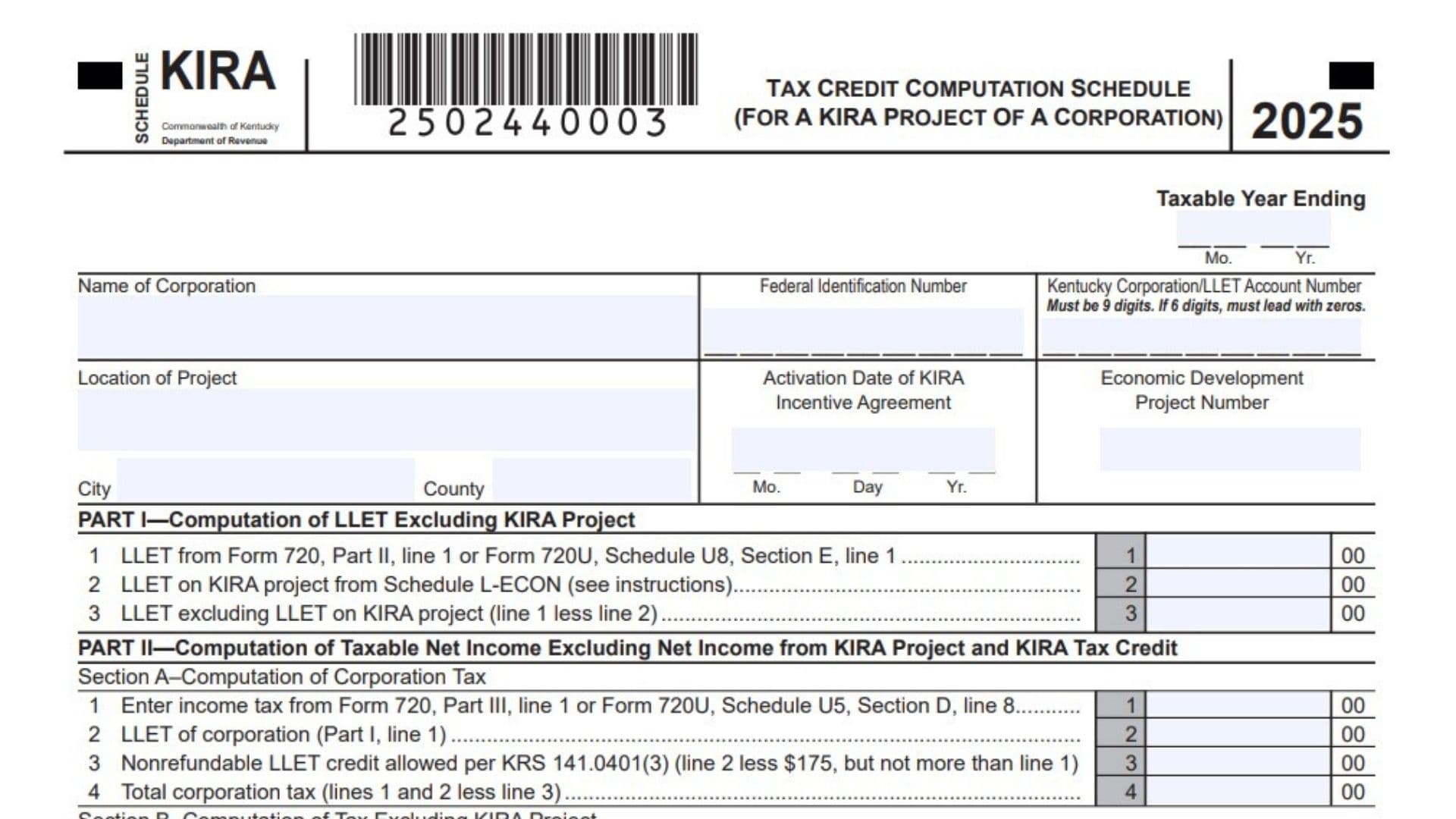
Kentucky PKG KIRA is a tax incentive package used by an approved business entity to report and track credits under the Kentucky Industrial Revitalization Act. This package applies to a KIRA project that has received approval through the Kentucky economic development process. It helps corporations and pass-through entities calculate the KIRA tax credit, determine the tax attributable to the approved revitalization project, and maintain a year-by-year record of approved costs, wage assessment fees, local wage assessment credits, and tax credits claimed. Corporations use Schedule KIRA and Schedule KIRA-T, while pass-through entities and general partnerships use Schedule KIRA-SP and Schedule KIRA-T. Each package should report only one approved KIRA project. If a business has more than one approved economic development project, it must prepare a separate package and separate schedules for each project.
How To File Kentucky PKG KIRA
Use Kentucky PKG KIRA only if your business has approval for a Kentucky Industrial Revitalization Act credit. The package should be attached to the Kentucky tax return that matches the entity type. Corporations filing Form 720 or Form 720U must complete Schedule KIRA and Schedule KIRA-T. Pass-through entities filing Form PTE or Form 725 must complete Schedule KIRA-SP and Schedule KIRA-T.
Only one incentive project should be included in each KIRA package. If the business has multiple approved projects, complete a separate package for each one. The tax incentive can only be claimed during the term of the incentive agreement. In the first and last years of the agreement, the incentive must be prorated for the eligible part of the year.
Separate period accounting is recommended. If separate period accounting is not available, calculate a proration factor. For the first year, divide the number of days from the activation date through the end of the taxable year by the total number of days in the taxable year. For the last year, divide the number of days from the first day of the taxable year through the end of the agreement term by the total number of days in the taxable year. Multiply total income by the proration factor to determine project income for the eligible period.

How To Complete Kentucky PKG KIRA
Package-Level Instructions
Line 1: Package Name: Use this package for the Kentucky Industrial Revitalization Act, also called KIRA.
Line 2: Tax Year: Confirm that the package is for the correct taxable year before completing any schedule.
Line 3: Approval Requirement: Use this package only if the business has approval for the KIRA credit through the Kentucky economic development process.
Line 4: Return Attachment: Attach the completed KIRA package to Form 720, Form 720U, Form PTE, or Form 725, depending on the type of return being filed.
Line 5: One Project Per Package: Include only one KIRA incentive project in each package. Do not combine multiple projects in the same package.
Line 6: Corporation Filing Rule: If the entity files Form 720 or Form 720U, complete Schedule KIRA and Schedule KIRA-T.
Line 7: Pass-Through Entity Filing Rule: If the entity files Form PTE or Form 725, complete Schedule KIRA-SP and Schedule KIRA-T.
Line 8: First Year Proration: In the first year of the agreement, claim the incentive only for the period beginning on the activation date and ending on the last day of the taxable year.
Line 9: Last Year Proration: In the final year of the agreement, claim the incentive only for the period beginning on the first day of the taxable year and ending on the final day of the agreement term.
Line 10: Separate Period Accounting: Use separate period accounting when available to identify the project income, receipts, profits, and other project amounts for the eligible period.
Line 11: Proration Factor: If separate period accounting is not available, use the proper first-year or last-year proration factor to calculate eligible project income.
Schedule KIRA Instructions For Corporations
Line 12: Taxable Year Ending: Enter the month and year when the corporation’s taxable year ends.
Line 13: Name Of Corporation: Enter the full legal name of the corporation claiming the KIRA credit.
Line 14: Federal Identification Number: Enter the corporation’s federal identification number.
Line 15: Kentucky Corporation/LLET Account Number: Enter the Kentucky Corporation or LLET account number. It must be 9 digits. If it has only 6 digits, add leading zeros.
Line 16: Location Of Project: Enter the physical location of the approved KIRA project.
Line 17: City: Enter the city where the project is located.
Line 18: County: Enter the county where the project is located.
Line 19: Activation Date Of KIRA Incentive Agreement: Enter the month, day, and year when the KIRA incentive agreement became active.
Line 20: Economic Development Project Number: Enter the project number assigned to the approved KIRA project.
Schedule KIRA, Part I, Computation Of LLET Excluding KIRA Project
Line 21: Part I, Line 1, LLET From Form 720 Or Form 720U: Enter the LLET from Form 720, Part II, line 1, or Form 720U, Schedule U8, Section E, line 1.
Line 22: Part I, Line 2, LLET On KIRA Project: Enter the LLET on the KIRA project from Schedule L-ECON. Schedule L-ECON should use only the Kentucky gross receipts and Kentucky gross profits from the KIRA project.
Line 23: Part I, Line 3, LLET Excluding KIRA Project: Subtract Part I, line 2 from Part I, line 1. Enter the result as LLET excluding the KIRA project.
Schedule KIRA, Part II, Section A, Computation Of Corporation Tax
Line 24: Section A, Line 1, Income Tax: Enter the income tax from Form 720, Part III, line 1, or Form 720U, Schedule U5, Section D, line 8.
Line 25: Section A, Line 2, LLET Of Corporation: Enter the corporation’s LLET from Part I, line 1.
Line 26: Section A, Line 3, Nonrefundable LLET Credit: Subtract $175 from Section A, line 2. Enter the result, but do not enter more than Section A, line 1.
Line 27: Section A, Line 4, Total Corporation Tax: Add Section A, lines 1 and 2, then subtract Section A, line 3. Enter the result.
Schedule KIRA, Part II, Section B, Computation Of Tax Excluding KIRA Project
Line 28: Section B, Line 1, Taxable Net Income: Enter taxable net income from Form 720, Part I, line 43, or Form 720U, Schedule U5, Section D, line 7.
Line 29: Section B, Line 2, Net Income From KIRA Project: Enter the net income from the KIRA project. If the project has a loss, enter zero.
Line 30: Section B, Line 3, Taxable Net Income Excluding KIRA Project: Subtract Section B, line 2 from Section B, line 1. If line 2 is greater than line 1, enter zero.
Line 31: Section B, Line 4, Income Tax Liability Excluding KIRA Project: Multiply Section B, line 3 by 5%. Enter the result.
Line 32: Section B, Line 5, LLET Excluding LLET On KIRA Project: Enter the amount from Part I, line 3.
Line 33: Section B, Line 6, LLET Credit Against Tax Excluding KIRA Project: Subtract $175 from Section B, line 5. Enter the result, but do not enter more than Section B, line 4.
Line 34: Section B, Line 7, Total Tax Excluding KIRA Project: Add Section B, lines 4 and 5, then subtract Section B, line 6.
Line 35: Section B, Line 8, Total Tax Attributable To KIRA Project: Subtract Section B, line 7 from Section A, line 4. Enter the result here and also carry it to Part III, line 1.
Schedule KIRA, Part III, Limitation
Line 36: Part III, Line 1, Tax Liability Attributable To KIRA Project: Enter the amount from Part II, Section B, line 8.
Line 37: Part III, Line 2, Limitation From Schedule KIRA-T: Enter the limitation from Schedule KIRA-T, Column E.
Line 38: Part III, Line 3, Allowable KIRA Tax Credit: Enter the smaller of Part III, line 1 or Part III, line 2. This is the allowable KIRA tax credit.
Line 39: Schedule TCS Entry: Enter the allowable credit on Schedule TCS, Part I, Column E and Column F.
Line 40: Schedule L-ECON Attachment: Attach Schedule L-ECON when computing the separate LLET for the KIRA project.
Line 41: Multiple Schedule L-ECON Rule: If the corporation has more than one approved project, attach a separate Schedule L-ECON for each project’s LLET computation.
Line 42: First And Last Year Gross Receipts Rule: In the first and last years of each project, include only Kentucky gross receipts and Kentucky gross profits received during the agreement term.
Line 43: Other Operations Attachment: If the corporation has operations other than the KIRA project, attach schedules showing how Kentucky gross receipts and Kentucky gross profits from the KIRA project were calculated.
Line 44: Corporation Project Income Rule: If the corporation’s only Kentucky operation is the KIRA project, enter the same taxable net income amount on Section B, line 1 and Section B, line 2.
Line 45: Net Income Schedule Attachment: If the corporation has operations other than the KIRA project, attach schedules showing how the KIRA project net income was calculated.
Line 46: Separate Facility Rule: If the KIRA project is a fully separate facility, determine project net income, Kentucky gross receipts, and Kentucky gross profits using separate accounting for that facility.
Line 47: Expansion Facility Rule: If the KIRA project expands an existing facility, first determine the entire facility’s amounts using separate accounting, then use the approved formula to assign the correct part to the KIRA project.
Line 48: Approved Formula Attachment: If an approved formula is used for an expansion project, attach the Department of Revenue approval letter.
Line 49: Alternative Method Attachment: If separate accounting is not practical and another approved method is used, attach the Department of Revenue approval letter.
Line 50: Multiple Corporation Projects: If the corporation has more than one economic development project, compute the credit separately for each project using the correct tax computation schedule.
Schedule KIRA-SP Instructions For Pass-Through Entities
Line 51: Taxable Year Ending: Enter the month and year when the pass-through entity’s taxable year ends.
Line 52: Name Of Pass-Through Entity: Enter the full legal name of the pass-through entity.
Line 53: Federal Identification Number: Enter the entity’s federal identification number.
Line 54: Kentucky Corporation/LLET Account Number: Enter the Kentucky Corporation or LLET account number. It must be 9 digits. If it has only 6 digits, add leading zeros.
Line 55: Location Of Project: Enter the physical location of the approved KIRA project.
Line 56: City: Enter the city where the project is located.
Line 57: County: Enter the county where the project is located.
Line 58: Activation Date Of KIRA Incentive Agreement: Enter the month, day, and year when the KIRA incentive agreement became active.
Line 59: Economic Development Project Number: Enter the assigned economic development project number.
Schedule KIRA-SP, Part I, Computation Of KIRA Tax Credit And Tax Due
Line 60: Part I, Line 1, Kentucky Taxable Income On KIRA Project: Enter the Kentucky taxable income from the KIRA project. If the entity’s only operation is the KIRA project, use the net income or loss from Form PTE. If the entity has other operations, attach a schedule showing how the KIRA project income or loss was calculated.
Line 61: Part I, Line 2, Net Operating Loss Deduction On KIRA Project: Enter any net operating loss deduction from the KIRA project that is being carried forward from previous years.
Line 62: Part I, Line 3, Kentucky Taxable Income After Net Operating Loss Deduction: Subtract line 2 from line 1. Enter the result.
Line 63: Part I, Line 4, Income Tax Of KIRA Project: Multiply line 3 by 5%. Enter the project income tax.
Line 64: Part I, Line 5, LLET On KIRA Project: Enter the LLET on the KIRA project from Schedule L-ECON. General partnerships should not complete this line.
Line 65: Part I, Line 6, Nonrefundable LLET Credit: Subtract $175 from line 5. Enter the result, but do not enter more than line 4. General partnerships should not complete this line.
Line 66: Part I, Line 7, Total Tax On KIRA Project: Add lines 4 and 5, then subtract line 6. Enter the total tax on the KIRA project.
Line 67: Part I, Line 8, Limitation: Enter the limitation from Schedule KIRA-T, Column E.
Line 68: Part I, Line 9(a), KIRA Tax Credit: Enter the smaller of line 7 or line 8 if the entity is claiming the amount as a KIRA tax credit.
Line 69: Part I, Line 9(b), Estimated Tax Payment: Enter the smaller of line 7 or line 8 if the entity elects to use the amount as an estimated tax payment instead of a KIRA tax credit. If this option is chosen, complete Part II.
Line 70: Line 9 Entry Rule: Enter an amount on either line 9(a) or line 9(b), not both.
Line 71: Part I, Line 10, Tax Due On The Project: If line 7 is greater than the amount entered on line 9(a) or line 9(b), enter the difference as tax due on the project. Add this amount to Form PTE, Part II, line 16, or Form 725, Part II, line 15.
Schedule KIRA-SP, Part II, Estimated Tax Election
Line 72: Election Statement: Complete Part II only if the pass-through entity chooses to apply the allowable KIRA amount as an estimated tax payment instead of a credit.
Line 73: Name Of Pass-Through Entity In Election: Enter the name of the pass-through entity making the election.
Line 74: Taxable Year Ended In Election: Enter the taxable year ending date for the election.
Line 75: Estimated Tax Payment Amount: The election applies an amount equal to the smaller of Part I, line 7 or Part I, line 8 as an estimated tax payment.
Line 76: Signature Of Shareholder, Partner, Or Member: The shareholder, partner, or member making the election must sign.
Line 77: Print Name: Print the name of the person signing the election.
Line 78: Date: Enter the date the election is signed.
Line 79: Credit Does Not Pass Through: The KIRA credit does not pass through to members, partners, or shareholders.
Line 80: Form PTE(K) Adjustment: Use Form PTE(K) to exclude the net income from the KIRA project from the distributive share income of partners, members, or shareholders.
Line 81: Multiple Pass-Through Projects: If the pass-through entity has multiple economic development projects, complete the applicable schedule for each project to determine the credit and any net tax liability.
Line 82: First And Last Year Income Rule: In the first and last years of the project, include only Kentucky taxable income received during the agreement term.
Line 83: Separate Facility Rule: If the KIRA project is a separate facility, determine net income, Kentucky gross receipts, and Kentucky gross profits using separate accounting for that facility.
Line 84: Expansion Facility Rule: If the KIRA project expands an existing facility, use separate accounting for the entire facility and an approved formula to assign the correct part to the KIRA project.
Line 85: Approved Formula Attachment: If an approved expansion formula is used, attach the Department of Revenue approval letter.
Line 86: Alternative Method Rule: If separate accounting is not practical and another approved method is used, attach the Department of Revenue approval letter.
Line 87: Net Operating Loss Rule: KIRA project losses do not pass through to partners, members, or shareholders. Prior year KIRA project net operating losses must be subtracted from project income before the credit is calculated.
Line 88: General Partnership Rule: A general partnership is not subject to LLET, so it should not complete Schedule KIRA-SP lines 5 and 6.
Line 89: Schedule L-ECON Rule For Pass-Through Entities: Use Schedule L-ECON to compute a separate LLET for the KIRA project when LLET applies.
Schedule KIRA-T Tracking Schedule Instructions
Line 90: Name Of Entity: Enter the legal name of the entity maintaining the KIRA tracking schedule.
Line 91: Entity Type, Corporation: Check this box if the entity is a corporation.
Line 92: Entity Type, Limited Liability Pass-Through Entity: Check this box if the entity is a limited liability pass-through entity.
Line 93: Entity Type, General Partnership: Check this box if the entity is a general partnership.
Line 94: Entity Type, Other: Check this box if another entity type applies, then write the entity type on the line provided.
Line 95: Federal Identification Number: Enter the entity’s federal identification number.
Line 96: Kentucky Corporation/LLET Account Number: Enter the Kentucky Corporation or LLET account number. It must be 9 digits. If it has only 6 digits, add leading zeros.
Line 97: Location Of Project: Enter the physical location of the approved KIRA project.
Line 98: City: Enter the city where the project is located.
Line 99: County: Enter the county where the project is located.
Line 100: Activation Date Of KIRA Incentive Agreement: Enter the month, day, and year when the KIRA incentive agreement became active.
Line 101: Economic Development Project Number: Enter the assigned project number.
Line 102: Schedule KIRA-T Purpose: Use Schedule KIRA-T to maintain a record of approved costs, wage assessment fees, local wage assessment credits, income tax credits, LLET credits, and older corporation license tax credits for the duration of the revitalization agreement.
Line 103: Separate Tracking Schedule Requirement: Keep a separate Schedule KIRA-T for each approved KIRA project for the full duration of the revitalization agreement.
Line 104: Year-By-Year Tracking Requirement: Starting with the first taxable year of the KIRA revitalization agreement, complete Columns A through F using a separate row for each year.
Line 105: Current Year Attachment: Attach the updated Schedule KIRA-T to Schedule KIRA or Schedule KIRA-SP when filing the Kentucky tax return.
Line 106: Wage Assessment Attachment: Attach an updated copy of Schedule KIRA-T to the Wage Assessment Report and Annual Reconciliation.
Line 107: Schedule TCS Credit Reporting: Enter all tax credits on Schedule TCS. Credits must be claimed in the required order.
Line 108: Credit Limitation Rule: Total credits cannot reduce the LLET below the $175 minimum and cannot reduce income tax below zero.
Schedule KIRA-T Columns
Line 109: Column A, Taxable Year Ended: Enter the month and year for the ending date of the taxable year shown on that row.
Line 110: Column B, Carry Forward Balance Of Approved Costs: For the taxable year that includes the revitalization agreement date, enter 50% or 75% of the approved costs verified by the Kentucky Economic Development Finance Authority. Use the percentage shown in the agreement.
Line 111: Column B, Later Years: For each later year, compare the prior year Column E amount with the combined income tax credit and corporation license tax credit claimed in prior year Column F. If the prior year Column E amount is greater, enter the difference.
Line 112: Column C, State Wage Assessment Credit Claimed Or Appropriations Received Under An Appropriation Agreement: Enter the total state wage assessments withheld from employee salaries during the taxable year. If an appropriation agreement was used instead of wage assessment, enter the appropriations received during the taxable year.
Line 113: Column D, Local Wage Assessment Credit Claimed: Enter the total local wage assessment credit claimed, if the entity is eligible.
Line 114: Column E, KIRA Tax Credit Limitation: Subtract Columns C and D from Column B. Enter the result as the KIRA tax credit limitation.
Line 115: Column E Transfer For Corporations: If the filer is a corporation, carry Column E to Schedule KIRA, Part III, line 2.
Line 116: Column E Transfer For Pass-Through Entities: If the filer is a pass-through entity, carry Column E to Schedule KIRA-SP, Part I, line 8.
Line 117: Column F, KIRA Tax Credit Claimed On Return: Enter the greater of the KIRA credit claimed against LLET or income tax for this project as reported on Schedule TCS. If no credit is claimed, enter zero.
Line 118: Corporation License Tax Note: Corporation license tax was repealed for tax periods ending on or after December 31, 2005. If KIRA credit was used to offset corporation license tax before that date, report it on Schedule KIRA-T.
Line 119: Final Review: Check the entity name, entity type, identification numbers, project location, activation date, project number, taxable year rows, approved costs, wage assessment amounts, local wage assessment credits, tax credit limitation, and credit claimed before filing.
Line 120: Final Filing Step: Attach the required KIRA schedules to the proper Kentucky return and make sure all transferred amounts match Schedule KIRA, Schedule KIRA-SP, Schedule KIRA-T, Schedule L-ECON, and Schedule TCS.