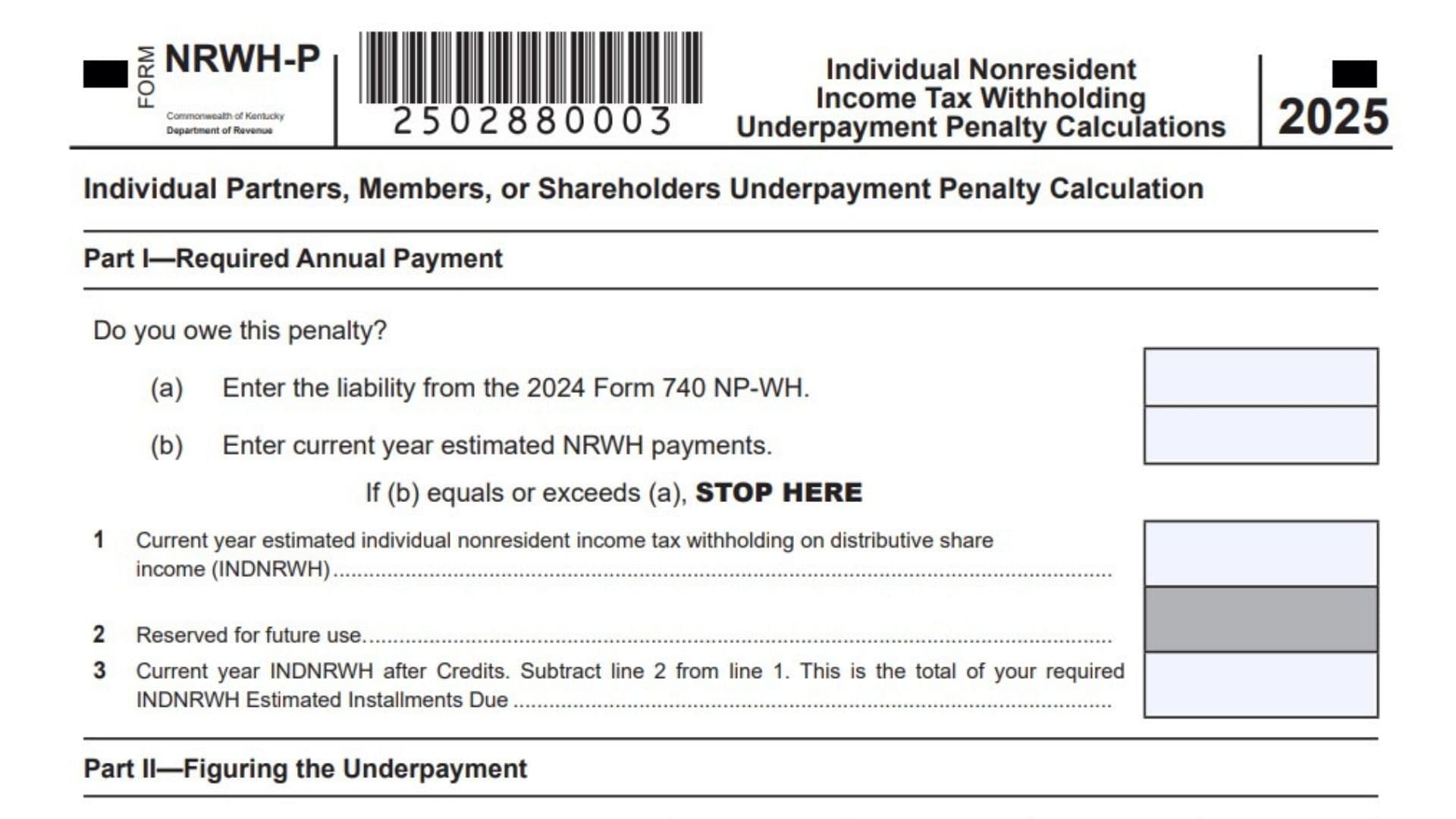
Kentucky Form NRWH-P, Individual Nonresident Income Tax Withholding Underpayment Penalty Calculations, is used to calculate the penalty when required estimated individual nonresident withholding payments were not paid on time or were not paid in the required amount. This form applies to individual partners, members, or shareholders who are connected with Kentucky nonresident withholding on distributive share income, commonly called INDNRWH. In simple terms, when a pass-through entity has nonresident individual owners, Kentucky may require withholding on those owners’ distributive share income. If the required withholding installments were underpaid during the year, Form NRWH-P helps determine the underpayment for each installment period and then calculates the penalty based on the number of days the payment was late and the applicable penalty rate. The form is divided into three major parts. Part I determines the required annual payment. Part II breaks the required payment into installment periods and calculates underpayment or overpayment amounts. Part III calculates the actual penalty using the underpayment, late-payment days, and rate formulas. The final penalty is then added to or entered on the appropriate line of Form 740NP-WH. This form is important because it gives taxpayers a structured way to determine whether an underpayment penalty applies and how much must be reported with the Kentucky nonresident withholding return.
How To File Kentucky Form NRWH-P
Complete Kentucky Form NRWH-P when individual nonresident withholding on distributive share income was underpaid or paid late. Use it together with Form 740NP-WH when calculating the penalty for underpayment of estimated nonresident withholding. Before completing the form, gather the prior-year Form 740NP-WH liability, current-year estimated NRWH payments, current-year INDNRWH amount, payment dates, installment due dates, and any payments or credits applied to each installment period. Work through one installment column at a time. Complete Lines 7 through 13 for Column A before moving to Column B, then repeat the process for Columns C and D. After the penalty is calculated on Line 23, transfer it to Form 740NP-WH as instructed. If there is an income tax overpayment on Form 740NP-WH, add the penalty to the appropriate overpayment adjustment line. If there is income tax due, enter the penalty on the tax due penalty line.

How To Complete Kentucky Form NRWH-P
Part I: Required Annual Payment
Use Part I to decide whether a penalty calculation is needed and to determine the total required INDNRWH estimated installments for the year.
Do You Owe This Penalty, Line (a): Enter the liability from the 2024 Form 740 NP-WH. This is used as the prior-year comparison amount.
Do You Owe This Penalty, Line (b): Enter the current-year estimated NRWH payments.
Stop Test: If the amount on Line (b) equals or is greater than the amount on Line (a), stop. No penalty calculation is needed under this test.
Line 1: Current Year Estimated INDNRWH: Enter the current-year estimated individual nonresident income tax withholding on distributive share income. This is the estimated INDNRWH amount for the year.
Line 2: Reserved For Future Use: Leave this line blank unless future instructions require an entry.
Line 3: Current Year INDNRWH After Credits: Subtract Line 2 from Line 1. The result is the total required INDNRWH estimated installment amount for the year.
Part II: Figuring The Underpayment
Use Part II to divide the required annual INDNRWH amount into installment periods and determine whether each period has an underpayment or overpayment.
Column A: Use this column for the first installment period.
Column B: Use this column for the second installment period.
Column C: Use this column for the third installment period.
Column D: Use this column for the fourth installment period.
Line 4: Installment Due Dates: Enter the required installment due dates based on the taxpayer’s tax year. Use the 15th day of the 4th month, 6th month, and 9th month of the tax year, plus the 15th day of the month following the close of the tax year.
Line 5: Required INDNRWH Installments: Enter 25% of Line 3 in each column. Multiply Line 3 by 0.25 and place the result in Columns A, B, C, and D.
Line 6: Estimated INDNRWH Tax Paid Or Credited For Each Period: Enter the estimated INDNRWH tax paid or credited for each installment period. For Column A only, also enter the amount from Line 6 on Line 10.
Complete One Column Before Moving To The Next: Complete Lines 7 through 13 for one column before starting the next column. This is important because overpayments and shortage amounts may carry from one column to the next.
Line 7: Prior Column Overpayment: Enter the amount from Line 13 of the preceding column, if there is one. Do not enter an amount in Column A because there is no preceding column.
Line 8: Total Available Payment For The Column: Add Line 6 and Line 7 for the column. This shows the amount available for that installment after including any prior overpayment.
Line 9: Prior Column Shortage Amounts: Enter the amounts from Lines 11 and 12 of the preceding column. This brings forward prior shortage amounts when required. Do not enter an amount in Column A.
Line 10: Net Available Amount: Subtract Line 9 from Line 8. If the result is zero or less, enter zero. For Column A only, enter the amount from Line 6.
Line 11: Remaining Shortage When Line 10 Is Zero: If Line 10 is zero, subtract Line 8 from Line 9 and enter the result. If Line 10 is more than zero, enter zero.
Line 12: INDNRWH Underpayment: If Line 10 is less than or equal to Line 5, subtract Line 10 from Line 5. This is the INDNRWH underpayment for the column. Then move to Line 7 of the next column. If Line 10 is more than Line 5, skip to Line 13.
Line 13: INDNRWH Overpayment: If Line 5 is less than Line 10, subtract Line 5 from Line 10. This is the INDNRWH overpayment for the column. Then carry it to Line 7 of the next column.
Part III: Figuring The INDNRWH Underpayment Penalty
Use Part III to calculate the penalty on each installment underpayment from Part II.
Line 14: Date Installment Was Paid In Full: For each column, enter the date when the specific INDNRWH installment was fully paid. If it was not paid earlier, enter the 15th day of the 4th month after the close of the tax year. Use whichever date is earlier.
Line 15: Number Of Days Late: For each column, enter the number of days from the installment due date on Line 4 to the date entered on Line 14.
Line 16: Days After 04/15/2025 And Before 01/01/2026: Enter the number of days from Line 15 that fall after April 15, 2025, and before January 1, 2026.
Line 17: Penalty For The 2025 Rate Period: Multiply Line 12 by Line 16 divided by 365, then multiply the result by 10%. Enter the result in each applicable column.
Line 18: Days After 12/31/2025 And Before The Earlier Cutoff Date: Enter the number of days from Line 15 that fall after December 31, 2025, and before the day after the due date of the return or January 1, 2027, whichever is earlier.
Line 19: Penalty For The 2026 Rate Period: Multiply Line 12 by Line 18 divided by 365, then multiply the result by 9%. Enter the result in each applicable column.
Line 20: Days After 12/31/2026 For Certain Fiscal Year Taxpayers: For September through November 2025 fiscal year-end taxpayers, enter the number of days from Line 15 that fall after December 31, 2026, and before March 16, 2027, or the day after the due date of the return, whichever is earlier.
Line 21: Penalty For The 2027 Rate Period: Multiply Line 12 by Line 20 divided by 365, then multiply the result by the 2027 tax due penalty rate. The 2027 tax due penalty rate is the same as the 2027 tax due interest rate.
Line 22: Total Penalty For Each Column: Add Lines 17, 19, and 21 in each column. Enter the total penalty for each installment column.
Line 23: INDNRWH Penalty: Add the Line 22 amounts from Columns A, B, C, and D. Enter the total in Column D. This is the total INDNRWH underpayment penalty.
Where To Report The Penalty
If There Is An Income Tax Overpayment On Form 740NP-WH: If Form 740NP-WH shows an income tax overpayment on Line 17, add the amount from Form NRWH-P, Line 23 to Form 740NP-WH, Line 19.
If There Is Income Tax Due On Form 740NP-WH: If income tax is due after Form 740NP-WH Line 8 plus Line 14 minus Line 13, enter the amount from Form NRWH-P, Line 23 on Form 740NP-WH, Line 15.
Important Rule For Pass-Through Entity Tax Election
Estimated Payment Requirement: Pass-through entities that made the election for the pass-through entity tax must make estimated tax payments if the tax liability is reasonably expected to exceed $500.
Penalty Calculation: Form 740NP-WH should be used to calculate the penalty for underpayment of estimated taxes.
Prior-Year Protection: The penalty does not apply if prepaid tax equals or exceeds the prior year’s pass-through entity tax liability.
Final Review Before Filing
Review the prior-year liability, current-year estimated NRWH payments, current-year INDNRWH amount, installment due dates, payment dates, and all underpayment or overpayment calculations before filing. Make sure you complete one column fully before starting the next column. Confirm that Line 5 equals 25% of Line 3 in each installment column. Check that late-payment days are separated correctly between the 2025, 2026, and 2027 rate periods. Finally, transfer the total penalty from Line 23 to the correct line of Form 740NP-WH based on whether the return shows an overpayment or a balance due.