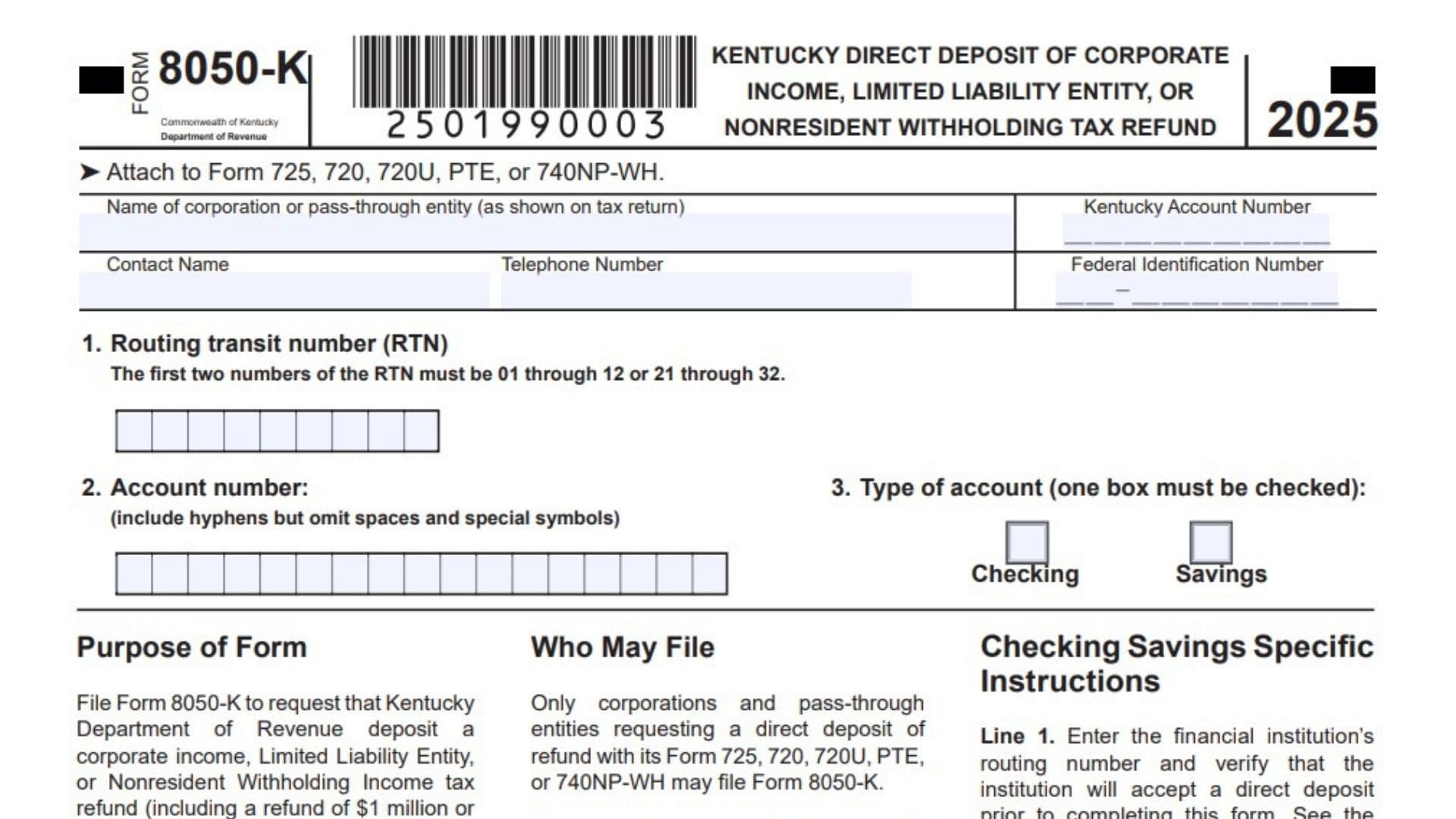
Kentucky Form 8050-K is used by a corporation or pass-through entity to ask the Kentucky Department of Revenue to send a corporate income tax, Limited Liability Entity tax, or nonresident withholding income tax refund directly to a U.S. bank or other U.S. financial institution that accepts direct deposits. The form is attached to Form 725, Form 720, Form 720U, Form PTE, or Form 740NP-WH when the taxpayer wants the refund deposited electronically instead of receiving a paper check. Kentucky Form 8050-K can also be used for large refunds, including refunds of $1 million or more, as long as the receiving account is eligible. The main purpose of the form is to collect the entity name, Kentucky account number, contact information, federal identification number, routing transit number, account number, and account type so the refund can be sent to the correct account. Direct deposit can help the entity receive the refund faster, reduce the risk of a lost or delayed paper check, and lower processing costs. However, the request can fail if the entity name on the tax return does not match the account name, the bank rejects the deposit because the routing or account number is wrong, or the entity does not choose checking or savings. The form should be completed carefully because even one incorrect digit in the routing number or account number can cause the refund to be issued by check instead.
How To File Kentucky Form 8050-K
Attach Kentucky Form 8050-K to the corporation’s or pass-through entity’s Form 725, Form 720, Form 720U, Form PTE, or Form 740NP-WH, if direct deposit applies. Complete the entity information at the top of the form, then enter the financial institution’s routing transit number, the account number, and the account type.
Before filing, verify that the financial institution accepts direct deposits. Also confirm that the account belongs to the corporation or pass-through entity shown on the tax return. The receiving financial institution cannot be a foreign bank or a foreign branch of a U.S. bank.
Do not use a deposit slip to confirm the routing number because deposit slips may show a different number. Use a check, bank records, online banking details, or direct confirmation from the financial institution. If the refund cannot be processed by direct deposit, the Department of Revenue may issue the refund by check instead.
How To Complete Kentucky Form 8050-K Line By Line
Line 1: Form 8050-K: This identifies the document as Kentucky Form 8050-K. Use this form only when requesting direct deposit of an eligible Kentucky refund for a corporation or pass-through entity.
Line 2: Commonwealth Of Kentucky Department Of Revenue: This identifies the Kentucky tax agency that processes the direct deposit request. You do not need to enter anything in this area.
Line 3: Kentucky Direct Deposit Of Corporate Income, Limited Liability Entity, Or Nonresident Withholding Tax Refund: This title explains the purpose of the form. It is used to request direct deposit of an eligible Kentucky refund.
Line 4: Tax Year 2025: This shows that the form applies to the 2025 tax year. Use this version for the tax year shown on the form.
Line 5: Attach To Form 725, 720, 720U, PTE, Or 740NP-WH: Attach this form to the applicable Kentucky return. Use it only with the listed forms when direct deposit of a refund is being requested.
Line 6: Name Of Corporation Or Pass-Through Entity: Enter the entity’s name exactly as it appears on the tax return. The name should also match the name on the receiving bank account to avoid a rejected direct deposit.
Line 7: Kentucky Account Number: Enter the Kentucky account number assigned to the corporation or pass-through entity. This helps match the direct deposit request to the correct Kentucky tax account.
Line 8: Contact Name: Enter the name of the person the Department of Revenue can contact if there is a question about the direct deposit request. This may be an owner, officer, employee, accountant, or authorized representative.
Line 9: Telephone Number: Enter a phone number for the contact person. Use a number where the person can be reached during normal business hours.
Line 10: Federal Identification Number: Enter the entity’s Federal Employer Identification Number. Make sure the number matches the tax return being filed with this direct deposit request.
Line 11: Routing Transit Number: Enter the financial institution’s routing transit number. The routing number must have nine digits. The first two digits must be 01 through 12 or 21 through 32. Verify the routing number with the financial institution before entering it.
Line 12: Routing Number Verification Rule: Check the first two digits of the routing transit number before filing. If the first two digits do not fall within the allowed range, the direct deposit request may not be processed.
Line 13: Account Number: Enter the corporation’s or pass-through entity’s checking or savings account number. Include hyphens if they are part of the account number, but do not include spaces or special symbols.
Line 14: Account Number Entry Format: Enter the account number from left to right. If the form has more boxes than the account number needs, leave the remaining boxes blank.
Line 15: Type Of Account: Check one account type. You must choose either checking or savings.
Line 16: Checking Box: Check this box if the refund should be deposited into a checking account.
Line 17: Savings Box: Check this box if the refund should be deposited into a savings account.
Purpose Of Form
Line 18: Purpose Of Form: Use Kentucky Form 8050-K to request direct deposit of an eligible Kentucky refund into an account at a U.S. bank or other U.S. financial institution that accepts direct deposits.
Line 19: Eligible Refund Types: The form applies to corporate income tax refunds, Limited Liability Entity tax refunds, and nonresident withholding income tax refunds.
Line 20: Large Refunds: The form may be used even when the refund is $1 million or more, as long as the refund and receiving account meet the requirements.
Line 21: Eligible Financial Institutions: The refund may be deposited into an account at a U.S. bank or another U.S. financial institution, such as a mutual fund or brokerage firm, if that institution accepts direct deposits.
Line 22: Benefits Of Direct Deposit: Direct deposit may help the taxpayer receive the refund faster, reduce the risk linked to paper checks, and lower processing costs.
Conditions Resulting In A Refund By Check
Line 23: Refund By Check May Be Issued: If the direct deposit request cannot be processed, the refund may be issued by check instead.
Line 24: Name Mismatch: A paper check may be issued if the corporation or pass-through entity name on the tax return does not match the name on the receiving account.
Line 25: Incorrect Routing Or Account Number: A paper check may be issued if the financial institution rejects the direct deposit because the routing number or account number is incorrect.
Line 26: Missing Account Type: A paper check may be issued if the corporation or pass-through entity does not check whether the account is checking or savings.
Who May File
Line 27: Eligible Filers: Only corporations and pass-through entities requesting direct deposit of a refund with Form 725, Form 720, Form 720U, Form PTE, or Form 740NP-WH may file Kentucky Form 8050-K.
Line 28: Foreign Bank Restriction: The corporation or pass-through entity cannot request direct deposit if the receiving financial institution is a foreign bank or a foreign branch of a U.S. bank.
How To File
Line 29: Attach To The Applicable Return: Attach Kentucky Form 8050-K to the corporation’s or pass-through entity’s Form 725, Form 720, Form 720U, Form PTE, or Form 740NP-WH, if direct deposit is being requested.
Line 30: Do Not File Alone: Do not send Form 8050-K by itself. It should be attached to the applicable Kentucky return.
Checking And Savings Specific Instructions
Line 31: Line 1 Routing Transit Number: Enter the financial institution’s routing number on line 1. Before completing the form, confirm that the institution accepts direct deposits.
Line 32: Sample Check Guidance For Routing Number: A check may help show where the routing number appears. The routing number is usually printed along the bottom of the check.
Line 33: Accounts Payable Through Another Institution: If the account is payable through a financial institution other than the one where the account is held, contact the financial institution to confirm the correct routing number.
Line 34: Do Not Use A Deposit Slip: Do not use a deposit slip to verify the routing number. A deposit slip may show a number that is not valid for direct deposit.
Line 35: Line 2 Account Number: Enter the corporation’s or pass-through entity’s checking or savings account number on line 2. Use the account number connected to the account where the refund should be deposited.
Line 36: Account Number Placement: Enter the account number from left to right and leave unused boxes blank.
Line 37: Sample Check Guidance For Account Number: A check may help show where the account number appears. The account number is usually printed along the bottom of the check near the routing number.
Line 38: Line 3 Account Type: Check the correct box for the account type. Choose checking if the refund goes to a checking account. Choose savings if the refund goes to a savings account.
Sample Check Instructions
Line 39: Sample Check: Use the sample check as a guide for locating the routing number and account number on a check.
Line 40: Routing Number On The Sample Check: The routing number is shown as the number used for line 1. It is normally located at the bottom of the check.
Line 41: Account Number On The Sample Check: The account number is shown as the number used for line 2. It is usually printed near the routing number.
Line 42: Do Not Include The Check Number: Do not enter the check number as part of the routing number or account number. The check number is separate and should not be included on the form.
Filing Tips For Kentucky Form 8050-K
Enter the entity name exactly as it appears on the Kentucky return. Confirm that the bank account is in the name of the corporation or pass-through entity. Double-check every digit in the routing number and account number before filing. Make sure one account type box is checked. Do not check both checking and savings.
Use reliable bank records to confirm the routing and account numbers. A check or direct confirmation from the bank is safer than relying on a deposit slip. If the account is connected to a brokerage, mutual fund, or another financial institution, ask the institution for the correct direct deposit routing information.
Keep a copy of the completed form with the filed return. Also keep proof of the bank information used to complete the direct deposit request.
Common Mistakes To Avoid
Do not leave the Kentucky account number blank. Do not enter a personal account if the refund belongs to the corporation or pass-through entity. Do not use a foreign bank account. Do not use a foreign branch of a U.S. bank. Do not use a deposit slip to confirm the routing number. Do not forget to check checking or savings. Do not include spaces or special symbols in the account number. Do not include the check number as part of the account number.
Final Review Before Filing
Before filing Kentucky Form 8050-K, review the entity name, Kentucky account number, contact name, telephone number, federal identification number, routing transit number, account number, and account type. Confirm that the form is attached to the correct Kentucky return. If any banking information is wrong or incomplete, the direct deposit request may fail and the refund may be issued by check.