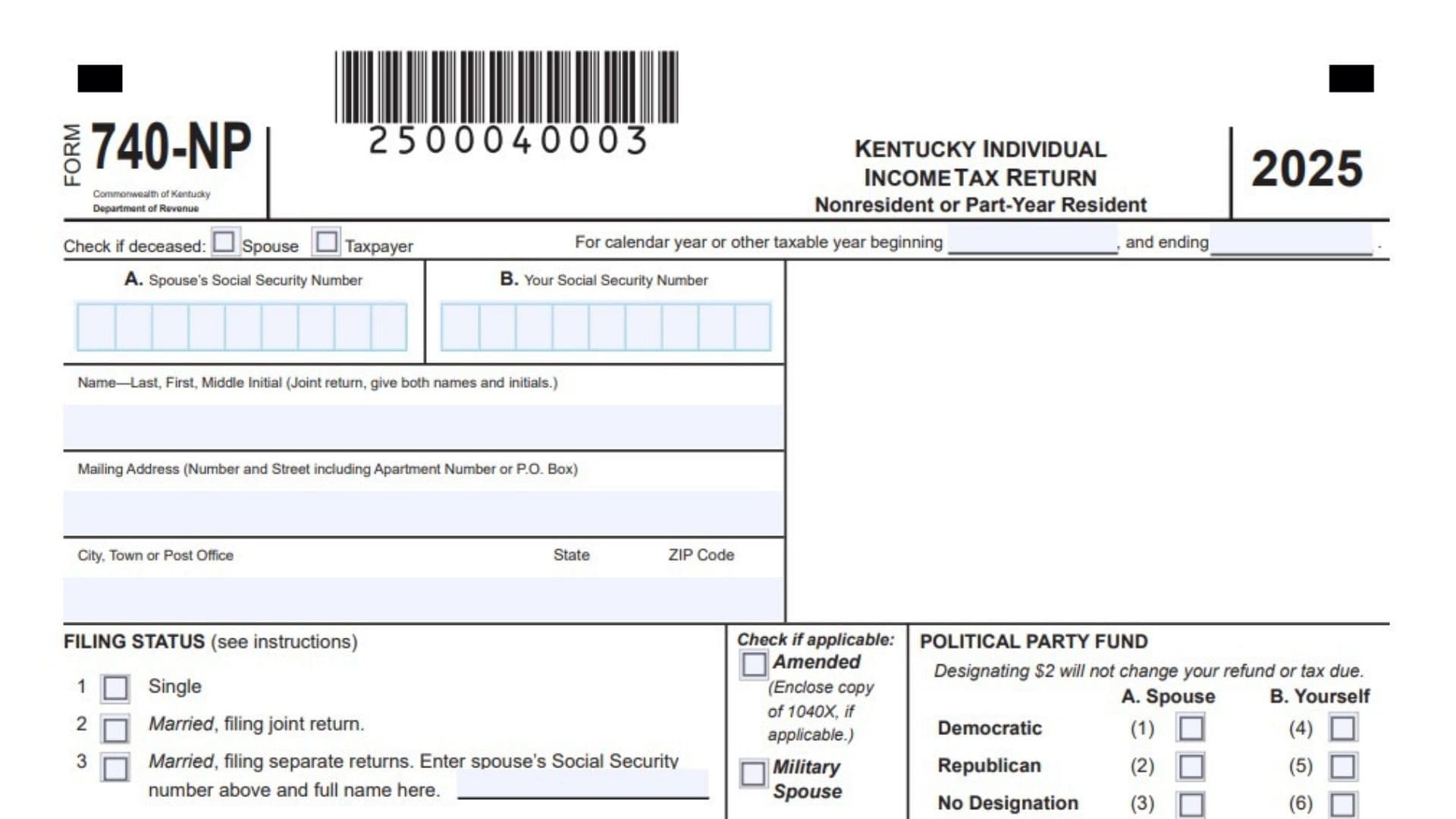
Kentucky Form 740-NP is the income tax return used by people who were either nonresidents for the full year or residents for only part of the year and still had income that Kentucky can tax. It is used to report total income, identify the Kentucky-taxable share of that income, apply deductions and credits, and determine whether you owe tax or should receive a refund. This return is especially important because it separates federal income from Kentucky income, which is the key to calculating the correct state tax for people who did not live in Kentucky all year. It also includes lines for withholding, estimated payments, use tax, penalties, interest, charitable contributions, and refund choices. If someone lived in another state all year and only earned Kentucky wages while living in a reciprocal state, a different Kentucky return may apply instead. In simple terms, this form helps Kentucky figure out how much of your income belongs on a Kentucky tax return when you were not a full-year Kentucky resident.
How To File It
- Complete Section B first.
- Then fill out Section A using the totals from Section B.
- Add withholding, estimated payments, credits, penalties, and refund information.
- Sign and date the return.
- Attach required schedules and supporting forms.
- Submit the return with payment if you owe tax, or file it as a refund or no-payment return if you do not.

How to Complete Kentucky Form 740-NP
Top Of The Form
Line A: Enter the spouse’s Social Security number if filing jointly or separately where required.
Line B: Enter your Social Security number.
Name: Enter your full name. If this is a joint return, enter both names.
Mailing Address: Enter your street address, apartment number if any, or post office box.
City, Town Or Post Office: Enter your city or town.
State: Enter your state.
ZIP Code: Enter your ZIP code.
Political Party Fund: Choose the political party fund designation for yourself and your spouse if filing jointly. This does not change your tax due or refund.
Filing Status: Check the box for Single, Married Filing Jointly, or Married Filing Separately.
Residency Status: Check whether you were a full-year nonresident or part-year resident.
Full-Year Nonresident State Of Residence: If you were a full-year nonresident, enter your state of residence at the end of the year.
Moved Into Kentucky: If you were a part-year resident and moved into Kentucky, enter the date.
State Moved From: Enter the state you moved from.
Moved Out Of Kentucky: If you moved out of Kentucky during the year, enter the date.
State Moved To: Enter the state you moved to.
Reciprocal State Note: If you were a full-year resident of a reciprocal state and only had Kentucky wages or salaries, do not use this return.
Amended Return Box: Check this if you are correcting a return that was already filed.
Military Spouse Box: Check this if military spouse rules apply to you.
Deceased Box: Check the proper box if the taxpayer or spouse is deceased.
Section B Income And Adjustments
Line 1: Enter all wages, salaries, tips, and similar compensation in Column A, and enter only the Kentucky-taxable amount in Column B.
Line 2: Enter moving expense reimbursement in Column A and the Kentucky amount in Column B.
Line 3: Enter taxable interest in Column A and the Kentucky portion in Column B.
Line 4: Enter taxable dividends in Column A and the Kentucky portion in Column B.
Line 5: Enter taxable refunds, credits, or offsets of state and local income taxes in Column A and the Kentucky portion in Column B.
Line 6: Enter alimony received in Column A and the Kentucky portion in Column B.
Line 7: Enter business income or loss in Column A and the Kentucky amount in Column B.
Line 8: Enter capital gain or loss in Column A and the Kentucky amount in Column B.
Line 9: Enter other gains or losses in Column A and the Kentucky portion in Column B.
Line 10a: Enter taxable IRA distributions, pensions, and annuities in Column A and the Kentucky-taxable amount in Column B.
Line 10b: Enter the pension income exclusion amount allowed under Kentucky rules.
Line 11: Enter rents, royalties, partnership income, estate income, trust income, and similar items in Column A and the Kentucky amount in Column B.
Line 12: Enter farm income or loss in Column A and the Kentucky amount in Column B.
Line 13: Enter unemployment compensation in Column A and the Kentucky amount in Column B.
Line 14: Enter taxable Social Security benefits in Column A and the Kentucky amount in Column B.
Line 15: Enter gambling winnings in Column A and the Kentucky amount in Column B.
Line 16: Enter other income, describe the type, and show the amount in both columns as applicable.
Line 17: Add lines 1 through 16 in each column. This is total income.
Line 18: Enter educator expenses in Column A and the Kentucky portion in Column B.
Line 19: Enter certain business expenses of reservists, performing artists, and fee-basis government officials in Column A and the Kentucky amount in Column B.
Line 20: Enter the health savings account deduction in Column A and the Kentucky amount in Column B.
Line 21: Enter moving expenses for members of the armed forces in Column A and the Kentucky amount in Column B.
Line 22: Enter the deductible part of self-employment tax in Column A and the Kentucky amount in Column B.
Line 23: Enter the self-employed SEP, SIMPLE, and qualified plan deduction in Column A and the Kentucky amount in Column B.
Line 24: Enter the self-employed health insurance deduction in Column A and the Kentucky amount in Column B.
Line 25: Enter the penalty on early withdrawal of savings in Column A and the Kentucky amount in Column B.
Line 26: Enter alimony paid in Column A and the Kentucky amount in Column B. Also provide the recipient’s name and Social Security number.
Line 27: Enter the IRA deduction in Column A and the Kentucky amount in Column B.
Line 28: Enter the student loan interest deduction in Column A and the Kentucky amount in Column B.
Line 29: Leave this reserved line blank unless a future instruction specifically tells you to use it.
Line 30: Enter the Archer MSA deduction in Column A and the Kentucky amount in Column B.
Line 31: Enter other deductions, describe the type, and show the amount in both columns as applicable.
Line 32: Add lines 18 through 31 in each column. This is total adjustments to income.
Line 33: Subtract line 32 from line 17 in each column. This is adjusted gross income.
Line 34: Divide line 33, Column B, by line 33, Column A. If the result is 100 percent or more, enter 100 percent.
Section A
Line 7: Enter the percentage from Section B, line 34.
Line 8: Enter the amount from Section B, line 33, Column A. This is federal adjusted gross income.
Line 9: Enter the amount from Section B, line 33, Column B. This is Kentucky adjusted gross income.
Line 10: If you are not itemizing, enter the standard deduction amount of 3,270. Do not prorate it.
Line 11: If you are itemizing, enter your Kentucky itemized deductions.
Line 12: Multiply line 11 by the percentage on line 7.
Line 13: Subtract line 10 or line 12 from line 9. This is taxable income.
Line 14: Multiply line 13 by 4 percent. This is your tax.
Line 15: Enter the credit from Schedule ITC, Section A, line 25.
Line 16: Subtract line 15 from line 14.
Line 17: Enter the personal tax credit amounts from Schedule ITC, Section B.
Line 18: Multiply line 17 by the percentage on line 7.
Line 19: Subtract line 18 from line 16.
Page 2
Line 20: Check the box that matches your total family size.
Line 21: Multiply line 19 by the family size tax credit decimal from Schedule ITC.
Line 22: Subtract line 21 from line 19.
Line 23: Enter the education tuition tax credit from Form 8863-K, line 17.
Line 24: Enter the child and dependent care credit from the worksheet.
Line 25: Leave this reserved line blank unless instructed otherwise.
Line 26: Subtract lines 23 through 25 from line 22. If the result is zero or less, enter zero.
Line 27: Enter Kentucky use tax due on taxable out-of-state purchases.
Line 28: Add lines 26 and 27. This is total tax liability.
Line 29: If this is an amended return, enter the overpayment shown on the original return.
Line 30: Add lines 28 and 29.
Line 31a: Enter Kentucky income tax withheld.
Line 31b: Enter 2025 Kentucky estimated tax and extension payments.
Line 31c: Enter the refundable certified rehabilitation credit.
Line 31d: Enter the refundable entertainment incentive tax credit.
Line 31e: Enter the refundable development area tax credit.
Line 31f: Enter the refundable decontamination tax credit.
Line 31g: Enter the refundable pass-through entity tax credit.
Line 31h: Enter nonresident withholding.
Line 31i: If this is an amended return, enter the amount paid with the original return plus any later payments.
Line 32: Add lines 31a through 31i.
Line 33: If line 30 is larger than line 32, subtract line 32 from line 30. This is additional tax due.
Line 34a: Enter estimated tax penalty. Check the box if the penalty form is attached.
Line 34b: Enter interest due.
Line 34c: Enter late payment penalty.
Line 34d: Enter late filing penalty.
Line 35: Add lines 34a through 34d.
Line 36: If the total of lines 30 and 35 is more than line 32, subtract line 32 from that total. This is the amount you owe.
Line 37: If line 32 is more than line 30, subtract lines 30 and 35 from line 32. This is the amount you overpaid.
Page 3 Refund And Contribution Area
Line 38a: Enter the amount you want to contribute to the Nature and Wildlife Fund.
Line 38b: Enter the amount you want to contribute to the Child Victims Trust Fund.
Line 38c: Enter the amount you want to contribute to the Veterans Program Trust Fund.
Line 38d: Enter the amount you want to contribute to the Breast Cancer Research Education Trust Fund.
Line 38e: Enter the amount you want to contribute to the Farms To Food Banks Trust Fund.
Line 38f: Enter the amount you want to contribute to the Local History Trust Fund.
Line 38g: Enter the amount you want to contribute to Special Olympics Kentucky.
Line 38h: Enter the amount you want to contribute to the Pediatric Cancer Research Trust Fund.
Line 38i: Enter the amount you want to contribute to the Rape Crisis Center Trust Fund.
Line 38j: Enter the amount you want to contribute to the Court Appointed Special Advocate Trust Fund.
Line 38k: Enter the amount you want to contribute to the YMCA Youth Association Fund.
Line 39: Add lines 38a through 38k. This is total fund contributions.
Line 40: Enter the part of your overpayment you want credited to your 2026 estimated tax. This option is not available for amended returns.
Line 41: Subtract lines 39 and 40 from line 37. This is your refund amount.
Signature Area
Taxpayer Signature: Sign and date the return.
Taxpayer ID Information: Enter the requested driver’s license or state-issued identification number if required.
Telephone Number: Enter your daytime phone number.
Spouse Signature: If filing jointly, the spouse should sign and date where required.
Paid Preparer Signature: If a preparer completed the return, the preparer should sign and date it.
Preparer Information: Enter the preparer’s name, firm name if any, identification number, email, and phone number.
Preparer Authorization: Check Yes or No to show whether the Department of Revenue may discuss the return with the preparer.