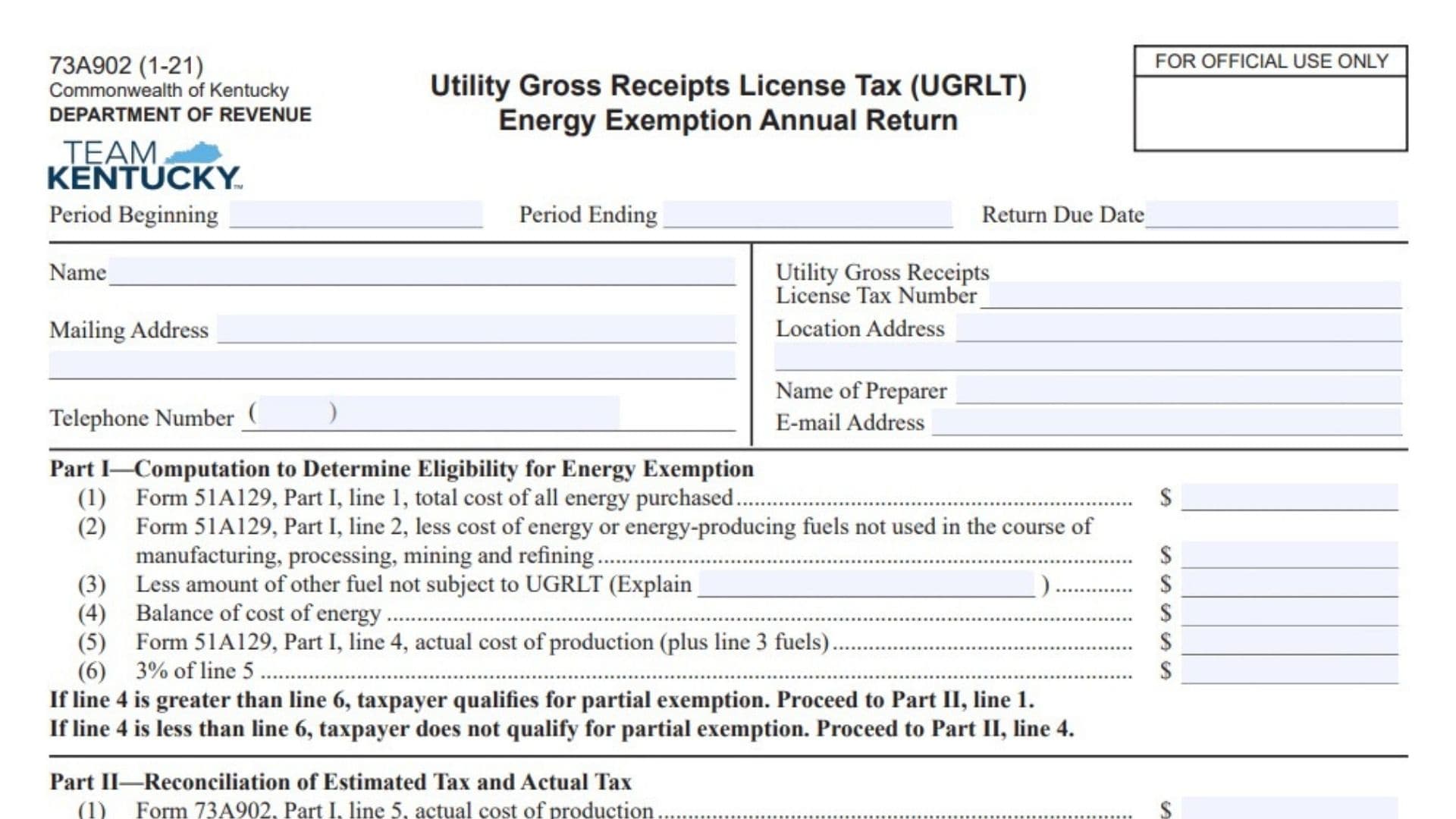
Kentucky Form 73A902, the Utility Gross Receipts License Tax (UGRLT) Energy Exemption Annual Return, is used by energy direct pay authorization holders to determine whether they qualify for an exemption from part of the Utility Gross Receipts License Tax and to reconcile estimated tax paid during the year with the actual tax due. Kentucky’s energy exemption applies when qualifying energy or energy-producing fuel used in manufacturing, processing, mining, or refining exceeds 3% of the cost of production. The cost-of-production calculation is made on a plant-facility basis, meaning the calculation applies to permanent structures attached to real property at one location. The form compares qualifying energy costs with the 3% production-cost threshold, calculates the amount of energy that remains subject to UGRLT, determines whether the taxpayer owes additional tax or has an overpayment, and, when applicable, establishes estimated taxable energy amounts for the following period. All energy direct pay authorization holders must file the annual return within four months after the end of their calendar or fiscal year. Accurate completion is important because the return reconciles annual tax liability with monthly UGRLT filings and determines how any additional tax, refund, or credit is handled.
How To File Form 73A902
Energy direct pay authorization holders must file Form 73A902 within four months after the end of their calendar or fiscal year.
Mail the completed return to:
Department of Revenue
Financial Tax Section
P.O. Box 1303
Frankfort, KY 40602-1303
Before completing the form, gather the records needed to support the calculations. These may include:
- Form 51A129 information used to determine energy costs and production costs.
- Records showing the total cost of energy purchased.
- Records separating energy used for manufacturing, processing, mining, or refining from energy used for other purposes.
- Records of diesel fuel or other fuels not subject to UGRLT.
- A schedule identifying each energy supplier, the type of energy or fuel purchased, and the total cost purchased from each supplier.
- A detailed cost-of-production schedule.
- Direct materials, direct labor, and production-related overhead records.
- Monthly Utility Gross Receipts License Tax Returns.
- Amounts reported on line 5b of each monthly Form 73A901.
- Prior-year credits or overpayments carried forward.
- Applicable school district tax rates and district codes.
- Supplier invoices showing tax paid directly to a supplier, when applicable.

How To Complete Form 73A902
Reporting Period And Taxpayer Information
Period Beginning
Enter the first date of the calendar or fiscal year covered by the annual return.
Period Ending
Enter the final date of the reporting period. The period should correspond with the taxpayer’s applicable calendar or fiscal year.
Return Due Date
Enter the due date for the annual return. Energy direct pay authorization holders generally must file within four months after the end of the applicable calendar or fiscal year.
Name
Enter the legal name of the taxpayer or business filing the return.
Mailing Address
Enter the complete mailing address where correspondence concerning the return should be sent.
Telephone Number
Provide a telephone number where the taxpayer or responsible representative can be contacted.
Utility Gross Receipts License Tax Number
Enter the taxpayer’s Utility Gross Receipts License Tax identification number.
Location Address
Enter the physical address of the plant or facility associated with the energy exemption calculation.
Because the exemption is determined using the cost of production for plant facilities at one location, make sure the location identifies the facility covered by the calculation.
Name of Preparer
Enter the name of the person who prepared the return.
E-mail Address
Provide an email address where the preparer or taxpayer can be contacted regarding the filing.
Part I: Computation To Determine Eligibility For Energy Exemption
Part I determines whether the taxpayer qualifies for a partial UGRLT energy exemption.
The basic test compares qualifying energy costs with 3% of the actual cost of production.
Attach a supporting schedule identifying each supplier, the type of energy or energy-producing fuel purchased, and the total energy cost associated with each supplier.
Line 1: Total Cost of All Energy Purchased
Enter the amount from Form 51A129, Part I, line 1.
This is the total cost of all energy purchased for the applicable period before subtracting energy or fuels that do not qualify for the exemption calculation.
Line 2: Energy Not Used in Manufacturing, Processing, Mining, or Refining
Enter the amount from Form 51A129, Part I, line 2.
This line removes the cost of energy or energy-producing fuels that were not used in the course of manufacturing, processing, mining, or refining.
The exemption calculation applies only to qualifying energy used in those activities.
Line 3: Other Fuel Not Subject to UGRLT
Enter the cost of diesel fuel or other energy-producing fuel that is not subject to UGRLT.
Use the explanation space on the line to identify the type of fuel being removed from the calculation.
These fuel costs should not be included when determining whether qualifying energy costs exceed the 3% production-cost threshold.
However, the excluded fuel costs are added to the cost of production for purposes of the threshold calculation on line 5.
Line 4: Balance of Cost of Energy
Determine the remaining qualifying energy cost after removing the amounts reported on lines 2 and 3 from the total energy cost on line 1.
In practical terms:
Line 1 – Line 2 – Line 3 = Line 4
This amount represents the energy cost used in the comparison with 3% of production costs.
Line 5: Actual Cost of Production
Enter the actual cost of production from Form 51A129, Part I, line 4, including the fuel costs removed on Part I, line 3.
The cost of production may include:
- Direct materials.
- Direct labor.
- Production-related overhead expenses.
Attach a schedule showing the account classifications and amounts included in the cost-of-production calculation.
If diesel or another fuel was removed from qualifying energy costs on line 3 because it is not subject to UGRLT, add that fuel cost to the cost of production reported here.
Line 6: Three Percent of Cost of Production
Multiply line 5 by 3%.
The calculation is:
Line 5 × 0.03 = Line 6
Line 6 establishes the threshold used to determine whether the taxpayer qualifies for the partial energy exemption.
Determining Eligibility After Line 6
Compare line 4 with line 6.
If line 4 is greater than line 6, the taxpayer qualifies for a partial exemption. Continue to Part II, line 1.
If line 4 is less than line 6, the taxpayer does not qualify for the partial exemption. Proceed to Part II, line 4.
When the taxpayer does not qualify, the annual instructions state that Part III does not need to be completed.
Part II: Reconciliation of Estimated Tax And Actual Tax
Part II compares the actual amount of UGRLT due with tax already paid or credited during the year.
The result determines whether additional tax must be paid or whether the taxpayer has an overpayment.
Line 1: Actual Cost of Production
Enter the actual cost of production reported on Part I, line 5.
This amount becomes the basis for determining the production energy amount subject to UGRLT.
Line 2: Production Energy Subject to UGRLT
Calculate 3% of line 1.
Use:
Line 1 × 0.03 = Line 2
This represents the portion of production energy that remains subject to UGRLT when the taxpayer qualifies for the energy exemption.
Line 3: Estimated Nonproduction Energy Purchased Without Tax
Enter the estimated cost of nonproduction energy purchased without the application of UGRLT.
This generally represents energy that was purchased under the direct pay arrangement without tax but does not qualify as exempt production energy.
Line 4: Total Amount Subject to UGRLT
The calculation depends on whether the taxpayer qualified for the partial exemption in Part I.
If the taxpayer qualifies for the exemption, add Part II, lines 2 and 3:
Line 2 + Line 3 = Line 4
If the taxpayer does not qualify, use the total cost of energy reported on Part I, line 1 and subtract the fuels reported on Part I, line 3 that are not subject to UGRLT:
Part I, Line 1 – Part I, Line 3 = Part II, Line 4
This is the total energy amount on which UGRLT must be calculated.
Line 5: UGRLT Due on Energy or Energy-Producing Fuels
Enter the applicable UGRLT tax percentage in the blank provided.
Use the tax rate for the school district in which the facility is located.
Multiply line 4 by that percentage:
Line 4 × Applicable UGRLT Rate = Line 5
Enter the resulting tax due.
Line 6: Estimated Tax Previously Paid
Enter the estimated tax already paid through monthly UGRLT returns for the period.
Include applicable credits carried forward from the previous year’s annual return that were not refunded.
If tax on energy or energy-producing fuels was paid to a supplier before issuance of the taxpayer’s energy direct pay authorization and the supplier did not refund that tax, the applicable tax may also be included in this line.
Attach the required supporting information, including:
- A breakdown of energy reported for taxation on line 5b of each monthly UGRLT return.
- The supplier’s name when tax was paid directly to a supplier.
- The amount of tax paid to each supplier.
- Copies of invoices showing the tax that was paid to the supplier.
The monthly energy schedule included with Form 73A902 can be used to provide the required breakdown.
Line 7: Additional Tax Due
Subtract line 6 from line 5 when actual tax due is greater than the estimated tax already paid.
Use:
Line 5 – Line 6 = Line 7
Enter the additional tax due.
When payment is required, the form instructs taxpayers to make the check payable to the Kentucky State Treasurer.
Line 8: Overpayment of Tax
If the amount on line 6 is greater than the amount on line 5, subtract line 5 from line 6:
Line 6 – Line 5 = Line 8
This is the tax overpayment.
The form provides two choices for handling the overpayment:
- Check the box requesting that the overpayment be refunded, or
- Check the box requesting that the overpayment be credited to Part III.
If the overpayment is credited forward, it is incorporated into the estimated taxable-energy calculation in Part III.
School District Allocation
If Part II produces an additional tax due on line 7 or an overpayment on line 8, provide the required school district breakdown.
School District
Enter the name of the school district associated with the tax amount.
District Code
Enter the applicable school district code.
Amount From Line 7 or Line 8
Allocate the applicable additional tax or overpayment to the school district.
The total allocation should correspond with the amount reported as tax due on Part II, line 7 or tax overpayment on Part II, line 8.
Tax Due, Part II, Line 7
Enter the additional tax due from Part II, line 7.
Tax Overpayment, Part II, Line 8
Enter the overpayment from Part II, line 8 when applicable.
Part III: Estimated Amount of Energy Subject to UGRLT
Part III calculates the estimated taxable energy that will be reported on monthly UGRLT returns after completion of the annual return.
Complete the beginning and ending period shown in the Part III heading.
The estimate normally uses the immediately preceding year’s cost of production.
If current-year operations have materially changed, the instructions allow an estimated cost of production to be used if approved. When the prior year’s cost of production is not used, provide a schedule and explanation supporting the estimated cost.
Taxpayers who do not qualify for the energy exemption under Part I generally do not need to complete Part III.
Line 1: Actual Cost of Production in Prior Year
Enter the actual prior-year cost of production from Part I, line 5.
This amount generally serves as the basis for estimating taxable production energy for the current year.
Line 2: Production Energy Subject to Tax
Calculate 3% of Part III, line 1.
Use:
Line 1 × 0.03 = Line 2
Line 3: Estimated Nonproduction Energy Purchased Without Tax
Enter the estimated amount of nonproduction energy expected to be purchased without the application of UGRLT.
This amount is added to the production energy amount because it remains subject to tax.
Line 4: Estimated Amount Subject to Tax for the Current Year
Add lines 2 and 3:
Line 2 + Line 3 = Line 4
This represents the estimated total taxable energy for the current year before considering amounts already reported.
Line 5: Energy Already Reported for Taxation
Enter the total amount of energy already reported for taxation on monthly returns filed for the current year before completing this annual return.
Use the taxable energy amounts reported on the applicable monthly UGRLT filings.
Line 6: Balance To Be Reported Subject to Tax
Subtract line 5 from line 4:
Line 4 – Line 5 = Line 6
This is the remaining estimated taxable energy that has not yet been included on monthly returns.
Line 7: Prior-Year Overpayment Credited Forward
Complete this line if the taxpayer elected on Part II, line 8 to carry an overpayment forward rather than receive a refund.
First enter the tax overpayment from Part II, line 8 in the space provided.
Then enter the applicable UGRLT tax rate.
Convert the tax overpayment into an equivalent amount of energy subject to tax by dividing the overpayment by the applicable tax rate.
For example, if the tax overpayment were $10,000 and the applicable rate were 3%, the conversion would be:
$10,000 ÷ 0.03 = taxable-energy equivalent
Enter the converted amount on line 7.
This allows the prior-year tax credit to reduce the amount of taxable energy that must be reported during the remaining months.
Line 8: Remaining Estimated Energy Subject to Tax
Subtract line 7 from line 6:
Line 6 – Line 7 = Line 8
This represents the estimated energy amount still subject to tax for the remainder of the current year.
Line 9: Monthly Amount To Report on UGRLT Returns
Divide line 8 by the number of months remaining in the current year for which monthly UGRLT returns have not yet been filed.
Use:
Line 8 ÷ Number of Remaining Unfiled Months = Line 9
The amount calculated on line 9 should be reported on line 5b of each monthly Form 73A901 until the next annual return is completed.
Estimated Tax Paid on Monthly Returns Schedule
The final page contains the Schedule of Energy Reported on Monthly Utility Gross Receipts License Tax Returns.
Use this schedule to provide the monthly breakdown supporting the estimated tax reported in Part II, line 6.
Monthly Reporting Columns
Complete a separate row for each applicable month.
Month
Enter the month covered by the monthly UGRLT return.
Continue month by month for the entire reporting period.
Total Amount on Line 5b of Monthly Return
Enter the amount of taxable energy reported on line 5b of the Form 73A901 monthly return for that month.
Use the actual amount reported on the monthly return rather than an estimate.
Amount of Energy Paid Directly to School District or Vendor
Enter the applicable amount of energy for which payment was made directly to a school district or vendor.
Complete this field for each month for which such an amount applies.
If tax on energy or energy-producing fuel was paid to a supplier before issuance of the energy direct pay authorization and the supplier did not refund the tax, retain the required supporting invoices and supplier information.
Schedule Totals
Line 1: Total Amount Subject to Tax
Total the applicable energy amounts reported in the monthly schedule and enter the resulting amount subject to tax.
This line summarizes the taxable energy represented by the monthly entries.
Line 2: Tax on Energy or Energy-Producing Fuels
Enter the applicable UGRLT percentage in the blank provided.
Multiply line 1 by that percentage:
Line 1 × Applicable Tax Rate = Line 2
Enter the resulting tax amount.
Line 3: Estimated Tax Reported on Part II, Line 6
Enter the estimated tax amount reported on Part II, line 6.
Compare the schedule totals with Part II to make sure the supporting monthly information agrees with the amount entered on the annual return.
Declaration And Signature Section
Before signing, review the return and all attached schedules for completeness and accuracy.
By signing the declaration, the taxpayer and preparer certify under penalties of perjury that the return, including accompanying schedules and statements, has been examined and is believed to be true, correct, and complete.
Signature of Preparer
The person who prepared the return should sign in the designated preparer signature area.
Date Signed
Enter the date the return is signed.
Signature of Taxpayer
The taxpayer or authorized person responsible for the return should sign in the designated taxpayer signature area.
Required Supporting Schedules And Records
Several calculations on Form 73A902 require supporting information.
Energy Supplier Schedule
For Part I, attach a schedule showing:
- Each energy supplier.
- The type of energy or energy-producing fuel obtained from that supplier.
- The total cost of the energy purchased from each supplier.
Cost of Production Schedule
Attach a schedule showing the account classifications and amounts included in actual cost of production.
Production costs may include direct materials, direct labor, and overhead expenses related to production.
If diesel fuel or another fuel not subject to UGRLT was removed from energy costs on Part I, line 3, include that fuel cost when determining the cost of production on Part I, line 5.
Monthly UGRLT Schedule
Provide a breakdown of taxable energy reported on line 5b of each monthly UGRLT return filed during the annual reporting period.
The monthly schedule included with the annual return provides spaces for the month, line 5b amount, and energy paid directly to a school district or vendor.
Supplier Tax Documentation
When tax was paid directly to an energy supplier before the energy direct pay authorization was issued and the tax was not refunded, provide:
- The supplier’s name.
- The amount of tax paid.
- Copies of invoices showing the tax paid to the supplier.
Understanding the 3% Energy Exemption Test
The central calculation on Form 73A902 determines whether qualifying production energy costs exceed 3% of production costs.
First, the taxpayer identifies total energy costs and removes energy that was not used for manufacturing, processing, mining, or refining. Fuel that is independently not subject to UGRLT is also removed from qualifying energy costs.
The remaining qualifying energy cost is shown on Part I, line 4.
Next, the taxpayer determines actual cost of production and calculates 3% of that amount on line 6.
If qualifying energy costs on line 4 exceed the 3% threshold on line 6, the taxpayer qualifies for the partial exemption. The energy cost represented by the 3% production threshold remains subject to UGRLT, along with applicable nonproduction energy.
If qualifying energy costs do not exceed the threshold under the form’s eligibility instructions, the taxpayer does not receive the partial exemption and proceeds with the tax calculation in Part II.
Final Review Before Filing
- Verify that the correct beginning and ending dates are entered.
- Confirm the annual return due date.
- Enter the taxpayer’s legal name and complete mailing address.
- Verify the telephone number.
- Confirm the Utility Gross Receipts License Tax number.
- Enter the correct plant or facility location address.
- Enter the preparer’s name and email address.
- Confirm that Part I, line 1 agrees with Form 51A129, Part I, line 1.
- Confirm that nonqualifying energy is properly reported on Part I, line 2.
- Identify diesel or other fuels not subject to UGRLT on Part I, line 3.
- Include an explanation of the fuel reported on line 3.
- Verify the balance of qualifying energy cost on Part I, line 4.
- Confirm the actual cost of production on Part I, line 5.
- Make sure line 3 fuel costs are included in production cost where required.
- Attach the detailed cost-of-production schedule.
- Verify the 3% calculation on Part I, line 6.
- Determine correctly whether the taxpayer qualifies for the partial exemption.
- Attach a schedule listing each energy supplier, energy type, and total cost.
- Complete Part II using the correct eligibility calculation.
- Verify the 3% production-energy calculation on Part II, line 2.
- Include estimated nonproduction energy on Part II, line 3.
- Calculate Part II, line 4 using the correct method for qualifying or nonqualifying taxpayers.
- Enter the correct school district UGRLT rate on Part II, line 5.
- Verify estimated tax previously paid on Part II, line 6.
- Include applicable prior-year credits.
- Attach the monthly Form 73A901 line 5b breakdown.
- Include supplier tax amounts and invoices when applicable.
- Calculate additional tax due on Part II, line 7 correctly.
- Make any required payment payable to the Kentucky State Treasurer.
- Calculate any overpayment on Part II, line 8 correctly.
- Choose either refund or credit to Part III when an overpayment exists.
- Provide the required school district and district-code breakdown for tax due or overpayment.
- Complete Part III when required.
- Confirm the prior-year cost of production used in Part III, line 1.
- Attach an explanation and schedule if an approved estimated current-year production cost is used instead.
- Enter taxable energy already reported on current-year monthly returns on Part III, line 5.
- Correctly convert any tax overpayment into an energy amount on Part III, line 7.
- Divide the remaining taxable energy among the unfiled months on Part III, line 9.
- Report the Part III, line 9 amount on line 5b of future monthly Form 73A901 returns until the next annual return.
- Complete the monthly energy schedule for all applicable months.
- Verify the total amount subject to tax on the schedule.
- Verify the tax calculation on the schedule.
- Confirm that the schedule agrees with Part II, line 6.
- Review all attachments and supporting calculations.
- Make sure the preparer has signed the return.
- Enter the date signed.
- Make sure the taxpayer has signed the return.
- File the completed return within four months after the end of the calendar or fiscal year.