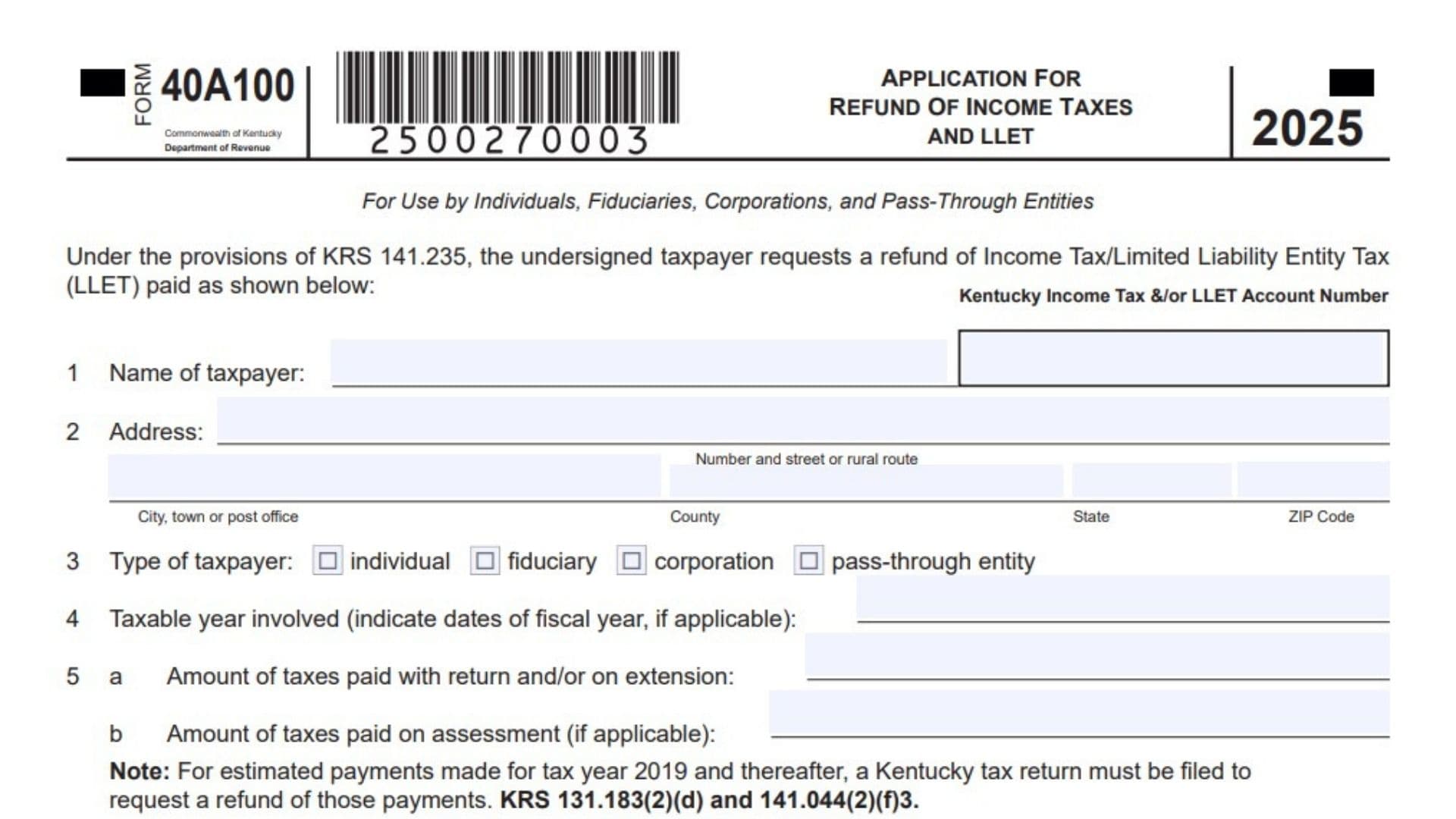
Kentucky Form 40A100 is an application used to request a refund of Kentucky income tax or Limited Liability Entity Tax when a taxpayer believes too much tax was paid and a regular return is not the method being used to recover that amount. It is available for individuals, fiduciaries, corporations, and pass-through entities, and it serves as a formal written refund claim to the Kentucky Department of Revenue. This form is not a general tax return. Instead, it is a separate refund application that asks for the taxpayer’s identity, the tax year involved, the amount paid, the amount being requested back, and a written explanation showing why the refund should be allowed. It is especially important to complete the explanation carefully, because this is the section that tells the state why the payment was incorrect, excessive, or no longer due. In short, Form 40A100 is the Kentucky refund claim form used when you need to ask the state to return income tax or LLET already paid.
When To Use It
You may use this form when you paid Kentucky income tax or LLET and believe the amount paid was more than what should have been due. This can happen because of an error in payment, a correction to tax liability, a payment applied to the wrong circumstances, or another reason that supports a refund claim.
However, if the issue involves estimated payments for tax years 2019 and later, a Kentucky tax return must generally be filed to request that refund rather than using this application by itself. That means this form should be used carefully and only when it fits the type of refund claim being made.

How To Complete Kentucky Form 40A100
Line 1: Enter the full name of the taxpayer requesting the refund.
Line 2: Enter the taxpayer’s complete address, including street or rural route, city, county, state, and ZIP code.
Line 3: Check the box showing the type of taxpayer. Choose the category that matches the applicant, such as individual, fiduciary, corporation, or pass-through entity.
Line 4: Enter the taxable year involved in the refund request. If the taxpayer uses a fiscal year instead of a calendar year, include the beginning and ending dates of that fiscal year.
Line 5a: Enter the amount of tax paid with the return and any amount paid with an extension, if applicable.
Line 5b: Enter the amount of tax paid on assessment, if applicable. If no assessed payment was made, leave this line blank or enter zero if appropriate.
Line 6: Enter the date or dates the payments were made.
Line 7: Enter the validation number printed by the department on each check used to make the payment, if payment was made by check. If there was more than one payment, list each payment date and its matching validation number separately.
Line 8: Enter the amount of refund being requested.
Line 9: Explain clearly why the refund is being requested. This is one of the most important parts of the form, so write a full but concise explanation. If more space is needed, attach a separate schedule.
Kentucky Income Tax Or LLET Account Number: Enter the taxpayer’s Kentucky account number in the space provided.
Signature Of Taxpayer Or Authorized Person: The taxpayer or authorized representative must sign and date the application.
Spouse’s Signature: If the tax was paid on a joint return, the spouse should also sign and date the form.
Corporate Officer Signature: If the applicant is a corporation, the principal officer or chief accounting officer should sign and date the form.
Preparer Signature: If someone other than the taxpayer prepared the application, that preparer should sign and include the firm or employer name.
How To File It
Before filing, make sure the form is fully completed and the refund explanation is strong enough to show why the state should issue the refund. If supporting schedules or documentation are needed, attach them to the application. Then sign the form in all required places and send it to the Kentucky Department of Revenue at the address shown on the form.
What To Include With The Form
You should include any schedule or statement that helps support the refund claim. For example, if the reason for the refund involves an incorrect payment amount, duplicate payment, or revised liability, attach documents that help explain that situation clearly. The stronger the written support, the easier it is for the state to review the request.
Tips For Writing Line 9
Line 9 is where many refund claims succeed or fail, so it should be written carefully.
A good explanation usually includes:
- What tax was paid.
- Why the payment was too high or not due.
- How the correct amount was determined.
- Why the taxpayer is entitled to the refund requested.
- A reference to any attached schedules or supporting documents.
For example, instead of writing “overpaid taxes,” it is better to write something more specific, such as that the taxpayer paid Kentucky income tax with an extension, later determined no tax was due for that year, and is requesting a refund of the excess payment.
Common Mistakes To Avoid
- Using the form for estimated payments that must be claimed through a Kentucky tax return.
- Leaving Line 9 too vague.
- Forgetting to include payment dates.
- Omitting validation numbers for check payments.
- Failing to sign the form.
- Not identifying the correct taxable year.
- Requesting a refund amount without explaining how it was calculated.
Simple Filing Checklist
- Enter the taxpayer name and address.
- Check the correct taxpayer type.
- Enter the correct tax year.
- List all relevant payment amounts.
- Enter payment dates.
- Add check validation numbers if applicable.
- State the exact refund amount requested.
- Write a clear explanation of the claim.
- Sign and date the form.
- Attach supporting schedules if needed.
- Mail the completed application to the Kentucky Department of Revenue.