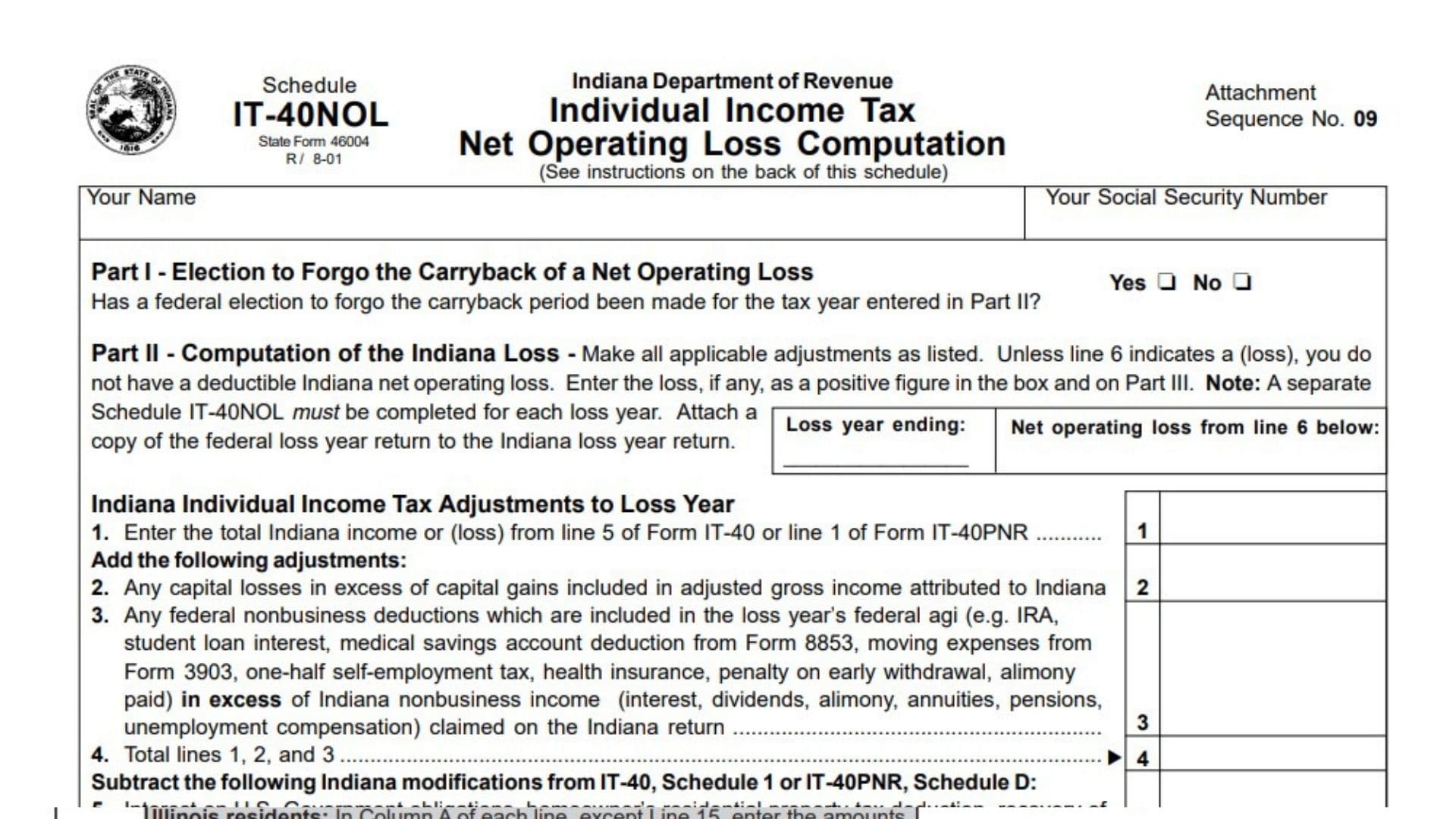
Indiana Schedule IT-40NOL, officially known as the Net Operating Loss Computation Schedule, is a tax form used by individual taxpayers to calculate and report net operating losses (NOLs) for Indiana income tax purposes. Issued by the Indiana Department of Revenue, this schedule helps taxpayers determine the amount of an eligible loss that can be applied against income from other tax years. It accounts for differences between federal and Indiana income tax calculations by requiring specific adjustments to the taxpayer’s income, deductions, and state modifications. The schedule collects information about the taxpayer, the year in which the loss occurred, the election to waive the federal carryback period, and the calculations needed to determine the Indiana net operating loss. It also provides a recordkeeping section for tracking how much of the loss is applied to previous or future tax years, how much remains unused, and how the deduction affects Indiana adjusted gross income. Taxpayers who want to claim an Indiana net operating loss deduction must complete this schedule and attach it to the applicable Indiana income tax return. A separate Schedule IT-40NOL is required for each year in which a net operating loss occurs. Completing the schedule correctly is important because Indiana net operating loss calculations may differ from federal calculations, and taxpayers must account for the applicable state adjustments and carryback or carryforward rules. The schedule itself is not a refund claim; instead, it provides the calculations supporting the net operating loss deduction reported on the relevant Indiana tax return.
How To File Indiana Schedule IT-40NOL
Schedule IT-40NOL must be attached to the applicable Indiana income tax return when an individual taxpayer wants to claim a net operating loss deduction.
The filing instructions identify the following Indiana returns:
- Form IT-40: Indiana Individual Income Tax Return.
- Form IT-40P: Indiana individual income tax return identified in the schedule instructions.
- Form IT-40PNR: Indiana Part-Year or Nonresident Individual Income Tax Return.
- Form IT-40X: Indiana Amended Individual Income Tax Return.
- Form IT-41: Indiana Fiduciary Income Tax Return.
Taxpayers should prepare the following information before completing the schedule:
- Full name and Social Security number.
- The Indiana income or loss reported on the applicable original loss-year return.
- Federal adjusted gross income information.
- Capital gains and capital losses attributed to Indiana.
- Federal nonbusiness deductions and Indiana nonbusiness income.
- Applicable Indiana income tax modifications.
- Information about any federal election to waive the NOL carryback period.
- Records of previous NOL carrybacks or carryforwards.
- Original or previously adjusted Indiana adjusted gross income for each year in which the loss deduction is claimed.
Attach the Federal Loss-Year Return
The schedule instructions require taxpayers to attach a copy of the federal income tax return for the loss year to the Indiana return for that loss year.
Complete a Separate Schedule for Each Loss Year
A separate Schedule IT-40NOL must be prepared for every tax year in which a net operating loss occurs. If the loss is used in more than one tax year, separate schedules must also be completed for the applicable utilization years.
Attach the Schedule to Returns Claiming the Deduction
Copies of the completed Schedule IT-40NOL must accompany the Indiana tax returns for every year in which the NOL deduction is claimed.
NOL Carryback Filing Deadline
The instructions state that a net operating loss carryback claim must generally be filed within three years from the original due date of the loss-year return, including extensions.
For example, the instructions describe a 2001 loss-year return filed under extension on June 17, 2002. A refund claim for 1999 based on that loss must be filed no later than June 15, 2005.
Net operating loss carryforward deductions are subject to the applicable statutory filing requirements.

How To Complete Indiana Schedule IT-40NOL
Schedule IT-40NOL contains three main parts:
- Part I: Election to Forgo the Carryback of a Net Operating Loss.
- Part II: Computation of the Indiana Loss.
- Part III: Record of Utilization of Net Operating Loss Deduction for Indiana.
Each part serves a different purpose. Part I identifies whether the taxpayer elected to waive the carryback period for federal tax purposes. Part II calculates the Indiana-specific net operating loss. Part III tracks how the loss is applied to previous or future tax years.
Taxpayer Identification Information
Complete the identification fields at the top of the schedule before proceeding to the calculations.
Your Name
Enter your full name as it appears on your Indiana income tax return for the year in which the net operating loss occurred.
Your Social Security Number
Enter your Social Security number in the designated field. Make sure it matches the identifying information reported on the associated Indiana tax return.
Part I: Election to Forgo the Carryback of a Net Operating Loss
Part I determines whether you made a federal election to waive the carryback period for the net operating loss.
Under the instructions, a taxpayer may elect to forgo the entire carryback period. If this election is made, the NOL can only be carried forward, subject to the applicable rules.
Election to Forgo the Carryback Period
Answer the question by selecting either Yes or No.
- Yes: Select this option if you made a federal election to waive the NOL carryback period for the tax year entered in Part II.
- No: Select this option if you did not make that federal election.
The election must be made by the due date of the loss-year return, including extensions. The instructions state that the taxpayer must use the same carryback or carryforward treatment for Indiana tax purposes as elected for federal tax purposes.
Once made, the election is irrevocable.
If you have no federal net operating loss but elect to forgo the Indiana carryback provision, the instructions require a statement to be attached to the Indiana loss-year return.
Part II: Computation of the Indiana Loss
Part II calculates the Indiana net operating loss after applying the required state-specific adjustments.
This section is important because the Indiana NOL may differ from the federal NOL. Taxpayers must account for Indiana income, capital losses, federal nonbusiness deductions, and specified Indiana modifications.
A separate Schedule IT-40NOL must be completed for each loss year.
The schedule instructs taxpayers to enter the loss as a positive figure in the designated box and carry it to Part III. If the final calculation on Line 6 does not produce a loss, there is no deductible Indiana net operating loss to report.
Loss Year Ending
Enter the ending date of the tax year in which the net operating loss occurred.
This identifies the specific tax year associated with the NOL calculation. A separate schedule is required for each loss year.
Net Operating Loss From Line 6 Below
Enter the Indiana net operating loss calculated on Line 6.
If Line 6 shows a deductible loss, enter the amount as a positive figure in this box and use it when completing Part III.
Indiana Individual Income Tax Adjustments to Loss Year
This section contains Lines 1 through 6. Follow the calculations in order because each line contributes to determining the final Indiana net operating loss.
Line 1: Total Indiana Income or Loss
Enter the total Indiana income or loss reported on the applicable original Indiana income tax return.
Use:
- Line 5 of Form IT-40, or
- Line 1 of Form IT-40PNR.
Enter the amount attributable to Indiana for the loss year.
The schedule instructions explain that certain federal adjustments should already be included in this amount. These include tax addbacks from federal Schedules C, E, and F, net operating loss addbacks from federal Form 1040, and the ordinary income and capital gain portion of a lump-sum distribution.
Line 2: Excess Capital Losses
Add back any capital losses that exceed capital gains and were included in adjusted gross income attributable to Indiana.
This adjustment accounts for capital losses that exceed the capital gains reported for Indiana income tax purposes.
Enter the applicable excess capital loss amount on Line 2.
Line 3: Excess Federal Nonbusiness Deductions
Add back certain federal nonbusiness deductions included in the loss year’s federal adjusted gross income when those deductions exceed the nonbusiness income reported on the Indiana return.
Examples of federal nonbusiness deductions include:
- Individual Retirement Account (IRA) deductions.
- Student loan interest deductions.
- Medical savings account deductions from Form 8853.
- Moving expenses from Form 3903.
- One-half of self-employment tax.
- Health insurance deductions.
- Penalties on early withdrawal.
- Alimony paid.
Compare these deductions with the Indiana nonbusiness income claimed on the state return.
Examples of Indiana nonbusiness income include:
- Interest.
- Dividends.
- Alimony received.
- Annuities.
- Pensions.
- Unemployment compensation.
Enter the applicable excess federal nonbusiness deduction amount on Line 3.
The adjustment reflects the amount by which the qualifying federal nonbusiness deductions exceed the nonbusiness income reported for Indiana purposes.
Line 4: Total Adjusted Indiana Income or Loss
Add the amounts reported on Lines 1, 2, and 3.
The calculation is:
Line 1 + Line 2 + Line 3 = Line 4.
Enter the combined amount on Line 4.
This figure represents the Indiana income or loss after adding back the specified capital losses and federal nonbusiness deductions.
Line 5: Indiana Modifications to Be Subtracted
Subtract the applicable Indiana modifications from the amount calculated on Line 4.
The schedule identifies the following modifications from Form IT-40, Schedule 1, or Form IT-40PNR, Schedule D:
- Interest on U.S. Government obligations.
- Homeowner’s residential property tax deduction.
- Recovery of itemized deductions.
- Taxable Social Security benefits.
- Taxable railroad retirement benefits.
- Non-Indiana locality earnings deduction.
- Human services deduction.
- Indiana partnership long-term care policy premiums deduction.
- Holocaust victim’s settlement payment deduction.
Enter the applicable combined amount of these modifications on Line 5.
These adjustments reduce the amount calculated on Line 4 when determining the Indiana net operating loss.
Line 6: Indiana Net Operating Loss
Calculate the final Indiana net operating loss by subtracting Line 5 from Line 4.
The calculation is:
Line 4 − Line 5 = Line 6.
Enter the resulting amount on Line 6.
If the result represents a deductible Indiana loss, enter the amount as a positive figure in the designated net operating loss box near the top of Part II.
Carry the applicable loss amount to Part III, Column 3, following the instructions for applying the loss to previous or future tax years.
If Line 6 does not indicate a loss, you do not have a deductible Indiana net operating loss under this schedule.
Part III: Record of Utilization of Net Operating Loss Deduction for Indiana
Part III tracks how an Indiana net operating loss is applied across different tax years.
This section records the tax year to which the loss is carried, the Indiana adjusted gross income before the NOL deduction, the amount of the loss used, the adjusted income after applying the deduction, and the remaining unused loss.
The table includes five columns and provides spaces for preceding and following tax years.
A separate Schedule IT-40NOL must be completed for each loss year. If the loss deduction is used across multiple years, the applicable schedules must be attached to the corresponding Indiana returns.
Understanding the Five Columns
Column 1: Tax Year to Which the Loss Is Carried
Enter the ending date of each applicable tax year to which the net operating loss is carried.
Include every applicable preceding or following tax year.
The instructions require an entry on each line, even if the taxpayer incurred another loss in that year or the Indiana adjusted gross income was previously reduced to zero by another NOL deduction.
In those situations, all five columns must still be completed.
Column 2: Indiana Adjusted Gross Income Before the Current NOL Deduction
Enter the Indiana adjusted gross income for the applicable year before exemptions and before calculating the current net operating loss deduction.
Use the amount from the original tax return or the amount as previously adjusted.
If the adjusted gross income was previously changed because of another NOL deduction, attach a copy of the Schedule IT-40NOL for the earlier loss year.
If the amount was changed through an audit or amended return, attach an explanation showing how the adjusted gross income figure was calculated.
Column 3: Amount of Net Operating Loss Deduction Carried Back or Forward
Enter the portion of the available net operating loss being applied to the applicable tax year.
The amount depends on the relationship between the available loss and the Indiana adjusted gross income reported in Column 2.
If the available loss is less than the adjusted gross income in Column 2, enter the entire available loss.
If the available loss exceeds the adjusted gross income in Column 2, enter only the amount needed to reduce the adjusted gross income to zero in Column 4.
Any unused loss must be reported in Column 5 and carried to the next applicable year.
The amount entered in Column 3 must also be transferred to the Indiana deductions schedule on the current-year tax return.
Column 4: Indiana Adjusted Gross Income After the NOL Deduction
Subtract the amount in Column 3 from the amount in Column 2.
The calculation is:
Column 2 − Column 3 = Column 4.
Enter the resulting Indiana adjusted gross income after applying the net operating loss deduction.
This amount cannot be less than zero.
The instructions also clarify that exemptions are deducted separately on the income tax return when calculating taxable income.
Column 5: Remaining Unused Net Operating Loss
Enter the portion of the net operating loss that remains after applying the deduction for the applicable year.
If the entire available loss has been used, enter zero.
If part of the loss remains unused, report that amount in Column 5.
The remaining amount becomes the available net operating loss for Column 3 of the following applicable year.
Preceding Tax Years
The first section of Part III provides spaces for applying the net operating loss to preceding tax years.
The schedule includes the following five entries:
5th Preceding Tax Year
Enter the applicable tax year ending date and complete all five columns if this year falls within the permitted carryback period.
4th Preceding Tax Year
Enter the ending date of the fourth preceding tax year and report the applicable adjusted gross income, NOL deduction, adjusted income, and remaining loss.
3rd Preceding Tax Year
Enter the third preceding tax year when applicable under the relevant carryback rules.
The schedule notes that, generally, for loss years beginning after August 5, 1997, the third preceding tax year carryback application is eliminated.
2nd Preceding Tax Year
Enter the second preceding tax year when the applicable NOL carryback rules permit the loss to be applied to that year.
1st Preceding Tax Year
Enter the immediately preceding tax year when the loss is eligible for carryback treatment.
For each applicable year, complete Columns 1 through 5 to show the loss utilization and any remaining unused amount.
Following Tax Years
The next section of Part III provides spaces for tracking the remaining loss as it is carried into future tax years.
The schedule includes the following entries:
1st Following Tax Year
Enter the first tax year following the loss year. Report the adjusted gross income, available NOL deduction, adjusted income after the deduction, and any remaining unused loss.
2nd Following Tax Year
Enter the second following tax year and calculate the amount of the remaining loss that can be applied to that year.
3rd Following Tax Year
Report the third following tax year and complete the five-column calculation using the available carryforward amount.
4th Following Tax Year
Enter the fourth following tax year and report the applicable income and loss deduction information.
5th Following Tax Year
Enter the fifth following tax year and determine how much of the available NOL can be applied.
6th Following Tax Year
Report the sixth following tax year and carry forward any remaining unused loss.
7th Following Tax Year
Enter the seventh following tax year and complete the applicable calculations.
8th Following Tax Year
Report the eighth following tax year, including the available loss deduction and remaining unused amount.
9th Following Tax Year
Enter the ninth following tax year and determine the amount of the NOL applied against Indiana adjusted gross income.
10th Following Tax Year
Enter the tenth following tax year and report the applicable NOL utilization figures.
11th Following Tax Year
Use this final row when the applicable carryforward rules permit the loss to be used in the eleventh following tax year.
The schedule directs taxpayers to consult the carryback and carryforward instructions to determine the applicable utilization period.
Additional Sheets
If the available rows in Part III are insufficient to record all required NOL utilization years, attach additional sheets.
Ensure that the additional information follows the same five-column format so the entire loss utilization history can be reviewed.
Indiana Net Operating Loss Carryback and Carryforward Rules
The instructions explain that Indiana net operating losses must generally be used in accordance with Section 172 of the Internal Revenue Code, subject to the applicable Indiana requirements.
The permitted carryback and carryforward periods depend on when the loss year began.
Loss Years Beginning on or Before August 5, 1997
For an NOL occurring in a tax year beginning on or before August 5, 1997, the instructions provide the following periods:
- Carryback: Up to three preceding tax years.
- Carryforward: Up to 15 following tax years.
Loss Years Beginning After August 5, 1997
For an NOL occurring in a tax year beginning after August 5, 1997, the instructions provide the following periods:
- Carryback: Up to two preceding tax years.
- Carryforward: Up to 20 following tax years.
The schedule’s Part III table provides spaces through the eleventh following tax year and directs taxpayers to the instructions for the remaining applicable carryforward years.
Special Carryback Treatment for Certain Losses
The instructions identify exceptions for certain types of losses.
Casualty and Theft Losses
The portion of an NOL attributable to casualty and theft losses may still be carried back three years under the applicable provisions described in the instructions.
Farm and Small Business Losses From Federally Declared Disasters
Certain farm and small business losses attributable to disasters declared by the President may also qualify for a three-year carryback.
Farm Losses
For tax years beginning after December 31, 1997, the instructions state that an NOL attributable to farming operations may be treated as a separate net operating loss.
This farm-related loss may be carried back five years under the federal provisions described in the instructions.
Taxpayers should determine whether a particular loss qualifies for any of these special treatments before completing the carryback and carryforward calculations.
Indiana Net Operating Loss Election Requirements
Taxpayers may elect to waive the entire NOL carryback period under the federal election provisions described in the schedule instructions.
When this election is made:
- The NOL is carried forward rather than backward.
- The election must be made by the due date of the loss-year return, including extensions.
- The same carryback or carryforward treatment elected for federal purposes must be used for Indiana tax purposes.
- The election is irrevocable.
The election must be reported in Part I of Schedule IT-40NOL.
If there is no federal net operating loss but the taxpayer elects to waive the Indiana carryback provision, a separate statement must accompany the Indiana loss-year return.
Indiana Net Operating Loss Calculation Requirements
The instructions also explain that Indiana NOL calculations must follow the computation method established by the schedule for tax years beginning after December 31, 1986.
Carryovers from earlier loss years must be adjusted to comply with the applicable Indiana calculation requirements.
The resulting Indiana net operating loss may then be used as a deduction against Indiana net taxable income, subject to the applicable carryback and carryforward rules.
It is important to distinguish the Indiana NOL from the federal NOL because state-specific modifications may change the amount available for deduction.
Final Review Before Filing
Before attaching Schedule IT-40NOL to your Indiana income tax return, review the following checklist to ensure that all required calculations and supporting information are complete.
- Enter your full name.
- Provide your correct Social Security number.
- Complete Part I and indicate whether you elected to forgo the federal NOL carryback period.
- Enter the ending date of the loss year in Part II.
- Report the Indiana income or loss from Form IT-40, Line 5, or Form IT-40PNR, Line 1, on Line 1.
- Include applicable excess capital losses on Line 2.
- Add the applicable excess federal nonbusiness deductions on Line 3.
- Add Lines 1, 2, and 3 to calculate Line 4.
- Subtract the applicable Indiana modifications on Line 5.
- Calculate the Indiana net operating loss on Line 6.
- Enter the deductible loss as a positive amount in the designated box.
- Complete Part III to record the applicable carryback or carryforward years.
- Enter the correct tax year ending dates in Column 1.
- Verify the Indiana adjusted gross income figures reported in Column 2.
- Calculate the applicable NOL deduction for each year in Column 3.
- Confirm that Column 4 does not contain a negative amount.
- Record the remaining unused NOL in Column 5.
- Carry forward any remaining unused loss to the next applicable year.
- Review the applicable carryback and carryforward periods.
- Attach explanations for adjusted gross income figures changed through an audit or amended return, when applicable.
- Attach prior Schedule IT-40NOL calculations when previously adjusted income requires them.
- Attach additional sheets if the Part III table does not provide enough space.
- Attach a copy of the federal loss-year income tax return to the Indiana loss-year return.
- Attach the completed Schedule IT-40NOL to every Indiana return on which the NOL deduction is claimed.
Indiana Schedule IT-40NOL provides a structured method for calculating and tracking net operating losses under Indiana income tax rules. By completing the required state adjustments, applying the appropriate carryback or carryforward treatment, and maintaining accurate utilization records, taxpayers can properly document the Indiana NOL deduction claimed on their tax returns. Review the loss-year calculations and supporting schedules carefully before filing to ensure that the reported deduction and remaining unused loss are accurate.