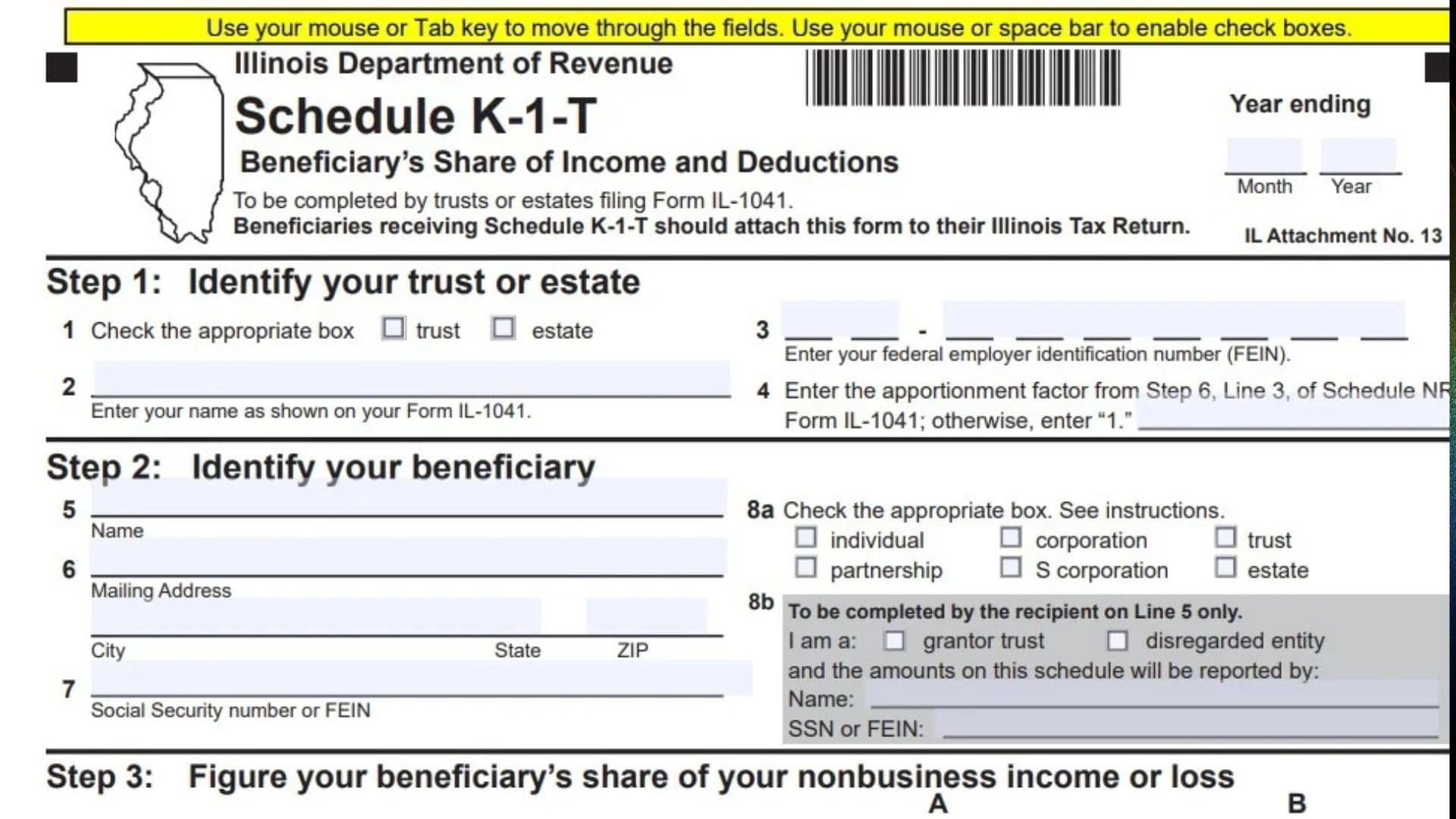
Illinois Schedule K-1-T, Beneficiary’s Share of Income and Deductions, is a tax schedule issued by the Illinois Department of Revenue. It is used by trusts and estates filing Form IL-1041 to report each beneficiary’s share of income, deductions, additions, subtractions, tax credits, and other tax-related information. The schedule provides beneficiaries with the information they need to correctly report their share of the trust or estate’s taxable income and other applicable amounts on their Illinois income tax returns.
The form identifies the trust or estate distributing the income and the beneficiary receiving it. It also reports the beneficiary’s share of different income categories, including interest, dividends, rental income, royalties, capital gains, business income, and other income or expenses. Additional sections report Illinois-specific tax additions and subtractions, appreciation amounts, pass-through withholding, pass-through entity tax credits, and certain income subject to surcharges.
Schedule K-1-T contains seven steps. Each step serves a different reporting purpose. Step 1 identifies the trust or estate, while Step 2 identifies the beneficiary. Steps 3 and 4 report the beneficiary’s share of nonbusiness and business income or loss. Step 5 reports Illinois additions and subtractions, and Step 6 addresses certain appreciation amounts. Step 7 reports pass-through withholding, pass-through entity tax credits, and federal income subject to specific Illinois surcharges.
The trust or estate generally prepares Schedule K-1-T and provides a separate schedule to each beneficiary. Beneficiaries receiving this form should attach it to their Illinois income tax returns and use the reported information when completing their tax filings. The form is an important reporting document because the income and deductions allocated to a beneficiary may affect their Illinois taxable income, available tax credits, withholding, and overall tax liability.
Completing the schedule accurately is important because the amounts reported must reflect the beneficiary’s correct share of the trust or estate’s income and deductions. The schedule also distinguishes between the beneficiary’s total share and the portion attributable to Illinois. Beneficiaries should carefully review both columns and follow the applicable Illinois reporting instructions before transferring amounts to their individual tax returns.
Who Must Complete and Receive Schedule K-1-T?
Schedule K-1-T is prepared by trusts or estates that file Form IL-1041 with the Illinois Department of Revenue.
The form is used to report the income, deductions, and other tax-related amounts allocated to individual beneficiaries. Each beneficiary should receive the schedule containing their allocated information.
The responsibilities are different for the trust or estate and the beneficiary:
- Trusts and estates: Prepare Schedule K-1-T, calculate the beneficiary’s share of applicable amounts, and provide the completed schedule to the beneficiary.
- Beneficiaries: Review the information received, use the applicable amounts when preparing their Illinois income tax returns, and attach the schedule to their Illinois returns.
The form includes reporting categories for individuals, corporations, trusts, partnerships, S corporations, and estates.
How To File Illinois Schedule K-1-T
Schedule K-1-T is prepared as part of the Illinois Form IL-1041 filing process. It is not a standalone income tax return.
The trust or estate completes the schedule and provides it to the appropriate beneficiary. The beneficiary then uses the information to prepare their Illinois income tax return.
Where To Submit Schedule K-1-T
The trust or estate must complete Schedule K-1-T as part of its Form IL-1041 filing.
Beneficiaries receiving Schedule K-1-T should attach it to their Illinois income tax returns.
The schedule identifies itself as Illinois Attachment No. 13.
Information To Prepare Before Completing Schedule K-1-T
Trusts and estates should gather the following information before preparing the schedule:
- The trust or estate’s legal name.
- The trust or estate’s federal employer identification number (FEIN).
- The tax year-end month and year.
- The applicable apportionment factor from Schedule NR of Form IL-1041, if required.
- Each beneficiary’s full name and mailing address.
- Each beneficiary’s Social Security number or FEIN.
- The beneficiary’s tax classification.
- Federal Schedule K-1 information.
- Income and expense allocation records.
- Illinois business and nonbusiness income information.
- Illinois Schedule M additions and subtractions.
- Illinois Schedule F appreciation information.
- Pass-through withholding information.
- Pass-through entity tax credit information.
- Information about income subject to applicable Illinois surcharges.
Beneficiaries should also have their completed Schedule K-1-T and the applicable Schedule K-1-T(2) instructions available when preparing their Illinois income tax returns.

How To Complete Illinois Schedule K-1-T
Schedule K-1-T contains seven steps covering identification details, income allocations, Illinois adjustments, appreciation amounts, and tax-related credits or withholding.
Complete each step using the trust or estate’s tax records and the applicable Illinois instructions.
Step 1: Identify Your Trust or Estate
Step 1 identifies the trust or estate responsible for preparing Schedule K-1-T. The information entered here helps connect the beneficiary’s schedule to the correct Form IL-1041 filing.
Year Ending – Month and Year
Enter the month and year in which the trust or estate’s tax year ends.
Use the applicable tax year-end information from the Form IL-1041 filing.
Line 1: Trust or Estate
Check the appropriate box to identify the entity preparing the schedule.
Select:
- Trust, if the schedule is being prepared by a trust.
- Estate, if the schedule is being prepared by an estate.
Select only the box that correctly identifies the entity.
Line 2: Name of Trust or Estate
Enter the legal name of the trust or estate exactly as it appears on Form IL-1041.
Make sure the name matches the corresponding income tax filing to avoid identification errors.
Line 3: Federal Employer Identification Number (FEIN)
Enter the federal employer identification number assigned to the trust or estate.
Use the FEIN associated with the Form IL-1041 filing. Do not enter the beneficiary’s Social Security number in this field.
Line 4: Apportionment Factor
Enter the apportionment factor reported on Step 6, Line 3, of Schedule NR attached to Form IL-1041.
If the trust or estate is not required to use Schedule NR, enter 1 instead.
Check the applicable Schedule NR information before entering this amount.
Step 2: Identify Your Beneficiary
Step 2 identifies the person or entity receiving the income and deductions reported on Schedule K-1-T.
Complete the beneficiary’s information carefully because it determines who is responsible for reporting the allocated amounts.
Line 5: Beneficiary’s Name
Enter the full legal name of the beneficiary receiving the schedule.
The name should identify the individual or entity that is entitled to receive the reported income and deductions.
Line 6: Mailing Address
Enter the beneficiary’s complete mailing address.
Include the following information:
- Street address.
- City.
- State.
- ZIP code.
Use the beneficiary’s current mailing address to help ensure that tax documents are delivered correctly.
Line 7: Social Security Number or FEIN
Enter the beneficiary’s identification number.
Use the Social Security number (SSN) for an individual beneficiary or the federal employer identification number (FEIN) for an entity beneficiary, as applicable.
Verify that the number matches the beneficiary’s tax records.
Line 8a: Beneficiary’s Entity Classification
Check the box that identifies the beneficiary’s legal or tax classification.
The available options are:
- Individual.
- Corporation.
- Trust.
- Partnership.
- S corporation.
- Estate.
Select the classification that applies to the beneficiary identified on Line 5.
Line 8b: Grantor Trust or Disregarded Entity Reporting Information
This section is completed by the recipient identified on Line 5 only when the applicable grantor trust or disregarded entity reporting arrangement applies.
The recipient should review the two available options:
- Grantor trust.
- Disregarded entity.
If applicable, identify which person or entity will report the amounts shown on Schedule K-1-T.
Name
Enter the name of the person or entity responsible for reporting the amounts shown on the schedule.
SSN or FEIN
Enter the Social Security number or federal employer identification number of the person or entity that will report the amounts.
This information identifies the actual taxpayer responsible for including the reported amounts on the appropriate tax return.
Step 3 reports the beneficiary’s allocated share of nonbusiness income or loss.
Nonbusiness income generally refers to income that is not treated as business income for Illinois allocation purposes. The schedule provides two columns to distinguish between the beneficiary’s overall share and the portion attributable to Illinois.
Column A: Beneficiary’s Share
Enter the beneficiary’s allocated share of each nonbusiness income or loss category.
Use the applicable trust or estate accounting records and tax allocation information.
Column B: Illinois Share
Enter the portion of the beneficiary’s income or loss that is attributable to Illinois.
Use the applicable Illinois sourcing and allocation rules to determine the correct amount.
Line 9: Interest
Enter the beneficiary’s allocated share of interest income.
Include the applicable interest income reported by the trust or estate and determine the portion attributable to Illinois.
Report the beneficiary’s share in Column A and the Illinois portion in Column B.
Line 10: Dividends
Enter the beneficiary’s allocated share of dividend income.
Use the trust or estate’s tax records to determine the amount attributable to the beneficiary.
Report the corresponding Illinois share in Column B.
Line 11: Rental Income
Enter the beneficiary’s share of nonbusiness rental income.
Use the applicable rental income records to determine the amount allocated to the beneficiary and the portion attributable to Illinois.
Line 12: Patent Royalties
Enter the beneficiary’s allocated share of patent royalty income.
Report the applicable income received from patent-related royalty arrangements and determine the corresponding Illinois share.
Line 13: Copyright Royalties
Enter the beneficiary’s share of income from copyright royalties.
Use the trust or estate’s income allocation records to determine the amount attributable to the beneficiary.
Report the Illinois portion separately in Column B.
Line 14: Other Royalty Income
Enter the beneficiary’s share of royalty income that is not included in the patent or copyright royalty categories.
Use this line for other applicable royalty income and report the corresponding Illinois share.
Line 15: Capital Gain or Loss From Real Property
Enter the beneficiary’s share of capital gain or loss resulting from the sale or disposition of real property.
Use the applicable tax records to determine the allocated gain or loss.
Report the amount in Column A and the Illinois portion in Column B.
Line 16: Capital Gain or Loss From Tangible Personal Property
Enter the beneficiary’s share of capital gain or loss from tangible personal property.
Tangible personal property refers to physical property other than real estate.
Use the trust or estate’s tax records to determine the beneficiary’s allocated amount and the applicable Illinois share.
Line 17: Capital Gain or Loss From Intangible Personal Property
Enter the beneficiary’s share of capital gain or loss from intangible personal property.
This category covers applicable gains or losses involving property that does not have a physical form.
Determine the beneficiary’s allocated amount and the corresponding Illinois portion.
Line 18: Other Income and Expense
Enter the beneficiary’s share of other nonbusiness income or expenses that are not specifically listed on Lines 9 through 17.
Specify
Describe the type of income or expense being reported.
Use a clear description so the beneficiary can understand what the amount represents.
Report the beneficiary’s share in Column A and the applicable Illinois share in Column B.
Step 4 reports the beneficiary’s share of business income or loss.
This section uses information from the beneficiary’s federal Schedule K-1 and distinguishes business income from nonbusiness income.
The schedule provides two columns:
- Column A: Beneficiary’s share from federal Schedule K-1, after excluding nonbusiness income and accounting for the applicable directly apportioned deductions.
- Column B: Illinois share of the reported amount.
Use the applicable federal and Illinois tax records when completing these calculations.
Line 19: Interest
Enter the beneficiary’s share of interest income classified as business income.
Use the applicable federal Schedule K-1 information after excluding amounts treated as nonbusiness income.
Report the corresponding Illinois share in Column B.
Line 20: Dividends
Enter the beneficiary’s share of dividends classified as business income.
Use the applicable federal Schedule K-1 information to determine the amount allocated to the beneficiary.
Report the Illinois portion separately.
Line 21: Net Short-Term Capital Gain or Loss
Enter the beneficiary’s share of net short-term capital gain or loss associated with business income.
Use the applicable federal Schedule K-1 information and the Illinois allocation rules to determine the amount.
Line 22: Net Long-Term Capital Gain or Loss (Total for Year)
Enter the beneficiary’s total allocated net long-term capital gain or loss for the year that belongs in the business income section.
Use the applicable federal Schedule K-1 information after accounting for nonbusiness income.
Report the corresponding Illinois share in Column B.
Line 23: Annuities, Royalties, and Other Nonpassive Income or Loss Before Directly Apportioned Deductions
Enter the beneficiary’s allocated amount of annuities, royalties, and other nonpassive income or loss before subtracting directly apportioned deductions.
Use the applicable federal Schedule K-1 information to determine the amount.
Do not subtract the directly apportioned depreciation, depletion, and amortization deductions here. Those amounts are reported separately on Line 24.
Line 24: Directly Apportioned Deductions – Depreciation, Depletion, and Amortization
Enter the beneficiary’s share of directly apportioned deductions related to annuities, royalties, and other nonpassive income or loss.
This line includes applicable depreciation, depletion, and amortization amounts.
Use the relevant tax records to determine the deductions directly associated with the income reported on Line 23.
Line 25: Total Annuities, Royalties, and Other Nonpassive Income or Loss
Calculate the total income or loss after subtracting the directly apportioned deductions reported on Line 24 from Line 23.
Use this formula:
Line 23 − Line 24 = Line 25
Enter the resulting amount in Column A.
Report the corresponding Illinois share in Column B.
Line 26: Trade or Business, Rental Real Estate, and Other Rental Income or Loss Before Directly Apportioned Deductions
Enter the beneficiary’s share of trade or business income or loss, rental real estate income or loss, and other rental income or loss before directly apportioned deductions.
Use the applicable federal Schedule K-1 information to determine the allocated amount.
Do not subtract the directly apportioned depreciation, depletion, and amortization deductions at this stage. Those deductions are reported separately on Line 27.
Line 27: Directly Apportioned Deductions – Depreciation, Depletion, and Amortization
Enter the beneficiary’s share of directly apportioned depreciation, depletion, and amortization deductions associated with the income reported on Line 26.
Use the applicable tax records to determine the correct deduction amount.
Line 28: Total Trade or Business, Rental Real Estate, and Other Rental Income or Loss
Calculate the total income or loss after subtracting the directly apportioned deductions reported on Line 27 from Line 26.
Use this formula:
Line 26 − Line 27 = Line 28
Enter the resulting amount in Column A.
Report the applicable Illinois share in Column B.
Line 29: Other Income and Expense
Enter the beneficiary’s share of other business income or expenses that are not specifically reported on Lines 19 through 28.
Specify
Describe the type of income or expense included on this line.
Use a clear description that identifies the nature of the reported amount.
Enter the beneficiary’s share in the appropriate reporting column and provide the corresponding Illinois share in Column B.
Step 5 reports Illinois-specific additions and subtractions allocated to the beneficiary.
These adjustments are important because Illinois taxable income may differ from federal taxable income.
The schedule contains two columns:
- Column A: Beneficiary’s share from Form IL-1041.
- Column B: Illinois share.
Important: Before using the information provided in Step 5, the beneficiary must read Schedule K-1-T(2). This additional schedule provides the instructions needed to correctly report the amounts in Columns A and B.
Additions
Additions are amounts that may need to be added when calculating Illinois income.
Line 30: Federally Tax-Exempt Interest Income
Enter the beneficiary’s allocated share of federally tax-exempt interest income.
Report the applicable amount from Form IL-1041 in Column A and the corresponding Illinois share in Column B.
Line 31: Illinois Taxes and Surcharge Deducted
Enter the beneficiary’s allocated share of Illinois taxes and surcharges that were deducted when calculating the applicable income.
Use the trust or estate’s tax records and the instructions for this line to determine the correct amount.
Line 32: Illinois Special Depreciation Addition
Enter the beneficiary’s allocated share of the Illinois special depreciation addition.
This line reports the applicable Illinois adjustment related to depreciation.
Use the amount determined from the trust or estate’s Form IL-1041 information.
Line 33: Related-Party Expenses Addition
Enter the beneficiary’s allocated share of any related-party expenses that must be added back for Illinois income tax purposes.
Use the applicable tax adjustment information to determine the correct amount.
Line 34: Distributive Share of Additions
Enter the beneficiary’s allocated distributive share of the additions reported by the trust or estate.
Use the applicable Form IL-1041 information and Schedule K-1-T(2) instructions to determine the amount.
Line 35: Other Additions From Illinois Schedule M (For Businesses)
Enter the beneficiary’s share of other applicable Illinois additions reported on Schedule M for businesses.
Use the trust or estate’s Illinois Schedule M information to determine the amount.
Include only additions that belong in this category and follow the applicable reporting instructions.
Subtractions
Subtractions are amounts that may be deducted when determining Illinois income.
Line 36a: Interest From U.S. Treasury Obligations Included as Business Income
Enter the beneficiary’s share of interest from U.S. Treasury obligations that was included in business income.
Use the applicable Form IL-1041 information to determine the amount.
Report the corresponding Illinois share in Column B.
Line 36b: Interest From U.S. Treasury Obligations Included as Nonbusiness Income
Enter the beneficiary’s share of interest from U.S. Treasury obligations that was included in nonbusiness income.
This line is separate from Line 36a because it covers interest classified as nonbusiness income.
Report the applicable beneficiary’s share and Illinois share.
Line 37: Payment From Certain Retirement Plans
Enter the beneficiary’s allocated share of qualifying payments from certain retirement plans.
Use the applicable trust or estate tax information and Schedule K-1-T(2) instructions to determine whether the payments belong in this category.
Line 38: Retirement Payments to Retired Partners
Enter the beneficiary’s share of qualifying retirement payments made to retired partners.
Use the applicable tax records to determine the amount allocated to the beneficiary.
Line 39: River Edge Redevelopment Zone Dividend Subtraction
Enter the beneficiary’s share of any qualifying River Edge Redevelopment Zone dividend subtraction.
Use the trust or estate’s tax records to identify the applicable amount.
Line 40: High Impact Business Within a Foreign Trade Zone Dividend Subtraction
Enter the beneficiary’s share of any qualifying dividend subtraction related to a high-impact business located within a foreign trade zone.
Verify the amount using the applicable Illinois tax information.
Line 41: Contributions to Certain Job Training Projects
Enter the beneficiary’s allocated share of qualifying contributions to certain job training projects.
Use the applicable trust or estate records and Illinois instructions to determine the reportable amount.
Line 42: Illinois Special Depreciation Subtraction
Enter the beneficiary’s allocated share of the Illinois special depreciation subtraction.
This line reports the applicable Illinois adjustment related to depreciation.
Use the trust or estate’s tax records to determine the correct amount.
Line 43: Related-Party Expenses Subtraction
Enter the beneficiary’s allocated share of any qualifying related-party expenses subtraction.
Use the applicable Illinois tax adjustments and supporting records to determine the amount.
Line 44: Distributive Share of Subtractions
Enter the beneficiary’s allocated distributive share of the subtractions reported by the trust or estate.
Use the applicable Form IL-1041 information and Schedule K-1-T(2) instructions to determine the correct amount.
Line 45: Other Subtractions From Illinois Schedule M (For Businesses)
Enter the beneficiary’s share of other applicable Illinois subtractions reported on Schedule M for businesses.
Use the trust or estate’s Illinois Schedule M information to identify the qualifying amount.
Do not include amounts already reported on the preceding subtraction lines.
Step 6 reports the beneficiary’s allocated share of certain appreciation amounts associated with Illinois assets as of August 1, 1969.
This section applies to beneficiaries other than corporate beneficiaries.
The schedule provides two columns:
- Column A: Beneficiary’s share from Illinois Schedule F attached to Form IL-1041.
- Column B: Illinois share.
Use the applicable Illinois Schedule F information to determine the amounts.
Line 46: Section 1245 and 1250 Gain
Enter the beneficiary’s allocated share of applicable Section 1245 and Section 1250 gains.
These amounts relate to gains associated with certain types of property and depreciation recapture.
Use the trust or estate’s Illinois Schedule F information to determine the amount allocated to the beneficiary.
Line 47: Section 1231 Gain
Enter the beneficiary’s share of applicable Section 1231 gain.
Use the amount reported on Illinois Schedule F and determine the corresponding Illinois share.
Line 48: Capital Gain
Enter the beneficiary’s allocated share of capital gain included in the Illinois August 1, 1969, appreciation calculation.
Use the applicable Illinois Schedule F information to determine the amount.
Corporate beneficiaries are excluded from this step.
Step 7 reports certain tax-related amounts allocated to the beneficiary.
These amounts include pass-through withholding, pass-through entity tax credits, and federal income associated with transactions subject to specific Illinois surcharges.
Complete each line using the applicable tax records and the instructions for the relevant item.
Line 49: Pass-Through Withholding Made on Behalf of Your Nonresident Beneficiary
Enter the amount of pass-through withholding made on behalf of the nonresident beneficiary.
This line reports withholding associated with the beneficiary’s share of income.
Review the applicable instructions before completing this line to determine the correct amount and reporting requirements.
Line 50: Pass-Through Entity (PTE) Tax Credit Received
Enter the beneficiary’s allocated share of any pass-through entity tax credit received by the trust or estate.
Use the applicable tax credit information to determine the amount available to the beneficiary.
This amount may be relevant when the beneficiary prepares their Illinois income tax return.
Line 51: Federal Income Attributable to Transactions Subject to the Compassionate Use of Medical Cannabis Program Act Surcharge
Enter the beneficiary’s allocated share of federal income attributable to transactions subject to the surcharge under the Compassionate Use of Medical Cannabis Program Act.
Use the trust or estate’s relevant income records to determine the amount.
Review the applicable instructions to ensure that only qualifying income is included.
Line 52: Federal Income Attributable to the Sale or Exchange of Assets by a Gaming Licensee Surcharge
Enter the beneficiary’s allocated share of federal income attributable to the sale or exchange of assets by a gaming licensee that is subject to the applicable Illinois surcharge.
Use the relevant trust or estate tax records to determine the amount.
Follow the applicable instructions to ensure that the reported amount relates to qualifying transactions.
Important Reporting Considerations for Schedule K-1-T
Several sections of Schedule K-1-T contain two reporting columns.
Column A generally reports the beneficiary’s allocated amount, while Column B reports the portion attributable to Illinois.
These amounts may not always be identical. The appropriate Illinois allocation and apportionment rules must be considered when calculating Column B.
Schedule K-1-T(2) Instructions
Schedule K-1-T recipients must read Schedule K-1-T(2) before using the information in Step 5.
This is particularly important for Illinois additions and subtractions because the recipient needs the additional reporting instructions to correctly transfer those amounts to their tax return.
Federal Schedule K-1 Information
Step 4 uses information from federal Schedule K-1, with nonbusiness income excluded from the applicable business income calculations.
Make sure the amounts used in Step 4 agree with the beneficiary’s federal Schedule K-1 and the trust or estate’s Illinois income allocation records.
Directly Apportioned Deductions
Lines 24 and 27 report directly apportioned depreciation, depletion, and amortization deductions.
These deductions must be subtracted from their corresponding income amounts when calculating Lines 25 and 28.
Corporate Beneficiary Exception
Step 6 specifically applies to beneficiaries other than corporate beneficiaries.
Corporate beneficiaries should not use the appreciation reporting section as if it applied to them.
Grantor Trusts and Disregarded Entities
Step 2, Line 8b, provides additional reporting information for applicable grantor trusts and disregarded entities.
The recipient identified on Line 5 must complete the applicable portion and identify the person or entity responsible for reporting the schedule’s amounts.
Final Review Before Filing
Before distributing or using Schedule K-1-T, review the following checklist to ensure that all required information is complete and accurate.
Step 1: Trust or Estate Information
- The correct tax year-ending month and year are entered.
- The appropriate trust or estate box is checked.
- The trust or estate name matches Form IL-1041.
- The correct FEIN is entered.
- The apportionment factor is entered correctly.
- A factor of 1 is entered when the applicable Schedule NR apportionment factor is not required.
Step 2: Beneficiary Information
- The beneficiary’s legal name is entered correctly.
- The complete mailing address is provided.
- The beneficiary’s SSN or FEIN is correct.
- The appropriate beneficiary classification is selected on Line 8a.
- The applicable grantor trust or disregarded entity information is completed on Line 8b.
Step 3: Nonbusiness Income or Loss
- Line 9 includes the appropriate interest income.
- Line 10 includes the appropriate dividend income.
- Line 11 includes rental income.
- Line 12 includes patent royalties.
- Line 13 includes copyright royalties.
- Line 14 includes other royalty income.
- Line 15 includes capital gains or losses from real property.
- Line 16 includes capital gains or losses from tangible personal property.
- Line 17 includes capital gains or losses from intangible personal property.
- Line 18 includes other applicable income or expenses and a description.
- Columns A and B are completed correctly.
Step 4: Business Income or Loss
- Line 19 includes business interest income.
- Line 20 includes business dividend income.
- Line 21 includes net short-term capital gain or loss.
- Line 22 includes net long-term capital gain or loss.
- Line 23 includes applicable annuities, royalties, and other nonpassive income or loss.
- Line 24 includes directly apportioned depreciation, depletion, and amortization deductions.
- Line 25 correctly subtracts Line 24 from Line 23.
- Line 26 includes applicable trade or business and rental income or loss.
- Line 27 includes directly apportioned deductions.
- Line 28 correctly subtracts Line 27 from Line 26.
- Line 29 includes other applicable income or expenses with a description.
- The Illinois shares in Column B are correctly determined.
Step 5: Illinois Additions and Subtractions
- Line 30 includes federally tax-exempt interest income.
- Line 31 includes applicable Illinois taxes and surcharges deducted.
- Line 32 includes the Illinois special depreciation addition.
- Line 33 includes the related-party expenses addition.
- Line 34 includes the distributive share of additions.
- Line 35 includes other applicable Illinois Schedule M additions.
- Line 36a includes qualifying U.S. Treasury interest classified as business income.
- Line 36b includes qualifying U.S. Treasury interest classified as nonbusiness income.
- Line 37 includes applicable retirement plan payments.
- Line 38 includes qualifying retirement payments to retired partners.
- Line 39 includes the applicable River Edge Redevelopment Zone dividend subtraction.
- Line 40 includes the applicable high-impact business dividend subtraction.
- Line 41 includes qualifying job training project contributions.
- Line 42 includes the Illinois special depreciation subtraction.
- Line 43 includes the related-party expenses subtraction.
- Line 44 includes the distributive share of subtractions.
- Line 45 includes other applicable Illinois Schedule M subtractions.
- Schedule K-1-T(2) has been reviewed before reporting these amounts.
Step 6: Illinois Appreciation Amounts
- The applicable Section 1245 and 1250 gains are reported on Line 46.
- The applicable Section 1231 gains are reported on Line 47.
- The applicable capital gains are reported on Line 48.
- The amounts agree with the relevant Illinois Schedule F information.
- The corporate beneficiary exception has been considered.
Step 7: Withholding, Credits, and Surcharges
- Line 49 includes applicable pass-through withholding for the nonresident beneficiary.
- Line 50 includes the applicable pass-through entity tax credit.
- Line 51 includes qualifying income subject to the medical cannabis program surcharge.
- Line 52 includes qualifying income from gaming licensee asset sales or exchanges subject to the applicable surcharge.
- The applicable instructions have been reviewed before completing these lines.
Final Submission and Recordkeeping
- All seven steps have been reviewed.
- The beneficiary’s identification information is accurate.
- Income and deduction allocations agree with the applicable tax records.
- Federal and Illinois amounts have been properly distinguished.
- All required descriptions have been provided.
- The completed schedule has been provided to the correct beneficiary.
- The beneficiary has been instructed to attach Schedule K-1-T to their Illinois income tax return.
- A copy of the completed schedule has been retained with the trust or estate’s tax records.
Accurately completing Illinois Schedule K-1-T helps ensure that beneficiaries receive the information needed to report their allocated income, deductions, and tax-related amounts. Trusts and estates should carefully review every applicable section before distributing the schedule, while beneficiaries should use the information together with the applicable Illinois instructions when preparing their tax returns.