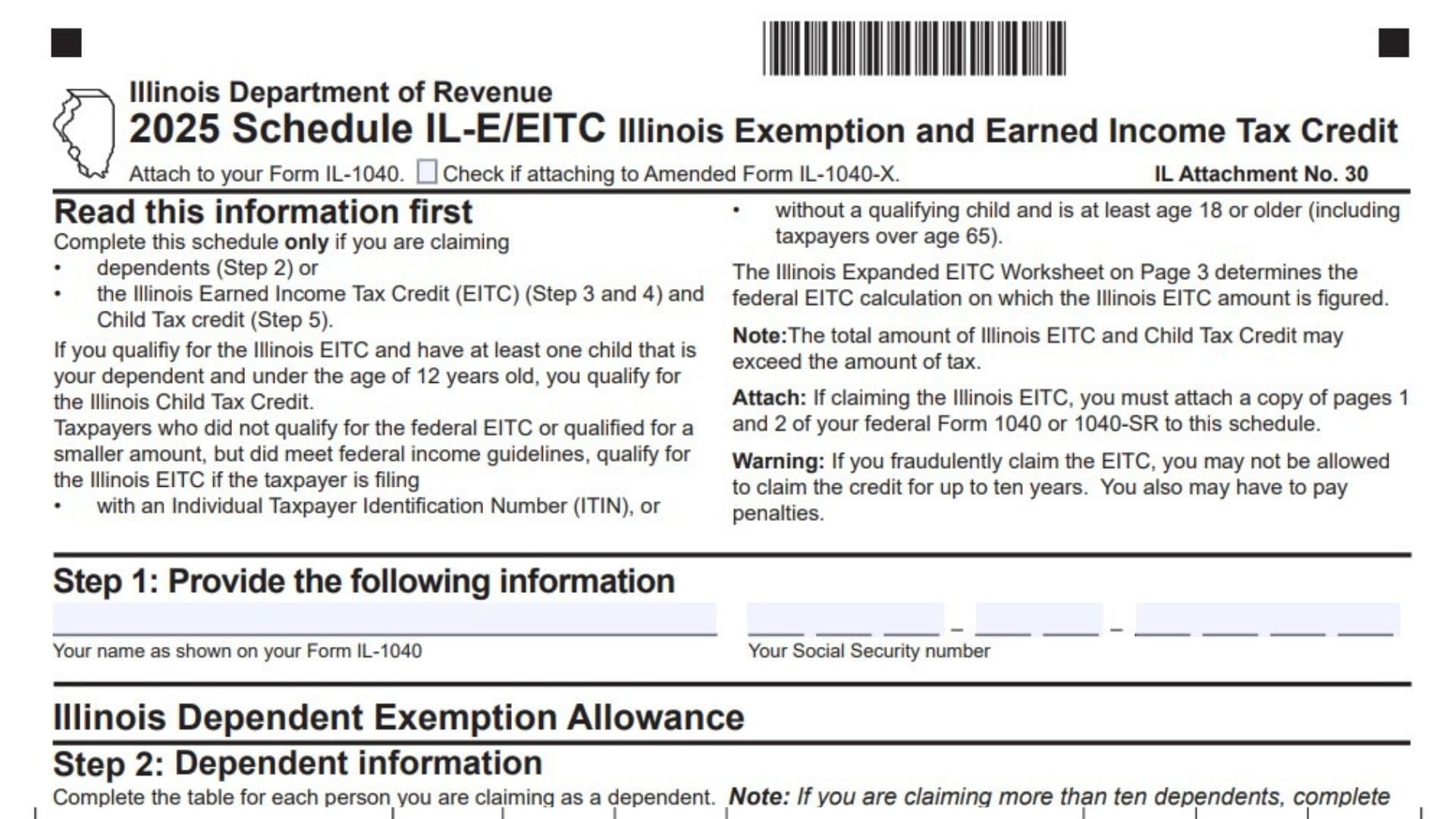
Illinois Schedule IL-E/EITC, officially titled Illinois Exemption and Earned Income Tax Credit, is a tax schedule issued by the Illinois Department of Revenue. It is used by eligible taxpayers to report dependent information, calculate the Illinois Earned Income Tax Credit (EITC), and determine whether they qualify for the Illinois Child Tax Credit. The schedule is attached to Form IL-1040, Illinois Individual Income Tax Return, and is identified as Illinois Attachment No. 30.
The schedule serves three main purposes. First, it allows taxpayers to identify their dependents and calculate the Illinois Dependent Exemption Allowance. Second, it helps eligible taxpayers calculate the Illinois Earned Income Tax Credit based on their federal earned income and applicable federal EITC calculation. Third, it determines the Illinois Child Tax Credit for qualifying taxpayers who have at least one dependent child under age 12.
Schedule IL-E/EITC is particularly important for taxpayers who qualify for the Illinois EITC but do not qualify for the federal EITC or qualify for a smaller federal credit. Certain taxpayers who meet federal income guidelines may still qualify for the Illinois EITC, including individuals filing with an Individual Taxpayer Identification Number (ITIN), individuals who do not meet federal age requirements, and taxpayers with children who were issued ITINs. The schedule also includes an Illinois Expanded EITC Worksheet to calculate the federal EITC amount used to determine the Illinois credit in certain circumstances.
The form is divided into five main steps and an additional worksheet. Step 1 collects the taxpayer’s name and Social Security Number. Step 2 identifies dependents and calculates the exemption allowance. Step 3 collects information about qualifying children who are not already included as dependents in Step 2. Step 4 calculates the Illinois EITC using federal income information and the applicable Illinois percentage. Step 5 determines the Illinois Child Tax Credit. The Illinois Expanded EITC Worksheet, provided on pages 3 and 4, is used when certain eligibility conditions apply.
For the 2025 tax year, the Illinois Dependent Exemption Allowance is calculated at $2,850 for each dependent claimed. The Illinois EITC is generally calculated as 20% of the applicable federal EITC amount, adjusted by an Illinois residency percentage when required. Eligible taxpayers may also receive an Illinois Child Tax Credit equal to 40% of their Illinois EITC if they qualify and have at least one dependent child under age 12 at the end of 2025.
Completing Schedule IL-E/EITC correctly is important because the information determines the exemptions and credits reported on the main Illinois income tax return. The dependent exemption amount is transferred to Form IL-1040, Line 10d, the Illinois EITC is transferred to Line 29, and the Illinois Child Tax Credit is transferred to Line 30. Taxpayers claiming the Illinois EITC must also attach pages 1 and 2 of their federal Form 1040 or Form 1040-SR. Incorrect dependent information or unsupported credit claims may result in adjustments, penalties, or restrictions on claiming the EITC in future years.
How To File Illinois Schedule IL-E/EITC
Illinois Schedule IL-E/EITC must be completed and attached to the taxpayer’s Form IL-1040.
If you are filing an amended Illinois individual income tax return using Form IL-1040-X, check the designated box at the top of Schedule IL-E/EITC to indicate that the schedule accompanies an amended return.
Who Needs To Complete Schedule IL-E/EITC?
You should complete this schedule if you are claiming either of the following:
- Dependent exemptions reported in Step 2.
- Illinois Earned Income Tax Credit reported in Steps 3 and 4, or Illinois Child Tax Credit reported in Step 5.
You do not need to complete every section if it does not apply to your tax situation.
For example, a taxpayer claiming dependents but not the Illinois EITC generally completes the identification section and Step 2 without completing the remaining credit calculations.
Who May Qualify For The Illinois EITC?
The schedule identifies several circumstances in which taxpayers may qualify for the Illinois EITC even if they did not qualify for the federal EITC or received a smaller federal credit.
These include taxpayers who:
- File using an Individual Taxpayer Identification Number (ITIN).
- Do not meet the federal age requirements.
- Have children who do not qualify for the federal EITC because those children were issued ITINs.
- Qualify for the federal EITC but have additional children who do not qualify for the federal EITC because they were issued ITINs.
Taxpayers must still meet the applicable income and other eligibility requirements described in the schedule and its expanded worksheet.
Illinois Child Tax Credit Eligibility
You may qualify for the Illinois Child Tax Credit if:
- You qualify for the Illinois EITC.
- At least one child is your dependent.
- The dependent child is under age 12 on December 31, 2025.
The Illinois Child Tax Credit is calculated as 40% of the Illinois EITC.
Documents To Prepare Before Completing The Schedule
Gather the following information before starting:
- Completed or prepared Form IL-1040.
- Taxpayer’s full name.
- Taxpayer’s Social Security Number.
- Names of all dependents being claimed.
- Dependents’ Social Security Numbers or ITINs.
- Dependents’ relationships to the taxpayer.
- Dependents’ dates of birth.
- Full-time student information.
- Disability information.
- Number of months each dependent lived with the taxpayer.
- Information about qualifying children not already listed as dependents.
- Federal Form 1040 or Form 1040-SR.
- Federal wages, salaries, and tips.
- Federal business income or loss.
- Federal adjusted gross income (AGI).
- Spouse’s Social Security Number, when applicable.
- Federal Schedule SE, Schedule C, Schedule F, and Schedule K-1 information, when applicable.
- Federal earned income credit calculation.
- Schedule NR, Line 48, for nonresidents and part-year residents.
If you are claiming the Illinois EITC, attach a copy of pages 1 and 2 of your federal Form 1040 or Form 1040-SR.
Important Filing Warnings
Federal Return Attachment Requirement
Taxpayers claiming the Illinois EITC must attach pages 1 and 2 of their federal Form 1040 or Form 1040-SR to Schedule IL-E/EITC.
Fraudulent Credit Claims
Intentionally providing false information to claim the EITC is a crime under Section 1301 of the Illinois Income Tax Act.
Fraudulent claims may result in penalties and disqualification from claiming the credit for up to ten years.
Illinois Credits May Exceed Tax Liability

The combined amount of the Illinois EITC and Illinois Child Tax Credit may exceed the amount of tax owed.
How To Complete Illinois Schedule ILE/EITC
Schedule IL-E/EITC contains five main steps, followed by the Illinois Expanded EITC Worksheet.
Follow the instructions below to complete each section and calculation.
Step 1: Provide The Following Information
Step 1 appears on page 1 of the schedule and collects the taxpayer’s identification information.
Complete both fields using the information associated with your Form IL-1040.
Your Name As Shown On Your Form IL-1040
Enter your full name exactly as it appears on your Illinois Form IL-1040.
If you are filing jointly, use the taxpayer names in the same manner as they appear on the main return.
Your Social Security Number
Enter your Social Security Number in the designated field.
Make sure the number matches the information reported on Form IL-1040.
This identification information connects Schedule IL-E/EITC to your main Illinois income tax return.
Illinois Dependent Exemption Allowance
Step 2: Dependent Information
Step 2 appears on page 1 and is used to identify every person you are claiming as a dependent for Illinois income tax purposes.
Complete one row for each dependent.
The table provides space for up to ten dependents. If you are claiming more than ten dependents, complete and attach additional dependent information tables.
Dependent Information Table Fields
Dependent’s First Name
Enter the first name of the dependent.
Use the name associated with the dependent’s identification and tax records.
Dependent’s Last Name
Enter the dependent’s last name.
Make sure the name is entered accurately.
Social Security Number Or Individual Taxpayer Identification Number
Enter the dependent’s Social Security Number or Individual Taxpayer Identification Number.
Use the identification number applicable to that dependent.
Verify the number before submitting the schedule.
Dependent’s Relationship To You
Identify the dependent’s relationship to the taxpayer.
For example, enter the applicable relationship, such as son, daughter, or another qualifying family relationship.
Dependent’s Date Of Birth
Enter the dependent’s date of birth using the required month/day/year format.
For example, enter July 15, 2015, as 07/15/2015.
The date of birth helps establish the dependent’s age for applicable tax requirements.
Full-Time Student
Check this box if the dependent qualifies as a full-time student.
Leave it unchecked if the dependent does not meet the applicable full-time student classification.
Person With Disability
Check this box if the dependent is a person with a disability.
Leave it unchecked if this designation does not apply.
Number Of Months Living With You
Enter the number of months the dependent lived with you during the applicable tax year.
Report the number of months accurately based on the dependent’s living arrangements.
Eligible For Earned Income Credit
Check this box if the dependent is eligible to be included in the applicable Earned Income Tax Credit calculation.
Leave it unchecked if the dependent does not meet the relevant qualifying-child requirements.
Line 1: Illinois Dependent Exemption Allowance
Line 1: Total Dependent Exemption Allowance
Count the total number of dependents you are claiming in Step 2.
Multiply that number by $2,850.
The calculation is:
Dependent Exemption Allowance = Number of Dependents × $2,850.
For example, if you claim three dependents:
3 × $2,850 = $8,550.
Enter the resulting amount on Line 1.
You must also transfer this amount to Form IL-1040, Line 10d.
If you have no dependents to claim, do not calculate a dependent exemption allowance for this line.
Illinois Earned Income Tax Credit
The Illinois Earned Income Tax Credit section begins on page 2.
Complete this section only if you qualify for the Illinois EITC.
Even if you did not qualify for the federal EITC, you may still qualify for the Illinois credit under the circumstances described in the schedule.
The instructions also require a copy of pages 1 and 2 of your federal Form 1040 or Form 1040-SR when claiming the Illinois EITC.
Step 3: Qualifying Child Information
Step 3 is used to identify qualifying children who are not already included in Step 2 as dependents.
Do not enter the same child in both tables.
Complete a separate row for each additional qualifying child.
The table provides space for up to three children.
Qualifying Child Information Table Fields
Child’s First Name
Enter the first name of the qualifying child.
Child’s Last Name
Enter the last name of the qualifying child.
Social Security Number Or Individual Taxpayer Identification Number
Enter the child’s Social Security Number or Individual Taxpayer Identification Number.
Use the correct identification number associated with the child.
Child’s Relationship To You
Enter the child’s relationship to the taxpayer.
Identify the applicable relationship, such as son or daughter.
Child’s Date Of Birth
Enter the child’s date of birth using the month/day/year format.
Use the actual date of birth shown in the child’s records.
Full-Time Student
Check this box if the child qualifies as a full-time student.
Person With Disability
Check this box if the child is a person with a disability.
Number Of Months Living With You
Enter the number of months the qualifying child lived with you during the applicable tax year.
Make sure the information is consistent with the child’s actual living arrangements.
Step 3 Income And Eligibility Questions
After the qualifying-child table, Step 3 contains four numbered entries and questions.
Line 1: Wages, Salaries, And Tips
Enter the amount of wages, salaries, and tips reported on your federal Form 1040 or Form 1040-SR, Line 1z.
Use the amount from your federal return rather than calculating a separate figure.
Line 2: Business Income Or Loss
Enter your business income or loss from federal Schedule 1, Line 3.
Use the amount reported on the applicable federal return.
If the business activity produced a loss, report the amount as shown on the federal schedule.
Line 3: Federal Adjusted Gross Income For Married Filing Jointly Taxpayers
Complete this line only if you filed your 2025 federal income tax return as married filing jointly but are filing your 2025 Illinois income tax return as married filing separately.
Enter your federal adjusted gross income (AGI) from the married filing jointly federal Form 1040 or Form 1040-SR, Line 11a.
Do not complete this line when the specified federal and Illinois filing-status combination does not apply.
Line 3a: Spouse’s Social Security Number
Complete this line if you entered an amount on Line 3.
Enter your spouse’s Social Security Number from your married filing jointly federal tax return.
This information identifies the spouse associated with the federal AGI entered on Line 3.
Line 4: Statutory Employee Question
The form asks whether the statutory employee box is checked on your Form W-2, Wage and Tax Statement, Box 13.
Select one answer:
- Yes: Check this option if the statutory employee box on your W-2, Box 13, is marked.
- No: Check this option if the statutory employee box is not marked.
Answer according to the information shown on your W-2.
Step 4: Figure Your Illinois EITC
Step 4 is used to calculate your Illinois Earned Income Tax Credit.
The first requirement is to determine whether you qualify for the federal EITC and whether you have additional children with ITINs who did not qualify for the federal credit.
If you qualify for the federal EITC and do not have additional children with ITINs, skip Line 5 and go directly to Line 6.
In that situation, you do not need to complete the Illinois Expanded EITC Worksheet.
Line 5: Illinois Expanded EITC Eligibility Categories
Line 5: Select The Applicable Eligibility Reason
Check the box that describes why you did not qualify for the federal EITC or why additional children were excluded from the federal credit.
There are four available options.
Line 5a: Did Not Qualify For Federal EITC Because Of An ITIN
Check this box if you did not qualify for the federal EITC because you have an Individual Taxpayer Identification Number (ITIN).
This option identifies taxpayers whose federal EITC eligibility was affected by their taxpayer identification status.
Line 5b: Did Not Meet Federal Age Requirements
Check this box if you did not qualify for the federal EITC because you did not meet the federal age requirements.
This option applies when age restrictions prevented you from receiving the federal credit.
Line 5c: Children Did Not Qualify For Federal EITC Because They Were Issued ITINs
Check this box if you did not qualify for the federal EITC and have children who were not eligible for the federal credit because they were issued ITINs.
Line 5d: Qualified For Federal EITC But Have Additional Children With ITINs
Check this box if you qualified for the federal EITC but have additional children who did not qualify for the federal credit because they were issued ITINs.
Illinois Expanded EITC Worksheet Requirement
If you check any box on Line 5, complete the Illinois Expanded EITC Worksheet on pages 3 and 4.
This worksheet calculates the federal EITC amount that will be used to determine your Illinois EITC.
If none of the Line 5 conditions applies and you qualify for the federal EITC without additional children with ITINs, skip the expanded worksheet and proceed to Line 6.
Line 6: Federal Earned Income Tax Credit Amount
Enter the amount of federal Earned Income Tax Credit from your federal Form 1040 or Form 1040-SR, Line 27a.
If you completed the Illinois Expanded EITC Worksheet, enter the amount calculated on that worksheet, Line 23, instead.
Use the applicable amount based on your circumstances.
Line 7: Illinois EITC Percentage
Multiply the amount on Line 6 by 20%, or 0.20.
The calculation is:
Line 7 = Line 6 × 0.20.
Enter the resulting amount on Line 7.
This represents the Illinois EITC before applying the residency percentage.
Line 8: Illinois Residency Percentage
Enter the applicable decimal based on your Illinois residency status.
- Illinois residents: Enter 1.0.
- Nonresidents and part-year residents: Enter the decimal reported on Schedule NR, Line 48.
Use the appropriate amount for your filing status and residency circumstances.
Line 9: Illinois Earned Income Tax Credit
Multiply the amount on Line 7 by the decimal entered on Line 8.
The calculation is:
Line 9 = Line 7 × Line 8.
The resulting amount is your Illinois Earned Income Tax Credit.
Enter this amount on Line 9 and transfer it to Form IL-1040, Line 29.
Step 5: Figure Your Illinois Child Tax Credit
Step 5 appears on page 3 of the schedule.
Complete this section only if you qualify for the Illinois EITC and have at least one dependent child who was under age 12 on the last day of 2025.
Line-by-Line Illinois Child Tax Credit Instructions
Line 10: Dependent Child Under Age 12
Check this box if you have at least one child who meets both of the following conditions:
- The child is your dependent.
- The child was under age 12 on December 31, 2025.
If you do not have a dependent child who meets both conditions, leave this box unchecked.
Line 11: Illinois Earned Income Tax Credit
Enter the amount of your Illinois Earned Income Tax Credit from Step 4, Line 9.
Use the same amount reported on Line 9.
Line 12: Illinois Child Tax Credit
Multiply the amount on Line 11 by 40%, or 0.40.
The calculation is:
Line 12 = Line 11 × 0.40.
The resulting amount represents your Illinois Child Tax Credit.
Enter this amount on Line 12 and transfer it to Form IL-1040, Line 30.
Illinois Expanded EITC Worksheet
The Illinois Expanded EITC Worksheet appears on pages 3 and 4 of Schedule IL-E/EITC.
Complete this worksheet only if you checked one or more boxes in Step 4, Line 5.
The worksheet contains six parts covering earned income, self-employment income, qualifying income limits, and the federal EITC calculation.
Part 1: Your Earned Income
Part 1 calculates your initial earned income using federal Form 1040 or Form 1040-SR information.
Line 1: Wages, Salaries, And Tips
Enter the amount reported on federal Form 1040 or Form 1040-SR, Line 1z.
This amount represents your wages, salaries, and tips for the tax year.
Line 2: Medicaid Waiver Payments Not Included In Earned Income
Enter the amount from Line 1 that represents Medicaid waiver payments you choose not to include in earned income.
Use the applicable amount reported on federal Form 1040 or Form 1040-SR, Line 1d.
Line 3: Earned Income After Medicaid Waiver Adjustment
Subtract Line 2 from Line 1.
The calculation is:
Line 3 = Line 1 − Line 2.
Enter the resulting amount on Line 3.
Line 4: Nontaxable Combat Pay Election
Enter the amount of nontaxable combat pay reported on federal Form 1040 or Form 1040-SR, Line 1i, if you elect to include it in earned income.
If you do not elect to include this income, do not enter an amount for it.
Line 5: Initial Earned Income Total
Add Lines 3 and 4.
The calculation is:
Line 5 = Line 3 + Line 4.
If you were not self-employed and were not required to file federal Schedule SE, skip Lines 6 through 14 and proceed to Line 15.
If you were self-employed, a qualifying member of the clergy, or had church employee income requiring Schedule SE, continue to Line 6.
Part 2: Self-Employed Individuals, Members Of The Clergy, And People With Church Employee Income Filing Federal Schedule SE
Part 2 is for taxpayers who have self-employment income or qualifying clergy or church employee income and are required to file federal Schedule SE.
Use the corresponding figures from Schedule SE, Part I.
Line 6: Schedule SE, Part I, Line 3
Enter the amount reported on federal Schedule SE, Part I, Line 3.
Use the figure from the specified federal schedule line.
Line 7: Schedule SE, Part I, Line 4b And Line 5a
Enter the amount from federal Schedule SE, Part I, Line 4b and Line 5a.
Use the applicable amount shown on those lines.
Line 8: Combined Schedule SE Amounts
Add Lines 6 and 7.
The calculation is:
Line 8 = Line 6 + Line 7.
Enter the resulting amount on Line 8.
Line 9: Schedule SE, Part I, Line 13
Enter the amount reported on federal Schedule SE, Part I, Line 13.
Use the amount shown on the federal schedule.
Line 10: Adjusted Self-Employment Income
Subtract Line 9 from Line 8.
The calculation is:
Line 10 = Line 8 − Line 9.
Enter the resulting amount on Line 10.
This amount is used in the total earned income calculation in Part 4.
Part 3: Self-Employed Individuals Not Required To File Federal Schedule SE And Statutory Employees Filing Federal Schedule C
Part 3 applies to taxpayers who are self-employed but are not required to file federal Schedule SE, as well as statutory employees filing federal Schedule C.
The section collects specific income amounts from federal Schedules F, C, and K-1.
Line 11: Net Farm Profit Or Loss
Enter any net farm profit or loss reported on:
- Federal Schedule F, Line 34.
- Federal Schedule K-1 (Form 1065), Box 14, Code A, for farm partnerships.
Combine the applicable amounts and enter the resulting figure on Line 11.
Line 12: Net Business Profit Or Loss
Enter any net profit or loss reported on:
- Federal Schedule C, Line 31.
- Federal Schedule K-1 (Form 1065), Box 14, Code A, for business activities other than farming.
Combine the applicable amounts and enter the resulting figure on Line 12.
Line 13: Statutory Employee Income
Enter the amount from federal Schedule C, Line 1, that you are filing as a statutory employee.
Use the applicable amount reported on the specified federal schedule.
Part 4: Total Earned Income
Part 4 combines the applicable amounts from the preceding sections to determine total earned income for the expanded EITC calculation.
Line 14: Additional Earned Income Total
Add Lines 10, 11, 12, and 13.
The calculation is:
Line 14 = Line 10 + Line 11 + Line 12 + Line 13.
Enter the resulting total on Line 14.
If no amount applies to a particular line, follow the worksheet’s instructions for leaving that line blank.
Line 15: Total Earned Income
Add Line 5 and Line 14.
The calculation is:
Line 15 = Line 5 + Line 14.
If Line 14 is blank, enter the amount from Line 5.
If the resulting total is zero or negative, enter zero.
This amount represents your total earned income for the next part of the worksheet.
Part 5: Do You Qualify?
Part 5 determines whether your earned income falls below the applicable federal EITC income limit based on your filing status and number of qualifying children.
Line 16: Federal EITC Income Limit Test
Compare the amount on Line 15 with the applicable income limit in Table 1.
Select Yes if your Line 15 amount is less than the applicable income limit.
If you select Yes, continue to Part 6.
Select No if your Line 15 amount is equal to or greater than the applicable income limit.
If you select No, stop. You do not qualify for the Illinois EITC under this expanded worksheet.
Table 1: Federal EITC Income Limits
The worksheet provides the following 2025 income limits:
| Qualifying children claimed | Single, Head of Household, or Widowed | Married Filing Jointly |
|---|---|---|
| Zero | $19,104 | $26,214 |
| One | $50,434 | $57,554 |
| Two | $57,310 | $64,430 |
| Three | $61,555 | $68,675 |
Select the income limit corresponding to your filing status and number of qualifying children.
For example, a taxpayer filing as single with one qualifying child must compare Line 15 with $50,434.
The amount on Line 15 must be less than the applicable threshold to continue.
Part 6: Your Federal EITC Calculation
Part 6 calculates the federal Earned Income Tax Credit amount that will be used to determine the Illinois EITC.
It uses the federal EITC table and, when required, compares earned income with adjusted gross income.
Line 17: Total Earned Income
Enter your total earned income from Part 4, Line 15.
Use the same amount calculated on Line 15.
Line 18: Federal EITC Based On Earned Income
Look up the amount reported on Line 17 in the 2025 federal Form 1040 Instructions for Line 27, EIC Table.
Use the correct column based on:
- Your federal filing status.
- The number of qualifying children.
Enter the corresponding federal EITC amount on Line 18.
Make sure you use the 2025 federal EIC table rather than a table from another tax year.
Line 19: Federal Adjusted Gross Income
Enter your federal adjusted gross income from Form 1040 or Form 1040-SR, Line 11a.
Use the amount reported on your federal income tax return.
Line 20: Compare Earned Income And Adjusted Gross Income
Compare the amount on Line 17 with the amount on Line 19.
Select Yes if the two amounts are the same.
Select No if the amounts are different.
Follow the applicable instruction:
- If Yes, skip Lines 21 and 22 and enter the amount from Line 18 on Line 23.
- If No, continue to Line 21.
Line 21: Adjusted Gross Income Limit Test
This line determines whether your adjusted gross income is below the applicable threshold.
Answer the question based on the number of qualifying children.
For taxpayers with no qualifying children, the adjusted gross income must be less than:
- $10,620 for taxpayers filing without married filing jointly status.
- $17,730 for taxpayers filing married filing jointly.
For taxpayers with one or more qualifying children, the adjusted gross income must be less than:
- $23,350 for taxpayers filing without married filing jointly status.
- $30,470 for taxpayers filing married filing jointly.
Select Yes if your adjusted gross income on Line 19 is below the applicable threshold.
Select No if it is not below the applicable threshold.
If you select Yes, leave Line 22 blank and enter the amount from Line 18 on Line 23.
If you select No, continue to Line 22.
Line 22: Federal EITC Based On Adjusted Gross Income
Complete this line only when Line 21 is No.
Look up the adjusted gross income amount from Line 19 in the 2025 federal Form 1040 Instructions for Line 27, EIC Table.
Use the correct column for your filing status and number of qualifying children.
Enter the corresponding federal EITC amount on Line 22.
If Line 21 is Yes, leave this line blank.
Line 23: Final Federal EITC Calculation
Compare the amounts on Lines 18 and 22 when Line 22 contains an amount.
Enter the smaller of the two amounts on Line 23.
If Line 22 is blank because Line 20 or Line 21 directs you to use Line 18, enter the amount from Line 18.
The amount on Line 23 represents your final federal EITC calculation for the Illinois expanded credit process.
Transfer this amount to page 2, Step 4, Line 6 of Schedule IL-E/EITC.
Important Filing And Calculation Rules
Before submitting Schedule IL-E/EITC, review the following requirements.
Dependent Exemption Allowance
The 2025 dependent exemption allowance is $2,850 per dependent claimed in Step 2.
Multiply the number of dependents by $2,850 and transfer the resulting amount to Form IL-1040, Line 10d.
If you claim more than ten dependents, attach additional dependent information tables.
Qualifying Children In Step 2 And Step 3
Step 2 identifies dependents, while Step 3 identifies qualifying children who are not already included in Step 2.
Do not duplicate the same child in both sections.
Federal EITC And Illinois EITC
Taxpayers who qualify for the federal EITC and do not have additional children with ITINs generally skip Line 5 and the Illinois Expanded EITC Worksheet.
Other taxpayers meeting the conditions listed in Step 4, Line 5, must complete the expanded worksheet.
Illinois EITC Calculation
The Illinois EITC is calculated by multiplying the applicable federal EITC amount by 20%.
For nonresidents and part-year residents, the result is further adjusted using the decimal from Schedule NR, Line 48.
Illinois Child Tax Credit
The Illinois Child Tax Credit is available only to taxpayers who qualify for the Illinois EITC and have at least one dependent child under age 12 on December 31, 2025.
The credit equals 40% of the Illinois EITC.
Federal Tax Return Attachment
Attach pages 1 and 2 of federal Form 1040 or Form 1040-SR when claiming the Illinois EITC.
Amended Illinois Returns
If you are attaching Schedule IL-E/EITC to an amended Form IL-1040-X, check the designated amended-return box at the top of the schedule.
Where To Report Schedule IL-E/EITC Amounts
The schedule contains three important amounts that must be transferred to the main Illinois individual income tax return.
| Schedule IL-E/EITC | Form IL-1040 |
|---|---|
| Step 2, Line 1: Dependent Exemption Allowance | Line 10d |
| Step 4, Line 9: Illinois Earned Income Tax Credit | Line 29 |
| Step 5, Line 12: Illinois Child Tax Credit | Line 30 |
Make sure the amounts entered on Form IL-1040 agree with the corresponding calculations on Schedule IL-E/EITC.
Final Review Before Filing
Before submitting Illinois Schedule IL-E/EITC for the 2025 tax year, review every applicable section and calculation.
Use the following checklist to help prevent errors.
- Confirm that you are using the correct 2025 Schedule IL-E/EITC.
- Check the amended Form IL-1040-X box if filing an amended return.
- Enter your name exactly as shown on Form IL-1040.
- Enter your correct Social Security Number.
- Complete Step 2 for every dependent being claimed.
- Verify each dependent’s first and last name.
- Enter the correct Social Security Number or ITIN for each dependent.
- Identify each dependent’s relationship to you.
- Enter each dependent’s date of birth.
- Check the full-time student box when applicable.
- Check the disability box when applicable.
- Enter the number of months each dependent lived with you.
- Identify dependents eligible for the Earned Income Tax Credit.
- Multiply the total number of dependents by $2,850.
- Transfer the dependent exemption amount to Form IL-1040, Line 10d.
- Attach additional dependent tables if claiming more than ten dependents.
- Complete Step 3 only for qualifying children not already included in Step 2.
- Enter federal wages, salaries, and tips on Step 3, Line 1.
- Enter business income or loss on Step 3, Line 2.
- Complete Line 3 if filing federal married filing jointly and Illinois married filing separately.
- Enter the spouse’s Social Security Number on Line 3a when required.
- Answer the statutory employee question on Line 4.
- Determine whether you qualify for the Illinois EITC.
- Check the appropriate eligibility category on Line 5, if applicable.
- Complete the Illinois Expanded EITC Worksheet when required.
- Enter the correct federal EITC amount on Line 6.
- Multiply Line 6 by 20% on Line 7.
- Enter 1.0 on Line 8 if you are an Illinois resident.
- Enter the Schedule NR, Line 48 decimal on Line 8 if you are a nonresident or part-year resident.
- Multiply Lines 7 and 8 to calculate the Illinois EITC on Line 9.
- Transfer the Illinois EITC to Form IL-1040, Line 29.
- Determine whether you qualify for the Illinois Child Tax Credit.
- Check Line 10 if you have at least one dependent child under age 12 on December 31, 2025.
- Enter the Illinois EITC from Line 9 on Line 11.
- Multiply Line 11 by 40% to calculate Line 12.
- Transfer the Illinois Child Tax Credit to Form IL-1040, Line 30.
- Complete all applicable sections of the Illinois Expanded EITC Worksheet.
- Verify the earned income calculations in Part 1.
- Check the federal Schedule SE amounts in Part 2, when applicable.
- Verify the Schedule F, Schedule C, and Schedule K-1 amounts in Part 3, when applicable.
- Calculate total earned income on Lines 14 and 15.
- Compare Line 15 with the applicable income limit in Table 1.
- Use the correct filing status and number of qualifying children.
- Complete the federal EITC calculation in Part 6.
- Verify the amounts from the 2025 federal EIC table.
- Compare earned income and adjusted gross income as instructed.
- Complete Lines 21 and 22 when required.
- Enter the final federal EITC calculation on Line 23.
- Transfer Line 23 to page 2, Step 4, Line 6 when applicable.
- Attach pages 1 and 2 of federal Form 1040 or Form 1040-SR when claiming the Illinois EITC.
- Review all amounts transferred to Form IL-1040.
Final Note: Illinois Schedule IL-E/EITC is used to claim dependent exemptions, the Illinois Earned Income Tax Credit, and the Illinois Child Tax Credit for the 2025 tax year. Accurate completion requires correct dependent identification, federal income information, appropriate EITC eligibility calculations, and the applicable residency adjustment. Review all five steps and the expanded worksheet when required, attach the necessary federal tax return pages, and verify that the final amounts agree with Form IL-1040 before filing.