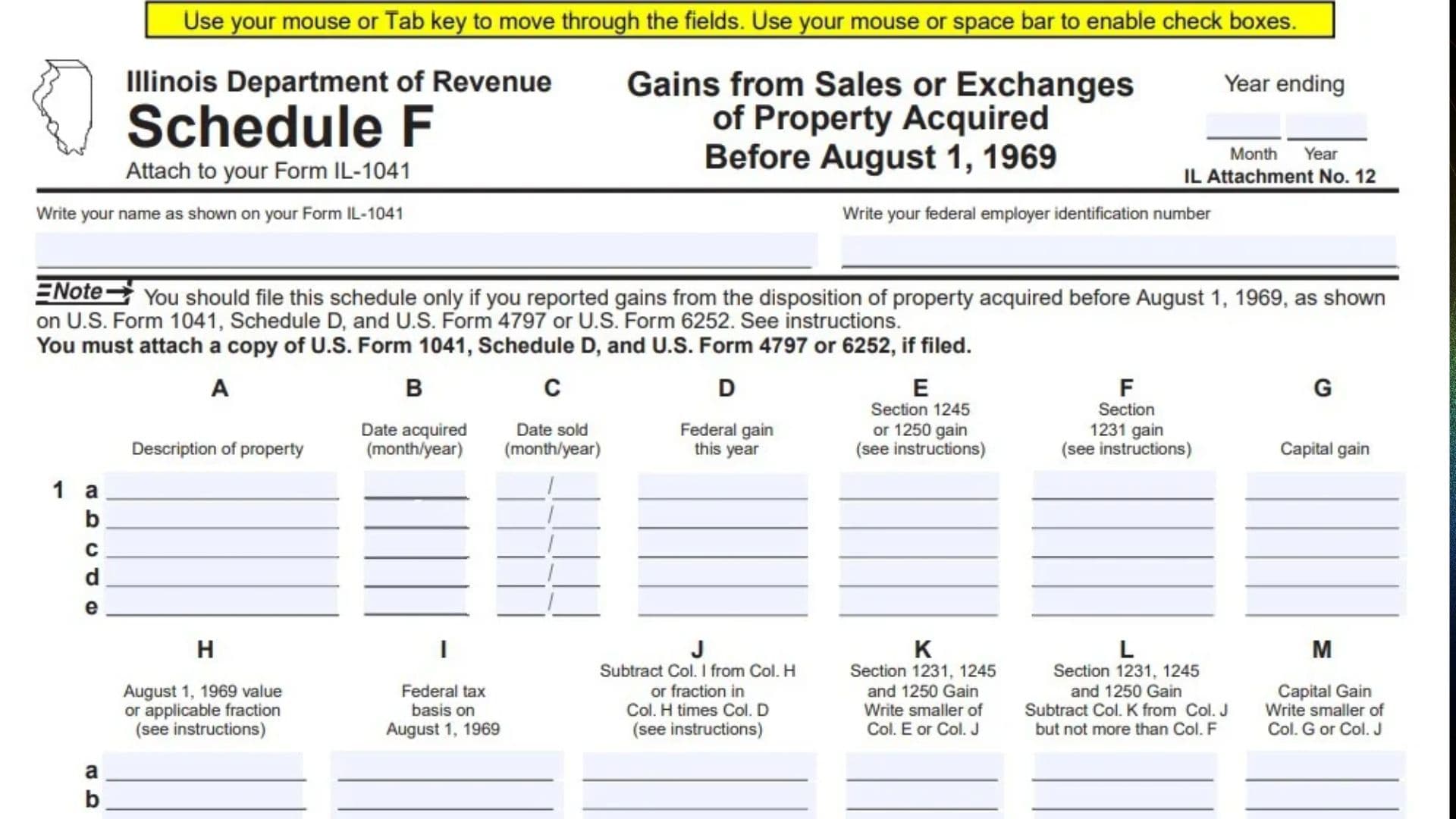
Illinois Schedule F, titled Gains From Sales or Exchanges of Property Acquired Before August 1, 1969, is a tax schedule issued by the Illinois Department of Revenue. It is used by estates and trusts filing Form IL-1041 to determine the portion of certain gains from the sale or exchange of property that represents appreciation occurring before August 1, 1969. This date is important because it marks the effective date of the Illinois Income Tax Act, and Illinois does not tax the gain attributable to appreciation that occurred before that date. Schedule F calculates this amount, commonly called the valuation limitation amount or pre-August 1, 1969 appreciation amount. The schedule applies to qualifying property acquired before August 1, 1969, including capital assets and certain business properties that generate gains under Sections 1231, 1245, and 1250 of the Internal Revenue Code. It uses information from federal Form 1041, Schedule D, Form 4797, and Form 6252 to determine the relevant gain and its allocation between the pre-August 1969 period and the subsequent period. The calculation considers the property’s acquisition date, disposition date, federal gain, August 1, 1969 fair market value, federal tax basis on that date, and applicable appreciation fraction. Schedule F also accounts for appreciation amounts received through partnerships and other trusts or estates, as well as certain distributions involving employer securities. Its second section distributes the calculated appreciation amounts between beneficiaries and the fiduciary. The final section calculates the valuation limitation amount that must be transferred to Form IL-1041. Estates and trusts must complete the schedule carefully because the calculation determines how much of the reported gain can be excluded from Illinois taxable income under the applicable pre-August 1969 appreciation rules. Schedule F is attached to Form IL-1041, and applicable federal schedules and supporting documents must also be included. The form contains five property-entry rows, a separate worksheet for certain installment sales, and 18 numbered lines covering appreciation calculations, distributions, and the final valuation limitation amount.
Who Should File Illinois Schedule F?
You should file Schedule F only if you reported qualifying gains from property acquired before August 1, 1969, under one or more of the following circumstances:
- You reported a capital gain from qualifying property on U.S. Form 1041, Schedule D, and have a net capital gain.
- You reported a gain from Section 1231, Section 1245, or Section 1250 property on U.S. Form 4797.
- You reported installment sale income from qualifying property on U.S. Form 6252.
The property must have been acquired before August 1, 1969.
Who Should Not File Schedule F?
Do not file Schedule F for distributions from an employee pension, profit-sharing, or stock bonus plan, or for gains from the disposition of employer securities, even if those amounts are reported on U.S. Form 1041, Schedule D.
For distributions from these plans, refer to the applicable instructions for Form IL-1041, Line 14.
For gains involving employer securities, refer to Form IL-4644.
Required Supporting Documents
Attach copies of the applicable federal forms and schedules that you filed:
- U.S. Form 1041, Schedule D.
- U.S. Form 4797.
- U.S. Form 6252.
If you filed Form 6252 but were not required to file Form 4797, attach a statement explaining that Form 4797 was not required, along with a copy of the filed Form 6252.
How To File Illinois Schedule F
Schedule F must be attached to your Illinois Form IL-1041, Income Tax Return for Estates and Trusts.
Before completing the schedule, gather the following information:
- Estate or trust name as shown on Form IL-1041.
- Federal Employer Identification Number (FEIN).
- Tax year ending date.
- Property descriptions and security names.
- Acquisition and disposition dates.
- Federal gain amounts.
- Section 1231, 1245, and 1250 gain information.
- Capital gain amounts.
- Fair market values as of August 1, 1969, when applicable.
- Federal income tax basis as of August 1, 1969.
- Applicable appreciation fractions.
- Partnership and trust Schedule K-1-P and K-1-T information.
- Form IL-4644 information, when applicable.
- Beneficiary and fiduciary allocation information.
Complete the applicable calculations before transferring the final amounts to Form IL-1041.

How To Complete Illinois Schedule F
The first page contains the taxpayer identification fields, Line 1 property information table, Lines 2 through 6, the Distribution of Appreciation Amounts section, and the Valuation Limitation Amount section.
Taxpayer and Tax Year Information
Year Ending
Enter the month and year in which the estate or trust’s tax year ends.
Use the applicable tax year ending date associated with Form IL-1041.
Name
Enter the estate’s or trust’s name exactly as it appears on Form IL-1041.
Make sure the name matches the primary Illinois income tax return.
Federal Employer Identification Number
Enter the estate’s or trust’s nine-digit federal employer identification number.
Use the same FEIN reported on Form IL-1041.
Illinois Attachment Number
The form identifies Schedule F as IL Attachment No. 12. This is a preprinted identification number and does not require a separate calculation.
Line 1: Property Description and Appreciation Calculation
Line 1 contains five property-entry rows, identified as a, b, c, d, and e.
Use a separate row for each qualifying property or security.
Each row contains 13 columns, labeled A through M. These columns collect the information needed to calculate the appreciation attributable to the period before August 1, 1969.
Property Identification and Federal Gain Information
Column A: Description of Property
Enter the description of the property or the full name of the security.
Use the same description shown on the applicable federal document:
- U.S. Form 1041, Schedule D.
- U.S. Form 4797.
- U.S. Form 6252.
Make sure the description clearly identifies the asset involved in the transaction.
Column B: Date Acquired
Enter the month and year when the property was acquired.
For securities acquired through the exercise of rights, warrants, or options, enter the date the rights, warrants, or options were exercised.
Use the applicable acquisition date rather than an unrelated purchase or transfer date.
Column C: Date Sold
Enter the month and year when the property was sold or otherwise disposed of.
Use the actual disposition date associated with the reported transaction.
Column D: Federal Gain This Year
Enter the total gain reported during the current tax year for the disposition of the property.
Include applicable gains from involuntary conversions resulting from casualty or theft.
Use the gain information reported on the applicable federal form:
- U.S. Form 1041, Schedule D.
- U.S. Form 4797.
- U.S. Form 6252.
Do not enter a transaction that resulted in a loss.
For installment sales, follow the special instructions on page 2 instead of entering the regular current-year gain amount.
Column E: Section 1245 or 1250 Gain
Enter the portion of the federal gain in Column D that represents ordinary income under Internal Revenue Code Section 1245 or Section 1250.
Use the applicable amount reported on U.S. Form 4797 or Form 6252.
If no Section 1245 or 1250 gain applies, leave the field blank as appropriate.
Column F: Section 1231 Gain
Enter the portion of the gain in Column D that qualifies as Section 1231 gain.
Use the applicable amount reported on U.S. Form 4797 or Form 6252.
This amount is used later to determine the portion of the pre-August 1969 appreciation attributable to Section 1231 gain.
Column G: Capital Gain
Enter the capital gain reported on U.S. Form 1041, Schedule D, for the property.
Use the corresponding federal capital gain amount.
August 1, 1969 Valuation Information
Column H: August 1, 1969 Value or Applicable Fraction
Enter the fair market value of the property on August 1, 1969, or the applicable fraction, depending on the type of property and the availability of a reliable historical valuation.
The correct method depends on whether the property was a listed security or another type of property.
For listed securities, use the applicable historical market value.
For other properties, use an independent appraisal when the fair market value was readily ascertainable.
If the fair market value was not readily ascertainable, use the number-of-months method to calculate the applicable fraction.
The fraction is calculated as:
Full calendar months held before August 1, 1969 ÷ Total full calendar months held
Do not include the month in which the property was acquired or the month in which it was disposed of in either calculation.
If the property was acquired in July 1969, enter zero in Columns H and J.
Column I: Federal Tax Basis on August 1, 1969
If you entered a fair market value or appraised value in Column H, enter the property’s federal income tax basis as of August 1, 1969.
This represents the cost or other basis that would have been reported on U.S. Form 1041, Schedule D, or Form 6252 if the property had been sold on August 1, 1969.
If you entered an applicable fraction in Column H instead of a fair market value, leave Column I blank.
Column J: Pre-August 1969 Appreciation
Calculate the amount attributable to appreciation before August 1, 1969.
The calculation depends on what you entered in Column H.
If Column H contains a fair market value or appraised value, subtract Column I from Column H.
If Column I is equal to or greater than Column H, enter zero.
If Column H contains an applicable fraction, multiply Column D by the fraction.
Enter the resulting amount in Column J.
Allocation of Appreciation Among Gain Categories
Column K: Section 1231, 1245, and 1250 Gain
Enter the smaller of Column E or Column J.
Compare the Section 1245 or 1250 gain with the appreciation calculated in Column J.
Use whichever amount is smaller.
If Column E contains no amount, enter zero in Column K.
Column L: Section 1231, 1245, and 1250 Gain
Subtract Column K from Column J.
Then compare the result with Column F.
Enter the smaller of the calculated difference and the Section 1231 gain in Column F.
The amount entered in Column L cannot exceed the amount reported in Column F.
If Column F is blank, enter zero.
Column M: Capital Gain
Enter the smaller of Column G or Column J.
Compare the federal capital gain with the appreciation amount calculated in Column J.
Enter whichever amount is smaller.
If Column G is blank, enter zero.
Lines 2 Through 6: Additional Appreciation Amounts
These lines collect additional pre-August 1, 1969 appreciation amounts from partnerships, trusts, estates, and other applicable transactions.
Line 2: Share of Pre-August 1, 1969 Appreciation From Partnerships and Other Trusts and Estates
Enter your share of pre-August 1, 1969 appreciation amounts received through partnerships and other trusts or estates.
Use the applicable Schedule K-1-P and Schedule K-1-T information.
Complete the applicable columns for:
- Column K: Section 1245 and 1250 gain or capital asset appreciation.
- Column L: Section 1231 gain appreciation.
- Column M: Capital gain appreciation.
For Column K, use the applicable amounts from Schedule K-1-P, Step 6, Line 48, Column A, and Schedule K-1-T, Step 6, Line 47, Column A.
For Column L, use Schedule K-1-P, Step 6, Line 49, Column A, and Schedule K-1-T, Step 6, Line 48, Column A.
For Column M, use Schedule K-1-P, Step 6, Line 51, Column A, and Schedule K-1-T, Step 6, Line 49, Column A.
Enter only the amounts attributable to the relevant pre-August 1969 appreciation categories.
Line 3: Amount From Form IL-4644, Line 18
Enter the amount from Form IL-4644, Line 18, if required.
This line relates to gains from the sale of employer securities received through a distribution from a qualified employee benefit plan.
Follow the applicable Form IL-4644 instructions to determine whether an amount must be reported.
Line 4: Total of Column K
Add the amounts reported in Column K for all applicable property entries.
Enter the total on Line 4.
Transfer this amount to Line 7, Column 1.
Line 5: Total of Column L
Add the amounts reported in Column L for all applicable property entries.
Enter the total on Line 5.
Transfer this amount to Line 8, Column 1.
Line 6: Total of Column M
Add the amounts reported in Column M for all applicable property entries.
Enter the total on Line 6.
Transfer this amount to Line 9, Column 1.
Distribution of Appreciation Amounts
This section divides the total pre-August 1, 1969 appreciation amounts between the beneficiaries and the fiduciary.
It contains three columns:
- Column 1: Total.
- Column 2: Beneficiaries.
- Column 3: Fiduciary.
The beneficiaries’ shares must also be reported on the applicable Schedule K-1-T.
Line 7: Section 1245 and 1250 Appreciation Distribution
Column 1: Enter the total amount from Line 4.
This represents the total pre-August 1, 1969 appreciation amount for Section 1245 and Section 1250 gain.
Column 2: Enter the portion allocated to the beneficiaries.
Report each beneficiary’s share on Schedule K-1-T, Step 6, Line 47, Column A.
Column 3: Enter the portion allocated to the fiduciary.
Transfer the fiduciary’s share to Line 17.
Line 8: Section 1231 Appreciation Distribution
Column 1: Enter the total amount from Line 5.
This represents the total pre-August 1, 1969 appreciation amount for Section 1231 gain.
Column 2: Enter the portion allocated to the beneficiaries.
Report each beneficiary’s share on Schedule K-1-T, Step 6, Line 48, Column A.
Column 3: Enter the portion allocated to the fiduciary.
If U.S. Form 1041, Schedule D, Line 10, reports a gain, transfer this amount to Line 11.
Line 9: Capital Asset Appreciation Distribution
Column 1: Enter the total amount from Line 6.
This represents the total pre-August 1, 1969 appreciation amount for capital assets.
Column 2: Enter the portion allocated to the beneficiaries.
Report each beneficiary’s share on Schedule K-1-T, Step 6, Line 49, Column A.
Column 3: Enter the portion allocated to the fiduciary.
Transfer the fiduciary’s share to Line 10.
Valuation Limitation Amount
This section calculates the final valuation limitation amount.
The calculation combines the applicable fiduciary appreciation amounts with the net capital gain limitation.
Line 10: Fiduciary’s Capital Gain Appreciation
Enter the amount from Line 9, Column 3.
This represents the fiduciary’s share of the pre-August 1, 1969 appreciation attributable to capital assets.
Line 11: Fiduciary’s Section 1231 Appreciation
Enter the amount from Line 8, Column 3.
If U.S. Form 1041, Schedule D, Line 10, is blank, enter zero.
If U.S. Form 6252 is used, refer to U.S. Form 1041, Schedule D, Line 7, instead.
Enter zero when the applicable referenced line is blank.
Line 12: Total Appreciation for Valuation Limitation
Add Lines 10 and 11.
The calculation is:
Line 10 + Line 11 = Line 12
Enter the combined amount.
Line 13: Net Capital Gain
Enter the amount, if any, reported on U.S. Form 1041, Schedule D, Line 15, Column 2.
Use the corresponding federal net capital gain amount.
Line 14: Amount From Form IL-4644, Line 13
Enter the amount from Form IL-4644, Line 13, if required.
This line applies to certain gains or limitations associated with employer securities and qualified employee benefit plan distributions.
Review the applicable Form IL-4644 instructions before entering an amount.
Line 15: Net Capital Gain After Subtraction
Subtract Line 14 from Line 13.
The calculation is:
Line 13 − Line 14 = Line 15
If Line 14 is equal to or greater than Line 13, enter zero.
Do not enter a negative amount.
Line 16: Limited Appreciation Amount
Enter the smaller of Line 12 or Line 15.
Compare the two amounts and use whichever is lower.
Line 17: Fiduciary’s Section 1245 and 1250 Appreciation
Enter the amount from Line 7, Column 3.
This represents the fiduciary’s share of the pre-August 1, 1969 appreciation attributable to Section 1245 and Section 1250 gain.
Line 18: August 1, 1969 Valuation Limitation Amount
Add Lines 16 and 17.
The calculation is:
Line 16 + Line 17 = Line 18
Enter the resulting valuation limitation amount.
Transfer this amount to Form IL-1041, Line 13, Column B.
Installment Sales
Page 2 contains special instructions for reporting gains from installment sales of property acquired before August 1, 1969.
If you reported installment sale gains on U.S. Form 1041, Schedule D, or Form 4797, complete Schedule F using the appropriate instructions below.
Installment Sales Before August 1, 1969
For installment sales involving property acquired before August 1, 1969, complete Schedule F using the following rules:
Columns A Through C
Complete these columns using the regular Schedule F instructions.
Enter the property description, acquisition date, and disposition date.
Column D
Write the word INST to identify the transaction as an installment sale.
Do not enter the regular current-year gain amount in this column.
Columns E Through J
Leave these columns blank.
Column K
Enter the amount of Section 1245 or Section 1250 gain from the installment sale reported during the current year on U.S. Form 4797 or Form 6252.
Column L
Enter the amount of Section 1231 gain from the installment sale reported during the current year on U.S. Form 4797 or Form 6252.
Column M
Enter the amount of gain from the installment sale reported during the current year on U.S. Form 1041, Schedule D.
Installment Sales On or After August 1, 1969
For installment sales involving property acquired on or after August 1, 1969, follow a different procedure.
Columns A Through I
Complete these columns using the regular Schedule F instructions.
Column J
Complete the Column J Worksheet provided on page 2.
Enter the amount calculated in Column 5 of that worksheet into Schedule F, Column J.
Although the heading of Schedule F, Column J, refers to a different calculation, use the special installment sale worksheet amount for these transactions.
Columns K Through M
Complete these columns using the regular Schedule F instructions.
Column J Worksheet
The Column J Worksheet is used to determine the appropriate amount for installment sales occurring on or after August 1, 1969.
It contains five columns and five property-entry rows, identified as a through e.
Complete a separate row for each applicable installment sale.
Column 1: Total Gain
Enter the total federal gain realized from the sale.
Use the entire gain from the transaction, not just the portion reported during the current tax year.
Column 2: Fraction
Enter the applicable fraction, if any, that you reported in Schedule F, Column H.
If Column H does not contain a fraction, leave this field blank.
Column 3: Adjusted Gain Amount
Calculate this amount based on the information entered in Columns 1 and 2.
If Column 2 contains a fraction, multiply Column 1 by that fraction.
If Column 2 is blank, subtract Schedule F, Column I, from Schedule F, Column H.
Enter the resulting amount.
Column 4: Gain Reported in Prior Years
Enter the total gain from the installment sale that was reported on federal income tax returns in previous tax years.
Use the cumulative amount previously reported, not just the amount reported in the immediately preceding year.
Column 5: Remaining Gain for Column J
Subtract Column 4 from Column 3.
The calculation is:
Column 3 − Column 4 = Column 5
If the result is negative, enter zero.
Transfer the amount from Column 5 to the corresponding property entry in Schedule F, Column J.
Additional Instructions for Special Situations
Property Valuation on August 1, 1969
The method used to determine Column H depends on the type of property and whether its fair market value could be reliably established on August 1, 1969.
Listed Securities
If the security was listed on a national securities exchange or quoted in the over-the-counter market between July 28 and July 31, 1969, enter its market value on August 1, 1969.
If the security was traded between July 28 and July 31, use the price of the last sale during that period.
If it was not traded during that period, use the average of the bid and ask quotations on July 31, 1969.
Other Properties With Readily Ascertainable Fair Market Value
If the property was not a listed security but its fair market value could be readily determined on August 1, 1969, enter its value on that date.
Attach a bona fide, independent written appraisal dated August 1, 1969.
The appraisal must be prepared by a competent appraiser with recognized standing and ability.
Book value is generally not acceptable as evidence of fair market value.
Other Properties Without Readily Ascertainable Fair Market Value
If the property’s fair market value could not be readily established on August 1, 1969, use the number-of-months method.
Calculate the applicable fraction using:
Full calendar months held before August 1, 1969 ÷ Total full calendar months held
Exclude the month of acquisition and the month of disposition from both calculations.
If the property was acquired in July 1969, enter zero in Columns H and J.
Employee Benefit Plan Distributions and Employer Securities
Certain amounts connected with qualified employee benefit plans may affect Lines 3 and 14 when applicable.
If you received a lump-sum distribution from a qualified employee benefit plan and part of the distribution was reported as capital gain on U.S. Form 1041, Schedule D, include your share of that capital gain on Line 14.
The applicable subtraction may be claimed on Form IL-1041, Line 14b, rather than Schedule F.
If you sold employer securities received through a qualified employee benefit plan distribution and realized a gain, include your share of the amount from Form IL-4644, Line 13, on Line 14.
If you are a beneficiary of another estate or trust that received a capital gain distribution from a qualified employee benefit plan or realized a capital gain from the disposition of certain employer securities distributed under such a plan, your share of the gain may be subject to a limitation.
The trustee or fiduciary must notify you of your share of the limitation. Include that amount on Line 14.
Final Review Before Filing
Before attaching Schedule F to Form IL-1041, review the following checklist to make sure every applicable field, calculation, and supporting document has been completed.
Taxpayer Information
- Enter the tax year ending month and year.
- Enter the estate’s or trust’s name exactly as shown on Form IL-1041.
- Enter the correct federal employer identification number.
- Confirm that Schedule F is identified as IL Attachment No. 12.
Filing Eligibility and Supporting Documents
- Confirm that the property was acquired before August 1, 1969, when required.
- Verify that qualifying gains were reported on the applicable federal forms.
- Confirm that Schedule F is required for the transaction.
- Attach U.S. Form 1041, Schedule D, when filed.
- Attach U.S. Form 4797 when filed.
- Attach U.S. Form 6252 when filed.
- If Form 6252 was filed without Form 4797 because Form 4797 was not required, attach the necessary explanatory statement and Form 6252.
Line 1: Property Information
- Complete a separate property row for each applicable asset.
- Enter the property description in Column A.
- Enter the acquisition date in Column B.
- Enter the disposition date in Column C.
- Report the current-year federal gain in Column D.
- Enter applicable Section 1245 or 1250 gain in Column E.
- Enter applicable Section 1231 gain in Column F.
- Enter capital gain in Column G.
- Determine the correct August 1, 1969 value or applicable fraction for Column H.
- Enter the federal tax basis in Column I when required.
- Calculate appreciation in Column J.
- Calculate the Section 1245 and 1250 amount in Column K.
- Calculate the Section 1231 amount in Column L.
- Calculate the capital gain amount in Column M.
- Do not report transactions that resulted in losses.
Lines 2 Through 6
- Enter applicable partnership and trust appreciation amounts on Line 2.
- Transfer the required amount from Form IL-4644, Line 18, to Line 3.
- Total Column K on Line 4.
- Total Column L on Line 5.
- Total Column M on Line 6.
Distribution of Appreciation Amounts
- Transfer Line 4 to Line 7, Column 1.
- Allocate the beneficiaries’ share on Line 7, Column 2.
- Enter the fiduciary’s share on Line 7, Column 3.
- Transfer Line 5 to Line 8, Column 1.
- Allocate the beneficiaries’ share on Line 8, Column 2.
- Enter the fiduciary’s share on Line 8, Column 3.
- Transfer Line 6 to Line 9, Column 1.
- Allocate the beneficiaries’ share on Line 9, Column 2.
- Enter the fiduciary’s share on Line 9, Column 3.
- Report the beneficiaries’ shares on the applicable Schedule K-1-T lines.
Valuation Limitation Amount
- Transfer Line 9, Column 3, to Line 10.
- Enter the applicable amount from Line 8, Column 3, on Line 11, or zero when required.
- Add Lines 10 and 11 on Line 12.
- Enter net capital gain from U.S. Form 1041, Schedule D, on Line 13.
- Enter the applicable amount from Form IL-4644, Line 13, on Line 14.
- Subtract Line 14 from Line 13 on Line 15.
- Enter zero if Line 14 equals or exceeds Line 13.
- Enter the smaller of Lines 12 and 15 on Line 16.
- Transfer Line 7, Column 3, to Line 17.
- Add Lines 16 and 17 on Line 18.
- Transfer the final amount to Form IL-1041, Line 13, Column B.
Installment Sales
- Identify installment sales involving property acquired before August 1, 1969.
- For installment sales before August 1, 1969, enter INST in Column D.
- Leave Columns E through J blank for those transactions.
- Complete Columns K through M using the current-year reported gains.
- For installment sales on or after August 1, 1969, complete the Column J Worksheet.
- Enter the correct total federal gain in Column 1.
- Enter the applicable fraction in Column 2.
- Calculate Column 3 correctly.
- Enter previously reported gain in Column 4.
- Calculate the remaining amount in Column 5.
- Transfer Column 5 to Schedule F, Column J.
Final Submission
- Review all calculations for accuracy.
- Verify the beneficiary and fiduciary allocations.
- Attach applicable supporting federal forms and schedules.
- Attach the required historical appraisal when applicable.
- Attach additional statements for special allocations or installment sale reporting when required.
- Attach the completed Schedule F to Form IL-1041.
- Retain copies of the completed schedule and supporting documentation.
Completing Illinois Schedule F correctly helps estates and trusts identify the portion of qualifying gains attributable to appreciation before August 1, 1969. Carefully review the property’s acquisition date, historical valuation, federal tax basis, gain categories, and beneficiary allocations. Once all applicable calculations are complete, transfer the final valuation limitation amount from Line 18 to Form IL-1041, Line 13, Column B, and submit the schedule with the required supporting documents.