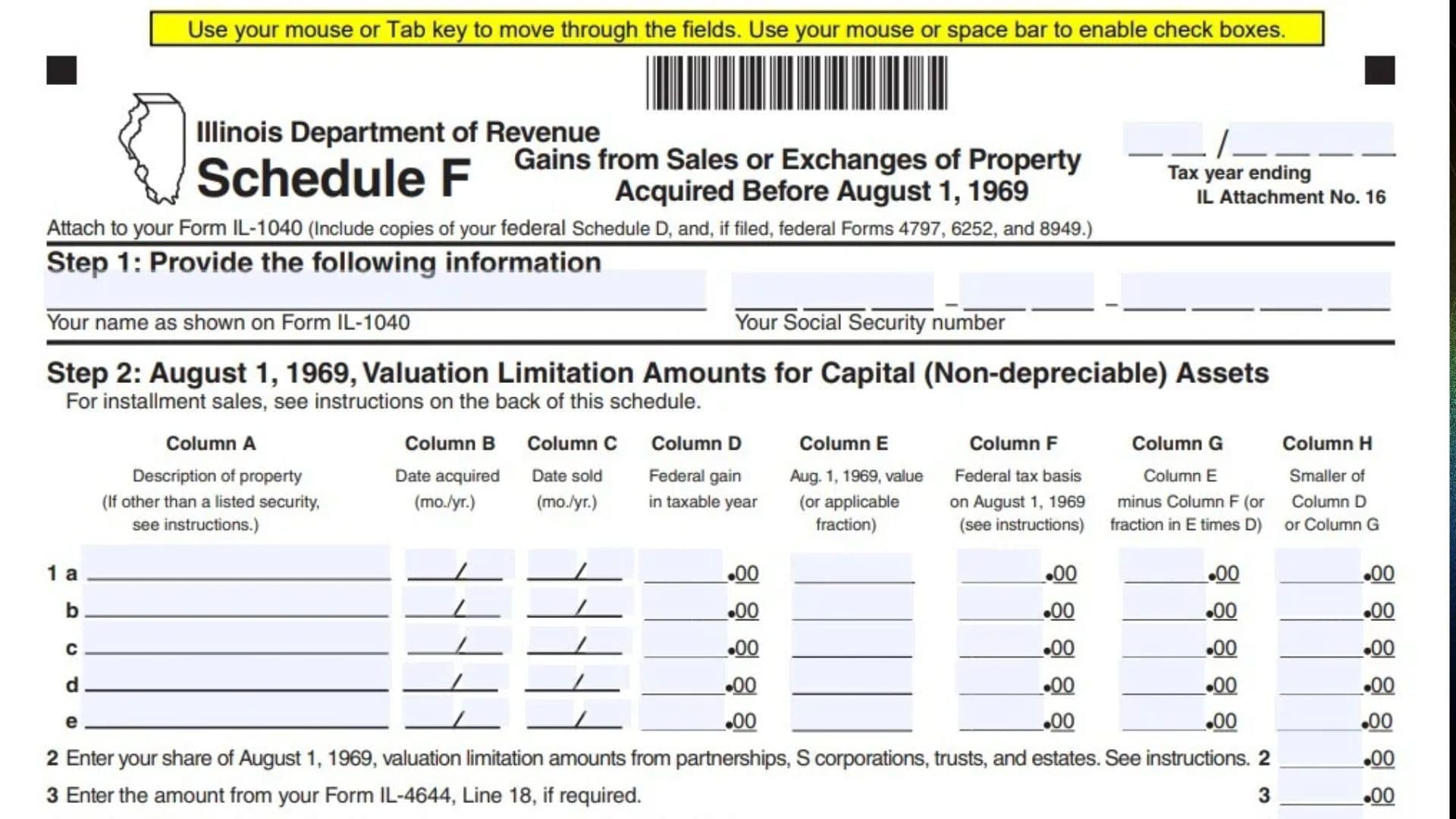
Illinois Form IL-1040 Schedule F, Gains from Sales or Exchanges of Property Acquired Before August 1, 1969, is a tax schedule issued by the Illinois Department of Revenue. It is used by individual taxpayers to calculate the Illinois income tax adjustment associated with gains from selling or exchanging property acquired before August 1, 1969. The schedule establishes the amount of historical property appreciation that may qualify for the August 1, 1969, valuation limitation.
The schedule applies to two main categories of property: capital assets that are not depreciable and property used in a trade or business. These categories require separate calculations because the tax treatment and types of gains involved can differ. The form collects information about each property transaction, including the property’s description, acquisition date, sale date, federal gain, August 1, 1969, value, and federal tax basis on that historical date.
Schedule F also accounts for qualifying valuation limitation amounts received through partnerships, S corporations, trusts, and estates. In addition, taxpayers may need to include amounts from Form IL-4644 when applicable. These figures are combined with federal capital gain information to calculate the final Illinois valuation limitation amount.
The schedule contains a separate procedure for installment sales. The reporting method depends on whether the property was acquired before August 1, 1969, or on or after that date. Taxpayers who report installment sale gains on federal Schedule D, Form 8949, or Form 4797 must follow the special instructions provided on the back of Schedule F.
Completing Schedule F correctly is important because the final calculation determines the amount reported as an addition or subtraction on Illinois Schedule M. The resulting amount is transferred to Schedule M, Other Additions and Subtractions for Individuals, line 23, and is used in calculating the taxpayer’s Illinois income tax.
How To File Illinois Form IL-1040 Schedule F
Schedule F must be attached to your Illinois Form IL-1040.
The schedule also requires supporting federal tax documents. Attach copies of:
- Federal Schedule D.
- Federal Form 4797, if filed.
- Federal Form 6252, if filed.
- Federal Form 8949, if filed.
If you reported an installment sale on federal Form 6252 but were not required to file federal Form 4797, attach a statement explaining that Form 4797 was not required and include a copy of the filed Form 6252.
Information To Prepare Before Completing Schedule F
Gather the following information before starting:
- Your name as reported on Form IL-1040.
- Your Social Security number.
- Tax year-ending date.
- Description of each property sold or exchanged.
- Property acquisition dates and sale dates.
- Federal gain reported during the current tax year.
- Property value as of August 1, 1969, or the applicable fraction.
- Federal tax basis as of August 1, 1969.
- Section 1245, Section 1250, and Section 1231 gain information, if applicable.
- Your share of valuation limitation amounts received through partnerships, S corporations, trusts, and estates.
- Information from Form IL-4644, if required.
- Federal Schedule D and other applicable supporting forms.
- Previous-year installment sale gain information, if applicable.
Keep the historical property valuation and tax basis records available because these figures are essential to the calculations.

How To Complete Illinois Form IL-1040 Schedule F
The schedule contains four main steps:
- Step 1: Provide taxpayer identification information.
- Step 2: Calculate valuation limitation amounts for capital, non-depreciable assets.
- Step 3: Calculate valuation limitation amounts for property used in a trade or business.
- Step 4: Calculate the final August 1, 1969, valuation limitation amount.
Complete all applicable sections and follow the special installment sale instructions when necessary.
Step 1: Provide Taxpayer Information
This section identifies the individual taxpayer filing Schedule F.
Tax Year Ending
Enter the month, day, and year when your Illinois tax year ends.
Use the same tax year as your Form IL-1040.
Your Name as Shown on Form IL-1040
Enter your full name exactly as it appears on your Illinois individual income tax return.
Make sure the spelling and name format match your main tax return.
Your Social Security Number
Enter your nine-digit Social Security number.
Verify that the number matches the identification information reported on Form IL-1040.
Step 2: August 1, 1969, Valuation Limitation Amounts for Capital (Non-Depreciable) Assets
Step 2 is used to calculate the valuation limitation amount for capital assets that are not depreciable. It provides space to report up to five property transactions.
For installment sales, follow the special instructions on the back of the schedule instead of applying the regular column calculations.
Property Information: Columns A Through H
Complete one row for each qualifying property sold or exchanged during the tax year.
Column A: Description of Property
Enter a description of the property that was sold or exchanged.
If the property is a listed security, identify it appropriately. For property other than a listed security, follow the additional description requirements in the applicable instructions.
Column B: Date Acquired
Enter the month and year when you acquired the property.
Use the original acquisition date to establish whether the property was acquired before August 1, 1969.
Column C: Date Sold
Enter the month and year when the property was sold or exchanged.
Use the date associated with the actual disposition.
Column D: Federal Gain in Taxable Year
Enter the federal gain from the sale or exchange that was reported during the current tax year.
Use the applicable federal tax reporting information for the transaction.
Column E: August 1, 1969, Value or Applicable Fraction
Enter the property’s value as of August 1, 1969, or the applicable fraction used in the valuation limitation calculation.
Follow the relevant instructions to determine whether a historical property value or a fraction should be entered.
Column F: Federal Tax Basis on August 1, 1969
Enter the property’s federal tax basis as of August 1, 1969.
Use the historical basis information applicable to the property.
Column G: Difference Between Column E and Column F
Calculate the amount using the applicable method:
- If Column E contains a property value, subtract Column F from Column E.
- If Column E contains an applicable fraction, multiply the fraction in Column E by the federal gain reported in Column D.
Enter the calculated amount in Column G.
Column H: Smaller of Column D or Column G
Compare the amounts in Column D and Column G.
Enter whichever amount is smaller in Column H.
This amount represents the applicable valuation limitation amount for the property transaction.
Additional Capital Asset Calculations: Lines 2 Through 4
Line 2: Share of Valuation Limitation Amounts From Other Entities
Enter your share of August 1, 1969, valuation limitation amounts received through partnerships, S corporations, trusts, and estates.
Use the applicable information provided by those entities to determine your share.
Line 3: Amount From Form IL-4644
Enter the amount reported on Form IL-4644, line 18, if that form is required for your tax situation.
If Form IL-4644 does not apply, follow the applicable instructions for this line.
Line 4: Total Capital Asset Valuation Limitation Amount
Add the amounts reported on lines 1 through 3.
Line 1 represents the applicable total from the property transactions reported in Step 2.
Enter the combined amount on line 4.
Transfer this amount to Step 4, line 9.
Step 3: August 1, 1969, Valuation Limitation Amounts for Property Used in Trade or Business
Step 3 calculates the valuation limitation amount for property used in a trade or business.
Unlike Step 2, this section separately identifies Section 1245 and Section 1250 gains and Section 1231 gains. It also provides separate calculations for the applicable historical property value, federal tax basis, and allowable gain amounts.
The schedule provides space for up to five property transactions.
For installment sales, follow the special instructions on the back of Schedule F.
Property Information and Gain Calculations: Columns A Through I
Column A: Description of Property
Enter a description of the property used in your trade or business that was sold or exchanged.
Identify each property clearly so that the transaction can be distinguished from other reported assets.
Column B: Date Acquired
Enter the month and year when you acquired the property.
Use the original acquisition date.
Column C: Date Sold
Enter the month and year when the property was sold or exchanged.
Column D: Federal Gain in Taxable Year
Enter the federal gain from the property reported during the current tax year.
Use the applicable federal tax reporting information.
Column D1: Section 1245 and Section 1250 Gain
Enter the applicable Section 1245 and Section 1250 gain reported for the property.
Use the relevant federal tax information to determine the amount.
Column D2: Section 1231 Gain
Enter the Section 1231 gain associated with the property transaction.
Use the applicable federal reporting information.
Column E: August 1, 1969, Value or Applicable Fraction
Enter the property’s value as of August 1, 1969, or the applicable fraction used for the calculation.
Follow the applicable instructions to determine the correct entry.
Column F: Federal Tax Basis on August 1, 1969
Enter the property’s federal tax basis as of August 1, 1969.
Use the applicable historical tax basis information.
Column G: Column E Minus Column F or Fraction in Column E Times Column D
Calculate the amount using the appropriate method:
- If Column E contains a property value, subtract Column F from Column E.
- If Column E contains an applicable fraction, multiply that fraction by the federal gain reported in Column D.
Enter the calculated result in Column G.
Column H: Smaller of Column D1 or Column G
Compare the Section 1245 and Section 1250 gain reported in Column D1 with the amount in Column G.
Enter whichever amount is smaller in Column H.
Column I: Smaller of Column G Minus Column H or Column D2
First subtract Column H from Column G.
Then compare the resulting amount with the Section 1231 gain reported in Column D2.
Enter whichever amount is smaller in Column I.
Additional Business Property Calculations: Lines 6 Through 8
Line 6: Share of Valuation Limitation Amounts From Other Entities
Enter your share of August 1, 1969, valuation limitation amounts received from partnerships, S corporations, trusts, and estates.
The schedule provides separate amount fields corresponding to the applicable Column H and Column I categories.
Enter the appropriate amounts in their respective fields.
Line 7: Total Section 1245, Section 1250, and Section 1231 Valuation Limitation Amount
Add the amounts in Column H for lines 5 and 6.
Enter the total on line 7.
Transfer this amount to Step 4, line 16.
Line 8: Total Remaining Valuation Limitation Amount
Add the amounts in Column I for lines 5 and 6.
Enter the total on line 8.
Transfer this amount to Step 4, line 10 only if federal Form 1040 or Form 1040-SR, Schedule D, line 11, shows a gain.
If there is no gain reported on that federal line, follow the applicable instructions and do not transfer the amount to line 10.
Step 4: August 1, 1969, Valuation Limitation Amount
Step 4 must be completed by all taxpayers filing Schedule F.
It combines the amounts calculated in Steps 2 and 3 with federal net capital gain and applicable information from Form IL-4644.
Line 9: Amount From Line 4
Transfer the total amount reported on Step 2, line 4, to line 9.
Do not recalculate the amount.
Line 10: Amount From Line 8
Transfer the amount reported on Step 3, line 8, to line 10.
Enter this amount only if federal Form 1040 or Form 1040-SR, Schedule D, line 11, shows a gain.
Line 11: Combined Valuation Limitation Amounts
Add the amounts reported on lines 9 and 10.
Enter the combined amount on line 11.
Line 12: Federal Net Capital Gain
Enter your net capital gain from federal Form 1040 or Form 1040-SR, Schedule D, line 16.
If there is no net capital gain, enter zero.
Use the amount reported on the applicable federal tax return.
Line 13: Amount From Form IL-4644
Enter the amount reported on Form IL-4644, line 13, if that form is required.
If Form IL-4644 does not apply, follow the applicable instructions.
Line 14: Net Capital Gain After Form IL-4644 Adjustment
Subtract the amount on line 13 from the amount on line 12.
If the amount on line 13 is equal to or greater than the amount on line 12, enter zero.
Enter the resulting amount on line 14.
Line 15: Allowable Capital Gain Valuation Limitation Amount
Compare the amounts reported on lines 11 and 14.
Enter whichever amount is smaller on line 15.
Line 16: Amount From Line 7
Transfer the amount reported on Step 3, line 7, to line 16.
Use the previously calculated amount without recalculating it.
Line 17: Final August 1, 1969, Valuation Limitation Amount
Add the amounts reported on lines 15 and 16.
Enter the total on line 17.
Transfer this amount to Illinois Schedule M, Other Additions and Subtractions for Individuals, line 23.
Attach Schedule F to your Form IL-1040.
Installment Sales: Special Reporting Instructions
The back of Schedule F contains special procedures for reporting installment sales involving property acquired before August 1, 1969, and property acquired on or after that date.
If you reported installment sale gains on federal Form 1040 or Form 1040-SR, Schedule D, federal Form 8949, or federal Form 4797, follow the appropriate instructions below.
Additional Federal Form 6252 Requirement
If you filed federal Form 6252 for federal tax purposes but were not required to file federal Form 4797, attach both of the following to Schedule F:
- A statement explaining that you were not required to file federal Form 4797.
- A copy of federal Form 6252 as filed.
Installment Sales of Property Acquired Before August 1, 1969
For installment sales involving property acquired before August 1, 1969, follow these instructions for Step 2 and Step 3.
Step 2, Line 1: Columns A Through C
Complete Columns A, B, and C using the regular Schedule F instructions.
Enter the property description, acquisition date, and sale date.
Step 2, Line 1: Column D
Enter the abbreviation INST in Column D to identify the transaction as an installment sale.
Step 2, Line 1: Columns E Through G
Leave Columns E, F, and G blank.
Do not enter the regular property valuation calculations in these columns for this type of installment sale.
Step 2, Line 1: Column H
Enter the amount of gain from the installment sale reported during the current tax year on federal Form 1040 or Form 1040-SR, Schedule D, or federal Form 8949.
Step 3, Line 5: Columns A Through C
Complete Columns A, B, and C using the regular Schedule F instructions.
Provide the property description, acquisition date, and sale date.
Step 3, Line 5: Column D
Enter INST in Column D to identify the transaction as an installment sale.
Step 3, Line 5: Columns D1 Through G
Leave Columns D1, D2, E, F, and G blank.
Do not complete the regular gain and valuation calculations in these columns for this type of installment sale.
Step 3, Line 5: Column H
Enter the amount of Section 1245 or Section 1250 gain from the installment sale reported during the current year on federal Form 4797 or Form 6252.
Step 3, Line 5: Column I
Enter the Section 1231 gain from the installment sale reported during the current year on federal Form 4797 or Form 6252.
Step 4, Lines 9 Through 17
Complete all applicable calculations using the regular Step 4 instructions.
Installment Sales of Property Acquired On or After August 1, 1969
For installment sales involving property acquired on or after August 1, 1969, the Column G Worksheet must be completed.
Follow these instructions for each applicable transaction.
Step 2, Line 1
Columns A Through F
Complete Columns A through F using the regular Schedule F instructions.
Enter the property description, acquisition and sale dates, federal gain, applicable historical value or fraction, and federal tax basis.
Column G: Amount From the Column G Worksheet
Complete the Column G Worksheet on the back of the schedule.
Enter the amount calculated in Column 5 of the worksheet in Column G of Step 2.
The regular Column G heading does not describe this special installment sale entry, so use the worksheet calculation instead.
Column H
Complete Column H using the regular Schedule F instructions.
Enter the smaller of Column D or Column G.
Step 3, Line 5
Columns A Through F
Complete Columns A through F using the regular Schedule F instructions.
Enter the property description, dates, federal gain, Section 1245 and Section 1250 gain, Section 1231 gain, and applicable valuation information.
Column G: Amount From the Column G Worksheet
Complete the Column G Worksheet on the back of Schedule F.
Transfer the amount from Column 5 of the worksheet to Column G of Step 3.
The regular Column G heading does not describe this installment sale entry.
Columns H and I
Complete Columns H and I using the regular Schedule F instructions.
Calculate the applicable amounts using the Section 1245, Section 1250, and Section 1231 gain information.
Step 4, Lines 9 Through 17
Complete all applicable calculations using the regular Step 4 instructions.
Column G Worksheet for Installment Sales
The Column G Worksheet is used to calculate the amount that must be entered in Column G for installment sales involving property acquired on or after August 1, 1969.
The worksheet provides five transaction rows and five calculation columns.
Column 1: Total Gain
Enter the total federal gain realized from the sale of the property.
Include the entire gain from the transaction, not just the portion reported during the current tax year.
Column 2: Applicable Fraction
Enter the fraction, if any, reported in Column E of Schedule F.
If no fraction applies, leave this column blank.
Column 3: Adjusted Gain Calculation
Calculate the amount using the applicable method:
- If Column 2 contains a fraction, multiply the total gain in Column 1 by that fraction.
- If Column 2 is blank, subtract Column F from Column E on the applicable Schedule F entry.
Enter the calculated amount in Column 3.
Column 4: Total Gain Reported in Prior Years
Enter the total gain from the installment sale that was reported on your federal income tax returns in previous years.
Use the cumulative amount reported before the current tax year.
Column 5: Remaining Gain
Subtract the amount in Column 4 from the amount in Column 3.
If the result is negative, enter zero.
Enter the calculated amount in Column 5.
Transfer this amount to Column G of Step 2 or Step 3, depending on the property transaction being reported.
Final Review Before Filing
Before attaching Schedule F to your Illinois Form IL-1040, review the following checklist to ensure that all information and calculations are complete.
- Your tax year-ending date is correct.
- Your name matches Form IL-1040.
- Your Social Security number is accurate.
- All qualifying capital, non-depreciable property transactions are reported in Step 2.
- Property descriptions are complete.
- Acquisition and sale dates are correctly entered.
- Federal gains are reported accurately.
- August 1, 1969, property values or applicable fractions are correctly entered.
- Historical federal tax basis amounts are accurate.
- Columns G and H in Step 2 are calculated correctly.
- Line 2 includes applicable amounts from partnerships, S corporations, trusts, and estates.
- Line 3 includes the applicable amount from Form IL-4644, line 18.
- Line 4 correctly totals lines 1 through 3.
- All applicable trade or business property transactions are reported in Step 3.
- Section 1245 and Section 1250 gains are correctly entered in Column D1.
- Section 1231 gains are correctly entered in Column D2.
- Columns G, H, and I are calculated correctly.
- Line 6 includes applicable amounts received through other entities.
- Line 7 correctly totals Column H amounts.
- Line 8 correctly totals Column I amounts.
- Line 8 is transferred to Step 4 only when federal Schedule D, line 11, shows a gain.
- Line 9 correctly transfers the amount from line 4.
- Line 10 correctly transfers the applicable amount from line 8.
- Line 11 correctly adds lines 9 and 10.
- Line 12 matches federal Schedule D, line 16, or is zero when there is no net capital gain.
- Line 13 includes the applicable amount from Form IL-4644, line 13.
- Line 14 correctly subtracts line 13 from line 12.
- Line 15 contains the smaller amount from lines 11 and 14.
- Line 16 correctly transfers the amount from line 7.
- Line 17 correctly adds lines 15 and 16.
- Installment sales are reported using the correct special procedures.
- The Column G Worksheet is completed for installment sales acquired on or after August 1, 1969.
- Required federal Form 6252 documentation and explanatory statements are attached when applicable.
- Copies of federal Schedule D and Forms 4797, 6252, and 8949 are attached when applicable.
- The amount from line 17 is transferred to Schedule M, line 23.
- The completed Schedule F is attached to Form IL-1040.
Illinois Form IL-1040 Schedule F helps individual taxpayers calculate the valuation limitation associated with gains from property acquired before August 1, 1969. Accurate historical property values, federal tax basis information, gain classifications, and installment sale calculations are essential to determining the correct amount. Review all applicable sections and supporting federal tax documents before transferring the final amount to Illinois Schedule M, line 23.