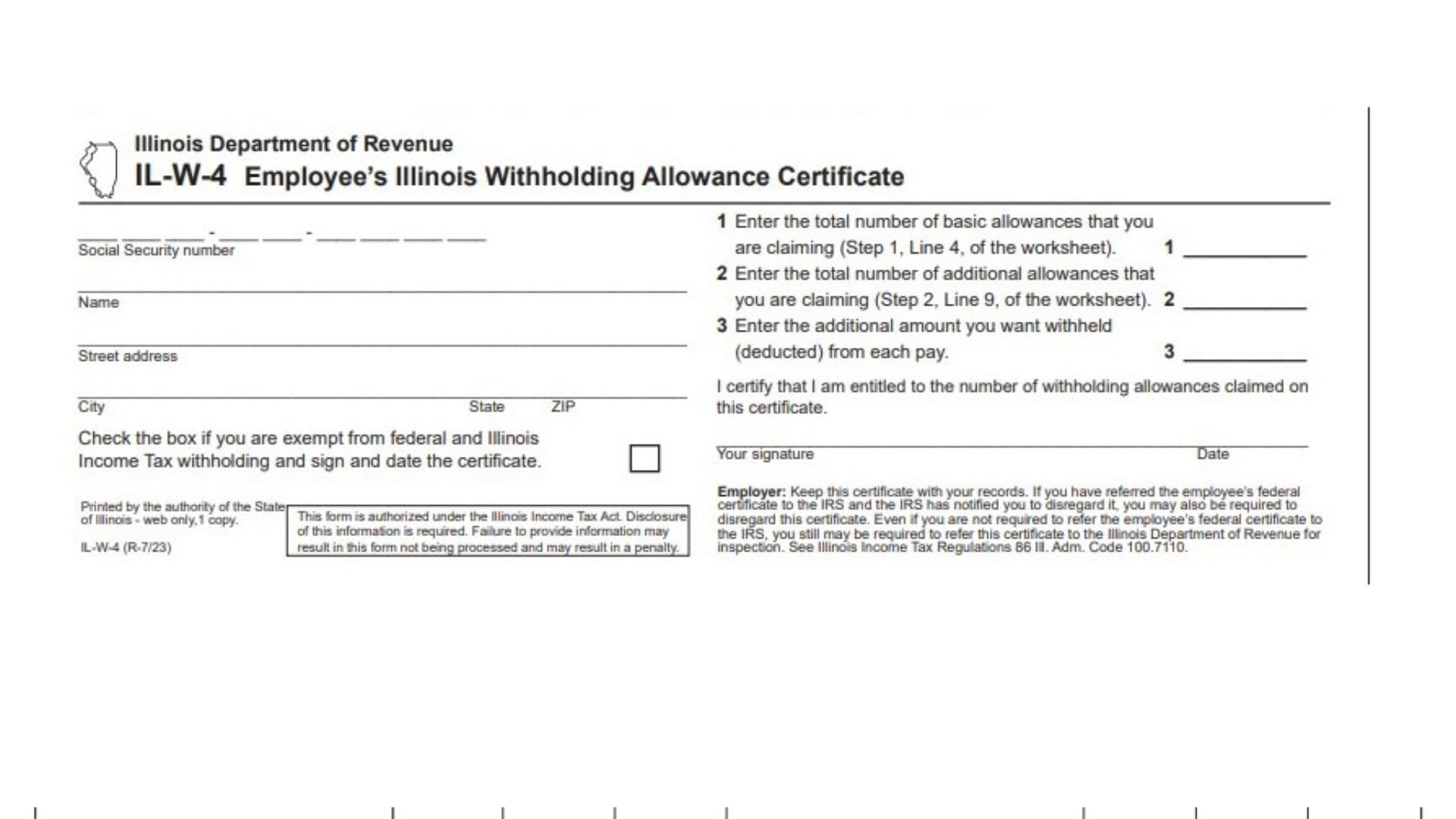
Illinois Form IL-W-4, officially titled Employee’s and Other Payee’s Illinois Withholding Allowance Certificate, is a tax form issued by the Illinois Department of Revenue. It allows employees and certain other payees to tell their employers or payors how much Illinois income tax should be withheld from their compensation. The amount withheld depends partly on the number of withholding allowances claimed on the certificate and whether the taxpayer requests an additional amount to be deducted from each payment.
The form is primarily designed for employees who receive wages subject to Illinois income tax withholding. However, it can also be completed and submitted to a payor when an agreement has been made to voluntarily withhold Illinois income tax from other types of compensation or non-wage Illinois income. Employees should complete the certificate so their employers can calculate the appropriate withholding amount. Even if an employee claims an exemption from federal income tax withholding on federal Form W-4, Illinois withholding may still be required.
Form IL-W-4 contains two main components. The first part provides instructions and an Illinois Withholding Allowance Worksheet. This worksheet helps taxpayers calculate their basic personal allowances and additional allowances based on dependents, age, blindness, and eligible deductions or subtractions. The second part is the actual withholding allowance certificate that employees complete and give to their employers.
The worksheet contains two steps. Step 1 calculates basic personal allowances, including allowances for dependents. Step 2 calculates additional allowances for taxpayers or spouses who are at least 65 years old, legally blind, or eligible for additional deductions and subtractions. The final certificate collects the taxpayer’s Social Security Number, full name, mailing address, number of basic allowances, number of additional allowances, and any additional dollar amount requested for withholding.
Completing Form IL-W-4 correctly is important because the number of allowances directly affects how much Illinois income tax is deducted from each paycheck. Claiming more allowances generally reduces withholding, while claiming fewer allowances increases the amount withheld. Employees who do not submit a properly completed and signed certificate may have Illinois income tax withheld from their entire compensation without any allowance deductions. The form also explains when a new certificate must be submitted, how long it remains valid, and how employees can adjust their withholding to avoid an unexpected tax balance or underpayment penalty.
How To File Illinois Form IL-W-4
Form IL-W-4 should be completed and given directly to your employer on or before the date you begin working when Illinois income tax withholding is required.
If you are an employee, your employer uses the information on the certificate to determine the appropriate amount of Illinois income tax to withhold from your compensation.
If you receive non-wage Illinois income and have an agreement with a payor to voluntarily withhold Illinois income tax, you may also complete and submit this form to that payor.
Who Must Complete Form IL-W-4?
You generally must complete Form IL-W-4 if you are an employee whose compensation is subject to Illinois income tax withholding.
The form helps your employer determine the correct withholding amount based on the allowances you claim.
You may also need to submit a new certificate when your personal circumstances change, such as when:
- Your number of eligible withholding allowances increases.
- Your number of eligible withholding allowances decreases.
- You want to request additional Illinois income tax withholding.
- You need to update your exemption information.
If you do not submit a properly completed and signed Form IL-W-4, your employer must withhold Illinois income tax from your entire compensation without allowing any exemptions.
When Must You Submit Form IL-W-4?
You should complete and provide Form IL-W-4 to your employer on or before your employment start date.
You must submit the form whenever Illinois income tax is required to be withheld from your employee compensation.
You may submit a new Form IL-W-4 whenever your withholding allowances increase.
If your withholding allowances decrease, you must submit a new certificate within 10 days.
However, the death of a spouse or dependent does not change your withholding allowances until the following tax year.
When Does Form IL-W-4 Take Effect?
If your employer does not already have a Form IL-W-4 on file, the new certificate generally becomes effective for the first payment of compensation made after you submit it.
If your employer already has a certificate on file, the employer may allow a change to take effect immediately.
However, the employer is not legally required to implement the change until the first compensation payment made after the beginning of the next calendar quarter that falls at least 30 days after the date you submit the updated form.
The four calendar-quarter starting dates are:
- January 1.
- April 1.
- July 1.
- October 1.
Example:
Suppose you submit a new Form IL-W-4 on September 1 to claim an additional allowance because you have a new baby.
Your employer may immediately adjust your withholding. However, if the employer does not implement the change immediately, the required effective date is the first compensation payment made after October 1.
If you submit the new form on September 2, the employer is not required to implement the change until the first compensation payment made after December 31.
How Long Is Form IL-W-4 Valid?
Your Form IL-W-4 remains valid until:
- A new withholding certificate you submit becomes effective.
- Your employer is required by the Illinois Department of Revenue to disregard the certificate.
An employer must disregard your Form IL-W-4 in certain circumstances.
These include:
- You claim total exemption from Illinois income tax withholding but have not filed a federal Form W-4 claiming total exemption.
- The Internal Revenue Service instructs your employer to disregard your federal Form W-4.
Important Rules For Claiming Exempt Status
If you want to claim exemption from Illinois income tax withholding, you must:
- Check the exempt status box on Form IL-W-4.
- Sign the certificate.
- Enter the date.
Do not complete Lines 1 through 3 when claiming exempt status.
The form also explains that an employee who claims exemption from federal withholding may still be required to have Illinois income tax withheld.
Residents of Iowa, Kentucky, Michigan, or Wisconsin, and qualifying military spouses, should review Form W-5-NR, Employee’s Statement of Nonresidence in Illinois, to determine whether an exemption applies.
Information To Prepare Before Completing Form IL-W-4
Gather the following information before starting:
- Social Security Number.
- Full legal name.
- Complete residential mailing address.
- City, state, and ZIP code.
- Marital and dependent information.
- Number of dependents you expect to claim on your tax return.
- Information about whether someone else can claim you as a dependent.
- Information about whether you can claim your spouse as a dependent.
- Your age and your spouse’s age.
- Disability or legal blindness information, if applicable.
- Amount reported on Line 4 of the federal Form W-4 Deductions Worksheet, if applicable.
- Additional Illinois subtractions or deductions.
- Desired number of basic withholding allowances.
- Desired number of additional withholding allowances.
- Any additional dollar amount you want withheld from each paycheck.

How To Complete Illinois Form IL-W-4
Form IL-W-4 contains an Illinois Withholding Allowance Worksheet and an Employee’s Illinois Withholding Allowance Certificate.
Complete the worksheet first to determine the number of allowances you are entitled to claim. Then transfer the selected amounts to the certificate that you give to your employer.
Illinois Withholding Allowance Worksheet
The Illinois Withholding Allowance Worksheet appears on page 2.
Use this worksheet to calculate your basic personal allowances and additional allowances.
You must complete Step 1.
Complete Step 2 if:
- You or your spouse is at least 65 years old or legally blind.
- You entered an amount on Line 4 of the Deductions Worksheet for federal Form W-4.
If you have more than one job or your spouse also works, the form recommends claiming all your allowances on the IL-W-4 associated with the highest-paying job and claiming zero allowances on your other Illinois withholding certificates.
Step 1: Figure Your Basic Personal Allowances
Step 1 determines the number of basic personal allowances you may claim, including allowances for dependents.
The first part contains two checkboxes and four numbered lines.
No One Else Can Claim Me As A Dependent
Check this box if another person cannot claim you as a dependent on their income tax return.
For example, if your parents cannot claim you as a dependent, select this option.
Leave it unchecked if another person is entitled to claim you as a dependent.
I Can Claim My Spouse As A Dependent
Check this box if you can claim your spouse as a dependent under the applicable tax rules.
Select this option only when it applies to your circumstances.
Line 1: Total Number Of Boxes You Checked
Count the number of checkboxes you selected in Step 1.
There are two possible checkboxes:
- No one else can claim me as a dependent.
- I can claim my spouse as a dependent.
Enter the total number of selected boxes on Line 1.
If you checked one box, enter 1. If you checked both, enter 2. If neither applies, enter 0.
Line 2: Number Of Dependents Other Than You Or Your Spouse
Enter the number of dependents you expect to claim on your Illinois income tax return, excluding yourself and your spouse.
Count only the dependents you are entitled to claim.
Enter the total number on Line 2.
Line 3: Total Basic Personal Allowances
Add the amounts entered on Lines 1 and 2.
The calculation is:
Line 3 = Line 1 + Line 2.
Enter the result on Line 3.
This is the total number of basic personal allowances you are entitled to claim.
You are not required to claim all the allowances calculated on this line.
The number you actually claim determines how much Illinois income tax is withheld from your compensation.
Line 4: Basic Personal Allowances You Choose To Claim
Enter the total number of basic personal allowances you want to claim.
The number entered on Line 4 must not exceed the amount calculated on Line 3.
However, you may choose to claim fewer allowances, including zero.
Enter this amount on Line 4 of the worksheet and transfer the same number to Line 1 of the Form IL-W-4 certificate.
Claiming fewer basic allowances generally results in more Illinois income tax being withheld from each paycheck.
Step 2: Figure Your Additional Allowances
Step 2 calculates additional withholding allowances based on age, legal blindness, and eligible deductions or subtractions.
Complete this section when it applies to you or your spouse.
I Am 65 Or Older
Check this box if you are at least 65 years old.
I Am Legally Blind
Check this box if you are legally blind.
My Spouse Is 65 Or Older
Check this box if your spouse is at least 65 years old.
My Spouse Is Legally Blind
Check this box if your spouse is legally blind.
Select every applicable checkbox.
Line 5: Total Number Of Boxes You Checked
Count the number of checkboxes selected in Step 2.
The available categories are:
- Taxpayer age 65 or older.
- Taxpayer legally blind.
- Spouse age 65 or older.
- Spouse legally blind.
Enter the total number of selected boxes on Line 5.
Line 6: Additional Deductions And Illinois Subtractions
Enter the amount reported on Line 4 of the Deductions Worksheet for federal Form W-4.
Add any additional Illinois subtractions or deductions that apply.
The calculation is:
Line 6 = Federal Form W-4 Deductions Worksheet, Line 4 + Additional Illinois Subtractions Or Deductions.
Enter the combined amount on Line 6.
If you have no applicable amount to report, enter zero.
Line 7: Additional Allowances From Deductions
Divide the amount on Line 6 by $1,000.
Round the result to the nearest whole number.
The calculation is:
Line 7 = Line 6 ÷ $1,000.
For example, if Line 6 is $5,600:
$5,600 ÷ $1,000 = 5.6.
Rounded to the nearest whole number, the result is 6.
Enter the rounded amount on Line 7.
Line 8: Total Additional Allowances
Add Lines 5 and 7.
The calculation is:
Line 8 = Line 5 + Line 7.
Enter the result on Line 8.
This represents the total number of additional withholding allowances you are entitled to claim.
You are not required to claim all the allowances calculated on this line.
Line 9: Additional Allowances You Choose To Claim
Enter the number of additional allowances you elect to claim.
The number entered on Line 9 cannot exceed the amount calculated on Line 8.
You may claim fewer allowances, including zero.
Transfer this amount to Line 2 of the Form IL-W-4 certificate.
Claiming fewer additional allowances generally increases the amount of Illinois income tax withheld from your compensation.
Important Additional Withholding Instruction
If you want your employer to withhold an additional dollar amount from every paycheck, you can enter that amount on Line 3 of the Form IL-W-4 certificate.
This additional amount is deducted from each payment in addition to the withholding calculated using your selected allowances.
Employee’s Illinois Withholding Allowance Certificate
After completing the worksheet, detach the certificate at the bottom of page 2 and give it to your employer.
The certificate contains your personal identification information, withholding allowance selections, additional withholding request, and signature.
Complete each field carefully.
Employee Identification Information
Social Security Number
Enter your Social Security Number in the designated field.
Use the correct number associated with your employment and Illinois tax records.
Name
Enter your complete legal name.
Make sure the name matches your identification and payroll records.
Street Address
Enter your complete residential street address.
Include the street number and street name.
City
Enter the city where you reside.
State
Enter the appropriate state abbreviation.
ZIP
Enter your ZIP code.
Make sure the city, state, and ZIP code match your mailing address.
Withholding Allowance Calculation
Line 1: Basic Personal Allowances
Enter the total number of basic personal allowances you selected on Step 1, Line 4 of the Illinois Withholding Allowance Worksheet.
Do not enter the total from Step 1, Line 3 unless you have elected to claim that entire amount.
The number entered here determines the basic personal allowances used in your Illinois withholding calculation.
Line 2: Additional Allowances
Enter the total number of additional allowances you selected on Step 2, Line 9 of the worksheet.
This amount represents the additional allowances you have elected to claim based on age, legal blindness, and eligible deductions or subtractions.
Make sure it does not exceed the amount calculated on Step 2, Line 8.
Line 3: Additional Amount To Be Withheld From Each Paycheck
Enter the additional dollar amount you want your employer to deduct from each compensation payment.
This amount is separate from the withholding calculated using your basic and additional allowances.
For example, if you want an additional $25 withheld from each paycheck, enter $25 on Line 3.
You can use this option to increase withholding and reduce the possibility of owing additional Illinois income tax when you file your annual return.
Exemption From Federal And Illinois Income Tax Withholding
Exempt Status Checkbox
Check this box only if you are claiming exemption from both federal and Illinois income tax withholding under the applicable requirements.
If you select this option, you must sign and date the certificate.
Do not complete Lines 1, 2, or 3 when claiming exempt status.
Remember that claiming exemption from federal withholding does not automatically make you exempt from Illinois income tax withholding.
Employee Certification And Signature
Your Signature
Sign the certificate to confirm that you are entitled to the number of withholding allowances claimed.
The signature certifies that the information provided on the form is accurate.
An unsigned certificate may not be processed correctly.
Date
Enter the date on which you sign the certificate.
Use the actual signing date.
Give the completed certificate to your employer after signing.
Employer Instructions
The bottom portion of Form IL-W-4 also contains instructions for employers.
Employer: Keep This Certificate With Your Records
The employer must retain the completed certificate in its records.
The certificate should be available for review when required.
Federal Certificate Referred To The IRS
If the employer has referred the employee’s federal withholding certificate to the Internal Revenue Service and the IRS has notified the employer to disregard it, the employer may also be required to disregard the Illinois certificate.
Illinois Department Of Revenue Inspection
Even if the employer is not required to refer the employee’s federal certificate to the IRS, the employer may still be required to submit the Illinois certificate to the Illinois Department of Revenue for inspection.
The form refers employers to Illinois Income Tax Regulations, 86 Ill. Adm. Code 100.7110, for additional requirements.
Important Illinois Withholding Rules
Before submitting Form IL-W-4, review the following rules to understand how your allowances affect withholding and your annual tax liability.
How Do Withholding Allowances Work?
An exemption is a dollar amount that is not subject to Illinois income tax under the applicable tax rules.
An allowance represents an amount used to determine the withholding exemption you may claim through Form IL-W-4.
As an employee, you generally receive one basic personal allowance unless another person can claim you as a dependent.
If you are married, you may qualify for additional allowances for your spouse and dependents that you are entitled to claim for federal income tax purposes.
You may also qualify for additional allowances if you or your spouse is at least 65 years old or legally blind.
What Happens If You Do Not Submit Form IL-W-4?
Your employer must withhold Illinois income tax from your entire compensation without allowing any exemptions if:
- You do not submit a completed Form IL-W-4.
- You fail to sign the certificate.
- You fail to provide all required information.
- You alter the certificate.
Always review the form before submitting it to ensure that all applicable fields are complete.
How Can You Avoid Underpaying Illinois Income Tax?
The form explains two ways to reduce the possibility of underpaying your Illinois income tax.
Reduce Your Number Of Allowances
You may claim fewer allowances than the total calculated on the worksheet.
Reducing your allowances generally increases the amount of Illinois income tax withheld from your paycheck.
Request Additional Withholding
You can enter an additional dollar amount on Line 3 of the certificate.
Your employer will deduct this amount from each compensation payment in addition to the regular withholding.
This can be particularly useful if you have other taxable income that is not subject to withholding.
Additional Tax Liability From Non-Wage Income
Even if your employer withholds enough Illinois income tax to cover the tax on your wages, you may still owe additional tax on other taxable income.
Examples include:
- Interest earned from bank accounts.
- Dividends from investments.
If you owe more than $1,000 in tax at the end of the year, you may be subject to a late-payment penalty or may be required to make estimated tax payments.
For additional penalty information, refer to Illinois Publication 103, Uniform Penalties and Interest.
Special Rule For High-Income Taxpayers
For tax years beginning on or after January 1, 2017, the personal exemption allowance and additional allowances for taxpayers or spouses who are at least 65 years old or legally blind may not be claimed on Form IL-1040 when adjusted gross income exceeds the applicable threshold.
The thresholds are:
- $500,000 for taxpayers filing married filing jointly.
- $250,000 for all other filing statuses.
The form indicates that taxpayers may complete a new Form IL-W-4 to update their exemption amounts and increase Illinois withholding.
Special Rule For Residents Working In Non-Reciprocal States
If you are an Illinois resident working for an employer in a state that does not have a reciprocal withholding agreement with Illinois, your withholding circumstances may require additional attention.
If you work from home or at locations in Illinois for more than 30 working days, you may need to adjust your withholding or begin making estimated tax payments.
Refer to the Illinois Department of Revenue website for additional information.
Special Rule For Residents Of Reciprocal States
Residents of Iowa, Kentucky, Michigan, or Wisconsin, as well as qualifying military spouses, should review Form W-5-NR, Employee’s Statement of Nonresidence in Illinois, to determine whether they qualify for an exemption from Illinois withholding.
Where To Get Help With Illinois Form IL-W-4
If you need assistance completing Form IL-W-4, calculating withholding allowances, or understanding Illinois income tax withholding requirements, contact the Illinois Department of Revenue.
Website: tax.illinois.gov
Taxpayer Assistance Division:
- 1-800-732-8866.
- 217-782-3336.
TDD (Telecommunications Device For The Deaf):
- 1-800-544-5304.
Mailing Address:
Illinois Department of Revenue
P.O. Box 19044
Springfield, IL 62794-9044
For additional information about underpayment penalties, consult Publication 103, Uniform Penalties and Interest.
Final Review Before Filing
Before submitting Illinois Form IL-W-4 to your employer, review the worksheet and certificate to ensure that all information and withholding selections are correct.
Use the following checklist:
- Enter your correct Social Security Number.
- Enter your full legal name.
- Provide your complete street address.
- Enter your city, state, and ZIP code.
- Complete Step 1 of the Illinois Withholding Allowance Worksheet.
- Check the box indicating that no one else can claim you as a dependent, if applicable.
- Check the box indicating that you can claim your spouse as a dependent, if applicable.
- Calculate the total number of selected boxes on Line 1.
- Enter the number of dependents other than yourself or your spouse on Line 2.
- Add Lines 1 and 2 on Line 3.
- Select the number of basic allowances you want to claim on Line 4.
- Complete Step 2 if you or your spouse is at least 65 years old or legally blind, or if the applicable deductions worksheet amount requires it.
- Check all applicable age and legal blindness boxes.
- Count the selected boxes on Line 5.
- Enter eligible federal deductions and Illinois subtractions on Line 6.
- Divide Line 6 by $1,000 and round the result on Line 7.
- Add Lines 5 and 7 on Line 8.
- Select the additional allowances you want to claim on Line 9.
- Transfer Step 1, Line 4, to certificate Line 1.
- Transfer Step 2, Line 9, to certificate Line 2.
- Enter an additional withholding amount on certificate Line 3 if desired.
- Check the exempt status box only if you qualify for both federal and Illinois withholding exemption.
- Leave Lines 1 through 3 blank if claiming exempt status.
- Sign and date the certificate.
- Give the completed certificate to your employer.
- Keep the worksheet for your personal records.
- Submit a new certificate within 10 days if your withholding allowances decrease.
- Review your withholding if you have multiple jobs or a working spouse.
- Consider additional withholding if you have taxable non-wage income.
- Review applicable Illinois reciprocal-state and nonresident withholding rules.
Final Note: Illinois Form IL-W-4 helps employees and other eligible payees determine the appropriate amount of Illinois income tax withheld from their compensation. Accurate completion requires calculating basic and additional allowances, entering the correct withholding selections, and signing the certificate before submitting it to the employer. Review your withholding whenever your personal or financial circumstances change to help ensure that enough Illinois income tax is paid throughout the year.