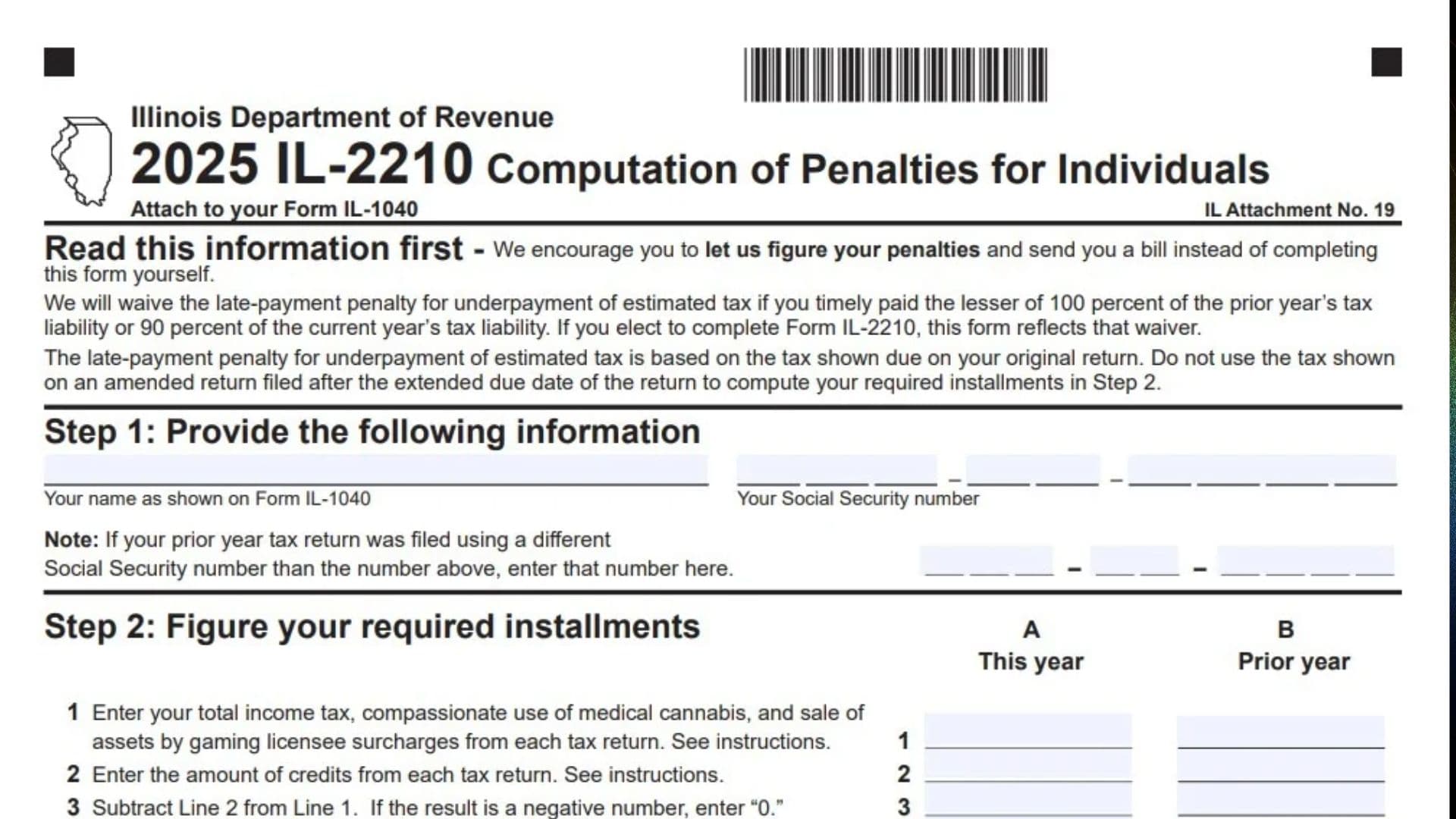
Form IL-2210, officially called Computation of Penalties for Individuals, is an Illinois Department of Revenue tax form used to calculate penalties related to underpayment of estimated income tax, unpaid taxes, and late filing. It helps individual taxpayers determine whether they owe additional penalties because they did not pay enough Illinois income tax throughout the tax year or did not pay their tax liability by the required deadlines.
The form is designed for individuals filing an Illinois individual income tax return using Form IL-1040. It collects information about current-year and prior-year tax liabilities, tax credits, Illinois withholding, pass-through withholding, estimated tax payments, and payment dates. Taxpayers use this information to determine their required quarterly installments and identify whether any installment was paid late or in an insufficient amount.
Form IL-2210 also provides calculations for unpaid tax penalties and late-filing penalties. Its worksheets help taxpayers calculate the applicable penalty based on unpaid balances, payment dates, and the number of days a payment was late. Additionally, the form includes an annualization worksheet for individuals whose income was not received evenly throughout the year. This method can help calculate required installments more accurately when income was earned during different periods rather than consistently throughout the year.
The Illinois Department of Revenue encourages taxpayers to allow the department to calculate applicable penalties and send a bill instead of completing Form IL-2210 themselves. However, individuals who choose to calculate their penalties can use this form to determine the amounts that should be reported with their Illinois income tax return.
Completing the form accurately is important because incorrect tax amounts, withholding information, payment dates, or installment calculations can lead to an incorrect penalty amount. Taxpayers should use their original return information and payment records when completing the calculations. The form also provides a waiver of the estimated-tax underpayment penalty when the taxpayer timely paid the lesser of 100% of the prior year’s tax liability or 90% of the current year’s tax liability. When the taxpayer elects to complete Form IL-2210, the form reflects this waiver.
How To File Form IL-2210
Form IL-2210 is attached to Form IL-1040, the Illinois Individual Income Tax Return. It is identified as Illinois Attachment No. 19. Taxpayers use it to calculate applicable penalties and determine the final amount owed or overpaid.
Before completing the form, gather the following information:
- Your current-year Illinois income tax return information.
- Your prior-year Illinois income tax return information.
- Your Social Security number and, if applicable, your previous Social Security number.
- W-2 and 1099 forms showing Illinois income tax withholding.
- Records of pass-through withholding paid on your behalf.
- Records of estimated Illinois income tax payments.
- Information about Form IL-505-I payments.
- Records of tax credits carried forward from previous years.
- Dates and amounts of all tax payments.
- Household employment tax and use tax amounts reported on Form IL-1040.
- Information about your income received during different periods of the tax year if you intend to use the annualized income installment method.
Use the original tax return amounts when calculating required installments. The estimated-tax underpayment penalty is based on the tax shown due on the original return. Do not use tax amounts from an amended return filed after the extended return due date to calculate the required installments in Step 2.
The form contains six main steps and two penalty worksheets. Complete the applicable sections in order and transfer the calculated amounts to the corresponding lines.

How To Complete Form IL-2210
Step 1: Provide Your Personal Information
The first step identifies the taxpayer associated with the Illinois income tax return. Make sure the information matches your Form IL-1040.
Your Name
Enter your full name exactly as it appears on your Form IL-1040. Use the same taxpayer name shown on the Illinois income tax return to ensure the penalty calculation is associated with the correct return.
Your Social Security Number
Enter your Social Security number in the designated space. Verify that the number matches the identification information on your Form IL-1040.
Previous Social Security Number
If your prior-year Illinois income tax return was filed using a different Social Security number, enter that previous number in the additional identification field. If the number has not changed, this additional information is not applicable.
Step 2: Figure Your Required Installments
Step 2 determines how much Illinois estimated income tax you were required to pay during the year. It compares current-year tax information with prior-year tax information and calculates the required quarterly installments.
This section contains two main columns:
- Column A: Current-year information.
- Column B: Prior-year information.
Complete the applicable entries using your tax returns and payment records.
Line 1: Total Income Tax and Applicable Surcharges
Enter the total income tax and applicable surcharges reported on each tax return.
Include the income tax amount, the compassionate use of medical cannabis surcharge, and the sale-of-assets-by-gaming-licensee surcharge.
Enter the current-year amount in Column A and the prior-year amount in Column B.
Line 2: Total Credits
Enter the amount of credits reported on each tax return.
Use the applicable credit information from the current-year return for Column A and the prior-year return for Column B. Refer to the form instructions when determining which credits should be included.
Line 3: Tax After Credits
Subtract Line 2 from Line 1 in each column.
The calculation is:
Tax After Credits = Line 1 − Line 2
If the result is negative, enter zero instead. Complete the calculation separately for the current-year and prior-year columns.
Line 4a: Illinois Income Tax Withholding
Enter the total Illinois income tax withheld during the current tax year.
Use the withholding amounts reported on your W-2 and 1099 forms. Add the applicable Illinois withholding amounts together and enter the total in Line 4a.
Line 4b: Pass-Through Withholding
Enter the total amount of Illinois pass-through withholding paid on your behalf.
Use the relevant withholding information provided by the pass-through entity or other applicable tax records.
Line 4c: Total Withholding
Add the amounts entered on Lines 4a and 4b.
The calculation is:
Line 4c = Line 4a + Line 4b
Enter the combined withholding amount.
Line 5: Remaining Tax After Withholding
Subtract Line 4c from Line 3.
The calculation is:
Line 5 = Line 3 − Line 4c
This amount represents the remaining tax after accounting for the applicable current-year withholding.
Line 6: Ninety Percent of Current-Year Tax
Multiply the amount in Column A, Line 3, by 90% (0.90).
The calculation is:
Line 6 = Column A, Line 3 × 0.90
Enter the result in the appropriate space.
Line 7: Required Annual Estimated Tax Amount
First, check whether the amount on Line 5 is $1,000 or less. Also determine whether you are required to make estimated tax payments.
If Line 5 is $1,000 or less, enter zero and continue to Step 3.
If you are not required to make estimated tax payments, enter zero and continue to Step 3.
Otherwise, compare Column A, Line 6, with Column B, Line 3. Enter the smaller of these two amounts.
This calculation determines the annual amount used to establish your required estimated tax installments.
Line 8: Required Quarterly Installment
Divide the amount entered on Line 7 by four.
The calculation is:
Line 8 = Line 7 ÷ 4
The result represents the amount of each required quarterly installment when using the regular installment method.
If you use the annualized income installment method because your income was not received evenly throughout the year, follow Step 6 to calculate the applicable installment amounts.
Quarterly Installment Information
The next part of Step 2 records the required installments, withholding, pass-through payments, and installment balances for four quarters.
The form identifies the following quarterly due dates:
- Quarter 1: The 15th day of the fourth month of the tax year.
- Quarter 2: The 15th day of the sixth month of the tax year.
- Quarter 3: The 15th day of the ninth month of the tax year.
- Quarter 4: The 15th day of the first month following the end of the tax year.
Enter the applicable calendar dates in the corresponding quarter columns.
Line 9a: Quarterly Installment Due Dates
Enter the due date for each required quarterly installment.
Use the applicable dates for all four quarters. Refer to the form instructions when determining the actual calendar due dates for the tax year.
Line 9b: Required Quarterly Installments
Enter the required installment amount for each quarter.
Under the regular installment method, use the amount calculated on Line 8. If you are using the annualized income installment method, use the amounts calculated in Step 6, Line 56, for the corresponding periods.
Line 10a: Tax Withholding
Enter the amount of Illinois income tax withheld and allocated to each quarter.
Use the applicable withholding information from your W-2 and 1099 records. Distribute the amounts to the appropriate quarterly periods based on the applicable payment dates and instructions.
Line 10b: Pass-Through Withholding
Enter the amount of pass-through withholding allocated to each quarter.
Use the applicable pass-through withholding records to determine the amounts for each period.
Line 10c: Total Quarterly Withholding
Add Line 10a and Line 10b for each quarter.
The calculation is:
Line 10c = Line 10a + Line 10b
Enter the combined withholding amount in each quarterly column.
Line 11: Quarterly Underpayment or Overpayment
Subtract Line 10c from Line 9b for each quarter.
The calculation is:
Line 11 = Line 9b − Line 10c
If the result is negative, enter the amount in brackets. A negative amount indicates that the withholding exceeds the required installment.
Line 12: Previous Quarter’s Underpayment Adjustment
Review Line 13 from the previous quarter.
If the previous quarter’s Line 13 amount is negative, enter that amount as a positive number in the current quarter’s Line 12.
If the previous quarter’s Line 13 amount is zero or positive, enter zero.
Do not complete this line for Quarter 1 because there is no preceding quarter.
Line 13: Remaining Quarterly Underpayment or Overpayment
Subtract Line 12 from Line 11 for each quarter.
The calculation is:
Line 13 = Line 11 − Line 12
If the result is negative, enter it in brackets.
This amount reflects the remaining installment balance after accounting for the applicable previous-quarter adjustment. You will use these amounts when completing the estimated-tax underpayment penalty worksheet in Step 4.
Step 3: Figure Your Unpaid Tax
Step 3 calculates the unpaid Illinois tax balance by combining the applicable tax amounts and comparing them with payments made by the original tax return due date.
Line 14: Income Tax After Credits
Enter the amount from Column A, Line 3.
This is your current-year income tax after subtracting the applicable credits.
Line 15: Household Employment Tax
Enter the household employment tax amount reported on Form IL-1040, Line 20.
Use the amount shown on the corresponding line of your Illinois income tax return.
Line 16: Use Tax
Enter the use tax amount reported on Form IL-1040, Line 21.
Use the amount from your completed Illinois income tax return.
Line 17: Total Tax Before Payments
Add the amounts on Lines 14, 15, and 16.
The calculation is:
Line 17 = Line 14 + Line 15 + Line 16
Enter the combined total.
Line 18: Total Payments Made by the Original Due Date
Calculate the total amount of payments made on or before the original due date of your tax return.
Include the following amounts:
- Tax credits carried forward from a previous year.
- Estimated tax payments made during the current year.
- Payments made using Form IL-505-I.
- Pass-through withholding paid on your behalf.
- Illinois income tax withholding reported on your W-2 and 1099 forms.
Next, compare the total payments with the combined required installments reported on Line 9b for Quarters 1 through 4.
Enter the greater of these two amounts on Line 18.
Only include payments that meet the applicable original-due-date requirement.
Line 19: Unpaid Tax Balance
Subtract Line 18 from Line 17.
The calculation is:
Line 19 = Line 17 − Line 18
If the result is positive, enter the amount as a positive number. Transfer this amount to Penalty Worksheet 2, Line 23, Column C, and continue to Step 4.
If the result is zero or negative, enter the calculated amount. Use brackets if the result is negative.
This line establishes the amount used to calculate the late-payment penalty for unpaid tax.
Step 4: Figure Your Late-Payment Penalty
Step 4 calculates late-payment penalties using two separate worksheets.
- Penalty Worksheet 1 calculates the penalty for underpayment of estimated tax.
- Penalty Worksheet 2 calculates the penalty for unpaid tax.
Follow the worksheets in order and use the applicable payment dates and amounts. Incorrect payment dates can affect the number of days late and the resulting penalty.
Line 20: Payment Amounts and Payment Dates
Enter the amount and payment date for each payment you made.
Include applicable tax credits carried forward from a previous year.
The form provides twelve payment entries, identified from A through L. Use these spaces to report the applicable payment amounts and their corresponding dates.
If you have additional payments, use the available entries as appropriate and follow the form instructions for reporting all applicable payments.
Penalty Rates
The form provides two penalty rates based on the number of days a payment is late.
| Number of Days Late | Penalty Rate |
|---|---|
| 1–30 days | 2% (0.02) |
| 31 days or more | 10% (0.10) |
Use the applicable rate when completing the penalty worksheets.
Penalty Worksheet 1: Late-Payment Penalty for Underpayment of Estimated Tax
This worksheet calculates the late-payment penalty associated with insufficient estimated tax installments.
If you paid the required amount shown on Line 13 by the payment due date for every quarter, you do not need to complete this worksheet.
Line 21: Calculate the Quarterly Estimated-Tax Penalty
Begin by entering the unpaid amounts from Line 13 for Quarters 1 through 4 in Column C.
Enter each quarter’s unpaid amount on the first available line in the corresponding quarterly section.
If you have more than four payments to apply to any quarter, prepare a separate sheet using the same worksheet format and attach it to Form IL-2210.
The worksheet contains nine columns:
Column A: Period
Identify the applicable quarter. The worksheet provides separate sections for Quarter 1, Quarter 2, Quarter 3, and Quarter 4.
Column B: Due Date
Enter the required installment due date for the corresponding quarter.
Use the due dates reported in Step 2, Line 9a.
Column C: Unpaid Amount
Enter the unpaid installment amount from Step 2, Line 13.
Enter the appropriate amount for each quarter. This establishes the starting balance for the penalty calculation.
Column D: Payment Applied
Enter the amount of each payment applied to the corresponding quarterly underpayment.
Use the payment records entered on Line 20 and apply the payments to the appropriate outstanding installment balances.
Column E: Balance Due
Subtract Column D from Column C.
The calculation is:
Column E = Column C − Column D
Enter the remaining balance after applying the payment.
Column F: Payment Date
Enter the date on which the payment was made.
Use the actual payment date from your records. This date is needed to determine how late the payment was.
Column G: Number of Days Late
Enter the number of days between the applicable installment due date and the payment date.
Use the number of days late to identify the correct penalty rate.
Column H: Penalty Rate
Enter the applicable penalty rate based on Column G.
Use 2% for payments that are 1 through 30 days late and 10% for payments that are 31 days late or more.
Column I: Penalty
Calculate the penalty for the applicable unpaid balance using the penalty rate.
Enter the resulting penalty amount in Column I for each applicable payment and quarterly entry.
Line 22: Total Estimated-Tax Underpayment Penalty
Add all amounts in Column I for Quarters 1 through 4.
The calculation is:
Line 22 = Total of Column I for all four quarters
Enter the total on Line 22 and transfer the same amount to Form IL-1040, Line 34.
Round the amount to the nearest whole dollar.
Important Quarter 4 Adjustment
If Quarter 4 has a remaining overpayment in Column E, you may apply that amount to an underpayment when completing Penalty Worksheet 2.
However, this adjustment is permitted only when the payment date shown in Column F is after the original due date of the tax return.
Penalty Worksheet 2: Late-Payment Penalty for Unpaid Tax
This worksheet calculates the late-payment penalty associated with unpaid Illinois tax.
Unlike Worksheet 1, which focuses on estimated-tax installment underpayments, Worksheet 2 uses the positive unpaid tax amount calculated on Line 19.
Line 23: Unpaid Tax Amount
If Line 19 contains a positive amount, enter that amount on the first line of Column C.
This amount represents the unpaid tax balance used to calculate the late-payment penalty.
The worksheet contains nine columns with the following purposes:
Column A: Return
Identify the tax return period associated with the unpaid tax. The worksheet provides an entry for the return.
Column B: Due Date
Enter the applicable original tax return due date.
Use the date that applies to the unpaid tax balance.
Column C: Unpaid Amount
Enter the positive amount from Line 19.
This is the starting unpaid tax balance for the penalty calculation.
Column D: Payment Applied
Enter the amount of each payment applied to the unpaid tax balance.
Use the payment information recorded on Line 20 and any applicable remaining Quarter 4 overpayment permitted by the worksheet instructions.
Column E: Balance Due
Subtract Column D from Column C.
The calculation is:
Column E = Column C − Column D
Enter the outstanding amount after applying the payment.
Column F: Payment Date
Enter the actual date of each payment applied to the unpaid tax balance.
Use your payment records to ensure the date is accurate.
Column G: Number of Days Late
Calculate the number of days between the original tax return due date and the payment date.
Enter the applicable number of days late.
Column H: Penalty Rate
Select the penalty rate based on the number of days late.
Use 2% when the payment is 1 through 30 days late and 10% when the payment is 31 days late or more.
Column I: Penalty
Calculate the applicable late-payment penalty using the outstanding balance and the appropriate penalty rate.
Enter the result in Column I.
Line 24: Total Late-Payment Penalty for Unpaid Tax
Add all amounts in Column I of Penalty Worksheet 2.
Enter the total penalty on Line 24.
Transfer this amount to Step 5, Line 34.
Step 5: Figure Your Late-Filing Penalty and the Amount You Owe
Step 5 determines whether a late-filing penalty applies and calculates the final amount owed or overpaid after accounting for the applicable penalties.
There is an important condition for calculating the late-filing penalty.
Complete the late-filing penalty calculation only if:
- You are filing your Illinois income tax return after its extended due date.
- Your tax was not paid on or before the original due date of the return.
If both conditions apply, complete Lines 25 through 33.
Line 25: Illinois Income Tax
Enter the amount reported on Form IL-1040, Line 14.
Use the amount from your completed Illinois income tax return.
Line 26: Household Employment Tax
Enter the household employment tax amount from Form IL-1040, Line 20.
Line 27: Use Tax
Enter the use tax amount from Form IL-1040, Line 21.
Line 28: Applicable Surcharges
Enter the total amount of the compassionate use of medical cannabis surcharge and the sale-of-assets-by-gaming-licensee surcharge reported on Form IL-1040, Line 22.
Use the amount shown on the corresponding line of your Illinois return.
Line 29: Total Tax and Surcharges
Add the amounts on Lines 25 through 28.
The calculation is:
Line 29 = Line 25 + Line 26 + Line 27 + Line 28
Enter the combined amount.
Line 30: Credits and Payments Made by the Original Due Date
Enter the total amount of applicable credits and payments made on or before the original due date of your tax return.
Use your tax records and payment history to determine the correct amount.
Line 31: Tax Remaining After Payments
Subtract Line 30 from Line 29.
The calculation is:
Line 31 = Line 29 − Line 30
This amount represents the remaining tax used to calculate the late-filing penalty.
Line 32: Calculate Two Percent of the Remaining Tax
Multiply the amount on Line 31 by 2% (0.02).
The calculation is:
Line 32 = Line 31 × 0.02
Enter the result.
Line 33: Maximum Late-Filing Penalty
Compare the amount on Line 32 with $250.
Enter the smaller amount.
The calculation is:
Line 33 = Lesser of Line 32 or $250
This amount represents the late-filing penalty calculated using the form.
Calculate the Final Amount You Owe
After calculating the applicable penalties, complete Lines 34 through 37 to determine whether you have a remaining balance or an overpayment.
Line 34: Late-Payment Penalty for Unpaid Tax
Enter the amount calculated on Line 24.
This is the late-payment penalty for unpaid tax from Penalty Worksheet 2.
Line 35: Late-Filing Penalty
Enter the amount calculated on Line 33.
This is the late-filing penalty, if applicable.
Line 36: Overpayment or Amount Due From Form IL-1040
Review your Form IL-1040 and determine whether it reports an overpayment or an amount due.
If Form IL-1040, Line 37, shows an overpayment, enter that amount as a negative number.
If Form IL-1040, Line 41, shows an amount due, enter that amount as a positive number.
Use the appropriate sign when entering the amount because it affects the final calculation.
Line 37: Final Amount Owed or Overpaid
Add the amounts on Lines 34, 35, and 36.
The calculation is:
Line 37 = Line 34 + Line 35 + Line 36
Interpret the result as follows:
- If the result is positive, this is the amount you owe.
- If the result is negative, this is the amount you are overpaid.
- If the result is zero, there is no additional balance or overpayment from this calculation.
For payment options, follow the instructions for Form IL-1040, Line 41.
Step 6: Complete the Annualization Worksheet for Step 2, Line 9b
Step 6 provides an alternative method for calculating required estimated-tax installments when income was not received evenly throughout the year.
Complete this worksheet only if your income was not received evenly throughout the year and you choose to annualize your income.
The worksheet contains four columns representing different periods:
- Column A: First 3 months.
- Column B: First 5 months.
- Column C: First 8 months.
- Column D: All 12 months.
Complete Lines 38 through 56 for one column before moving to the next column. Begin with Column A and continue through Column D.
Line 38: Illinois Base Income
Enter your Illinois base income for each applicable period.
Calculate the amount for the first three months, first five months, first eight months, and all twelve months.
Use the applicable income information and follow the form instructions when determining the amounts.
Line 39: Annualization Factors
Enter the annualization factor assigned to each period.
The form provides the following factors:
| Period | Annualization Factor |
|---|---|
| First 3 months | 4.0 |
| First 5 months | 2.4 |
| First 8 months | 1.5 |
| All 12 months | 1.0 |
Use the factor shown for the corresponding column.
Line 40: Annualized Income
Multiply the amount on Line 38 by the annualization factor on Line 39.
The calculation is:
Line 40 = Line 38 × Line 39
Enter the resulting annualized income for each period.
Line 41: Exemptions
Enter the applicable exemption amount for each period.
Refer to the form instructions to determine the exemptions that apply to your Illinois tax calculation.
Line 42: Illinois Net Income
Subtract Line 41 from Line 40.
The calculation is:
Line 42 = Line 40 − Line 41
Enter the resulting Illinois net income.
Line 43: Illinois Income Tax
Multiply Line 42 by 4.95% (0.0495).
The calculation is:
Line 43 = Line 42 × 0.0495
Enter the calculated Illinois income tax amount for each period. Follow the applicable form instructions.
Line 44: Applicable Surcharges
Enter the applicable compassionate use of medical cannabis surcharge and sale-of-assets-by-gaming-licensee surcharge for each period.
Use the amounts determined under the applicable instructions.
Line 45: Total Income Tax and Surcharges
Add Line 43 and Line 44.
The calculation is:
Line 45 = Line 43 + Line 44
Enter the combined amount.
Line 46: Tax Credits
For each period, enter the amount entered on Step 2, Line 2, Column A, as directed by the worksheet.
Use the applicable credit amount for the calculation.
Line 47: Tax After Credits
Subtract Line 46 from Line 45.
The calculation is:
Line 47 = Line 45 − Line 46
If the result is less than zero, enter zero instead.
Line 48: Applicable Percentage
Enter the applicable percentage for each annualization period.
Use the percentages provided by the form:
| Period | Applicable Percentage |
|---|---|
| First 3 months | 22.5% (0.225) |
| First 5 months | 45% (0.450) |
| First 8 months | 67.5% (0.675) |
| All 12 months | 90% (0.900) |
Make sure you use the percentage corresponding to the correct column.
Line 49: Annualized Installment
Multiply Line 47 by Line 48.
The calculation is:
Line 49 = Line 47 × Line 48
The result represents the annualized installment for the applicable period.
Line 50: Previous Period’s Required Installments
For Columns B, C, and D, add the amounts entered on Line 56 of all preceding columns.
Enter the combined amount.
Do not complete this line for Column A because there is no preceding period.
Line 51: Remaining Annualized Installment
Subtract Line 50 from Line 49.
The calculation is:
Line 51 = Line 49 − Line 50
If the result is less than zero, enter zero.
For Column A, Line 50 is skipped, so use the applicable amount from Line 49.
Line 52: Regular Required Installment
Enter the amount you would have reported on Step 2, Line 9b, if you were not using the annualized income installment method.
Use the regular required installment amount for the applicable period.
Line 53: Previous Period’s Adjustment
Enter the amount from Line 55 of the preceding column.
Do not complete this line for Column A because it has no preceding column.
Line 54: Combined Installment Amount
Add Lines 52 and 53.
The calculation is:
Line 54 = Line 52 + Line 53
Enter the combined amount for the applicable period.
Line 55: Additional Required Installment Adjustment
Compare Line 54 with Line 51.
If Line 54 is greater than Line 51, subtract Line 51 from Line 54.
The calculation is:
Line 55 = Line 54 − Line 51
If Line 54 is not greater than Line 51, enter zero.
Do not complete this line for Column D.
Line 56: Final Required Installment
Compare the amounts on Lines 51 and 54.
Enter the smaller amount.
The calculation is:
Line 56 = Lesser of Line 51 or Line 54
This is the final required installment for the applicable period.
Enter the amount from Line 56 on Step 2, Line 9b, in the corresponding quarterly column.
Complete this calculation for each applicable period to determine your required installments using the annualized income method.
Final Review Before Filing
Before attaching Form IL-2210 to your Form IL-1040, review all entries and calculations carefully. Incorrect payment amounts, dates, or installment calculations can affect the final penalty amount.
Use the following checklist to review your completed form.
- Your name matches the name shown on Form IL-1040.
- Your Social Security number is correct.
- You entered your previous Social Security number if your prior-year return used a different number.
- You entered the correct current-year and prior-year tax amounts in Step 2.
- Your applicable tax credits are included in Line 2.
- Your W-2 and 1099 Illinois withholding amounts are correct.
- Pass-through withholding is included where applicable.
- Lines 4c through 8 are calculated correctly.
- All four quarterly installment due dates are correct.
- Required installments and quarterly withholding amounts are entered correctly.
- Lines 11 through 13 reflect the correct quarterly adjustments.
- Step 3 includes the correct income tax, household employment tax, and use tax amounts.
- Line 18 includes the applicable payments made by the original return due date.
- Line 19 is calculated correctly.
- Line 20 includes the correct payment amounts and payment dates.
- You completed Penalty Worksheet 1 if an estimated-tax underpayment penalty applies.
- You completed Penalty Worksheet 2 if there is a positive unpaid tax amount.
- You used the correct penalty rate based on the number of days late.
- You entered the correct penalty totals on Lines 22 and 24.
- You completed the late-filing penalty calculation only when the stated conditions apply.
- Lines 25 through 33 contain the correct tax amounts and penalty calculation.
- Lines 34 through 37 reflect the correct penalties and Form IL-1040 balance.
- You completed Step 6 only if your income was not received evenly throughout the year and you chose the annualized income installment method.
- If using annualization, all four columns were completed in the required order.
- Any additional worksheet sheets are prepared and attached when required.
- The completed Form IL-2210 is attached to your Form IL-1040.
After reviewing the calculations, verify that the final amount on Line 37 agrees with the applicable payment or overpayment information on your Illinois income tax return.
Form IL-2210 is an important calculation document for individuals who need to determine Illinois estimated-tax underpayment penalties, unpaid-tax penalties, or late-filing penalties. Keeping accurate tax returns, withholding statements, payment confirmations, and payment dates will help you complete the form correctly and avoid calculation errors.