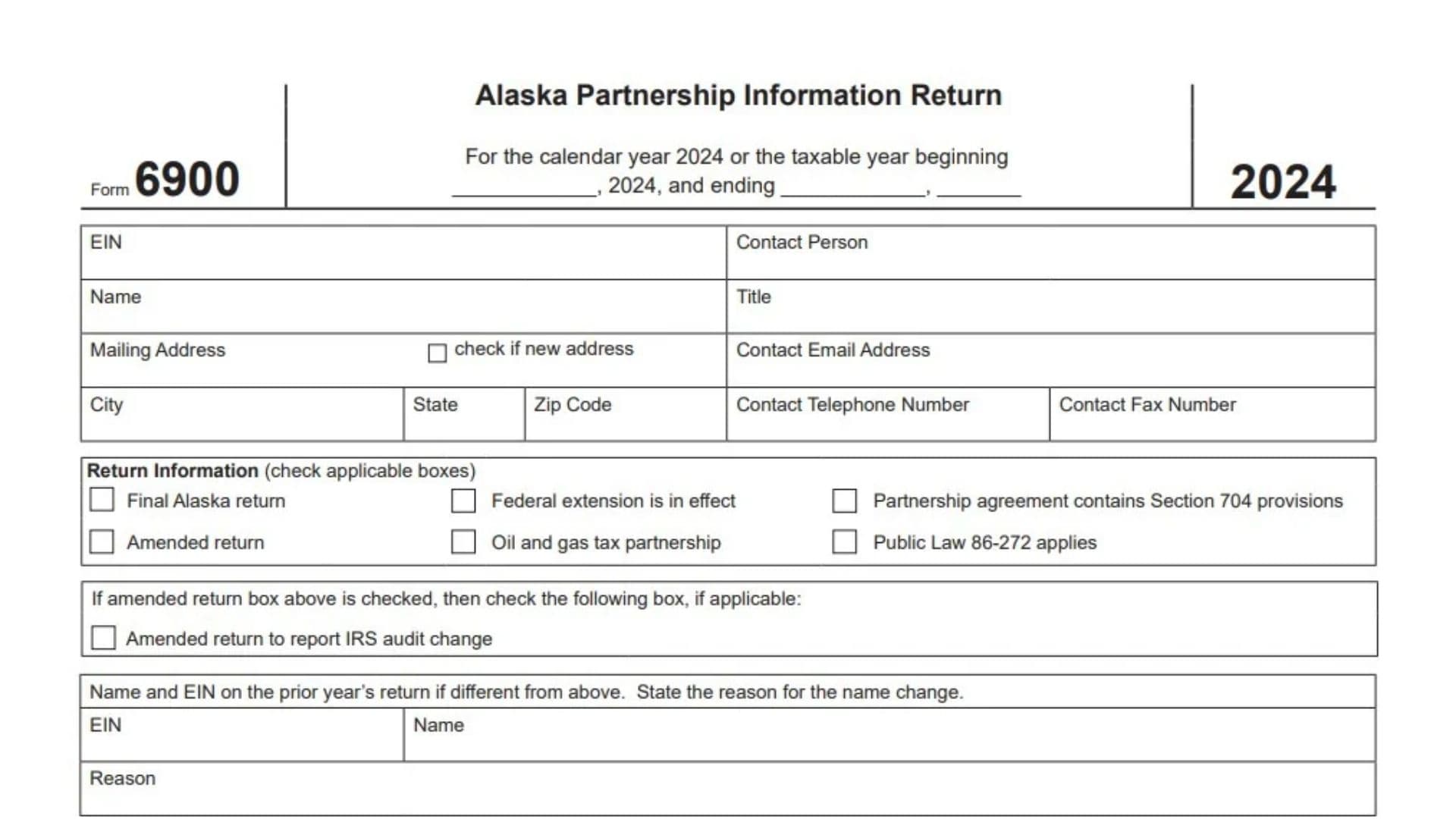
Alaska Form 6900, officially titled Alaska Partnership Information Return, is a state informational tax return issued by the Alaska Department of Revenue (DOR). Because Alaska does not impose a personal income tax on individuals, this return exists specifically to track and report Alaska-source income, modification items, apportionment factors, and state tax credits flowing through partnerships to corporate or pass-through entity partners. Partnerships that derive income from Alaska, hold assets in Alaska, or own an interest in a lower-tier partnership doing so must file Form 6900—provided the partnership has at least one partner that is not a natural person (or effectively treated as a natural person). The return collects partnership identification details, nexus and ownership screening answers, Alaska modification and apportionment figures (Schedule A), partner ownership breakdowns (Schedule B), and individual partner pass-through statements (Schedule K-1). Completing Form 6900 accurately ensures that corporate and upper-tier partners receive exact apportionment and credit data needed to compute their own Alaska corporate net income taxes.
How To File Alaska Form 6900
Submit the completed Form 6900—along with Schedule A, Schedule B, individual Schedules K-1 for all partners treated as corporations or partnerships for federal tax purposes, and any required attachments—to the Alaska Department of Revenue. In addition, provide each applicable partner with a copy of their Form 6900, Schedule K-1 so they can report their distributive share of Alaska modifications, apportionment factors, and credits on their own state tax returns.
Before completing Form 6900, gather the following records and details:
- Partnership Identification: The partnership’s federal Employer Identification Number (EIN), legal name, mailing address, contact person details, and any prior-year name or EIN if changed.
- Federal Partnership Return: A completed copy of the partnership’s 2024 federal Form 1065 and federal Schedules K-1 to verify ownership percentages, entity types, and total income, expense, and apportionment figures.
- Alaska Apportionment Records: Property, sales, payroll, tariff, intangible drilling cost, and oil/gas production figures both within Alaska and everywhere.
- Foreign Entity Schedules: Details of any foreign corporations (including tax haven corporations) or foreign partnerships owned by the partnership.
- Partner Roster: Names, EINs, entity classification codes, and ownership percentages (or special allocation agreements) for all corporate, pass-through, and individual partners.

How To Complete Alaska Form 6900
Page 1: Partnership Identification, Screening Questions, and Signatures
Header and Contact Information
Tax Year Dates If filing for the 2024 calendar year, leave the fiscal dates blank. If filing on a fiscal-year basis, enter the start date and end date of the taxable year beginning in 2024.
EIN Enter the partnership’s 9-digit federal Employer Identification Number.
Name Enter the full legal name of the partnership.
Contact Person and Title Enter the full name and official title of the partner, officer, or representative the Alaska Department of Revenue should contact with questions.
Mailing Address, City, State, Zip Code, and New Address Checkbox Enter the partnership’s current street address or P.O. Box, city, state, and ZIP code. Mark the check if new address box if the mailing address has changed since your prior filing.
Contact Email Address, Telephone Number, and Fax Number Enter a valid email address, daytime telephone number, and fax number (if available) for the designated contact person.
Return Information Checkboxes
Mark an X in every box that applies to this return:
- Final Alaska return: Mark if this is the last Alaska return the partnership will ever file (for example, due to dissolution or permanent cessation of Alaska operations).
- Amended return: Mark if you are correcting a previously filed 2024 Form 6900.
- Partnership agreement contains Section 704 provisions: Mark if the partnership agreement includes special allocations under Internal Revenue Code Section 704.
- Federal extension is in effect: Mark if the partnership obtained a valid federal extension of time to file its 2024 Form 1065.
- Oil and gas tax partnership: Mark if the entity operates as an oil and gas tax partnership.
- Public Law 86-272 applies: Mark if the partnership claims immunity from state net income taxation under federal Public Law 86-272 (solicitation of orders for tangible personal property).
- Amended return to report IRS audit change: If you checked Amended return above, also check this box if the amendment results from an Internal Revenue Service audit adjustment.
Prior-Year Name or EIN Change
EIN, Name, and Reason If the partnership’s name or EIN changed from the prior year’s return, enter the previous EIN, previous Name, and a brief explanation of the Reason for the change.
Other Information (Questions 1 through 5)
Question 1a: Alaska-Source Income Check yes or no to indicate whether the partnership has income derived from sources within Alaska.
Question 1b: Alaska Assets Check yes or no to indicate whether the partnership owns or holds assets located within Alaska.
Question 1c: Lower-Tier Partnership Interest Check yes or no to indicate whether this partnership owns an interest in a lower-tier partnership that is required to file an Alaska partnership return. If yes, attach the Form 6900, Schedule K-1 received from that lower-tier partnership. (Note: If you answered no to all three questions—1a, 1b, and 1c—STOP; the partnership is not required to file Form 6900.)
Question 1d: Non-Natural Person Partners Check yes or no to indicate whether the partnership has any partners that are not natural persons (such as C corporations, S corporations, other partnerships, LLCs taxed as corporations/partnerships, or certain trusts) or effectively treated as natural persons. (Note: If you answered no to Question 1d, STOP; you are not required to file Form 6900.)
Question 1e: Publicly Traded Partnership Status Check yes or no to indicate whether the entity is a publicly traded partnership (PTP).
Question 1f: IRC §7704(c) Exception If you answered yes to Question 1e, check yes or no to indicate whether the publicly traded partnership meets the qualifying income exception under Internal Revenue Code Section 7704(c) to be treated as a partnership rather than a corporation. (Note: If you answered no to Question 1f, STOP; do not file Form 6900—file an Alaska corporate return instead.)
Question 2: Oil or Gas Production or Transportation Check yes or no to indicate whether the partnership engages in the production or transportation of oil or gas in Alaska. Your answer determines which apportionment lines you complete on Schedule A.
Question 3: Ownership of Foreign Corporations Check yes or no to indicate whether the partnership owns any foreign corporations. If yes, attach a supporting schedule.
Question 4: Tax Haven Corporations If you answered yes to Question 3, check yes or no to indicate whether any of those foreign corporations qualify as a “tax haven corporation” under Alaska regulation 15 AAC 20.900(b)(4).
Question 5: Interest in Foreign Partnerships Check yes or no to indicate whether the partnership holds an interest in any foreign partnerships. If yes, attach a supporting schedule.
Signatures and Preparer Authorization
Officer’s Signature, Title, and Date A general partner, managing member, or authorized officer must sign the declaration under penalty of perjury, enter their official title, and write the date signed.
Third-Party Designee Checkbox Check the box (Check if the DOR may discuss this return with the preparer) if you authorize the Alaska Department of Revenue to communicate directly with the paid preparer listed below regarding this return.
Preparer Information If a paid preparer completed the return, the preparer must enter their Preparer’s Signature, Date, Preparer Firm’s Name, firm EIN, Preparer Firm’s Address (street, city, state, ZIP code), Preparer’s SSN or PTIN, and Phone number.
Page 2: Schedule A — Modifications, Apportionment Data, and Credits
At the top of Page 2, enter the partnership’s EIN and Name. Schedule A reports partnership-wide Alaska items across three columns:
- Column A (Total): Enter the partnership’s total dollar amount or factor quantity for each line.
- Column B (Percentage): Enter the aggregate ownership percentage held by partners that are treated as corporations or partnerships for federal tax purposes (from Schedule B, Line 2), or check the various box if special allocations or changing ownership percentages apply during the year.
- Column C (Distributable Portion): Multiply Column A by Column B (or enter the exact sum distributed to corporate/partnership partners if various is checked).
Income/Expense Items Subject to Alaska Modification
Line 1: Taxes Based on or Measured by Net Income Enter the amount of state, local, or foreign taxes based on or measured by net income that were deducted in computing federal partnership income.
Line 2: Interest Income From Obligations of the United States Enter interest income earned from U.S. government obligations (such as Treasury bills, notes, and bonds) included in federal income.
Line 3: Oil and Gas Service Industry Expenditures Enter qualified oil and gas service industry expenditures subject to Alaska modification rules.
Line 4: Reserved Leave Line 4 blank.
Apportionment Data
Line 5a: Property Within Alaska Enter the average value of real and tangible personal property owned or rented by the partnership within Alaska.
Line 5b: Property Everywhere Enter the average value of all real and tangible personal property owned or rented by the partnership everywhere.
Line 6a: Sales in Alaska (Excluding Tariffs) Enter gross receipts and sales sourced to Alaska, excluding tariff revenues.
Line 6b: Sales Everywhere (Excluding Tariffs) Enter total gross receipts and sales everywhere, excluding tariff revenues.
Lines 7a and 7b: Payroll in Alaska / Payroll Everywhere (Skip Lines 7a and 7b and proceed directly to Line 8a if you answered yes to Question 2 on Page 1 regarding oil or gas production/transportation.)
- Line 7a: Enter total compensation paid to employees in Alaska.
- Line 7b: Enter total compensation paid to employees everywhere.
Lines 8a and 8b: Tariffs in Alaska / Tariffs Everywhere
- Line 8a: Enter tariff revenues (including intercompany tariffs) earned in Alaska.
- Line 8b: Enter total tariff revenues (including intercompany tariffs) earned everywhere.
Lines 9a and 9b: Cumulative Intangible Drilling Costs (IDCs)
- Line 9a: Enter cumulative intangible drilling costs incurred in Alaska.
- Line 9b: Enter cumulative intangible drilling costs incurred everywhere.
Lines 10a and 10b: Barrels of Oil or NGLs Produced
- Line 10a: Enter the number of barrels of oil or natural gas liquids (NGLs) produced in Alaska.
- Line 10b: Enter the total number of barrels of oil or NGLs produced everywhere.
Lines 11a and 11b: One-Sixth the Number of Mcf of Gas Produced
- Line 11a: Enter one-sixth (1/6) of the thousand cubic feet (Mcf) of natural gas produced in Alaska.
- Line 11b: Enter one-sixth (1/6) of the Mcf of natural gas produced everywhere.
Alaska Credit-Related Items
Line 12: Alternative Tax Credit for Oil and Gas Exploration Enter the partnership’s total alternative tax credit for oil and gas exploration.
Line 13: Reserved Leave Line 13 blank.
Line 14: Qualified Oil and Gas Service Industry Expenditure Credit Enter the total qualified oil and gas service industry expenditure credit earned by the partnership.
Line 15: Exploration Incentive Credit – Mining Enter the total mining exploration incentive credit.
Line 16: Veteran Employment Tax Credit Enter the total Alaska veteran employment tax credit.
Line 17: Reserved Leave Line 17 blank.
Line 18: Education Credit Contributions – Qualified Deductions Enter the amount of qualified educational contributions eligible for the Alaska education credit.
Lines 19 and 20: Reserved Leave Lines 19 and 20 blank.
Line 21: Recapture of LNG or Gas Storage Facility Tax Credit Enter any required recapture amount for previously claimed liquefied natural gas (LNG) or gas storage facility tax credits.
Page 3: Schedule B — Partner Ownership Breakdown
Enter the partnership’s EIN and Name at the top of Page 3.
Partners Treated as Corporations or Partnerships for Federal Tax Purposes
Line 1: Corporate and Pass-Through Partner Roster (Rows 1 through 10) List every partner that is treated as a corporation or partnership for federal tax purposes (such as C corporations, S corporations, upper-tier partnerships, and multi-member LLCs not disregarded):
- Column A (Name of Partner): Enter the partner’s full legal name.
- Column B (Percentage Owned): Enter the partner’s profit/loss ownership percentage, or mark the various box if the partner’s percentage fluctuated during the tax year.
- Column C (EIN): Enter the partner’s 9-digit federal EIN.
- Column D (Entity Code): Enter the applicable Alaska entity classification code for the partner (such as C corporation, S corporation, or partnership).
- Special Allocation Checkbox: Mark the checkbox in the far-right column if this partner receives special allocations under IRC Section 704.
Line 2: Total Corporate and Partnership Ownership Percentage Add all percentages entered in Line 1, Column B. Enter the sum on Line 2 (this figure transfers to Schedule A, Column B unless various applies).
Partners That Are Natural Persons or Effectively Treated as Natural Persons
Line 3: Individual and Disregarded/Natural-Person Partner Roster List partners who are individual human beings or entities effectively treated as natural persons (such as single-member LLCs owned by individuals or grantor trusts):
- Column A (Name of Partner): Enter the partner’s full name.
- Column B (Percentage Owned): Enter the partner’s ownership percentage.
- Column C (Special Allocation Checkbox): Mark this checkbox if the partner is subject to special allocations.
Line 4: Total Natural-Person Ownership Percentage Add all percentages entered in Line 3, Column B.
Ownership Reconciliation Check Verify that the sum of Line 2 and Line 4 equals exactly 100%, unless various or a Special Allocation box is checked on Schedule B.
Prepare a separate Form 6900, Schedule K-1 for every partner listed in Line 1 of Schedule B (partners treated as corporations or partnerships for federal tax purposes).
Header and Entity Identification
Tax Year Dates Enter the calendar year or fiscal tax year beginning and ending dates matching Page 1.
Information About the Partner Enter the recipient partner’s EIN, legal Name, Mailing Address, City, State, and Zip Code.
Information About the Partnership Enter the filing partnership’s EIN, legal Name, Mailing Address, City, State, and Zip Code.
Information for Partner Checkboxes
Mark an X in every checkbox that applies to the partnership or this specific Schedule K-1:
- Amended Alaska Schedule K-1: Mark if correcting a previously issued 2024 Schedule K-1.
- Final Alaska Schedule K-1: Mark if this is the final Schedule K-1 issued to this departing or liquidating partner.
- Partnership is engaged in production or transportation of oil or gas in Alaska: Mark if Question 2 on Page 1 was answered yes.
- Amended Schedule K-1 to report IRS audit change: If Amended Alaska Schedule K-1 is marked above, check this box if the change stems from an IRS audit.
- Partnership owns foreign corporation(s): Mark if Question 3 on Page 1 was answered yes.
- Partnership owns tax haven corporation(s): Mark if Question 4 on Page 1 was answered yes.
- Public Law 86-272 applies: Mark if the Public Law 86-272 applies box on Page 1 was checked.
Enter the specific partner’s distributive share of each Alaska item from Schedule A:
- Lines 1 through 3 (Income/Expense Modifications): Enter the partner’s share of net income taxes (Line 1), U.S. government interest income (Line 2), and oil and gas service industry expenditures (Line 3). Leave Line 4 (Reserved) blank.
- Lines 5a through 11b (Apportionment Factors): Enter the partner’s distributive share of Alaska and everywhere property (Lines 5a–5b), sales excluding tariffs (Lines 6a–6b), payroll (Lines 7a–7b, omitted if oil/gas production or transportation applies), tariffs (Lines 8a–8b), cumulative intangible drilling costs (Lines 9a–9b), barrels of oil or NGLs (Lines 10a–10b), and one-sixth Mcf of gas produced (Lines 11a–11b).
- Lines 12 through 21 (Alaska Credit-Related Items): Enter the partner’s share of the alternative oil and gas exploration credit (Line 12), qualified oil and gas service industry expenditure credit (Line 14), mining exploration incentive credit (Line 15), veteran employment tax credit (Line 16), education credit qualified deductions (Line 18), and recapture of LNG or gas storage facility tax credit (Line 21). Leave Reserved Lines 13, 17, 19, and 20 blank.
Final Review Before Filing
Before submitting Alaska Form 6900 and distributing Schedules K-1, verify every item on this checklist:
- Filing Requirement Verified: Confirm that at least one of Questions 1a, 1b, or 1c is answered yes, Question 1d is answered yes, and Question 1f (if applicable) is answered yes.
- Lower-Tier and Foreign Schedules Attached: Ensure any Schedule K-1 received from a lower-tier partnership (Question 1c) and any schedules for foreign corporations or partnerships (Questions 3 and 5) are attached.
- Schedule A Apportionment Rules Followed: Verify that Lines 7a and 7b (payroll) were skipped if the partnership answered yes to Question 2 for oil or gas production or transportation.
- Schedule B Totals 100%: Confirm that Schedule B, Line 2 plus Line 4 equals exactly 100% (unless various or Special Allocation is marked) and that all corporate/pass-through partners have valid EINs and entity codes.
- Schedules K-1 Reconciled: Verify that the sum of all partners’ individual Schedules K-1 matches the distributable totals reported in Schedule A, Column C, and deliver copies to all non-natural-person partners.
- Return Signed and Dated: Ensure an authorized officer or partner signed and dated Page 1 and completed the paid preparer section if applicable.