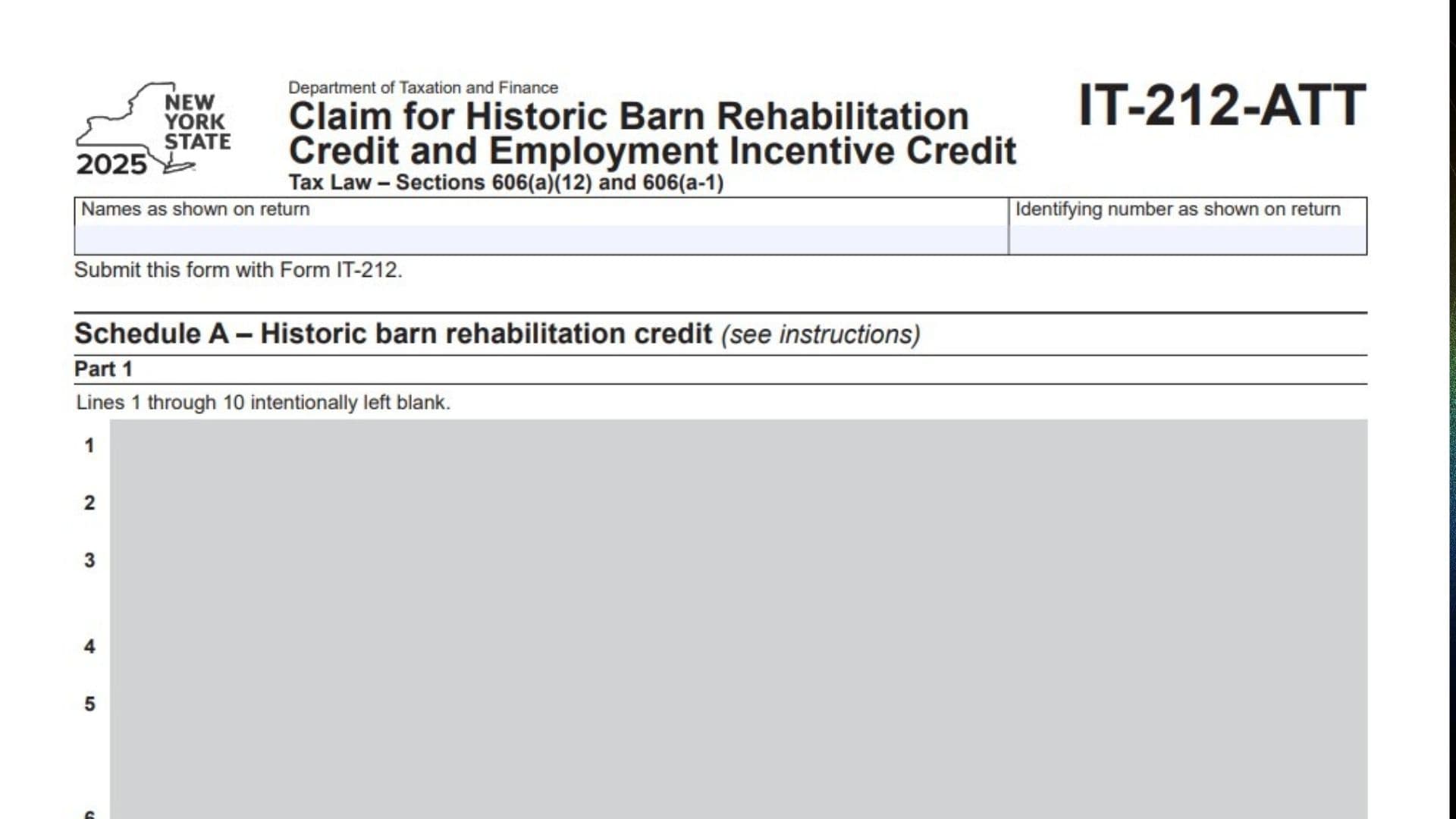
Form IT-212-ATT, titled Claim for Historic Barn Rehabilitation Credit and Employment Incentive Credit, is a New York State Department of Taxation and Finance supplemental schedule authorized under Tax Law Sections 606(a)(12) and 606(a-1). It exists for individual, fiduciary, and partnership-level personal income taxpayers who are either claiming the 25% credit for qualified historic barn rehabilitation expenditures, calculating a credit addback because previously qualified historic barn property ceased to qualify early, or claiming the employment incentive credit tied to an earlier investment tax credit. The form collects project certificate numbers, qualified rehabilitation costs, early-disposition useful-life calculations, quarterly New York State employee headcounts, and investment credit base figures. Completing Form IT-212-ATT accurately is essential because its totals feed directly into Form IT-212 (Investment Credit), ensuring you receive the full credit you qualify for while properly reporting any required recapture.
How To File Form IT-212-ATT
Form IT-212-ATT is not a standalone tax return. Once completed, you must submit it together with your Form IT-212 (Investment Credit) and your New York State personal income tax return. If you have more historic barn rehabilitation projects or early dispositions than fit on a single form, complete additional copies of Form IT-212-ATT and carry their column totals onto the primary form.
What To Prepare Before Starting
Gather the following records before completing the schedules:
- Your name(s) and identifying number (SSN or EIN) exactly as shown on your main New York State return.
- Certificates of completion for any qualified historic barn rehabilitation projects, including project numbers, completion dates, and total qualified rehabilitation expenditures.
- Acquisition dates, disposal or disqualification dates, useful life in months, and original credit amounts for any historic barn property disposed of early.
- Quarterly New York State employee counts (March 31, June 30, September 30, and December 31) for both your employment base year and each applicable credit year.
- Your original investment credit base from the tax year in which the investment tax credit was allowed (excluding R&D property claimed at the optional rate).

How To Complete Form IT-212-ATT
Complete the identification fields at the top of page 1, then fill out Schedule A, Schedule B, or both depending on which credits or addbacks apply to your 2025 tax year. Monetary totals on Lines 11, 12, and 19 are reported in whole dollars.
Taxpayer Identification
Name(s) As Shown On Return
Enter your full name (or both names if filing jointly) exactly as it appears on your main New York State tax return.
Identifying Number As Shown On Return
Enter your Social Security number (SSN) or Employer Identification Number (EIN) exactly as shown on your main return.
Schedule A: Historic Barn Rehabilitation Credit
Use Schedule A to calculate your 2025 historic barn rehabilitation credit and any required addback of credit if qualified property ceased to qualify before the end of its useful life.
Part 1: Reserved Lines
Lines 1 Through 10: Intentionally Left Blank
Do not make any entries on Lines 1 through 10. These lines are intentionally left blank on the 2025 form.
Part 2: Qualified Rehabilitation Expenditures
Use the table in Part 2 to list each qualified historic barn rehabilitation project completed during the tax year.
Column A: Project Number From Certificate Of Completion
Enter the official project number printed on your certificate of completion for the rehabilitated historic barn.
Column B: Certificate Of Completion Date
Enter the date shown on the certificate of completion.
Column C: Amount Of Qualified Rehabilitation Expenditures
Enter the total qualified rehabilitation expenditures incurred for the project.
Column D: Rehabilitation Credit
Multiply the amount in Column C by 0.25 (25%) and enter the resulting credit amount.
Total Of Column D Amounts From Any Additional Forms IT-212-ATT
If you used extra copies of Form IT-212-ATT to list additional projects, add all Column D credit amounts from those extra forms and enter the combined total on this line.
Line 11: Total Historic Barn Rehabilitation Credit
Add all amounts in Column D, including any total carried over from additional Forms IT-212-ATT. Enter the result on Line 11 and transfer this same figure to Form IT-212, Line 23.
Part 3: Early Dispositions Of Qualified Property And Addback Of Credit On Early Dispositions
Complete Part 3 (located on the back of the form) if any historic barn rehabilitation property for which you previously claimed a credit was disposed of or stopped qualifying before the end of its useful life.
Column A: Description Of Rehabilitation Expenditures
Briefly describe the historic barn rehabilitation property or expenditures that ceased to qualify.
Column B: Date Acquired
Enter the date the qualified property was originally acquired or placed in service.
Column C: Date Property Ceased To Qualify
Enter the date the property was disposed of or otherwise stopped meeting qualification rules.
Column D: Property’s Useful Life (Months)
Enter the property’s total useful life expressed in months.
Column E: Unused Life (Months)
Enter the number of months remaining in the property’s useful life as of the date it ceased to qualify.
Column F: Percentage
Divide the unused life in Column E by the total useful life in Column D (E ÷ D) to determine the recapture percentage.
Column G: Total Investment Tax Credit Allowed For Rehabilitation Of A Historic Barn
Enter the total historic barn rehabilitation credit originally allowed for that property.
Column H: Addback Of Credit On Early Dispositions
Multiply the percentage in Column F by the original credit allowed in Column G (F × G) to compute the credit addback.
Total Of Column H Amounts From Any Additional Forms IT-212-ATT
If you listed additional early dispositions on extra copies of Form IT-212-ATT, enter the combined total of their Column H amounts here.
Line 12: Total Addback Of Credit On Early Dispositions
Add all amounts in Column H, including any total from additional Forms IT-212-ATT. Enter the result on Line 12 and transfer this same figure to Form IT-212, Line 27.
Schedule B: Employment Incentive Credit
Use Schedule B to verify whether your New York State employment level meets the 101% threshold required for the employment incentive credit and to calculate the credit for the first and second succeeding tax years after an investment tax credit was allowed.
Part 1: Eligibility For Employment Incentive Credit
For each applicable line (Lines 13 through 16), complete Columns A through H across the row:
Column A: Year
Enter the calendar or tax year being reported on that line.
Columns B, C, D, And E: Quarterly Employee Counts (Mar. 31, June 30, Sept. 30, Dec. 31)
Enter the number of New York State employees employed on March 31 (Column B), June 30 (Column C), September 30 (Column D), and December 31 (Column E).
Column F: Total
Add Columns B, C, D, and E (B + C + D + E) and enter the sum.
Column G: Average
Calculate the average number of New York State employees for the year following the Form IT-212-ATT instructions (typically dividing Column F by the number of reporting periods in the year).
Column H: Percent
On Lines 14 and 16, divide the average number of employees in the credit year (Column G) by the average number of employees in the corresponding employment base year (Column G), and round the result to two decimal places. If the percentage in Column H is less than 101% (1.01), stop—you do not qualify for the employment incentive credit for that year.
Line 13: Number Of New York State Employees In Employment Base Year (First Succeeding Tax Year)
Under Section A (used with Part 2, Line 17), enter the year and quarterly New York State employee counts, total, and average for the employment base year.
Line 14: Number Of New York State Employees In Credit Year (First Succeeding Tax Year)
Enter the year, quarterly New York State employee counts, total, average, and eligibility percentage (Column H) for the first succeeding tax year.
Line 15: Number Of New York State Employees In Employment Base Year (Second Succeeding Tax Year)
Under Section B (used with Part 2, Line 18), enter the year and quarterly New York State employee counts, total, and average for the employment base year.
Line 16: Number Of New York State Employees In Credit Year (Second Succeeding Tax Year)
Enter the year, quarterly New York State employee counts, total, average, and eligibility percentage (Column H) for the second succeeding tax year.
Part 2: Computation Of Employment Incentive Credit
Use the percentages from Part 1, Column H, together with the Tax Rate Schedule below to compute your credit on Lines 17 and 18.
Tax Rate Schedule (Employment Incentive Credit Rates)
Match your Column H percentage to the rate tiers below:
- At least 101% but less than 102%: 1½% (0.015) of the investment credit base.
- At least 102% but less than 103%: 2% (0.02) of the investment credit base.
- 103% or more: 2½% (0.025) of the investment credit base.
Line 17: First Succeeding Tax Year
In Column A, enter the tax year in which the original investment tax credit was allowed. In Column B, enter the investment credit base upon which that original credit was allowed (excluding any research and development [R&D] property claimed at the optional rate). In Column C, multiply Column B by the rate from the Tax Rate Schedule determined by Line 14, Column H.
Line 18: Second Succeeding Tax Year
In Column A, enter the tax year in which the original investment tax credit was allowed. In Column B, enter the investment credit base upon which that original credit was allowed (excluding R&D property claimed at the optional rate). In Column C, multiply Column B by the rate from the Tax Rate Schedule determined by Line 16, Column H.
Line 19: Total Employment Incentive Credit
Add the Column C amounts from Lines 17 and 18. Enter the total on Line 19 and transfer this same figure to Form IT-212, Line 24.
Final Review Before Filing
Before attaching Form IT-212-ATT to Form IT-212, verify the following details:
- Confirm your name(s) and identifying number match your main New York State tax return.
- Verify that Lines 1 through 10 in Schedule A, Part 1, remain blank.
- Check that every project in Schedule A, Part 2, lists a valid certificate of completion number, date, and 25% credit calculation, and that Line 11 is carried to Form IT-212, Line 23.
- If you reported any early dispositions in Schedule A, Part 3, verify your useful-life month fractions (
E ÷ D) and confirm Line 12 is carried to Form IT-212, Line 27. - In Schedule B, confirm that your Column H employment percentage is at least 101% before claiming any credit on Lines 17 or 18, and verify that R&D property at the optional rate is excluded from Column B.
- Check that Line 19 is accurately carried to Form IT-212, Line 24, and attach all extra copies of Form IT-212-ATT if you used continuation sheets.