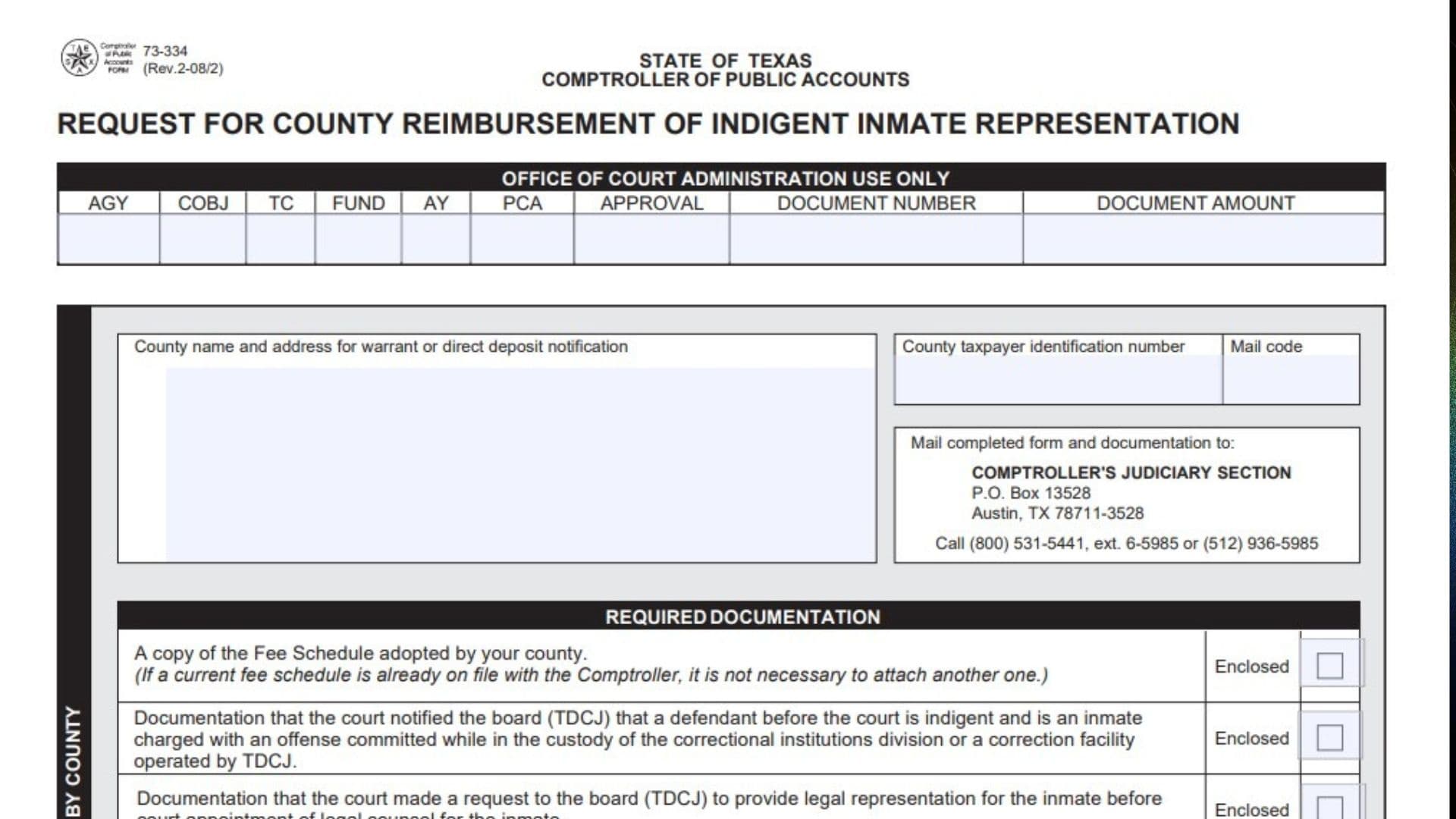
Texas Form 73-334, officially known as the Request for County Reimbursement of Indigent Inmate Representation, is a reimbursement application used by Texas counties to request payment from the state for eligible legal representation expenses involving indigent inmates. The form is issued by the Texas Comptroller of Public Accounts and relates to Article 26.051 of the Texas Code of Criminal Procedure. It provides a formal process through which a county can request reimbursement for qualifying attorney compensation and related expenses that the county has already paid. The form applies to cases involving defendants who are indigent and are inmates charged with offenses committed while in the custody of the Texas Department of Criminal Justice (TDCJ) Correctional Institutions Division or a correctional facility operated by TDCJ.
The application collects information about the county, its taxpayer identification number, payment notification address, and the amount being claimed. It also requires supporting documentation to establish that the defendant qualified for the applicable legal representation, that the court notified TDCJ about the defendant’s indigent status and circumstances, and that the court requested legal representation from the board before appointing an attorney. Additional documentation must explain any specific conflict of interest that affected the appointment of legal counsel. Counties must also provide the payment order signed by the presiding judge and attorney fee vouchers showing each attorney’s name and a detailed breakdown of in-court and out-of-court hourly charges. The county must certify that the requested expenses were paid and are due for reimbursement under the applicable law. An authorized county official must sign the certification and provide contact information so the Comptroller’s office can request clarification if needed. Completing Form 73-334 accurately is important because the reimbursement amount must agree with the attached documentation, and incomplete supporting records may delay payment. Once the request is approved, the state sends a warrant or direct deposit confirmation to the county’s designated address, with the form instructions indicating that a copy of the request will be returned within 60 days if reimbursement is due.
How To File Form 73-334
Form 73-334 must be completed by the county requesting reimbursement for eligible indigent inmate representation expenses.
The completed application must be submitted to the Texas Comptroller of Public Accounts, Comptroller’s Judiciary Section, along with all required supporting documentation.
Where To Submit Form 73-334
Mail the completed form and supporting documents to:
Texas Comptroller of Public Accounts
Comptroller’s Judiciary Section
P.O. Box 13528
Austin, TX 78711-3528
For assistance, contact the Comptroller’s office using the following telephone numbers:
- 800-531-5441, extension 6-5985
- 512-936-5985
Information To Prepare Before Filing
Before completing the application, the county should gather the following information:
- County’s legal name.
- County’s mailing address for warrant or direct deposit notification.
- County taxpayer identification number.
- County mail code.
- Total reimbursement amount being requested.
- County-adopted attorney fee schedule.
- Documentation showing that the court notified TDCJ about the defendant’s indigent status and custody-related offense.
- Documentation showing that the court requested legal representation from TDCJ before appointing counsel.
- Description of the specific conflict of interest.
- Payment order signed by the presiding judge.
- Attorney fee vouchers submitted by each individual attorney.
- Breakdown of in-court and out-of-court attorney charges.
- Name and contact information of the authorized county representative.
- Court certification and signature.
Make sure the supporting documents establish the amount paid by the county and demonstrate that the reimbursement request meets the applicable requirements.
Who Completes Form 73-334?
The county is responsible for preparing and submitting the reimbursement application.
The county must provide the required information and supporting documents. An authorized official must certify the reimbursement request and confirm that the expenses have been paid by the county.
The Comptroller’s office uses the lower approval section to review and approve the reimbursement request.

How To Complete Form 73-334
Form 73-334 contains several sections covering administrative information, county identification, required documentation, the reimbursement amount, court certification, and county contact details.
The following instructions explain how to complete each section.
Office of Court Administration Use Only
The first section of the form is reserved for the Office of Court Administration. Counties should not complete these fields.
The section contains the following administrative fields:
AGY
This field identifies the agency associated with the reimbursement transaction.
It is reserved for administrative processing by the Office of Court Administration.
COBJ
This field identifies the applicable comptroller object code used for payment processing.
The county does not need to enter this information.
TC
This field is reserved for the applicable transaction code used in processing the reimbursement.
FUND
This field identifies the fund associated with the payment.
AY
This field identifies the applicable appropriation year.
PCA
This field is used for the applicable program cost account information.
APPROVAL
This field records the approval information associated with the reimbursement request.
DOCUMENT NUMBER
This field contains the administrative document number assigned during payment processing.
DOCUMENT AMOUNT
This field records the amount associated with the approved payment document.
All fields in this section are reserved for administrative use.
County Information
This section identifies the county requesting reimbursement and provides the information needed to issue payment or send direct deposit notifications.
County Name and Address for Warrant or Direct Deposit Notification
Enter the complete legal name and mailing address of the county requesting reimbursement.
The address should be the location where the county wants to receive the state warrant or direct deposit notification.
Include the appropriate mailing details so that payment-related correspondence can reach the county.
If the county’s payment notification address changes, provide the updated information in this section.
County Taxpayer Identification Number
Enter the taxpayer identification number associated with the county.
Make sure the identification number matches the county’s records and the tax identification information used for the reimbursement request.
Mail Code
Enter the county’s applicable mail code.
This code helps identify the correct payment notification or mailing destination within the county’s records.
Use the appropriate code associated with the county’s payment information.
Payment Mailing Information
The form also displays the Comptroller’s mailing address and telephone numbers.
This information is provided to guide counties when submitting the completed application.
Mail the form and all required documentation to:
Comptroller’s Judiciary Section
P.O. Box 13528
Austin, TX 78711-3528
Required Documentation
This section must be completed by the county.
It identifies the documents that must accompany the reimbursement request. Each requirement has an Enclosed checkbox.
Review every item and mark the corresponding box when the required document is included with the application.
Copy of the County-Adopted Fee Schedule
Provide a copy of the fee schedule adopted by the county.
This schedule establishes the applicable attorney compensation rates and helps verify that the requested reimbursement amount falls within the county’s approved fee limits.
The county does not need to attach another copy if a current fee schedule is already on file with the Comptroller.
Mark the Enclosed checkbox when the required fee schedule is included.
Documentation of Court Notification to TDCJ
Provide documentation showing that the court notified the board (TDCJ) that the defendant appearing before the court:
- Is indigent.
- Is an inmate.
- Has been charged with an offense committed while in the custody of the TDCJ Correctional Institutions Division or a correctional facility operated by TDCJ.
This documentation establishes that the court notified the appropriate authority about the defendant’s circumstances.
The notification must relate to the specific defendant and qualifying offense.
Mark the Enclosed checkbox when the documentation is attached.
Documentation of the Court’s Request for Legal Representation
Provide documentation showing that the court requested the board (TDCJ) to provide legal representation for the inmate before the court appointed legal counsel.
This document establishes that the court made the required request for representation before appointing an attorney.
Make sure the supporting record clearly shows that the request occurred before the appointment of counsel.
Mark the Enclosed checkbox when the documentation is included.
Description of Specific Conflict of Interest
Provide a written description of the specific conflict of interest associated with the case.
The description should explain the conflict that affected the availability or appointment of legal representation.
Include sufficient information to establish the circumstances surrounding the conflict.
Mark the Enclosed checkbox when the written description is attached.
Payment Order and Attorney Fee Vouchers
Attach a copy of the payment order signed by the presiding judge.
Also include a copy of the attorney fee voucher submitted by each individual attorney.
The supporting documentation must include:
- Each attorney’s name.
- A breakdown of hourly charges for in-court expenses.
- A breakdown of hourly charges for out-of-court expenses.
- The total amount paid by the county.
The documents should establish how the total reimbursement amount was calculated and confirm the expenses paid by the county.
This information also helps verify that the requested amount is consistent with the county-adopted fee schedule.
Mark the Enclosed checkbox when the payment order and all required attorney fee vouchers are attached.
Total Reimbursement Amount
Total Amount of Claim Supported by the Attached Documentation
Enter the total amount of reimbursement being requested.
The amount must agree with the supporting documents submitted with the application.
Use the attorney payment records, signed payment order, and individual fee vouchers to calculate the total.
Make sure the amount reflects the expenses actually paid by the county.
Do not include expenses that are not supported by the attached documentation.
The form provides a dollar sign field for entering the total claim amount.
Court Certification
This section requires an authorized official to certify the reimbursement request.
The certification confirms that the requested amounts are due and payable under Article 26.051 of the Texas Code of Criminal Procedure and that the court has paid the expenses.
Authorized Official’s Name
Enter the full name of the authorized official making the certification.
The official should have the appropriate authority to certify the reimbursement request on behalf of the court.
Certification Statement
The authorized official must review the declaration confirming that:
- The requested amounts are due and payable under Article 26.051 of the Code of Criminal Procedure.
- The court has paid the expenses.
- The information provided is true and correct to the best of the official’s knowledge.
Make sure the reimbursement amount agrees with the attached payment documentation before signing.
Authorized Official Signature
The authorized official must sign the certification.
The signature confirms that the official has reviewed the reimbursement request and certifies the information provided.
Date
Enter the date the authorized official signs the certification.
Use the date of actual signing.
County Contact Information
This section provides the Comptroller’s office with contact details for the person who can answer questions about the reimbursement application.
Provide accurate information so that the department can contact the county if additional details or clarification are required.
Person to Contact Regarding Information on This Form
Enter the full name of the county representative responsible for handling questions about the reimbursement application.
This should be someone who understands the submitted documentation and can provide additional information if necessary.
Contact Phone Number (Area Code and Number)
Enter the contact person’s telephone number.
Include the area code and complete telephone number.
Make sure the number is active and can be used to reach the representative.
Title
Enter the official job title or position of the county contact person.
For example, provide the person’s relevant position within the county administration or court.
Contact E-mail Address
Enter the contact person’s working email address.
Check the spelling carefully to ensure that the Comptroller’s office can send questions or requests for additional information.
Comptroller Approval
The final section is reserved for the Texas Comptroller’s office.
The county should leave this section blank when submitting the application.
It records the state’s approval and payment processing information.
Approval Certification
This statement confirms that the Comptroller’s office approves the payment request and that the request is considered true and correct to the best of the approving official’s knowledge.
It also confirms that the payment complies with Article 26.051(i) of the Code of Criminal Procedure.
Direct Deposit
The Comptroller’s office marks this checkbox when the reimbursement is processed through direct deposit.
Check Enclosed
The Comptroller’s office marks this checkbox when payment is issued by check.
The county does not select either payment method in this section.
Certified By
The authorized Comptroller representative enters the appropriate certification information.
Date
The approving official enters the date of approval.
Additional Filing Procedures and Instructions
The reverse side of Form 73-334 provides important procedures for submitting the reimbursement request and its supporting documents.
Reimbursement Claim Requirements
The total reimbursement amount must correspond with the supporting documentation attached to the application.
Make sure the payment order, attorney fee vouchers, and total claim amount agree.
Incomplete documentation may delay the reimbursement process.
Submission to the Comptroller
The completed reimbursement request must be mailed to the Comptroller’s office for approval.
Use the Comptroller’s Judiciary Section mailing address shown on the front of the form.
Payment Notification Address
Warrants and direct deposit notifications are mailed to the address provided on the front of the application.
If the county’s payment notification address changes, enter the corrected information on the form so that the Comptroller’s records can be updated.
Authorized Official Certification
An authorized official must certify the reimbursement request.
The county must also provide the contact person’s name, email address, and telephone number below the certification section.
Reimbursement Processing Time
The instructions state that a copy of the reimbursement request will be returned with a state warrant or direct deposit confirmation within 60 days if reimbursement is due.
This timeframe is provided as part of the form’s payment instructions.
Supporting Documentation Requirements
The reverse side also explains the specific records needed to support the reimbursement claim.
Each document serves a particular purpose in establishing the county’s eligibility and verifying the amount requested.
County Fee Schedule
Provide the county-adopted fee schedule in accordance with Article 26.05(c) of the Code of Criminal Procedure.
The schedule helps establish the applicable attorney compensation rates.
A duplicate is not required if a current fee schedule is already on file with the Comptroller.
Court Notification to TDCJ
Provide documentation showing that the court notified TDCJ about the defendant’s indigent status and qualifying inmate circumstances.
The defendant must have been charged with an offense committed while in the custody of the TDCJ Correctional Institutions Division or a correctional facility operated by TDCJ.
Court Request for Legal Representation
Provide evidence that the court requested TDCJ to provide legal representation for the inmate before appointing legal counsel.
The documentation should establish the sequence of events and confirm that the request was made before the appointment.
Specific Conflict of Interest
Include a written description of the specific conflict of interest.
This documentation supports the circumstances associated with the appointment of legal representation.
Payment Order and Attorney Fee Vouchers
Include the payment order signed by the presiding judge and the fee voucher submitted by each individual attorney.
The attorney fee vouchers must identify the attorney and provide a breakdown of hourly charges for in-court and out-of-court expenses.
The combined amounts must support the total amount paid by the county.
These documents allow the reimbursement request to be checked against the county’s adopted fee schedule under Article 26.05(c).
Court Certification of Reimbursement Claim
The court must certify the amount of compensation and expenses for which the county is entitled to reimbursement.
This certification is made to the Comptroller under Article 26.051(i) of the Code of Criminal Procedure.
The certification must be completed by an authorized official and must confirm that the requested expenses have been paid.
Final Review Before Filing
Before mailing Form 73-334 to the Texas Comptroller of Public Accounts, review the following checklist to make sure the application and supporting records are complete.
County Information
- The county’s legal name is entered correctly.
- The warrant or direct deposit notification address is complete.
- The county taxpayer identification number is correct.
- The mail code is entered accurately.
- The total reimbursement amount is supported by the attached records.
Required Documentation
- A copy of the county-adopted fee schedule is attached, unless a current copy is already on file with the Comptroller.
- Documentation of the court’s notification to TDCJ is included.
- Documentation of the court’s request for legal representation is included.
- A description of the specific conflict of interest is attached.
- The payment order signed by the presiding judge is included.
- Attorney fee vouchers from each individual attorney are attached.
- Each attorney’s name is provided.
- In-court hourly charges are itemized.
- Out-of-court hourly charges are itemized.
- The supporting documents establish the amount paid by the county.
- All applicable Enclosed checkboxes are marked.
Court Certification
- The authorized official’s name is provided.
- The requested reimbursement amount has been reviewed.
- The official confirms that the expenses have been paid by the court.
- The authorized official has signed the certification.
- The certification date is entered.
County Contact Information
- The contact person’s name is provided.
- The contact telephone number includes the area code.
- The contact person’s title is entered.
- A working contact email address is provided.
Final Submission
- The Comptroller Approval section is left blank.
- The completed application is addressed to the Comptroller’s Judiciary Section.
- All required supporting documents are attached.
- The reimbursement amount matches the supporting documentation.
- The county has retained appropriate copies of the submitted records.
Form 73-334 provides Texas counties with a process for requesting reimbursement of eligible indigent inmate representation expenses. Accurate county information, complete supporting documentation, a properly certified reimbursement amount, and the authorized official’s signature are essential for processing the request. Review the entire application and supporting records before mailing them to the Texas Comptroller of Public Accounts.