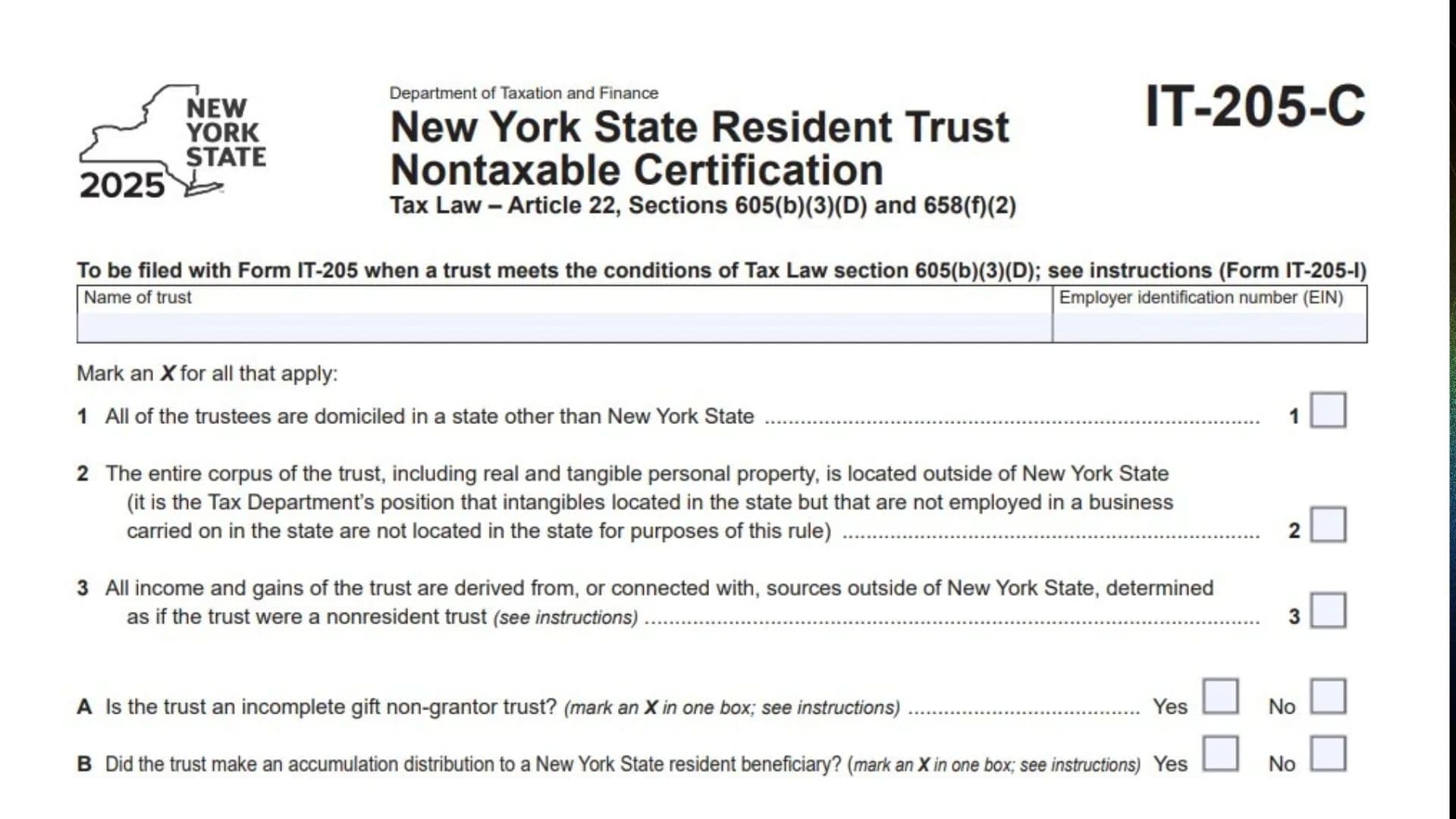
New York Form IT-205-C, officially called the New York State Resident Trust Nontaxable Certification, is a tax form used by certain resident trusts to certify that they meet specific conditions under New York State Tax Law. The form relates to Sections 605(b)(3)(D) and 658(f)(2) of Article 22 of the New York Tax Law. Its main purpose is to provide information about a trust’s trustees, assets, income sources, and other relevant circumstances to establish whether the trust qualifies for nontaxable treatment under the applicable New York State rules.
The form focuses on three important conditions: whether all trustees are domiciled outside New York State, whether the entire trust corpus is located outside New York State, and whether all trust income and gains come from or are connected with sources outside New York State. It also asks whether the trust is an incomplete gift non-grantor trust and whether it has made an accumulation distribution to a New York State resident beneficiary. In addition, the form collects identifying and residential information for individual trustees, including their names, taxpayer identification numbers, mailing addresses, and nonresident status. The fiduciary or an authorized officer must sign the certification and provide the signing date. Completing Form IT-205-C accurately is important because the information helps determine whether the trust meets the statutory conditions for the applicable New York State tax treatment. Incorrect answers, incomplete trustee details, or missing signatures may affect the trust’s certification and tax filing.
How To File Form IT-205-C
Form IT-205-C must be filed with New York State Form IT-205 when a trust meets the conditions described in Section 605(b)(3)(D) of the New York Tax Law. It is not presented on the form as a standalone tax return. Instead, it accompanies the trust’s New York State fiduciary income tax return.
Before completing the certification, the fiduciary should prepare the following information:
- The legal name of the trust.
- The trust’s Employer Identification Number (EIN).
- The domicile or residency information of every trustee.
- Details about the location of the trust’s assets and property.
- Information about the sources of the trust’s income and gains.
- Information about incomplete gift non-grantor trust status.
- Details of any accumulation distributions made to New York State resident beneficiaries.
- Each trustee’s name, Social Security Number (SSN) or EIN, and mailing address.
- The name of the fiduciary or authorized officer who will sign the form.
The form refers taxpayers to the instructions for Form IT-205-I for additional guidance. Questions about eligibility, the meaning of specific tax terms, and the appropriate filing treatment should be checked against those instructions.
Filing destination: Submit Form IT-205-C together with Form IT-205 through the applicable New York State fiduciary tax filing process. The certification itself does not provide a separate mailing address or independent filing destination.

How To Complete Form IT-205-C
Form IT-205-C contains several sections that collect information about the trust and its trustees. Each section must be completed carefully so that the certification accurately reflects the trust’s circumstances.
Trust Identification Information
This section identifies the trust submitting the nontaxable certification. Enter the legal name and federal identification number of the trust.
Name of Trust
Enter the complete legal name of the trust as it appears on its tax and legal records. Use the same name associated with the trust’s New York State fiduciary income tax return.
Employer Identification Number (EIN)
Enter the trust’s nine-digit federal Employer Identification Number. This number identifies the trust for federal tax purposes. Do not enter an individual trustee’s Social Security Number in this field.
Trust Qualification Requirements
This section contains three statements about the trustees, trust property, and income sources. The fiduciary must mark an X beside every statement that applies to the trust.
Statement 1: All Trustees Are Domiciled Outside New York State
Mark this box if every trustee is domiciled in a state other than New York State.
The requirement applies to all trustees, not just the person managing the trust or signing the tax return. If even one trustee is domiciled in New York State, this statement does not apply.
Statement 2: Entire Trust Corpus Is Located Outside New York State
Mark this box if all property and assets belonging to the trust are located outside New York State.
The trust corpus includes real estate and tangible personal property owned by the trust. The statement also includes the form’s explanation concerning intangible property. Under the New York State Tax Department’s stated position, intangible assets located in New York State but not used in a business conducted within the state are not treated as located in New York State for this particular rule.
Review the location of all trust property before selecting this box. The requirement concerns the entire trust corpus, not just its largest or most valuable assets.
Statement 3: All Trust Income and Gains Come From Outside New York State
Mark this box if all income and gains received by the trust come from or are connected with sources outside New York State.
The income source must be evaluated as though the trust were a nonresident trust. This means the relevant income and gains must be considered under the rules used to determine New York-source income for a nonresident trust.
Review the trust’s income sources and gains carefully before marking this statement. The form refers taxpayers to the Form IT-205-I instructions for additional guidance.
Additional Trust Information
This section contains two questions about the trust’s classification and distributions. Each question requires one answer. Mark an X in either the Yes or No box, as appropriate.
Question A: Is the Trust an Incomplete Gift Non-Grantor Trust?
Select Yes if the trust is classified as an incomplete gift non-grantor trust.
Select No if the trust does not have this classification.
This question identifies a particular type of trust arrangement involving gift and grantor tax treatment. The correct answer should be based on the trust’s legal structure and applicable tax treatment rather than assumptions about its general purpose.
Only one answer should be selected. Refer to the Form IT-205-I instructions if the trust’s classification is unclear.
Question B: Did the Trust Make an Accumulation Distribution to a New York State Resident Beneficiary?
Select Yes if the trust made an accumulation distribution to a beneficiary who is a New York State resident.
Select No if the trust did not make such a distribution.
An accumulation distribution generally refers to a distribution of income that the trust retained from an earlier tax period rather than distributing in the year it was earned. The question specifically concerns distributions to New York State resident beneficiaries.
Review the trust’s distribution records and the beneficiary’s residency information before answering.
Trustee Identifying Information
This section collects identifying and contact information for the trustees associated with the trust.
The form provides space for four trustees. Each trustee has a separate information block containing fields for their name, taxpayer identification number, mailing address, and nonresident status.
If the trust has more trustees than the available spaces, additional sheets may be submitted. These sheets must follow the same format and include the trust’s name and EIN on each additional sheet.
Trustee Name
Enter the full legal name of the trustee.
If the trust has multiple trustees, provide each person’s name in a separate trustee information block. Make sure the names match the trust’s legal and administrative records.
Identifying Number (SSN or EIN)
Enter the trustee’s applicable taxpayer identification number.
An individual trustee should generally provide their Social Security Number (SSN). If the trustee is an entity or organization, enter its Employer Identification Number (EIN), as applicable.
Make sure the identification number belongs to the trustee rather than the trust.
Nonresident Status
Mark an X in this box if the trustee is a nonresident of New York State.
The box identifies trustees who are not New York State residents. Review each trustee’s residency status separately before selecting the appropriate box.
Do not assume that all trustees have the same residency status simply because they serve the same trust.
Mailing Address (Number and Street or PO Box)
Enter the trustee’s complete mailing address.
You may provide a street address or a Post Office Box (PO Box), as applicable. Use the address where the trustee can receive official tax correspondence.
Apartment Number
Enter the apartment, suite, or unit number if the trustee’s mailing address includes one.
If the address does not have an apartment or unit number, leave this field blank.
City, Village, or Post Office
Enter the name of the city, village, or post office associated with the trustee’s mailing address.
Make sure the location matches the state and ZIP code provided in the following fields.
State
Enter the two-letter postal abbreviation for the state associated with the trustee’s mailing address.
For example, use NY for New York, CA for California, or FL for Florida.
ZIP Code
Enter the ZIP code associated with the trustee’s mailing address.
Check the number carefully to avoid mailing or identification errors.
Additional Trustee Information Sheets
If the trust has more than four trustees, attach additional sheets containing the same identifying information requested in this section.
Each additional sheet must follow the same information format as the original form. Include the trust’s complete name and EIN on every additional sheet so that the information can be associated with the correct trust.
Fiduciary Signature And Certification
The final section of Form IT-205-C requires the signature and identifying information of the person authorized to represent the fiduciary.
Signature of Fiduciary or Officer Representing Fiduciary
The fiduciary or an authorized officer representing the fiduciary must sign this section.
The signature confirms that the person is formally representing the trust in connection with the certification. Make sure the person signing has the appropriate authority to act on behalf of the fiduciary.
Printed Name of Person Signing
Enter the full printed name of the individual who signed the form.
The name should clearly identify the person responsible for signing on behalf of the fiduciary.
Date
Enter the date the fiduciary or authorized officer signs the certification.
Use the applicable date format and make sure the date accurately reflects when the form was signed.
Additional Filing Considerations
Before submitting Form IT-205-C, review the trust’s circumstances and supporting records carefully.
The three qualification statements are separate requirements concerning trustee domicile, trust property location, and income sources. The form instructs the fiduciary to mark every statement that applies. Do not automatically mark all three simply because the trust has trustees or assets outside New York State.
The two additional questions also require separate answers. A trust’s classification as an incomplete gift non-grantor trust does not automatically determine whether it made an accumulation distribution to a New York State resident beneficiary.
If the available trustee spaces are insufficient, provide additional sheets using the same information format. Include the trust’s name and EIN on each sheet.
For questions about the legal meaning of the qualification requirements or the correct treatment of trust income and distributions, consult the applicable Form IT-205-I instructions.
Final Review Before Filing
Before submitting Form IT-205-C with Form IT-205, review the following checklist to make sure the certification is complete and accurate.
- The legal name of the trust is entered correctly.
- The trust’s nine-digit EIN is provided.
- Each of the three qualification statements has been reviewed.
- All applicable qualification boxes are marked with an X.
- Question A has one answer selected.
- Question B has one answer selected.
- Every trustee’s full legal name is provided.
- Each trustee’s correct SSN or EIN is entered.
- The nonresident status box is marked for each applicable trustee.
- Each trustee’s complete mailing address is provided.
- Apartment or unit numbers are included where applicable.
- City, state, and ZIP code information is accurate.
- Additional trustee information sheets are attached if needed.
- The trust’s name and EIN appear on every additional sheet.
- The fiduciary or authorized officer has signed the form.
- The printed name of the person signing is included.
- The signature date is entered correctly.
- Form IT-205-C is included with the applicable Form IT-205 filing.
Completing Form IT-205-C correctly helps ensure that the trust’s identifying information, qualification statements, trustee details, and fiduciary certification are properly presented. Review every section before filing and consult the Form IT-205-I instructions whenever additional clarification is needed.