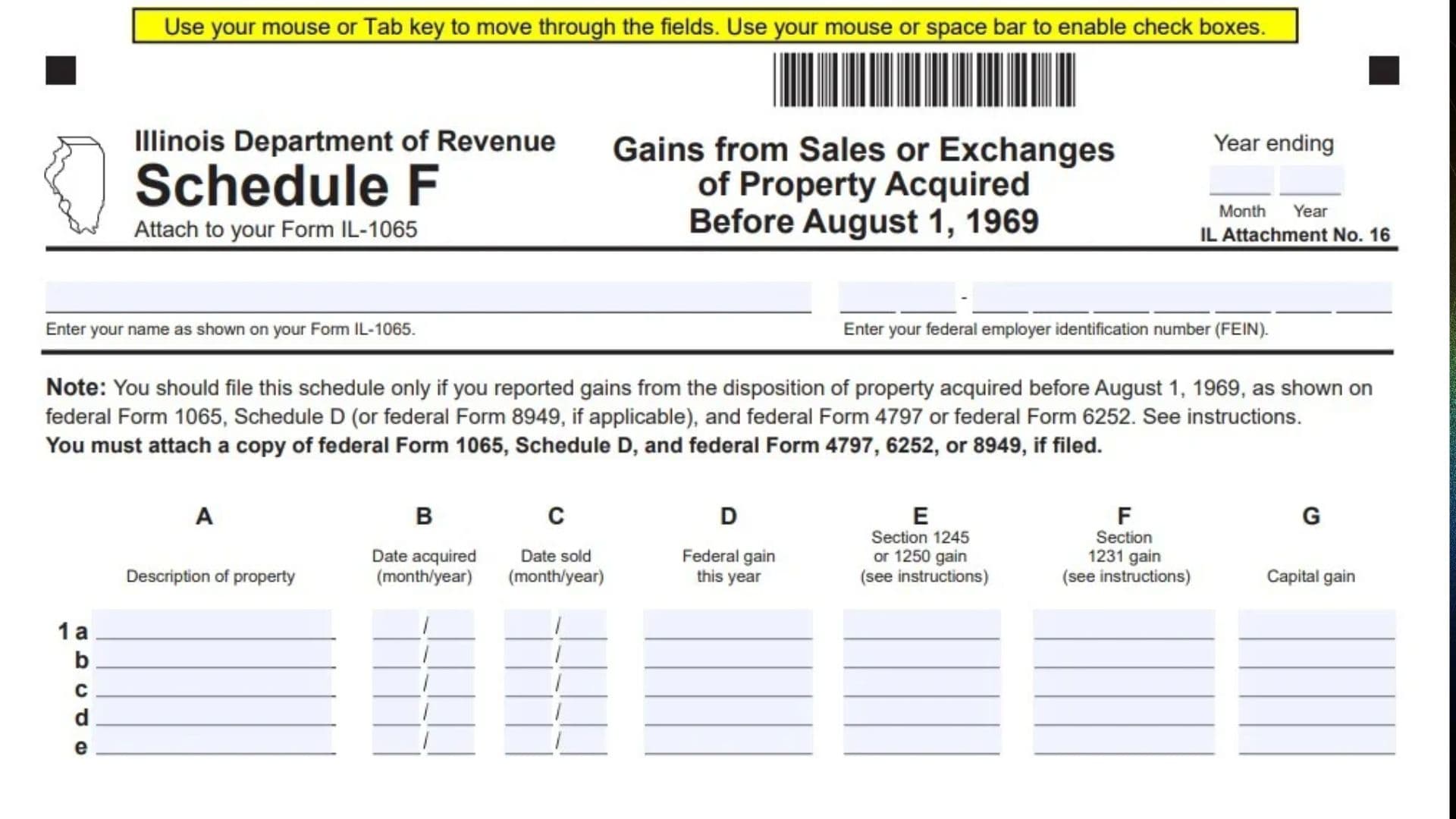
Illinois Schedule F, titled Gains from Sales or Exchanges of Property Acquired Before August 1, 1969, is a tax schedule issued by the Illinois Department of Revenue. It is used by partnerships to calculate the Illinois tax adjustment associated with gains from selling or exchanging property acquired before August 1, 1969. The schedule helps determine how much of the gain is subject to the applicable Illinois valuation limitation.
Partnerships use this schedule when they have reported gains from the disposition of qualifying property on their federal Form 1065, Schedule D, federal Form 8949, federal Form 4797, or federal Form 6252, as applicable. It collects information about each property transaction, including the property’s description, acquisition and sale dates, federal gain, applicable federal tax basis, August 1, 1969, property value, and different categories of gain.
The schedule also separates Section 1245 and Section 1250 gains, Section 1231 gains, and capital gains. These amounts are used to calculate the applicable valuation limitation and determine the final amount transferred to Form IL-1065. Additional calculations may be required for appreciation received through other partnerships, estates, and trusts.
Schedule F also includes special reporting procedures for installment sales. The reporting requirements differ depending on whether the property was acquired before August 1, 1969, or on or after that date. Completing the schedule correctly is important because the calculations determine the amount reported as the August 1, 1969, valuation limitation adjustment on the partnership’s Illinois income tax return.
How To File Illinois Schedule F
Illinois Schedule F must be attached to Form IL-1065, the Illinois Partnership Replacement Tax Return.
A partnership should file this schedule only when it reported gains from disposing of property acquired before August 1, 1969, on the applicable federal tax schedules or forms.
Required Supporting Documents
Before completing Schedule F, prepare the following information and documents:
- A copy of federal Form 1065, Schedule D.
- Federal Form 4797, if filed.
- Federal Form 6252, if filed.
- Federal Form 8949, if applicable and filed.
- Property acquisition dates and sale dates.
- Federal gain information for each property transaction.
- August 1, 1969, property values or applicable fractions.
- Federal tax basis information as of August 1, 1969.
- Information about Section 1245, Section 1250, Section 1231, and capital gains.
- Details of relevant appreciation amounts received from other partnerships, estates, and trusts.
- Previous-year installment sale gain information, when applicable.
The schedule specifically requires a copy of federal Form 1065, Schedule D, and federal Form 4797, 6252, or 8949, if filed.
Special requirement for certain installment sales: If the partnership filed federal Form 6252 for federal tax purposes but was not required to file federal Form 4797, attach a statement explaining that Form 4797 was not required and include a copy of the filed Form 6252.

How To Complete Illinois Schedule F
The schedule contains two pages. The first page reports property transactions and calculates the valuation limitation amount. The second page provides special instructions and a worksheet for installment sales.
Taxpayer Identification Information
Complete the identification section at the top of the first page before entering transaction details.
Tax Year Ending
Enter the month and year when the partnership’s tax year ends. Use the reporting period applicable to the attached Form IL-1065.
Partnership Name
Enter the partnership’s legal name exactly as it appears on Form IL-1065. The name must match the Illinois partnership income tax return.
Federal Employer Identification Number (FEIN)
Enter the partnership’s federal employer identification number. Use the same FEIN reported on Form IL-1065.
Property Transaction Information: Columns A Through G
This section records the details of each property sold or exchanged. The schedule provides five transaction rows, identified as 1a through 1e.
Complete a separate row for each applicable property transaction.
Column A: Description of Property
Enter a clear description of the property that was sold or exchanged. Identify each asset sufficiently to distinguish it from other property transactions reported on the schedule.
Column B: Date Acquired
Enter the month and year when the partnership acquired the property.
The acquisition date is important because Schedule F applies to property acquired before August 1, 1969.
Column C: Date Sold
Enter the month and year when the property was sold or exchanged.
Use the transaction date applicable to the reported disposition.
Column D: Federal Gain This Year
Enter the amount of federal gain from the property reported for the current tax year.
Use the corresponding federal tax reporting information for the transaction. For installment sales, follow the special Column D instructions on page 2.
Column E: Section 1245 or 1250 Gain
Enter the applicable Section 1245 or Section 1250 gain associated with the property transaction.
Use the amount reported on the relevant federal tax forms and follow the applicable instructions for determining the gain.
Column F: Section 1231 Gain
Enter the Section 1231 gain associated with the property transaction.
Use the corresponding amount reported for the current year on the applicable federal tax forms.
Column G: Capital Gain
Enter the capital gain associated with the property sale or exchange.
Use the amount reported on federal Form 1065, Schedule D, or federal Form 8949, as applicable.
Property Valuation and Gain Calculations: Columns H Through M
This section calculates the differences between the property’s historical value and federal tax basis and determines the amounts attributable to different gain categories.
Complete the corresponding row for each property reported in Columns A through G.
Column H: August 1, 1969, Value or Applicable Fraction
Enter the property’s value as of August 1, 1969, or the applicable fraction required for the calculation.
Follow the specific instructions for determining the appropriate value or fraction for the property.
Column I: Federal Tax Basis on August 1, 1969
Enter the property’s federal tax basis as of August 1, 1969.
Use the applicable historical tax basis information for the property.
Column J: Difference Between Column H and Column I, or Applicable Fraction Calculation
Calculate the amount using the applicable method:
- If Column H contains a property value, subtract Column I from Column H.
- If Column H contains an applicable fraction, multiply that fraction by the federal gain reported in Column D.
Enter the calculated result in Column J.
Column K: Section 1231, 1245, and 1250 Gain
Compare the amounts in Columns E and J. Enter whichever amount is smaller.
This calculation determines the applicable gain amount for this column.
Column L: Remaining Section 1231, 1245, and 1250 Gain
Subtract the amount in Column K from the amount in Column J.
However, the amount entered in Column L cannot exceed the Section 1231 gain reported in Column F.
Enter the resulting amount in Column L.
Column M: Capital Gain
Compare the amounts in Columns G and J.
Enter whichever amount is smaller in Column M.
This amount represents the capital gain subject to the applicable calculation.
Summary Calculations: Lines 2 Through 7
After completing the property transaction rows, calculate the summary amounts using the relevant columns.
Line 2: Share of Pre-August 1, 1969, Appreciation From Other Entities
Enter your partnership’s share of appreciation amounts attributable to property acquired before August 1, 1969, from other partnerships, estates, and trusts.
Include the applicable amount attributable to the partnership from these sources.
Line 3: Total Section 1231, 1245, and 1250 Gain From Column K
Add all applicable amounts reported in Column K.
Enter the total on line 3. This amount must also be transferred to line 13 in the valuation limitation section.
Line 4: Total Amount From Column L
Add the amounts reported in Column L for all applicable property transactions.
Enter the combined amount on line 4. Transfer this amount to line 9.
Line 5: Amount Attributable to Involuntary Conversions
Enter the portion of line 4 attributable to involuntary conversions resulting from casualty or theft.
This line identifies the applicable amount associated with these types of property dispositions.
Line 6: Adjusted Amount After Casualty and Theft Conversions
Subtract the amount on line 5 from the amount on line 4.
Enter the remaining amount on line 6.
Line 7: Total Capital Gain From Column M
Add all applicable amounts reported in Column M.
Enter the total on line 7. This amount must also be transferred to line 8.
Important distribution note: If the partnership distributes amounts reported on lines 3, 4, 6, or 7 to its partners, consult the specific instructions for those lines to determine the applicable reporting treatment.
Valuation Limitation Amount
This section calculates the final August 1, 1969, valuation limitation amount. The calculations use the totals from the earlier sections and the partnership’s net capital gain.
Line 8: Capital Gain Amount
Enter the amount reported on line 7.
This transfers the total from Column M into the valuation limitation calculation.
Line 9: Amount From Line 4
Transfer the total amount reported on line 4 to line 9.
Do not recalculate this amount; use the previously calculated total.
Line 10: Total Revalued Capital Gain
Add the amounts reported on lines 8 and 9.
Enter the combined result on line 10.
Line 11: Net Capital Gain
Enter the partnership’s net capital gain.
Determine the amount using the applicable instructions for this line.
Line 12: Allowable Revalued Capital Gain
Compare the amounts on lines 10 and 11.
Enter whichever amount is smaller. This amount represents the allowable revalued capital gain for the calculation.
Line 13: Revalued Ordinary Gain
Transfer the amount reported on line 3 to line 13.
This carries forward the previously calculated Section 1231, 1245, and 1250 gain amount.
Line 14: August 1, 1969, Valuation Limitation Amount
Add the amounts reported on lines 12 and 13.
Enter the total on line 14.
The amount on line 14 must also be transferred to Form IL-1065, line 25. This completes the main valuation limitation calculation.
Installment sale reminder: If the partnership reported installment sales, complete the additional reporting requirements on page 2 before finalizing Schedule F.
Installment Sales: Special Reporting Instructions
The second page of Schedule F provides special procedures for reporting installment sales involving property acquired before August 1, 1969.
If the partnership reported gains from installment sales on federal Form 1065, Schedule D, federal Form 8949, or federal Form 4797, complete Schedule F using the applicable procedures below.
The reporting method depends on when the property was acquired.
Installment Sales of Property Acquired Before August 1, 1969
For installment sales involving property acquired before August 1, 1969, complete the schedule using the following instructions.
Columns A Through C: Property Information
Complete Columns A, B, and C using the regular Schedule F instructions.
Enter the property description, acquisition date, and sale date.
Column D: Installment Sale Indicator
Enter the letters INST in Column D to identify the transaction as an installment sale.
Columns E Through J: Leave Blank
Do not enter amounts in Columns E, F, G, H, I, or J for these installment sales.
Column K: Section 1245 or Section 1250 Gain
Enter the amount of Section 1245 or Section 1250 gain from the installment sale reported during the current year on federal Form 4797 or Form 6252.
Column L: Section 1231 Gain
Enter the Section 1231 gain from the installment sale reported during the current year on federal Form 4797 or Form 6252.
Column M: Capital Gain
Enter the gain from the installment sale reported during the current year on federal Form 1065, Schedule D, or federal Form 8949.
Installment Sales of Property Acquired On or After August 1, 1969
For installment sales involving property acquired on or after August 1, 1969, follow a different procedure.
Columns A Through I: Property Information and Historical Values
Complete Columns A through I using the regular Schedule F instructions.
Enter the property details, federal gain information, applicable gain categories, August 1, 1969, value or applicable fraction, and federal tax basis as required.
Column J: Installment Sale Worksheet Amount
Complete the Column J Worksheet on page 2.
After calculating the worksheet, transfer the amount from Column 5 to Column J of Schedule F.
The regular Column J heading does not describe this installment sale entry, so follow the special worksheet instructions rather than the normal Column J calculation.
Columns K Through M: Gain Classification
Complete Columns K, L, and M using the regular Schedule F instructions.
Enter the applicable Section 1231, Section 1245, Section 1250, and capital gain amounts.
Column J Worksheet for Installment Sales
The Column J Worksheet is used to calculate the amount to report in Column J for installment sales involving property acquired on or after August 1, 1969.
The worksheet contains five columns and provides space for five transactions.
Worksheet Column 1: Total Gain
Enter the total federal gain realized from the sale of the property.
Include the entire gain from the transaction, not just the portion reported as income during the current tax year.
Worksheet Column 2: Applicable Fraction
Enter the fraction, if any, reported in Column H of Schedule F.
If no fraction applies, leave this column blank.
Worksheet Column 3: Adjusted Gain Calculation
Calculate the amount using the appropriate method:
- If Column 2 contains a fraction, multiply the total gain in Column 1 by that fraction.
- If Column 2 is blank, subtract Column I from Column H on Schedule F.
Enter the calculated amount in Column 3.
Worksheet Column 4: Gain Reported in Previous Years
Enter the total gain from the installment sale that was reported on federal income tax returns in previous years.
Use the cumulative amount reported before the current tax year.
Worksheet Column 5: Remaining Gain
Subtract the amount in Column 4 from the amount in Column 3.
If the calculation produces a negative amount, enter zero instead.
Transfer the resulting amount from Column 5 to Column J of Schedule F.
Complete a separate worksheet row for each applicable installment sale.
Final Review Before Filing
Before attaching Schedule F to Form IL-1065, review the following checklist to ensure that the required information and calculations are complete.
- The partnership’s tax year-ending date is correct.
- The partnership name matches Form IL-1065.
- The federal employer identification number is accurate.
- The partnership reported qualifying gains from property acquired before August 1, 1969.
- A copy of federal Form 1065, Schedule D, is attached.
- Copies of federal Forms 4797, 6252, or 8949 are attached, if filed.
- Each property transaction is properly described in Column A.
- Acquisition and sale dates are correctly entered in Columns B and C.
- Federal gain information is correctly reported in Column D.
- Section 1245 and Section 1250 gains are entered in Column E, where applicable.
- Section 1231 gains are entered in Column F, where applicable.
- Capital gains are entered in Column G.
- August 1, 1969, property values or applicable fractions are entered in Column H.
- Federal tax basis information is entered in Column I.
- Column J is calculated using the applicable method.
- Columns K, L, and M contain the correct calculated amounts.
- Line 2 includes applicable appreciation from other partnerships, estates, and trusts.
- Lines 3 through 7 are correctly calculated from the applicable columns.
- Lines 8 and 9 contain the correct transferred amounts.
- Line 10 correctly combines lines 8 and 9.
- Line 11 contains the applicable net capital gain.
- Line 12 contains the smaller amount from lines 10 and 11.
- Line 13 correctly transfers the amount from line 3.
- Line 14 correctly combines lines 12 and 13.
- The amount on line 14 is transferred to Form IL-1065, line 25.
- Special installment sale reporting requirements are followed, if applicable.
- The Column J Worksheet is completed for installment sales involving property acquired on or after August 1, 1969.
- The required additional statement and federal Form 6252 are attached when Form 4797 was not required.
- The completed Schedule F is attached to Form IL-1065.
Illinois Schedule F is an important supporting schedule for partnerships reporting gains from qualifying historical property transactions. Carefully completing the property details, gain classifications, valuation calculations, and installment sale worksheets helps ensure that the correct August 1, 1969, valuation limitation amount is reported on Form IL-1065.