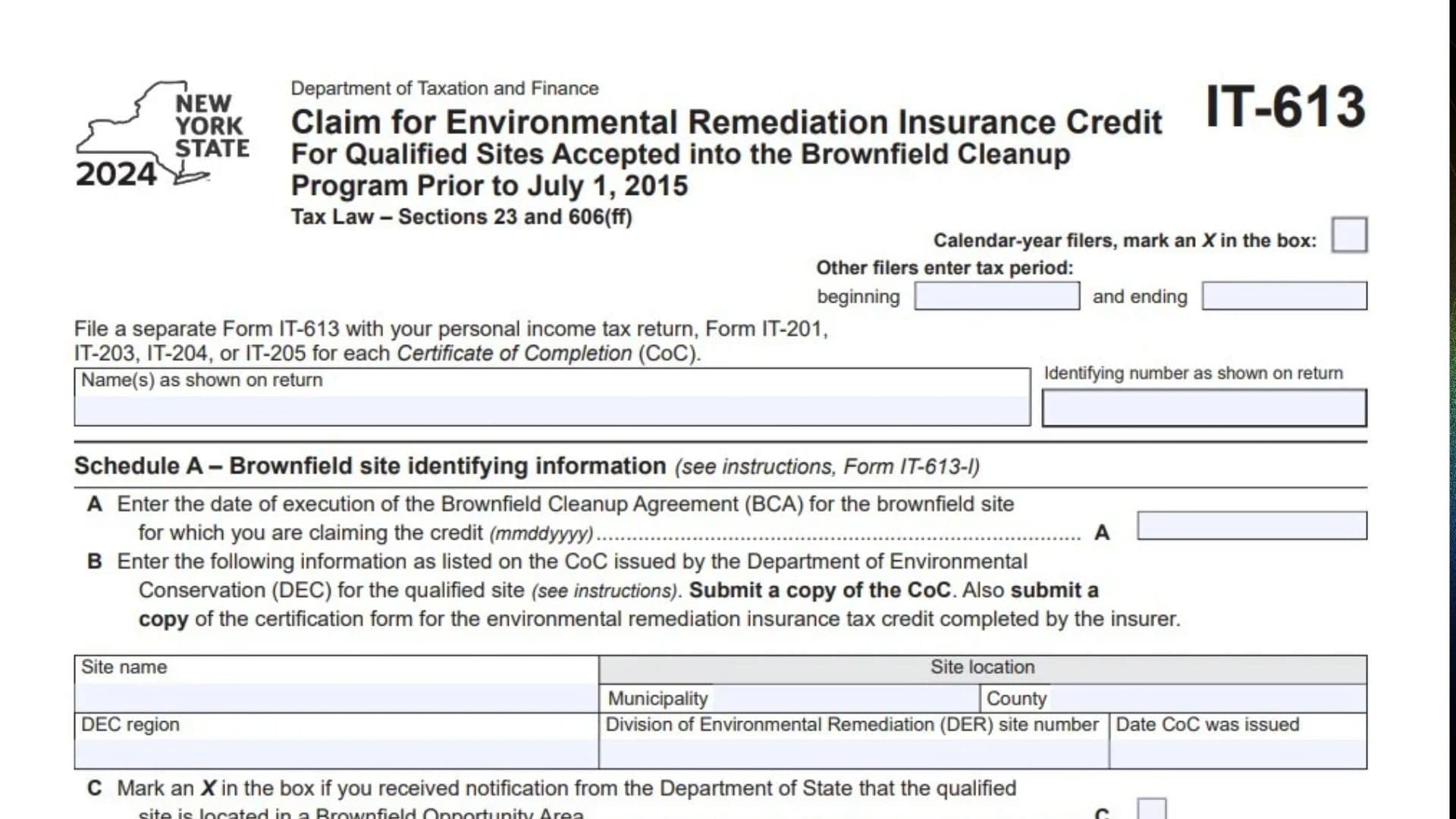
New York Form IT-613, Claim for Environmental Remediation Insurance Credit, is a tax form used by eligible individuals, sole proprietors, partnerships, and fiduciaries to claim a credit for qualifying environmental remediation insurance premiums associated with brownfield sites. The credit applies to qualified sites accepted into the New York State Brownfield Cleanup Program before July 1, 2015, under New York Tax Law Sections 23 and 606(ff). The form allows eligible taxpayers to calculate a credit based on the environmental remediation insurance premiums paid for a qualified site. It also provides a way for partners, shareholders of New York S corporations, and beneficiaries of estates or trusts to report their allocated shares of the credit. The form collects information about the taxpayer, the Brownfield Cleanup Agreement (BCA), the qualified brownfield site, the Certificate of Completion (CoC), environmental remediation insurance premiums, and credit allocations received through other entities. It also includes provisions for reporting credit recapture when previously claimed credits must be recovered. The calculation generally begins with the qualifying insurance premiums paid, applies a 50% rate, and limits the resulting credit to $30,000. However, the amount available to an individual taxpayer may also depend on credit allocations received through partnerships, S corporations, estates, or trusts. Fiduciaries must complete additional schedules to report the portions allocated to beneficiaries and the fiduciary’s own share. Completing Form IT-613 correctly is important because the credit depends on the qualification of the brownfield site, the insurance premiums paid, the applicable statutory limitation, and the taxpayer’s relationship with the entity claiming or distributing the credit. The form also requires supporting documentation, including the Certificate of Completion and a certification form for the environmental remediation insurance tax credit completed by the insurer. A separate Form IT-613 must be completed for each Certificate of Completion associated with a qualified site.
How To File Form IT-613
Form IT-613 must be filed with the applicable New York State personal income tax or fiduciary income tax return. A separate form is required for each Certificate of Completion (CoC).
Attach Form IT-613 to one of the following returns, as applicable:
- Form IT-201 – Resident Income Tax Return.
- Form IT-203 – Nonresident and Part-Year Resident Income Tax Return.
- Form IT-204 – Partnership Return.
- Form IT-205 – Fiduciary Income Tax Return.
Calendar-year filers should mark the calendar-year checkbox at the top of the form. Taxpayers using a different reporting period must enter the beginning and ending dates of their tax period.
Before completing Form IT-613, prepare the following information:
- Your name as shown on the applicable tax return.
- Your taxpayer identification number.
- The beginning and ending dates of the tax period, if applicable.
- The date the Brownfield Cleanup Agreement (BCA) was executed.
- The official name and location of the qualified brownfield site.
- The municipality and county where the site is located.
- The Department of Environmental Conservation (DEC) region.
- The Division of Environmental Remediation (DER) site number.
- The date the Certificate of Completion was issued.
- A copy of the Certificate of Completion.
- A copy of the environmental remediation insurance tax credit certification form completed by the insurer.
- The amount of qualified environmental remediation insurance premiums paid.
- Information about partnerships, New York S corporations, estates, or trusts from which you received a share of the credit.
- Beneficiary information and credit allocation details, if applicable.
- Information about previously claimed credits that may be subject to recapture.
Important Supporting Documents
You must submit a copy of the Certificate of Completion issued by the New York State Department of Environmental Conservation (DEC).
You must also submit a copy of the certification form for the environmental remediation insurance tax credit completed by the insurer.
These documents support the credit claim and identify the qualified site and associated insurance coverage.

How To Complete Form IT-613
Form IT-613 contains seven main sections, including Schedules A through G. Each schedule addresses a different part of the environmental remediation insurance credit calculation, including site identification, insurance premiums, credit allocations, and recapture.
Follow the instructions below in the same order as the form.
Taxpayer and Tax Period Information
The top section identifies the taxpayer and the tax period covered by the credit claim.
Calendar-Year Filer Checkbox
Mark an X in this box if you file your New York State tax return using a calendar-year reporting period.
If you use a calendar-year basis, you do not need to enter a separate beginning and ending date in the tax-period fields.
Tax Period Beginning
If you are not a calendar-year filer, enter the beginning date of your tax period.
Provide the applicable month, day, and year.
Tax Period Ending
If you are not a calendar-year filer, enter the ending date of your tax period.
Make sure the beginning and ending dates match the reporting period used on your tax return.
Name(s) as Shown on Return
Enter your name exactly as it appears on the New York State tax return to which Form IT-613 will be attached.
For an individual, enter the taxpayer’s name. For a partnership or fiduciary, use the applicable entity name.
Identifying Number as Shown on Return
Enter the taxpayer identification number associated with the return.
Use the appropriate identification number shown on the applicable New York State tax return.
Schedule A: Brownfield Site Identifying Information
Schedule A identifies the qualified brownfield site associated with the environmental remediation insurance credit.
The information must correspond to the Brownfield Cleanup Agreement and the Certificate of Completion issued by the New York State Department of Environmental Conservation.
Schedule A, Line A: Date of Execution of the Brownfield Cleanup Agreement
Enter the date the Brownfield Cleanup Agreement (BCA) was executed for the qualified brownfield site.
Use the MMDDYYYY format.
For example, if the agreement was executed on April 15, 2014, enter 04152014.
Make sure the date corresponds to the specific site for which you are claiming the credit.
Schedule A, Line B: Qualified Brownfield Site Information
Enter the information associated with the qualified site as shown on the Certificate of Completion issued by the Department of Environmental Conservation.
The schedule requires the following details.
Site Name
Enter the official name of the qualified brownfield site.
Use the name shown on the Certificate of Completion.
Site Location: Municipality
Enter the municipality where the qualified brownfield site is located.
Use the official location information associated with the site.
Site Location: County
Enter the county in which the qualified brownfield site is situated.
Make sure the county matches the information shown in the site’s environmental records.
DEC Region
Enter the Department of Environmental Conservation region associated with the qualified site.
Use the region identified in the applicable site documentation.
Division of Environmental Remediation (DER) Site Number
Enter the site identification number assigned by the Division of Environmental Remediation.
Verify the number against the Certificate of Completion.
Date CoC Was Issued
Enter the date the Department of Environmental Conservation issued the Certificate of Completion.
Use the date shown on the CoC.
You must submit a copy of the Certificate of Completion with Form IT-613.
You must also include the insurer-completed certification form for the environmental remediation insurance tax credit.
Schedule A, Line C: Brownfield Opportunity Area Notification
Mark an X in this box if you received notification from the New York State Department of State confirming that the qualified site is located in a Brownfield Opportunity Area.
Only mark the box if you received the specified notification.
This information identifies whether the site has the relevant Brownfield Opportunity Area designation.
Schedule B: Individuals, Sole Proprietors, Partnerships, and Fiduciaries
Schedule B calculates the environmental remediation insurance credit based on the qualified insurance premiums paid.
The calculation applies a 50% rate to the qualifying premiums and limits the resulting credit to $30,000.
Line 1: Qualified Environmental Remediation Insurance Premiums Paid
Enter the total amount of qualified environmental remediation insurance premiums paid for the applicable brownfield site.
Use the amount determined under the applicable Form IT-613 instructions.
Only include premiums that qualify for the environmental remediation insurance credit.
Line 2: 50% of Qualified Insurance Premiums
Multiply the amount on Line 1 by 50% (0.50).
The calculation is:
Line 1 × 0.50 = Line 2
Enter the resulting amount on Line 2.
For example, if you paid $40,000 in qualified environmental remediation insurance premiums, the calculation would be:
$40,000 × 0.50 = $20,000
Line 3: Allowable Environmental Remediation Insurance Credit
Enter the smaller of the amount on Line 2 or $30,000.
The calculation is:
Smaller of Line 2 or $30,000 = Line 3
For example:
- If Line 2 is $20,000, enter $20,000.
- If Line 2 is $35,000, enter $30,000.
The credit cannot exceed the $30,000 limitation specified on the form.
Transfer Instructions for Line 3
The next step depends on your taxpayer classification.
- Individuals and partnerships: Enter the amount from Line 3 on Line 8.
- Fiduciaries: Include the amount from Line 3 in the Total line of Schedule E, Column C.
Make sure the amount is transferred to the correct section.
Schedule C: Partnership, S Corporation, Estate, and Trust Information
Schedule C identifies the partnerships, New York S corporations, estates, and trusts from which you received a share of the environmental remediation insurance credit.
Complete this schedule if you were:
- A partner in a partnership.
- A shareholder of a New York S corporation.
- A beneficiary of an estate or trust.
You must provide the required information for each entity from which you received a share of the credit.
Column A: Name
Enter the complete name of the partnership, New York S corporation, estate, or trust from which you received the credit.
Use the entity’s official name.
Column B: Type
Enter the appropriate entity classification code.
Use the following codes:
- P – Partnership.
- S – New York S corporation.
- ET – Estate or trust.
Select the code that corresponds to the entity distributing the credit.
Column C: Employer Identification Number
Enter the Employer Identification Number (EIN) of the partnership, New York S corporation, estate, or trust.
Verify the identification number against the entity’s tax records.
If you received credit from more than one entity, provide the information for each applicable entity in the available spaces.
Schedule D calculates the taxpayer’s share of environmental remediation insurance credit received through a partnership, New York S corporation, estate, or trust.
Complete the lines that apply to your relationship with the entity distributing the credit.
Line 4: Partner’s Share of Credit
Enter your share of the environmental remediation insurance credit received from a partnership.
Use the amount allocated to you by the partnership.
Line 5: S Corporation Shareholder’s Share of Credit
Enter your share of the environmental remediation insurance credit received from a New York S corporation.
Use the amount allocated to you as a shareholder.
Line 6: Beneficiary’s Share of Credit
Enter your share of the environmental remediation insurance credit received from an estate or trust.
Use the amount allocated to you as a beneficiary.
Line 7: Total Share of Credit
Add the amounts reported on Lines 4, 5, and 6.
The calculation is:
Line 4 + Line 5 + Line 6 = Line 7
Enter the combined amount on Line 7.
Transfer Instructions for Line 7
The treatment of this amount depends on your taxpayer classification.
- Fiduciaries: Include the Line 7 amount in the Total line of Schedule E, Column C.
- All others: Enter the Line 7 amount on Line 9.
Schedule E is used by fiduciaries to report how the environmental remediation insurance credit and any applicable recapture amount are allocated between beneficiaries and the fiduciary.
The schedule contains four columns.
Column A: Beneficiary’s Name
Enter the name of each beneficiary receiving a share of the environmental remediation insurance credit.
The beneficiary’s name must match the name reported on Form IT-205, Schedule C.
Column B: Identifying Number
Enter the taxpayer identification number associated with each beneficiary.
Use the correct identification number for the beneficiary listed in Column A.
Column C: Share of Environmental Remediation Insurance Credit
Enter the amount of environmental remediation insurance credit allocated to each beneficiary.
Use the amount determined under the applicable allocation instructions.
The fiduciary must also report the fiduciary’s own share of the credit in the designated Fiduciary row.
Column D: Share of Recapture of Credit
Enter the amount of credit recapture allocated to each beneficiary.
Use the applicable recapture calculation and allocation information.
If no recapture applies to a beneficiary, follow the instructions for reporting the applicable amount.
Total: Beneficiary’s Share of Credit and Recapture
Complete the Total row to report the combined beneficiary allocations.
For Column C, add the amounts allocated to beneficiaries.
For Column D, add the amounts of recapture allocated to beneficiaries.
Use the applicable instructions to determine the amounts included in each total.
Fiduciary
Enter the fiduciary’s own share of the environmental remediation insurance credit in Column C.
Enter the fiduciary’s own share of recapture in Column D.
Keep the fiduciary’s amounts separate from the beneficiary allocations.
The amounts reported in Schedule E are used in the credit and recapture calculations in Schedules F and G.
Schedule F: Computation of Credit
Schedule F calculates the total environmental remediation insurance credit available to the taxpayer.
The applicable line depends on whether the credit comes directly from insurance premiums paid or through an allocation from another entity.
Line 8: Credit for Individuals and Partnerships
Individuals and partnerships must enter the amount from Schedule B, Line 3.
Transfer the calculated credit amount without changing it.
Line 9: Credit for Partners, S Corporation Shareholders, and Beneficiaries
Partners, New York S corporation shareholders, and beneficiaries must enter the amount from Schedule D, Line 7.
Use the total credit allocated to you through the applicable partnership, S corporation, estate, or trust.
Line 10: Credit for Fiduciaries
Fiduciaries must enter the amount from Schedule E, Column C, Fiduciary row.
Use the amount representing the fiduciary’s own share of the environmental remediation insurance credit.
Line 11: Total Environmental Remediation Insurance Credit
Enter the total environmental remediation insurance credit determined under the applicable instructions.
Use the appropriate credit amount based on your taxpayer classification and the amounts reported in the preceding lines.
Make sure the amount includes only the credit applicable to the taxpayer claiming it.
Schedule G: Summary of Recapture of Environmental Remediation Insurance Credit
Schedule G reports the environmental remediation insurance credit that must be recaptured.
A recapture amount may apply when previously claimed credits become subject to recovery under the applicable tax rules.
Complete the applicable lines based on whether you are an individual, partner, S corporation shareholder, beneficiary, partnership, or fiduciary.
Line 12: Recaptured Environmental Remediation Insurance Credit
Enter the amount of environmental remediation insurance credit subject to recapture.
Determine the applicable amount using the Form IT-613 instructions.
Transfer Instructions for Line 12
The next step depends on your taxpayer classification.
- Fiduciaries: Include the Line 12 amount in the Total row of Schedule E, Column D, and continue with Line 14.
- All others: Continue with Line 13.
Line 13: Partner’s, Shareholder’s, or Beneficiary’s Share of Recapture
This line applies to partners in partnerships, shareholders of New York S corporations, and beneficiaries of estates or trusts.
Enter your share of the recaptured environmental remediation insurance credit.
Use the recapture amount allocated to you by the applicable partnership, S corporation, estate, or trust.
Line 14: Fiduciary’s Share of Recapture
This line applies to fiduciaries.
Enter the amount from Schedule E, Column D, Fiduciary row.
Transfer the fiduciary’s own share of recapture to this line.
Line 15: Total Recapture Amount
Add the applicable amounts reported on Lines 12, 13, and 14.
The calculation is:
Line 12 + Line 13 + Line 14 = Line 15
Enter the resulting recapture amount on Line 15, following the special instructions for fiduciaries.
Transfer Instructions for Line 15
The reporting destination depends on your taxpayer classification.
- Individuals: Enter the Line 15 amount and code 173 on Form IT-201-ATT, Line 20, or Form IT-203-ATT, Line 19.
- Partnerships: Enter the Line 15 amount and code 173 on Form IT-204, Line 148.
- Fiduciaries: Include the Line 15 amount on Form IT-205, Line 12.
Make sure the recapture amount is reported on the appropriate New York State tax return.
Final Review Before Filing
Before submitting Form IT-613, review the following checklist to confirm that the qualified site information, insurance premium calculations, credit allocations, and recapture amounts are accurate.
Taxpayer and Tax Period Information
- Enter the taxpayer’s name as shown on the applicable New York State tax return.
- Verify the taxpayer identification number.
- Mark the calendar-year checkbox if applicable.
- Enter the beginning and ending dates if filing for another tax period.
- Confirm that a separate Form IT-613 is prepared for each Certificate of Completion.
Schedule A: Brownfield Site Information
- Enter the correct Brownfield Cleanup Agreement execution date.
- Verify the official brownfield site name.
- Enter the correct municipality and county.
- Confirm the DEC region.
- Verify the DER site number.
- Enter the Certificate of Completion issuance date.
- Attach a copy of the Certificate of Completion.
- Attach the insurer-completed environmental remediation insurance tax credit certification form.
- Mark the Brownfield Opportunity Area checkbox only if the required notification was received.
Schedule B: Insurance Premium and Credit Calculation
- Enter the qualified environmental remediation insurance premiums paid on Line 1.
- Multiply Line 1 by 50% and report the result on Line 2.
- Apply the $30,000 limitation on Line 3.
- Transfer the Line 3 amount to the correct section based on your taxpayer classification.
Schedule C and Schedule D: Entity and Credit Information
- Complete Schedule C if you received credit through a partnership, New York S corporation, estate, or trust.
- Enter the correct entity name.
- Use the appropriate entity type code.
- Verify each entity’s EIN.
- Complete Line 4 for partnership credit, if applicable.
- Complete Line 5 for S corporation credit, if applicable.
- Complete Line 6 for beneficiary credit, if applicable.
- Add Lines 4, 5, and 6 correctly on Line 7.
- Transfer Line 7 to the appropriate destination.
Schedule E: Beneficiary and Fiduciary Allocations
- Complete Schedule E if filing as a fiduciary.
- Verify beneficiary names against Form IT-205, Schedule C.
- Enter the correct beneficiary identification numbers.
- Report each beneficiary’s share of credit in Column C.
- Report each beneficiary’s share of recapture in Column D.
- Calculate the beneficiary totals correctly.
- Report the fiduciary’s own share separately.
Schedule F: Credit Calculation
- Enter the correct amount on Line 8 for individuals and partnerships.
- Enter the correct amount on Line 9 for partners, S corporation shareholders, and beneficiaries.
- Enter the fiduciary’s share on Line 10.
- Verify the total environmental remediation insurance credit on Line 11.
Schedule G: Recapture Calculation
- Enter applicable recapture on Line 12.
- Complete Line 13 if you received a share of recapture through a partnership, S corporation, estate, or trust.
- Complete Line 14 if filing as a fiduciary.
- Calculate the total recapture amount on Line 15.
- Use code 173 when reporting recapture on the applicable individual or partnership return.
- Transfer the fiduciary recapture amount to Form IT-205, Line 12, when applicable.
Final Filing Checks
- Verify all financial amounts and calculations.
- Confirm that all applicable schedules are completed.
- Attach the required supporting documentation.
- Check that the form identifies the correct qualified brownfield site.
- Attach Form IT-613 to the appropriate New York State tax return.
- Retain copies of the completed form and supporting records.
Final Filing Reminder: New York Form IT-613 is used to claim the Environmental Remediation Insurance Credit for qualified sites accepted into the Brownfield Cleanup Program before July 1, 2015. Complete the applicable schedules based on your taxpayer classification, calculate the credit using the 50% premium rate and $30,000 limitation, and report any required recapture on the appropriate tax return. Make sure the Certificate of Completion and the insurer-completed certification form are included with your submission. Always consult the applicable Form IT-613 instructions when determining qualifying insurance premiums, credit allocations, and recapture requirements.