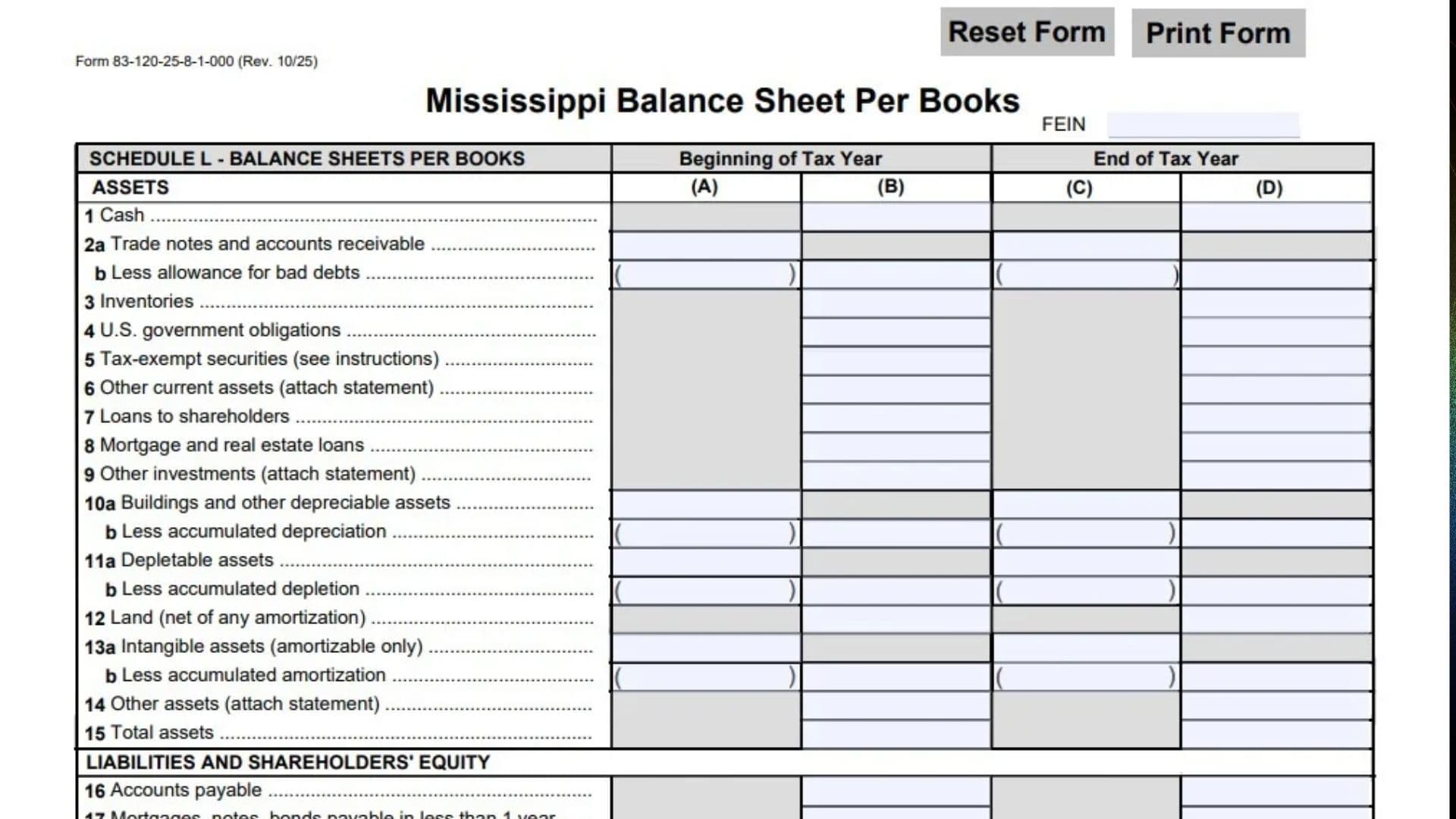
The Mississippi Balance Sheet Per Books is a financial reporting form used to present a corporation’s assets, liabilities, and shareholders’ equity at the beginning and end of its tax year. It also provides information about differences between the corporation’s financial accounting records and its federal taxable income. The form contains three main schedules: Schedule L, Schedule M-1, and Schedule M-2. Schedule L reports the corporation’s financial position, including cash, accounts receivable, inventory, investments, property, depreciation, liabilities, capital stock, and retained earnings. It compares the beginning-of-year and end-of-year balances to show how the company’s financial position changed during the reporting period. Schedule M-1 reconciles the corporation’s net income or loss according to its accounting books with the income reported on its federal tax return. It identifies differences such as federal income tax recorded as an expense, capital losses exceeding capital gains, tax-exempt interest, depreciation, charitable contributions, and other book or tax adjustments. Schedule M-2 provides an analysis of the corporation’s unappropriated retained earnings by tracking the opening balance, current-year net income or loss, other increases, distributions, other decreases, and closing balance. Together, these schedules provide a detailed picture of the corporation’s financial condition, accounting adjustments, and retained earnings. Completing the form accurately is important because the reported figures should agree with the corporation’s financial statements, accounting records, and applicable tax return. Any differences between book income and taxable income should be properly identified and explained so that the financial information can be reviewed consistently.

How To Complete the Mississippi Balance Sheet Per Books
The form is identified as Form 83-120-25-8-1-000, revised October 2025. It contains one page with three schedules.
The form itself does not specify a separate mailing address, filing deadline, or the exact Mississippi tax return to which it must be attached. Check the applicable Mississippi Department of Revenue filing instructions to confirm the submission requirements.
Before completing the form, prepare the following information:
- The corporation’s Federal Employer Identification Number (FEIN).
- The corporation’s balance sheet at the beginning of the tax year.
- The corporation’s balance sheet at the end of the tax year.
- Cash and bank account balances.
- Accounts receivable and allowances for bad debts.
- Inventory records.
- Investment and loan balances.
- Property, buildings, and depreciation records.
- Intangible assets and amortization records.
- Accounts payable and other liability balances.
- Capital stock and additional paid-in capital information.
- Retained earnings records.
- Current-year financial statements.
- Federal income tax return information.
- Details of book-to-tax income and expense adjustments.
- Records of shareholder distributions and other retained earnings changes.
Make sure all figures are supported by the corporation’s accounting records. Amounts should be reported for both the beginning and end of the tax year wherever the form provides corresponding entry spaces.

How To Complete Schedule L: Balance Sheets Per Books
Schedule L reports the corporation’s financial position at two points in time:
- Beginning of the tax year.
- End of the tax year.
The schedule is divided into assets and liabilities and shareholders’ equity. Enter the applicable balances in the designated spaces for each reporting period. Follow the form’s shaded and unshaded entry areas when completing the columns.
Assets
This section reports everything the corporation owns or has a financial interest in. It includes current assets, investments, property, and other assets.
Line 1: Cash
Enter the corporation’s cash balances at the beginning and end of the tax year.
Include applicable cash held in business bank accounts and other cash balances recorded in the accounting books.
Use the corresponding balance sheet records for each reporting date.
Line 2a: Trade Notes and Accounts Receivable
Enter the total amount of trade notes and accounts receivable owed to the corporation.
Include amounts customers or other business parties owe for goods or services provided by the company.
Report the applicable beginning-of-year and end-of-year balances.
Line 2b: Less Allowance for Bad Debts
Enter the allowance established for accounts that the corporation does not expect to collect.
This amount reduces the gross accounts receivable reported on line 2a.
Show the allowance as a deduction in parentheses in the designated spaces.
Line 3: Inventories
Enter the value of the corporation’s inventory at the beginning and end of the tax year.
Include the inventory amounts recorded in the company’s accounting books. Use the applicable inventory valuation records for each reporting date.
Line 4: U.S. Government Obligations
Enter the book value of investments held in obligations issued by the United States government.
Use the corporation’s investment records to determine the applicable balances at the beginning and end of the year.
Line 5: Tax-Exempt Securities
Enter the value of tax-exempt securities owned by the corporation.
Use the investment records to determine the amounts for both reporting periods. Refer to the applicable form instructions for additional information about the securities included in this category.
Line 6: Other Current Assets
Enter the value of current assets that are not included in the previous asset categories.
These may include other short-term assets recorded in the corporation’s books.
Attach a separate statement describing the assets included in this line. Make sure the statement supports the reported totals.
Line 7: Loans to Shareholders
Enter the amounts the corporation has loaned to its shareholders.
Use the corporation’s loan records to determine the outstanding balances at the beginning and end of the tax year.
Do not include amounts that are properly classified under another asset category.
Line 8: Mortgage and Real Estate Loans
Enter the balances of mortgages and loans secured by real estate that are held by the corporation.
Use the applicable loan agreements and accounting records to determine the outstanding amounts for both reporting periods.
Line 9: Other Investments
Enter the value of investments that are not included in the categories listed on the previous lines.
Include the applicable investment balances recorded in the corporation’s books.
Attach a separate statement identifying the investments included in this line.
Line 10a: Buildings and Other Depreciable Assets
Enter the recorded cost or book amount of buildings and other depreciable business assets.
Include the applicable property and equipment balances shown in the corporation’s accounting records.
Report the amounts for both the beginning and end of the tax year.
Line 10b: Less Accumulated Depreciation
Enter the total accumulated depreciation associated with the buildings and other depreciable assets reported on line 10a.
Show the amount as a deduction in parentheses.
Use the depreciation balances recorded in the corporation’s books for each reporting period.
Line 11a: Depletable Assets
Enter the book value of assets that are subject to depletion.
Use the corporation’s accounting records to determine the applicable balances at the beginning and end of the year.
Line 11b: Less Accumulated Depletion
Enter the accumulated depletion associated with the assets reported on line 11a.
Show the amount as a deduction in parentheses.
Use the applicable depletion records to determine the balances for both reporting periods.
Line 12: Land (Net of Any Amortization)
Enter the value of land owned by the corporation, after accounting for any applicable amortization reflected in the books.
Use the recorded land balances for the beginning and end of the tax year.
Line 13a: Intangible Assets (Amortizable Only)
Enter the value of intangible assets that are subject to amortization.
Include the applicable balances recorded in the corporation’s accounting books.
Only include intangible assets that qualify as amortizable for this reporting category.
Line 13b: Less Accumulated Amortization
Enter the accumulated amortization associated with the intangible assets reported on line 13a.
Show the amount as a deduction in parentheses.
Use the accumulated amortization balances recorded at the beginning and end of the tax year.
Line 14: Other Assets
Enter the value of assets that do not fit into the categories reported on the previous lines.
Attach a separate statement identifying and explaining the other assets included in this amount.
Line 15: Total Assets
Enter the corporation’s total assets for the beginning and end of the tax year.
Add the applicable asset amounts reported on lines 1 through 14, accounting for the deductions for bad debts, depreciation, depletion, and amortization.
The total should represent the corporation’s complete asset position for each reporting date.
This section reports the corporation’s outstanding obligations and the amounts attributable to shareholders’ ownership interests.
Line 16: Accounts Payable
Enter the amounts the corporation owes to suppliers, vendors, and other creditors for goods or services received.
Use the accounts payable balances recorded at the beginning and end of the tax year.
Line 17: Mortgages, Notes, and Bonds Payable in Less Than One Year
Enter the outstanding amounts of mortgages, notes, and bonds that are payable within less than one year.
Use the applicable loan and debt records to determine the balances for both reporting periods.
Line 18: Other Current Liabilities
Enter current liabilities that are not included in accounts payable or short-term mortgages, notes, and bonds.
Attach a separate statement identifying the liabilities included in this amount.
Line 19: Loans From Shareholders
Enter the outstanding amounts the corporation owes to its shareholders.
Use the corporation’s shareholder loan records to determine the balances at the beginning and end of the tax year.
Line 20: Mortgages, Notes, and Bonds Payable in One Year or More
Enter the outstanding amounts of long-term mortgages, notes, and bonds that are payable in one year or more.
Use the applicable debt agreements and accounting records to determine the amounts for both reporting periods.
Line 21: Other Liabilities
Enter liabilities that are not included in the previous liability categories.
Attach a separate statement describing the other obligations included in this line.
Line 22a: Capital Stock – Preferred Stock
Enter the recorded amount of the corporation’s preferred stock.
Use the corporation’s equity records to determine the balances at the beginning and end of the tax year.
Line 22b: Capital Stock – Common Stock
Enter the recorded amount of the corporation’s common stock.
Use the applicable shareholder equity and capital stock records for both reporting periods.
Line 23: Additional Paid-In Capital
Enter the amount shareholders have contributed to the corporation above the stated value of the issued stock.
Use the corporation’s accounting records to determine the applicable additional paid-in capital balances.
Line 24: Retained Earnings – Appropriated
Enter the amount of retained earnings that has been formally set aside or designated for a specific purpose.
Use the corporation’s accounting records to determine the applicable balances.
Attach a separate statement explaining the appropriated retained earnings included in this line.
Line 25: Retained Earnings – Unappropriated
Enter the corporation’s unappropriated retained earnings at the beginning and end of the tax year.
These are retained earnings that have not been formally designated for a specific purpose.
The ending balance should agree with the closing balance calculated in Schedule M-2.
Line 26: Adjustments to Shareholders’ Equity
Enter adjustments to shareholders’ equity that are not included in the preceding capital stock or retained earnings categories.
Attach a separate statement explaining the adjustments and supporting the reported amounts.
Line 27: Less Cost of Treasury Stock
Enter the cost of treasury stock held by the corporation.
Show the amount as a deduction in parentheses because treasury stock reduces shareholders’ equity.
Use the applicable treasury stock records for the beginning and end of the tax year.
Line 28: Total Liabilities and Shareholders’ Equity
Enter the corporation’s total liabilities and shareholders’ equity for both reporting periods.
Add the applicable amounts reported on lines 16 through 26 and subtract the cost of treasury stock reported on line 27.
The total should equal the corresponding total assets reported on line 15 for each reporting date.
Schedule M-1: Reconciliation of Income (Loss) Per Books With Federal Income Per Return
Schedule M-1 explains the differences between the corporation’s net income or loss recorded in its accounting books and the income reported on its federal tax return.
Some financial transactions are recorded differently for accounting and tax purposes. This schedule identifies the applicable differences and reconciles the two income amounts.
The form also notes that the corporation may be required to file Schedule M-3. Check the applicable tax return instructions to determine whether Schedule M-3 is required.
Line 1: Net Income (Loss) Per Books
Enter the corporation’s net income or loss according to its financial accounting records for the tax year.
Use the amount reported in the company’s books before making the adjustments listed in the remaining Schedule M-1 lines.
Line 2: Federal Income Tax Per Books
Enter the federal income tax expense recorded in the corporation’s accounting books.
Use the amount charged against book income during the tax year.
Line 3: Excess of Capital Losses Over Capital Gains
Enter the amount by which the corporation’s capital losses exceed its capital gains, if applicable.
Calculate the difference using the corporation’s capital transaction records.
Line 4: Income Subject to Tax Not Recorded on Books This Year
Enter income that is subject to federal tax but was not included in the corporation’s accounting income for the current year.
Itemize the applicable income amounts and provide supporting details.
Line 5: Expenses Recorded on Books This Year Not Deducted on This Return
Enter expenses that were charged against the corporation’s accounting income but are not deducted on its federal tax return.
The form provides three specific categories:
- Line 5a: Depreciation – Enter depreciation expense recorded in the books that is not deducted on the current tax return.
- Line 5b: Charitable Contributions – Enter charitable contributions recorded as expenses in the books that are not deducted on the current tax return.
- Line 5c: Travel and Entertainment – Enter travel and entertainment expenses recorded in the books that are not deducted on the current tax return.
Enter the applicable amounts and provide additional itemization where necessary.
Line 6: Total of Lines 1 Through 5
Add the amounts reported on lines 1, 2, 3, 4, and 5.
Formula:
Line 1 + Line 2 + Line 3 + Line 4 + Line 5 = Line 6.
Include the applicable adjustments reported on lines 5a, 5b, and 5c in the line 5 total.
Enter the combined amount in the designated space.
Line 7: Income Recorded on Books This Year Not Included on This Return
Enter income included in the corporation’s accounting books that is not included in the current federal income tax return.
The form specifically identifies tax-exempt interest as an example.
Tax-Exempt Interest
Enter the amount of tax-exempt interest recorded in the corporation’s books but excluded from taxable income on the return.
Provide the amount in the designated space and itemize any additional income that belongs in this category.
Line 8: Deductions on This Return Not Charged Against Book Income This Year
Enter deductions claimed on the federal tax return that were not recorded as expenses in the corporation’s accounting books for the current year.
The form provides two specific categories:
- Line 8a: Depreciation – Enter the depreciation deduction claimed on the tax return that was not charged against book income during the year.
- Line 8b: Charitable Contributions – Enter charitable contributions deducted on the tax return that were not recorded as expenses in the accounting books during the year.
Itemize the applicable amounts and provide supporting details where necessary.
Line 9: Total of Lines 7 and 8
Add the amounts reported on lines 7 and 8.
Formula:
Line 7 + Line 8 = Line 9.
Include the applicable amounts reported for tax-exempt interest, depreciation, charitable contributions, and other itemized entries.
Enter the combined total.
Line 10: Income Reported on the Tax Return
Subtract line 9 from line 6.
Formula:
Line 6 − Line 9 = Line 10.
Enter the resulting amount. The form identifies this figure as the income reported on page 1, line 28.
This completes the Schedule M-1 reconciliation.
Schedule M-2: Analysis of Unappropriated Retained Earnings Per Books
Schedule M-2 explains the changes in the corporation’s unappropriated retained earnings during the tax year.
It starts with the opening retained earnings balance, adds current-year income and other increases, subtracts distributions and other decreases, and calculates the ending balance.
The final amount should agree with Schedule L, line 25, for the end of the tax year.
Line 1: Balance at Beginning of Year
Enter the corporation’s unappropriated retained earnings balance at the beginning of the tax year.
Use the opening balance from the corporation’s accounting records.
This amount should generally agree with the previous year’s ending unappropriated retained earnings balance.
Line 2: Net Income (Loss) Per Books
Enter the corporation’s net income or loss according to its accounting books for the current tax year.
Use the same book income or loss amount reported on Schedule M-1, line 1.
Line 3: Other Increases
Enter increases in unappropriated retained earnings that are not included in net income or the opening balance.
Itemize the applicable increases and provide supporting details in the designated space.
Line 4: Total Beginning Balance, Income, and Other Increases
Add lines 1, 2, and 3.
Formula:
Line 1 + Line 2 + Line 3 = Line 4.
Enter the combined amount. This represents the retained earnings balance available before accounting for distributions and other decreases.
Line 5a: Distributions – Cash
Enter the total cash distributions made by the corporation during the tax year that reduce unappropriated retained earnings.
Use the corporation’s distribution and accounting records to determine the amount.
Line 5b: Distributions – Stock
Enter the value of stock distributions made during the tax year that reduce unappropriated retained earnings.
Use the applicable stock distribution records to determine the amount.
Line 5c: Distributions – Property
Enter the value of property distributed by the corporation during the tax year.
Use the corporation’s accounting records to determine the applicable amount.
Line 6: Other Decreases
Enter decreases in unappropriated retained earnings that are not included in the distributions reported on line 5.
Itemize the applicable decreases and provide supporting information.
Line 7: Total Distributions and Other Decreases
Add lines 5 and 6.
Formula:
Line 5 + Line 6 = Line 7.
Include all applicable cash, stock, property distributions, and other decreases.
Enter the combined amount.
Line 8: Balance at End of Year
Subtract line 7 from line 4.
Formula:
Line 4 − Line 7 = Line 8.
Enter the resulting ending balance of unappropriated retained earnings.
This amount should agree with Schedule L, line 25, for the end of the tax year.
Final Review Before Filing
Before submitting the Mississippi Balance Sheet Per Books form with the applicable tax filing, review the following checklist:
Schedule L: Balance Sheets Per Books
- Enter the corporation’s correct FEIN.
- Prepare beginning-of-year and end-of-year financial balances.
- Verify cash balances on line 1.
- Check trade notes and accounts receivable on line 2a.
- Verify the allowance for bad debts on line 2b.
- Confirm inventory balances on line 3.
- Check U.S. government obligations on line 4.
- Verify tax-exempt securities on line 5.
- Attach a statement for other current assets on line 6.
- Check shareholder loans on line 7.
- Verify mortgage and real estate loans on line 8.
- Attach a statement for other investments on line 9.
- Check buildings and depreciable assets on line 10a.
- Verify accumulated depreciation on line 10b.
- Check depletable assets on line 11a.
- Verify accumulated depletion on line 11b.
- Confirm land values on line 12.
- Check amortizable intangible assets on line 13a.
- Verify accumulated amortization on line 13b.
- Attach a statement for other assets on line 14.
- Recalculate total assets on line 15.
- Verify accounts payable on line 16.
- Check short-term mortgages, notes, and bonds on line 17.
- Attach a statement for other current liabilities on line 18.
- Verify shareholder loans payable on line 19.
- Check long-term mortgages, notes, and bonds on line 20.
- Attach a statement for other liabilities on line 21.
- Verify preferred and common stock on lines 22a and 22b.
- Check additional paid-in capital on line 23.
- Attach a statement for appropriated retained earnings on line 24.
- Verify unappropriated retained earnings on line 25.
- Attach a statement for shareholders’ equity adjustments on line 26.
- Check treasury stock deductions on line 27.
- Recalculate total liabilities and shareholders’ equity on line 28.
- Confirm that line 15 equals line 28 for both reporting periods.
Schedule M-1: Income Reconciliation
- Verify net income or loss per books on line 1.
- Check federal income tax expense on line 2.
- Confirm excess capital losses over capital gains on line 3.
- Itemize taxable income not recorded in the books on line 4.
- Review nondeductible book expenses on line 5.
- Check depreciation, charitable contributions, and travel and entertainment adjustments.
- Recalculate line 6 using lines 1 through 5.
- Itemize book income excluded from the tax return on line 7.
- Verify tax-exempt interest.
- Check deductions not charged against book income on line 8.
- Verify depreciation and charitable contribution adjustments.
- Recalculate line 9 using lines 7 and 8.
- Confirm that line 10 equals line 6 minus line 9.
- Check whether Schedule M-3 filing is required.
Schedule M-2: Retained Earnings Analysis
- Verify the beginning retained earnings balance on line 1.
- Confirm current-year net income or loss on line 2.
- Itemize other increases on line 3.
- Recalculate line 4.
- Verify cash distributions on line 5a.
- Check stock distributions on line 5b.
- Verify property distributions on line 5c.
- Itemize other decreases on line 6.
- Recalculate total decreases on line 7.
- Confirm the ending retained earnings balance on line 8.
- Make sure Schedule M-2, line 8, agrees with Schedule L, line 25, at the end of the tax year.
Final Submission: Review the applicable Mississippi Department of Revenue filing instructions to confirm where the completed balance sheet schedules must be submitted and whether additional statements or schedules are required. Retain supporting financial records and reconciliation details with the corporation’s tax documentation.