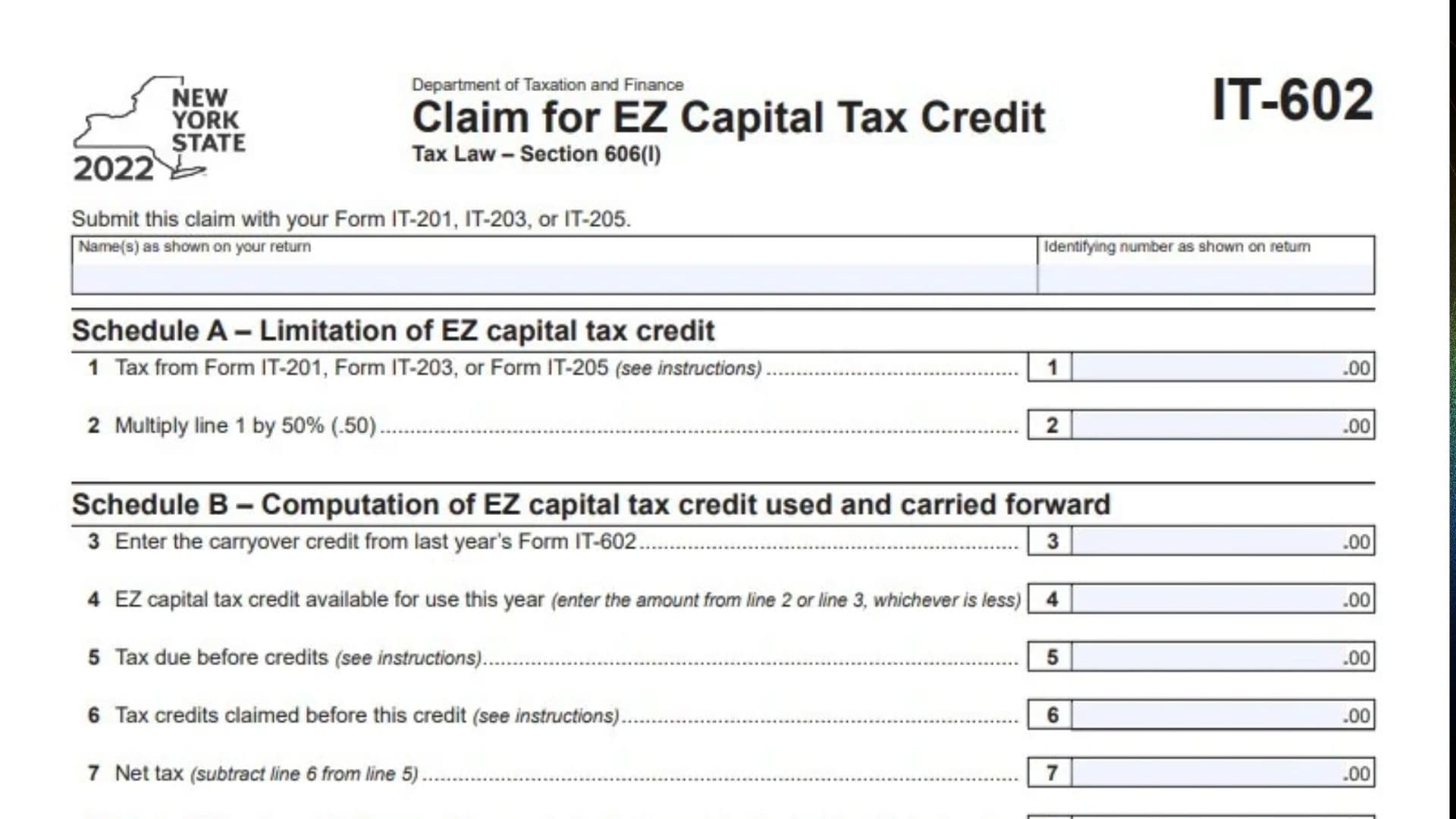
Form IT-602, Claim for EZ Capital Tax Credit, is a New York State tax form used to calculate and claim an unused Empire Zone (EZ) Capital Tax Credit carried forward from previous tax years. The credit was established under Section 606(l) of the New York State Tax Law and was originally available to qualifying taxpayers making eligible investments in certified Empire Zone businesses and community development projects. However, the EZ Capital Tax Credit has expired. For tax years beginning on or after April 1, 2014, taxpayers can no longer claim new credits under this program. They may only use eligible credit amounts carried forward from earlier years. Form IT-602 allows individuals, nonresidents, and fiduciaries to calculate how much of their remaining credit can be applied against their current New York State tax liability and how much can be carried forward to future years. The form collects the taxpayer’s identification information, applicable tax liability, previous-year credit carryovers, other tax credits claimed, and the amount of EZ Capital Tax Credit used during the current tax year. It contains two main schedules. Schedule A determines the maximum credit allowed based on the taxpayer’s tax liability, while Schedule B calculates the credit available for use, the amount applied to the current year’s tax, and the remaining balance available for future years. The credit generally cannot exceed the smaller of the tax due under Article 22 or 50% of the tax imposed under Article 22, Section 601, without regard to any credit. Certain taxpayers may also need to consider special eligibility restrictions. For example, a business that was required to obtain an EZ retention certificate but was denied one cannot claim the carryover attributable to investments in a certified EZ business. However, a retention certificate is not required for carryover credits resulting from contributions to community development projects. Completing Form IT-602 correctly is important because the available credit is subject to tax limitations and the order in which other credits are applied. Any eligible amount that cannot be used in the current tax year may generally be carried forward to succeeding tax years.
How To File Form IT-602
Form IT-602 must be submitted with the applicable New York State income tax return. It is not filed as a separate standalone return.
Attach the completed form to one of the following tax returns:
- Form IT-201: New York State resident income tax return.
- Form IT-203: New York State nonresident and part-year resident income tax return.
- Form IT-205: New York State fiduciary income tax return.
Before completing Form IT-602, prepare the following information:
- Your name as shown on your New York State income tax return.
- Your taxpayer identification number (SSN or EIN).
- Your current-year tax information.
- Your previous year’s Form IT-602 showing the remaining EZ Capital Tax Credit carryover.
- Your applicable tax return, including the relevant tax amounts.
- Information about resident credits and accumulation distribution credits, if applicable.
- Details of other tax credits claimed before the EZ Capital Tax Credit.
- Supporting records for any eligible credit carryovers from previous years.
- Any applicable EZ retention certificate information or records relating to community development project contributions.
The amount claimed must represent an eligible unused credit from a previous tax year. New EZ Capital Tax Credits cannot be generated under this expired program for tax years beginning on or after April 1, 2014.

How To Complete Form IT-602
Taxpayer Identification Information
At the top of Form IT-602, provide the following information.
Name(s) as Shown on Your Return
Enter the taxpayer’s name exactly as it appears on the applicable New York State income tax return. If the return includes more than one taxpayer, provide the names as shown on that return.
Identifying Number as Shown on Return
Enter the taxpayer identification number associated with the income tax return. This will generally be the Social Security number (SSN) or Employer Identification Number (EIN), as applicable.
Make sure the number matches the identification information on your main tax return.
Schedule A: Limitation of EZ Capital Tax Credit
Schedule A determines the maximum amount of EZ Capital Tax Credit that can be considered for use during the current tax year. The calculation is based on the taxpayer’s applicable tax liability and the 50% limitation.
Line 1: Tax From Your New York State Return
Enter the applicable tax amount based on the type of New York State return you are filing.
For Form IT-201 filers:
Add the tax reported on Form IT-201, line 39, and Form IT-230-I, Worksheet A, line 1. Reduce the total by any applicable resident credit and accumulation distribution credit.
For Form IT-203 filers:
Add the tax reported on Form IT-203, line 46, and Form IT-203-ATT, line 18. Subtract any applicable resident credit and accumulation distribution credit.
For Form IT-205 filers:
- Resident fiduciaries: Enter the tax from Form IT-205, line 8, reduced by any resident credit and accumulation distribution credit.
- Nonresident and part-year resident fiduciaries: Enter the tax from Form IT-205, line 9, reduced by any resident credit and accumulation distribution credit.
Use the calculation that matches your filing category.
Line 2: Fifty Percent of Tax
Multiply the amount on line 1 by 50%.
Formula:
Line 1 × 0.50 = Line 2.
Enter the result. This amount establishes the 50% tax limitation used to determine how much EZ Capital Tax Credit can be considered for use during the current year.
Schedule B: Computation of EZ Capital Tax Credit Used and Carried Forward
Schedule B calculates the available credit, determines how much can be applied against the current year’s tax, and identifies the remaining credit that can be carried forward.
Line 3: Credit Carryover From the Previous Year
Enter the unused EZ Capital Tax Credit carried forward from your previous year’s Form IT-602.
Use the amount reported as the carryover from the prior year. Make sure it represents an eligible credit balance that remains available for use.
Do not include new credits generated after the program expired.
Line 4: EZ Capital Tax Credit Available for Use This Year
Compare the amounts on lines 2 and 3. Enter whichever amount is smaller.
Formula:
Smaller of Line 2 or Line 3 = Line 4.
This calculation limits the credit available for use during the current tax year to the applicable 50% tax limitation or the existing carryover balance, whichever is lower.
Line 5: Tax Due Before Credits
Enter your tax due before applying tax credits, using the applicable return instructions.
For Form IT-201 filers:
Enter the tax from Form IT-201, line 39, plus any amount from Form IT-201-ATT, line 21.
For Form IT-203 filers:
Enter the tax from Form IT-203, line 46, plus any amount from Form IT-203-ATT, line 20.
For Form IT-205 filers:
- Resident fiduciaries: Enter the tax from Form IT-205, line 8.
- Nonresident fiduciaries: Enter the tax from Form IT-205, line 9.
For Form IT-205 filers, also include any applicable credits shown on line 1 of the Addbacks Worksheet in the instructions for Form IT-205, line 12.
Use the calculation that applies to your return type.
Line 6: Tax Credits Claimed Before This Credit
Enter the total amount of other tax credits being applied against your tax before the EZ Capital Tax Credit.
Include the applicable credits that must be used before this credit.
Follow the required credit application order:
- Apply any household credit first.
- Apply credits that cannot be carried forward or refunded.
- Apply credits that can be carried forward for a limited period.
- Apply credits that can be carried forward for an unlimited period.
- Apply refundable credits last.
The EZ Capital Tax Credit must be calculated after accounting for the credits that take priority under these rules.
Line 7: Net Tax After Previous Credits
Subtract line 6 from line 5.
Formula:
Line 5 − Line 6 = Line 7.
Enter the remaining tax amount. This represents the net tax available for calculating how much EZ Capital Tax Credit can be used during the current year.
Line 8: EZ Capital Tax Credit Used for the Current Tax Year
Compare the amounts on lines 4 and 7. Enter whichever amount is smaller.
Formula:
Smaller of Line 4 or Line 7 = Line 8.
This is the amount of EZ Capital Tax Credit you can apply against your current-year tax liability.
Transfer the amount from line 8 to the appropriate location:
- Form IT-201-ATT, line 6, using credit code 162.
- Form IT-203-ATT, line 7, using credit code 162.
- Form IT-205, line 10.
Use the destination that matches your tax return.
Line 9: EZ Capital Tax Credit Available for Carryover to Next Year
Subtract line 8 from line 3.
Formula:
Line 3 − Line 8 = Line 9.
Enter the remaining eligible credit balance. This represents the unused portion of your previous-year carryover that can be carried forward to succeeding tax years.
Keep this amount with your tax records because it will be needed when completing Form IT-602 for the next tax year.
Important Rules for EZ Capital Tax Credit Carryovers
The Empire Zone Capital Tax Credit program has expired, but eligible unused credit balances from previous years may still be claimed.
Keep the following rules in mind when completing Form IT-602:
Expiration of the Credit Program
The EZ Capital Tax Credit expired. For tax years beginning on or after April 1, 2014, taxpayers may only claim eligible credit carryovers from previous years.
New credits cannot be claimed under the expired program for these tax years.
EZ Retention Certificate Requirement
Some businesses were required to obtain an EZ retention certificate to qualify for certain credit carryovers.
If your business was required to obtain this certificate but was denied one, you cannot claim the carryover attributable to investments in a certified EZ business.
However, a retention certificate is not required to claim eligible carryover credits resulting from contributions to community development projects.
Fifty Percent Tax Limitation
The EZ Capital Tax Credit cannot exceed the smaller of:
- The tax due under Article 22.
- 50% of the tax imposed under Article 22, Section 601, without regard to any credit.
Schedule A calculates the applicable 50% limitation using lines 1 and 2.
Carryforward of Unused Credits
Any eligible credit carryover that cannot be deducted in the current tax year may be carried forward and deducted from tax in succeeding tax years.
Use line 9 to calculate the remaining amount available for future years.
Maintain accurate records of the original credit, previous-year carryovers, and amounts used so that the remaining balance can be reported correctly on future returns.
Final Review Before Filing
Before submitting Form IT-602 with your New York State income tax return, review the following checklist:
- Confirm that the taxpayer’s name matches the main income tax return.
- Verify the SSN or EIN.
- Confirm that the credit being claimed is an eligible carryover from a previous year.
- Check whether any EZ retention certificate requirement applies.
- Verify the tax calculation on line 1 using the correct return type.
- Confirm that line 2 correctly represents 50% of line 1.
- Check that line 3 matches the eligible carryover from the previous year’s Form IT-602.
- Verify that line 4 contains the smaller amount from lines 2 and 3.
- Confirm that line 5 includes the applicable tax and required adjustments.
- Check that line 6 includes all credits applied before the EZ Capital Tax Credit.
- Verify the required order for applying tax credits.
- Confirm that line 7 correctly subtracts line 6 from line 5.
- Check that line 8 contains the smaller amount from lines 4 and 7.
- Transfer the credit from line 8 to the correct location on Form IT-201-ATT, Form IT-203-ATT, or Form IT-205.
- Use credit code 162 when reporting the credit on Form IT-201-ATT or Form IT-203-ATT.
- Confirm that line 9 correctly subtracts line 8 from line 3.
- Keep a record of the remaining credit carryover for the next tax year.
- Make sure all calculations agree with the applicable New York State income tax return.
Submission: Attach the completed Form IT-602 to Form IT-201, Form IT-203, or Form IT-205, depending on your filing status. Transfer the credit used to the appropriate line of your main tax return and retain the remaining carryover information for future tax years.