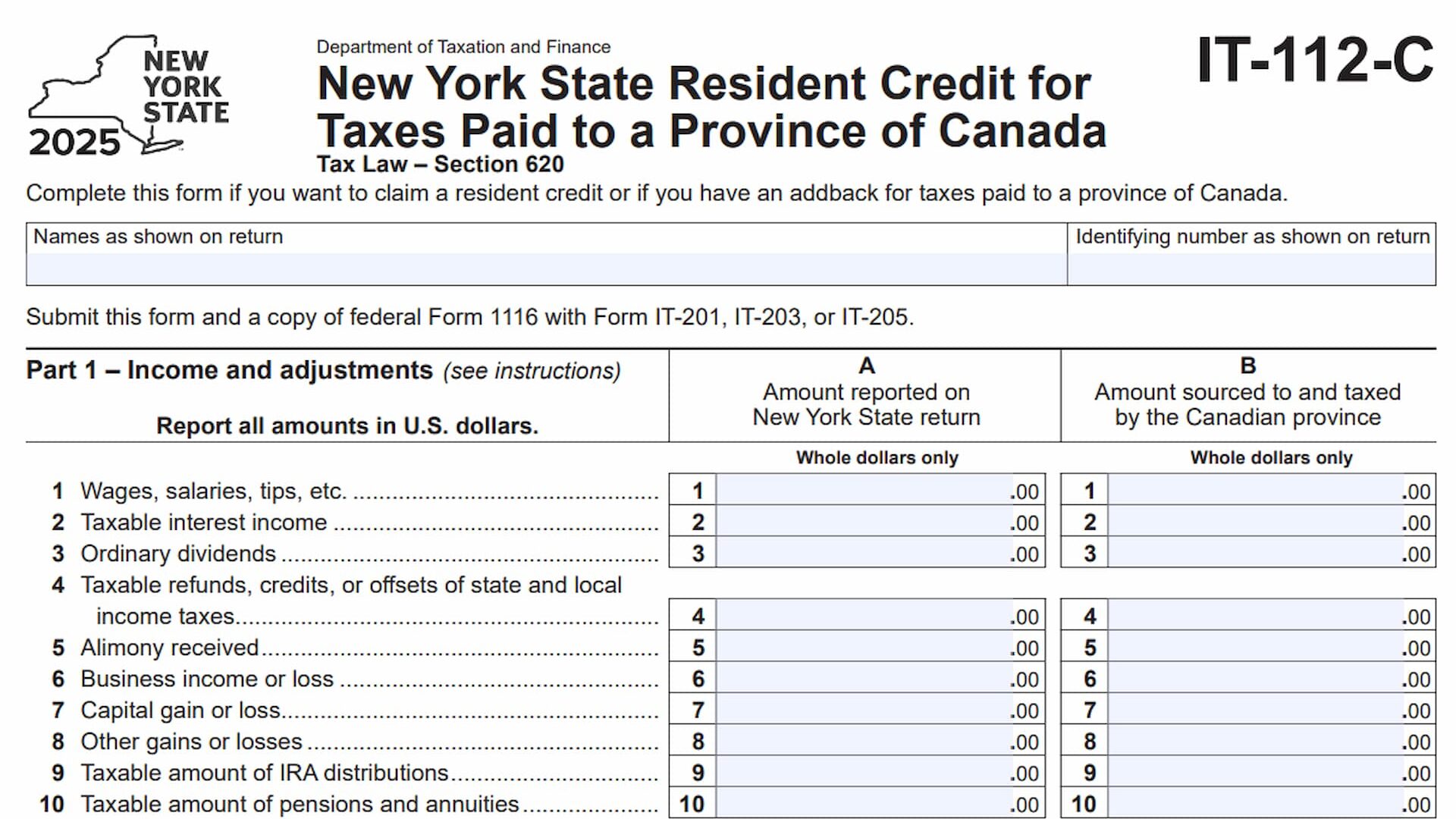
Form IT-112-C, New York State Resident Credit for Taxes Paid to a Province of Canada, is a New York State tax form used by eligible residents and fiduciaries to claim a resident credit for income taxes paid to a Canadian province. The credit is authorized under Section 620 of the New York State Tax Law. The form is designed to prevent double taxation when income is subject to both New York State income tax and Canadian provincial income tax. It allows eligible taxpayers to calculate a credit for qualifying Canadian provincial taxes while accounting for foreign tax credits claimed on their federal income tax return.
Form IT-112-C is also used when a taxpayer must report an addback of a previously claimed New York resident credit because the corresponding Canadian provincial income tax is later claimed as a federal foreign tax credit.
The 2025 Form IT-112-C contains four main parts:
- Part 1: Reports income and adjustments, including amounts reported on the New York return and amounts sourced to and taxed by the Canadian province.
- Part 2: Calculates the resident credit or addback for taxes paid to a Canadian province.
- Part 3: Determines how much of the calculated credit can actually be applied against New York tax liability.
- Part 4: Collects information from the taxpayer’s Canadian federal and provincial income tax returns.
Part 1 contains Lines 1 through 22, Part 2 contains Lines 23 through 46, Part 3 contains Lines 47 through 50, and Part 4 contains Lines 51 through 55.
Completing Form IT-112-C correctly is important because the allowable resident credit depends on several factors, including Canadian provincial taxes, federal foreign tax credit adjustments, prior-year credit amounts, and the portion of income taxed by both jurisdictions.
How To File Form IT-112-C
Form IT-112-C must be submitted with one of the following New York State income tax returns:
- Form IT-201: New York State Resident Income Tax Return.
- Form IT-203: New York State Nonresident and Part-Year Resident Income Tax Return.
- Form IT-205: New York State Fiduciary Income Tax Return.
The form specifically requires taxpayers to submit a copy of federal Form 1116 with their New York return.
A copy of the Canadian provincial income tax return is not required when initially submitting Form IT-112-C. However, taxpayers may voluntarily include it and may be required to provide a copy later.
Information to Prepare Before Completing Form IT-112-C
Before filling out the form, gather the following information:
- Your applicable New York income tax return.
- Your name as shown on the return.
- Your taxpayer identification number.
- Your Canadian provincial income tax return.
- Your Canadian federal income tax information, if applicable.
- Federal Form 1116, Foreign Tax Credit.
- Income reported on your New York State return.
- Income sourced to and taxed by the Canadian province.
- Federal adjustments to income.
- New York State adjustments to income.
- New York State adjusted gross income.
- Capital gain information, if applicable.
- Canadian provincial income tax paid.
- Foreign tax credit adjustments and carryovers.
- New York State tax payable.
- Prior-year New York resident credits claimed for Canadian provincial taxes.
- Other credits applied against your New York tax liability.
- Canadian tax prepayments, overpayments, and outstanding balances.
All monetary amounts reported on Form IT-112-C must be expressed in U.S. dollars and entered in whole dollars only.

How To Complete Form IT-112-C
The 2025 Form IT-112-C is a three-page tax form divided into four parts.
Page 1 contains taxpayer identification information and Part 1, which compares income reported on the New York return with income sourced to and taxed by the Canadian province.
Page 2 contains Part 2, which calculates the resident credit or addback, and Part 3, which determines the amount of credit that can be applied against New York tax liability.
Page 3 contains Part 4, which collects information from the taxpayer’s Canadian federal and provincial income tax returns.
Complete the taxpayer identification information first, then follow the four parts in order.
Taxpayer Information
At the top of page 1, enter the identifying information associated with your New York income tax return.
Names as Shown on Return
Enter your name exactly as it appears on your applicable New York income tax return.
If you are filing jointly, use the names shown on the return.
Fiduciaries should use the applicable identifying name associated with Form IT-205.
Identifying Number as Shown on Return
Enter the taxpayer identification number associated with your New York return.
Individuals generally use their Social Security Number (SSN), while estates and trusts use the applicable Employer Identification Number (EIN).
Make sure the identifying number matches the information reported on your New York return.
Part 1: Income and Adjustments
Part 1 appears on page 1 and compares income reported on your New York State return with income sourced to and taxed by the Canadian province.
The schedule contains two columns:
- Column A: Amount reported on New York State return.
- Column B: Amount sourced to and taxed by the Canadian province.
All amounts must be reported in U.S. dollars and whole dollars only.
For each applicable income category, enter the amount reported on your New York return in Column A and the corresponding amount sourced to and taxed by the Canadian province in Column B.
Line 1: Wages, Salaries, Tips, and Other Compensation
Enter your wages, salaries, tips, and other applicable compensation.
- Column A: Enter the amount reported on your New York State return.
- Column B: Enter the portion sourced to and taxed by the Canadian province.
Use the corresponding income information from your tax records.
Line 2: Taxable Interest Income
Enter your taxable interest income.
- Column A: Report the amount included on your New York return.
- Column B: Report the amount sourced to and taxed by the Canadian province.
Include the applicable taxable interest income for the reporting period.
Line 3: Ordinary Dividends
Enter your ordinary dividend income.
- Column A: Enter the amount reported on your New York State return.
- Column B: Enter the amount sourced to and taxed by the Canadian province.
Use the corresponding dividend income figures from your tax records.
Line 4: Taxable Refunds, Credits, or Offsets of State and Local Income Taxes
Enter taxable refunds, credits, or offsets of state and local income taxes.
- Column A: Report the amount included on your New York return.
- Column B: Report the portion sourced to and taxed by the Canadian province.
Line 5: Alimony Received
Enter any alimony received that is included in the applicable income calculations.
- Column A: Enter the amount reported on your New York State return.
- Column B: Enter the amount sourced to and taxed by the Canadian province.
Line 6: Business Income or Loss
Enter your business income or loss.
- Column A: Report the amount included on your New York return.
- Column B: Report the amount sourced to and taxed by the Canadian province.
Use the applicable business income or loss figures from your tax records.
Line 7: Capital Gain or Loss
Enter your capital gain or loss.
- Column A: Report the amount included on your New York State return.
- Column B: Enter the portion sourced to and taxed by the Canadian province.
Use the applicable capital gain or loss information.
Line 8: Other Gains or Losses
Enter other gains or losses included in the applicable income calculations.
- Column A: Report the amount on your New York return.
- Column B: Report the amount sourced to and taxed by the Canadian province.
Line 9: Taxable Amount of IRA Distributions
Enter the taxable amount of your Individual Retirement Account (IRA) distributions.
- Column A: Enter the amount reported on your New York State return.
- Column B: Enter the amount sourced to and taxed by the Canadian province.
Line 10: Taxable Amount of Pensions and Annuities
Enter the taxable amount of pensions and annuities.
- Column A: Report the amount included on your New York return.
- Column B: Report the amount sourced to and taxed by the Canadian province.
Line 11: Rental Real Estate, Royalties, Partnerships, S Corporations, Trusts, and Other Related Income
Enter income or losses from rental real estate, royalties, partnerships, S corporations, trusts, and similar sources.
- Column A: Enter the amount reported on your New York State return.
- Column B: Enter the amount sourced to and taxed by the Canadian province.
Use the applicable income information from your federal and New York tax records.
Line 12: Farm Income or Loss
Enter your farm income or loss.
- Column A: Report the amount included on your New York return.
- Column B: Report the amount sourced to and taxed by the Canadian province.
Line 13: Unemployment Compensation
Enter your unemployment compensation.
- Column A: Enter the amount reported on your New York State return.
- Column B: Enter the portion sourced to and taxed by the Canadian province.
Line 14: Taxable Amount of Social Security Benefits
Enter the taxable amount of your Social Security benefits.
- Column A: Report the amount included on your New York return.
- Column B: Report the amount sourced to and taxed by the Canadian province.
Line 15: Other Income
Enter any other income included in the applicable income calculations that is not covered by Lines 1 through 14.
- Column A: Enter the amount reported on your New York return.
- Column B: Enter the amount sourced to and taxed by the Canadian province.
Line 16: Total Income
Add the amounts reported on Lines 1 through 15 separately for each column.
Enter the resulting totals on Line 16.
The calculation is:
Line 1 + Line 2 + … + Line 15 = Line 16
Complete the calculation for both Column A and Column B.
Line 17: Total Federal Adjustments to Income
Enter your total federal adjustments to income.
Report the applicable amount in both columns.
Use the federal adjustment information associated with your tax return and the portion attributable to income sourced to and taxed by the Canadian province.
Line 18: Federal Adjusted Gross Income
Subtract the amount on Line 17 from the amount on Line 16.
Enter the resulting amount on Line 18.
The calculation is:
Line 16 − Line 17 = Line 18
Complete the calculation separately for Columns A and B.
Line 19: New York State Adjustments
Enter the applicable New York State adjustments to income.
- Column A: Enter the New York State adjustments reported on your return.
- Column B: Enter the applicable adjustments attributable to the income sourced to and taxed by the Canadian province, as determined under the instructions.
Consult the separate Form IT-112-C instructions for the applicable adjustment treatment.
Line 20: New York State Adjusted Gross Income
Enter your New York State adjusted gross income.
The form provides separate amounts for Column A and Column B.
Use the applicable New York State adjusted gross income calculations and instructions.
Line 21: Capital Gain Portion of Lump-Sum Distributions
Enter the capital gain portion of lump-sum distributions, if applicable.
- Column A: Enter the amount included in the applicable New York State calculation.
- Column B: Enter the amount sourced to and taxed by the Canadian province.
Follow the separate instructions for determining the applicable amounts.
Line 22: Total Adjusted Income and Capital Gain Portion
Add the amounts on Lines 20 and 21 separately for each column.
Enter the resulting amounts on Line 22.
The calculation is:
Line 20 + Line 21 = Line 22
The amounts on Line 22 are used later in Part 2 to calculate the proportion of income taxed by both New York State and the Canadian province.
Part 2: Calculating Your Resident Credit or Addback for Taxes Paid to a Province of Canada
Part 2 appears on page 2 and contains Lines 23 through 46.
This section calculates the allowable resident credit for Canadian provincial income taxes and determines whether any previously claimed New York resident credit must be added back.
The calculation considers:
- The Canadian province where the tax was paid.
- Current-year foreign taxes reported on federal Form 1116.
- Foreign tax reductions and carrybacks.
- Prior-year foreign tax carryovers.
- The current-year federal foreign tax credit.
- New York State tax payable.
- The proportion of income taxed by both jurisdictions.
- Prior-year New York resident credits.
Important: If any portion of Canadian provincial income tax that entitled you to a New York State resident credit is claimed as a foreign tax credit on your federal return in a succeeding tax year, the amount claimed must be added back to your New York State tax liability for that succeeding year.
Line 23: Canadian Province Abbreviation
Enter the two-letter abbreviation of the Canadian province where the tax was paid.
Use the applicable provincial abbreviation.
Make sure the province corresponds to the tax amounts reported in the remaining lines of Part 2.
Line 24: Current-Year Foreign Taxes Paid
Enter the amount from federal Form 1116, Line 9, pertaining to the current year’s income taxes imposed by the Canadian province identified on Line 23.
Use the amount associated with the applicable province and tax year.
Line 25: Reduction in Foreign Taxes Paid
Enter the amount from federal Form 1116, Line 12, pertaining to the reduction in foreign taxes paid to the Canadian province.
Use the amount attributable to the province identified on Line 23.
Line 26: Foreign Taxes Carried Back
Enter the amount from Line 24 that was carried back and claimed as a credit for federal purposes.
Use the applicable federal foreign tax credit records.
Line 27: Total Foreign Tax Adjustments
Add the amounts reported on Lines 25 and 26.
Enter the resulting amount on Line 27.
The calculation is:
Line 25 + Line 26 = Line 27
Line 28: Adjusted Current-Year Foreign Taxes
Subtract the amount on Line 27 from the amount on Line 24.
Enter the resulting amount on Line 28.
The calculation is:
Line 24 − Line 27 = Line 28
This amount represents current-year Canadian provincial taxes after the applicable reductions and carrybacks.
Line 29: Prior-Year Foreign Tax Carryover
Enter the amount from federal Form 1116, Line 10, pertaining to the carryover of taxes paid in prior years to the Canadian province identified on Line 23.
Submit copies of the applicable federal Forms 1116 as required by the form.
Use the carryover amount associated with the relevant Canadian province.
Line 30: Total Adjusted Foreign Taxes
Add the amounts reported on Lines 28 and 29.
Enter the resulting amount on Line 30.
The calculation is:
Line 28 + Line 29 = Line 30
This amount combines adjusted current-year foreign taxes with eligible prior-year carryovers.
Line 31: Current-Year Federal Foreign Tax Credit
Enter the amount from federal Form 1116, Line 24, pertaining to the current year’s foreign tax credit for taxes paid to the Canadian province.
Use the amount attributable to the province identified on Line 23.
Line 32: Foreign Taxes Remaining After Federal Credit
Subtract the amount on Line 31 from the amount on Line 30.
Enter the resulting amount on Line 32.
The calculation is:
Line 30 − Line 31 = Line 32
This amount represents the adjusted foreign taxes remaining after accounting for the current-year federal foreign tax credit.
Line 33: New York State Tax Payable
Enter your New York State tax payable.
Use the applicable amount determined under the instructions for Form IT-112-C.
The amount is used to calculate the maximum resident credit attributable to income taxed by both New York State and the Canadian province.
Line 34: Canadian Income Proportion
Divide the amount on Line 22, Column B, by the amount on Line 22, Column A.
Round the result to four decimal places.
The calculation is:
Line 22, Column B ÷ Line 22, Column A = Line 34
This determines the proportion of the applicable income reported on the New York return that was sourced to and taxed by the Canadian province.
Line 35: New York Tax Attributable to Canadian Income
Multiply the amount on Line 33 by the percentage or decimal reported on Line 34.
Enter the resulting amount on Line 35.
The calculation is:
Line 33 × Line 34 = Line 35
This represents the New York State tax attributable to the income sourced to and taxed by the Canadian province.
Line 36: Tentative Resident Credit
Enter the smallest of the amounts reported on Lines 28, 32, and 35.
The calculation is:
Line 36 = Smallest of Lines 28, 32, or 35
This establishes the tentative resident credit before accounting for prior-year resident credits.
Line 37: Prior-Year Foreign Tax Carryover
Enter the amount from Line 29.
This transfers the prior-year Canadian provincial foreign tax carryover into the subsequent credit adjustment calculation.
Line 38: Current-Year Foreign Tax Credit
Enter the amount from Line 31.
This transfers the current-year federal foreign tax credit into the subsequent calculation.
Line 39: Remaining Foreign Tax Carryover
Subtract the amount on Line 38 from the amount on Line 37.
Enter the resulting amount on Line 39.
The calculation is:
Line 37 − Line 38 = Line 39
If the amount on Line 38 is greater than the amount on Line 37, leave Line 39 blank.
Line 40: Total Tentative Credit and Remaining Carryover
Add the amounts reported on Lines 36 and 39.
Enter the resulting amount on Line 40.
The calculation is:
Line 36 + Line 39 = Line 40
Line 41: Prior-Year New York Resident Credit
Enter the amount of prior-year resident credit claimed on Forms IT-112-R or IT-112-C for taxes paid to Canadian provinces.
Use the applicable historical New York tax records.
This amount is compared with Line 40 to determine whether an addback is required.
Line 42: Addback of Resident Credit
Complete Line 42 if the amount on Line 41 is greater than the amount on Line 40.
Subtract Line 40 from Line 41.
The calculation is:
Line 41 − Line 40 = Line 42
This represents the addback of previously claimed New York resident credit.
If Line 42 applies, do not make any entries on Lines 43 through 50.
The amount must be handled as an addback under the applicable New York tax instructions.
Line 43: Remaining Resident Credit After Prior-Year Credits
Complete Line 43 if the amount on Line 41 is less than or equal to the amount on Line 40.
Subtract Line 41 from Line 40.
The calculation is:
Line 40 − Line 41 = Line 43
This amount represents the remaining credit after accounting for the prior-year resident credit claimed.
Line 44: Allowable Resident Credit
Enter the smaller of Line 36 or Line 43.
The calculation is:
Line 44 = Lesser of Line 36 or Line 43
This is the resident credit available before accounting for additional forms.
Line 45: Additional Resident Credit Amounts
Enter the total of:
- Line 44 amounts from additional Forms IT-112-C, if any.
- Line 28 amounts from Forms IT-112-R, if any.
Use the applicable additional forms and supporting calculations.
If no additional forms apply, enter zero.
Line 46: Total Resident Credit
Add the amounts reported on Lines 44 and 45.
Enter the resulting amount on Line 46.
The calculation is:
Line 44 + Line 45 = Line 46
This represents the total resident credit calculated before applying the limitation in Part 3.
Part 3: Application of Credit
Part 3 appears on page 2 and determines how much of the resident credit calculated in Part 2 can actually be applied against New York tax liability.
Even when a taxpayer qualifies for a resident credit, the amount applied cannot exceed the remaining tax due after other applicable credits.
Line 47: Tax Due Before Credits
Enter your New York State tax due before credits.
Use the applicable amount determined under the instructions.
Line 48: Other Credits Applied Before This Credit
Enter the total amount of other credits applied before the resident credit calculated on Form IT-112-C.
Use the applicable New York tax return and supporting schedules.
Line 49: Remaining Tax After Other Credits
Subtract the amount on Line 48 from the amount on Line 47.
Enter the resulting amount on Line 49.
The calculation is:
Line 47 − Line 48 = Line 49
This represents the remaining tax liability before applying the Form IT-112-C resident credit.
Line 50: Final Resident Credit Applied
Enter the smaller of Line 46 or Line 49.
The calculation is:
Line 50 = Lesser of Line 46 or Line 49
This is the final amount of the resident credit that can be applied against the applicable New York State tax liability.
Part 4: Information From Your Canadian Federal and Provincial Returns
Part 4 appears on page 3 and collects additional information from your Canadian federal and provincial income tax returns.
The form states that submitting a copy of your Canadian provincial return with Form IT-201, IT-203, or IT-205 is optional.
However, you must submit a copy of federal Form 1116 if you filed it.
You may also be required to provide a copy of your Canadian provincial income tax return at a later date.
Regardless of whether you attach the provincial return, you must complete Part 4.
Line 51: Provincial Tax
Enter the amount of your Canadian provincial tax.
Report the amount in U.S. dollars.
Use the applicable tax amount from your Canadian provincial return.
Lines 52 Through 55: Canadian or Quebec Tax Information
The form provides two separate columns:
- Canada: Used by provinces other than Quebec.
- Quebec: Used for Quebec tax information.
For provinces other than Quebec, use the Canada column.
If the applicable provincial tax was paid to Quebec, use the Quebec column.
Line 52: Total Tax Payable
Enter your total tax payable.
Use the applicable total tax payable amount shown on your Canadian or Quebec tax return.
Complete the appropriate column.
Line 53: Prepayments
Enter the amount of prepayments reported on your Canadian or Quebec tax return.
Include the applicable prepayments used in determining the final balance.
Line 54: Overpayment
Enter the amount of any overpayment shown on the Canadian or Quebec tax return.
If no overpayment is reported, enter zero.
Line 55: Balance Due
Enter the balance due, if any, shown on your Canadian or Quebec tax return.
Use the applicable amount reported on the return and follow the separate instructions for this line.
Additional Form Instructions and Important Requirements
The 2025 Form IT-112-C includes several important rules concerning Canadian provincial taxes, federal foreign tax credits, prior-year carryovers, and supporting documentation.
All Amounts Must Be Reported in U.S. Dollars
The form specifically instructs taxpayers to report all monetary amounts in U.S. dollars.
This applies to income, provincial taxes, foreign tax credit adjustments, and other amounts reported throughout the form.
Part 1 also requires whole-dollar amounts only.
Federal Form 1116
Taxpayers must submit a copy of federal Form 1116 with Form IT-112-C and the applicable New York return.
Several lines in Part 2 require amounts transferred directly from Form 1116, including Lines 24, 25, 29, and 31.
Make sure the amounts correspond to the Canadian province identified on Line 23.
Canadian Provincial Income Tax Return
A copy of the Canadian provincial income tax return is optional when initially submitting Form IT-112-C.
However, Part 4 must still be completed.
The New York Department of Taxation and Finance may request a copy of the Canadian provincial return later.
Foreign Tax Credit Addback
If Canadian provincial income tax that previously qualified for a New York resident credit is claimed as a federal foreign tax credit in a succeeding tax year, the corresponding New York resident credit must be added back to New York State tax liability for that succeeding year.
Line 42 is used to calculate an applicable resident credit addback.
Prior-Year Foreign Tax Carryovers
Part 2 accounts for Canadian provincial foreign tax carryovers from previous years.
Line 29 transfers the applicable amount from federal Form 1116, Line 10.
The form also requires copies of the applicable federal Forms 1116 when reporting these carryovers.
Quebec Versus Other Canadian Provinces
Part 4 distinguishes between Quebec and other Canadian provinces.
Provinces other than Quebec should use the Canada column for Lines 52 through 55.
Quebec taxpayers should use the separate Quebec column.
Credit Limitations
The final resident credit is subject to two important limitations.
First, Line 36 limits the tentative credit to the smallest of Lines 28, 32, or 35.
Second, Line 50 limits the credit actually applied to the smaller of Line 46 or Line 49.
These calculations ensure that the credit does not exceed the applicable adjusted foreign taxes or the remaining New York tax liability.
Final Review Before Filing
Before submitting Form IT-112-C with your New York tax return, review the following checklist to make sure all required information and calculations are complete.
- Correct tax year: Confirm that you are using the 2025 Form IT-112-C.
- Taxpayer information: Verify that your name matches your New York tax return.
- Identifying number: Check that your SSN or EIN is correct.
- Federal Form 1116: Prepare a copy of the applicable federal foreign tax credit form.
- Part 1, Lines 1–15: Report the applicable income categories in Columns A and B.
- Line 16: Add Lines 1 through 15 separately for both columns.
- Line 17: Enter total federal adjustments to income.
- Line 18: Subtract Line 17 from Line 16.
- Line 19: Enter the applicable New York State adjustments.
- Line 20: Determine New York State adjusted gross income.
- Line 21: Enter the applicable capital gain portion of lump-sum distributions.
- Line 22: Add Lines 20 and 21 separately for both columns.
- Line 23: Enter the two-letter abbreviation of the Canadian province.
- Line 24: Transfer the applicable amount from federal Form 1116, Line 9.
- Line 25: Enter the applicable foreign tax reduction from Form 1116, Line 12.
- Line 26: Enter foreign taxes carried back and claimed as a federal credit.
- Line 27: Add Lines 25 and 26.
- Line 28: Subtract Line 27 from Line 24.
- Line 29: Enter the applicable prior-year foreign tax carryover from Form 1116, Line 10.
- Line 30: Add Lines 28 and 29.
- Line 31: Enter the current-year federal foreign tax credit from Form 1116, Line 24.
- Line 32: Subtract Line 31 from Line 30.
- Line 33: Enter New York State tax payable.
- Line 34: Divide Line 22, Column B, by Line 22, Column A and round to four decimal places.
- Line 35: Multiply Line 33 by Line 34.
- Line 36: Enter the smallest amount from Lines 28, 32, or 35.
- Line 37: Transfer the amount from Line 29.
- Line 38: Transfer the amount from Line 31.
- Line 39: Subtract Line 38 from Line 37, leaving blank if Line 38 is greater.
- Line 40: Add Lines 36 and 39.
- Line 41: Enter prior-year New York resident credits claimed on Forms IT-112-R or IT-112-C.
- Line 42: If Line 41 exceeds Line 40, calculate the resident credit addback and leave Lines 43–50 blank.
- Line 43: If Line 41 is less than or equal to Line 40, subtract Line 41 from Line 40.
- Line 44: Enter the smaller of Line 36 or Line 43.
- Line 45: Include applicable amounts from additional Forms IT-112-C and IT-112-R.
- Line 46: Add Lines 44 and 45.
- Line 47: Enter New York tax due before credits.
- Line 48: Enter other credits applied before this credit.
- Line 49: Subtract Line 48 from Line 47.
- Line 50: Enter the smaller of Line 46 or Line 49.
- Line 51: Enter the amount of Canadian provincial tax.
- Lines 52–55: Complete the appropriate Canada or Quebec column.
- Line 52: Report total tax payable.
- Line 53: Report applicable prepayments.
- Line 54: Report any overpayment.
- Line 55: Report any remaining balance due.
- Currency: Make sure all monetary amounts are expressed in U.S. dollars.
- Supporting documents: Attach federal Form 1116 and retain the Canadian provincial tax return.
- Final review: Verify all foreign tax credit adjustments, carryovers, resident credit calculations, and addback amounts before filing.
Review all three pages of Form IT-112-C carefully before submitting your New York tax return. Make sure the income reported in Part 1 accurately reflects the amounts sourced to and taxed by the Canadian province. Verify the federal foreign tax credit adjustments in Part 2, check the applicable credit limitations in Part 3, and complete all Canadian tax information in Part 4. Include a copy of federal Form 1116 with your return and retain the relevant Canadian provincial tax documentation.