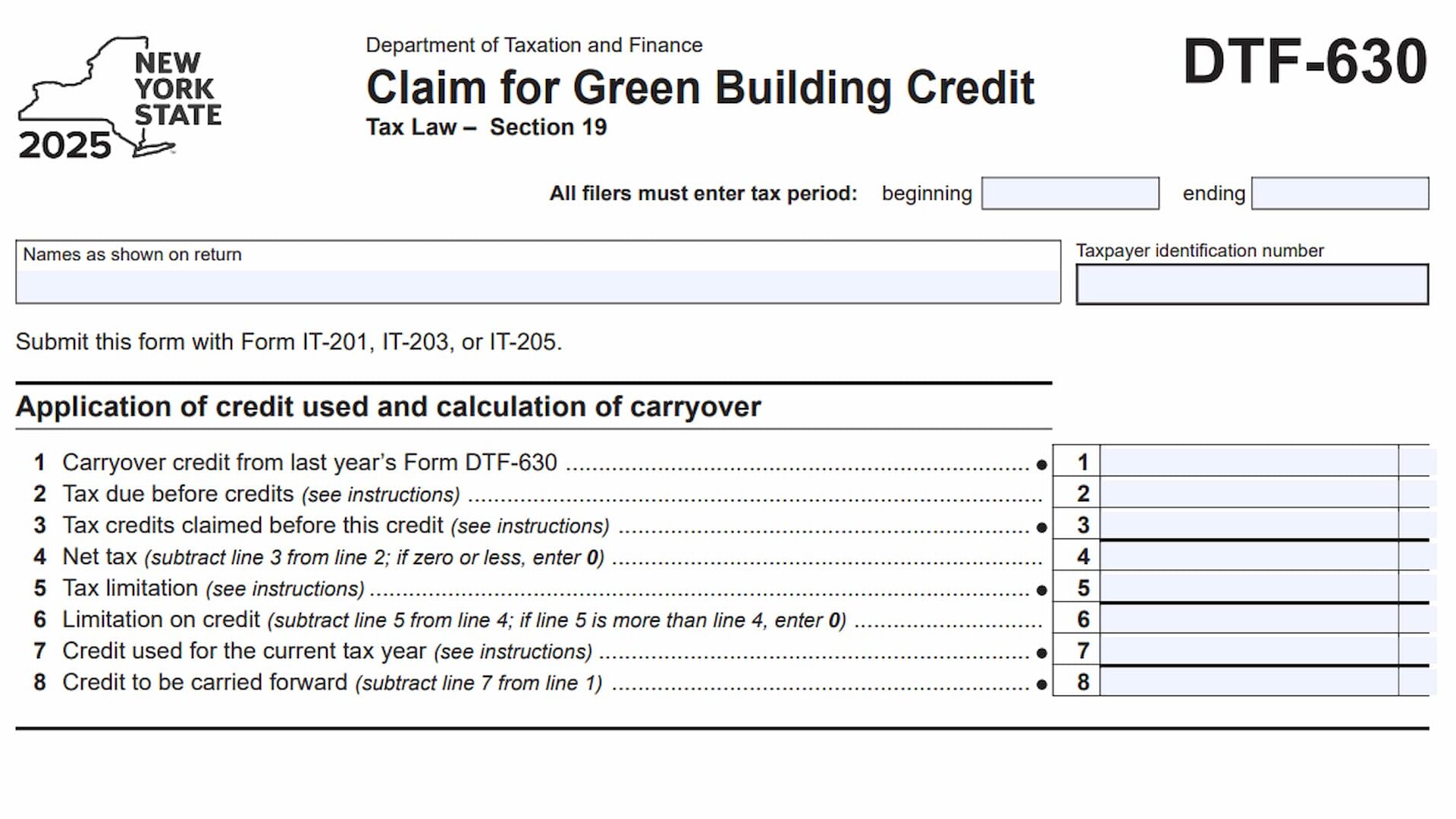
Form DTF-630, Claim for Green Building Credit, is a New York State tax form used by eligible taxpayers to claim unused Green Building Credit amounts carried forward from previous tax years. The credit is authorized under Section 19 of the New York State Tax Law.
The Green Building Credit program has expired. Therefore, taxpayers cannot claim new credits under the program but may continue applying eligible unused credit carryovers from previous years against their current tax liability.
Form DTF-630 calculates how much of the available credit carryover can be used during the current tax year and how much must remain available for future periods.
The form collects the taxpayer’s name, identification number, tax period, previous credit carryover, tax liability, and other credits claimed before the Green Building Credit. These amounts are used to determine the applicable tax limitation and calculate the credit available for the current year.
Form DTF-630 contains one main calculation section with eight lines. Lines 1 through 6 determine the amount of credit available after applying the tax limitations. Line 7 calculates the credit used during the current year, while Line 8 determines the remaining credit carryforward.
Completing Form DTF-630 correctly is important because the credit cannot be refunded. However, eligible unused amounts can be carried forward indefinitely to future tax years.
How To File Form DTF-630
Form DTF-630 must be submitted with the applicable New York income tax return.
The form identifies three possible returns:
- Form IT-201: New York State Resident Income Tax Return.
- Form IT-203: New York State Nonresident and Part-Year Resident Income Tax Return.
- Form IT-205: New York State Fiduciary Income Tax Return.
The completed DTF-630 determines the amount of Green Building Credit that can be claimed during the current tax year.
The credit amount calculated on Line 7 must be transferred to the appropriate return:
- Form IT-201-ATT, Line 6, using credit code 630.
- Form IT-203-ATT, Line 7, using credit code 630.
- Form IT-205, Line 10.
Important Credit Eligibility Information
The Green Building Credit program has expired. Only unused credit carryforward amounts from previous tax years may be claimed.
Taxpayers cannot generate new credits under the expired program.
There is also an important distinction between claiming a current-year credit and carrying forward an unused amount. The credit cannot be refunded, but eligible unused balances may be carried forward indefinitely.
Before completing Form DTF-630, gather the following information:
- Your applicable Form IT-201, IT-203, or IT-205.
- Your name as shown on the income tax return.
- Your taxpayer identification number.
- The beginning and ending dates of the tax period.
- The unused Green Building Credit carried forward from the previous year’s Form DTF-630.
- Your tax due before credits.
- The amounts of other tax credits claimed before the Green Building Credit.
- The applicable tax limitation.
- Your previous credit carryforward records.
Make sure the credit carryover amount matches the balance reported on your previous year’s Form DTF-630.

How To Complete Form DTF-630
The 2025 Form DTF-630 is a two-page tax form. The first page contains the taxpayer identification fields and the eight-line credit calculation. The second page provides general information, credit restrictions, and line-by-line instructions.
The form contains one main section titled Application of Credit Used and Calculation of Carryover.
Complete the taxpayer identification information first, then follow the calculation in numerical order.
Taxpayer Information
At the top of Form DTF-630, enter the identifying information associated with your New York income tax return.
Tax Period Beginning
Enter the beginning date of the tax period covered by the form.
Use the date corresponding to the applicable income tax reporting period.
Tax Period Ending
Enter the ending date of the tax period.
Make sure the beginning and ending dates match the reporting period on your applicable New York income tax return.
Names as Shown on Return
Enter your name exactly as it appears on your applicable income tax return.
Individuals should use the name shown on Form IT-201 or IT-203. Fiduciaries should use the applicable name shown on Form IT-205.
Taxpayer Identification Number
Enter the taxpayer identification number associated with the income tax return.
Use the appropriate identifying number and make sure it matches the information reported on the associated return.
Filing Instructions
The form includes the following submission notice:
Submit this form with Form IT-201, IT-203, or IT-205.
Attach the completed DTF-630 to the applicable New York income tax return.
Application of Credit Used and Calculation of Carryover
This section contains Lines 1 through 8 and determines how much unused Green Building Credit can be applied against the current year’s tax liability.
The calculation begins with the available credit carryover and compares it with the taxpayer’s remaining tax liability after other credits and applicable limitations.
Line 1: Carryover Credit from Last Year’s Form DTF-630
Enter the unused Green Building Credit carried forward from the previous year’s Form DTF-630.
Use the amount reported as the credit available for carryforward on Line 8 of the previous year’s form.
This amount represents the unused credit balance available for the current tax year.
Because the Green Building Credit program has expired, only eligible carryforward amounts from previous years can be entered here.
Make sure the amount agrees with your previous tax records.
Line 2: Tax Due Before Credits
Enter your tax due before credits.
The amount depends on which New York income tax return you filed.
The instructions on page 2 provide a specific table identifying the applicable line for each return type.
| Income tax return | Amount to enter on Line 2 |
|---|---|
| Form IT-201 | Line 39 plus Form IT-201-ATT, Line 21 |
| Form IT-203 | Line 46 plus Form IT-203-ATT, Line 20 |
| Form IT-205 (residents) | Line 8 plus Line 1 of the Addbacks worksheet in Form IT-205-I, Line 12 |
| Form IT-205 (nonresidents) | Line 9 plus Line 1 of the Addbacks worksheet in Form IT-205-I, Line 12 |
Select the row corresponding to your income tax return and enter the applicable amount.
Use the tax due before credits, as specified in the instructions, rather than the final balance due after payments.
Line 3: Tax Credits Claimed Before This Credit
Enter the total amount of other tax credits you are claiming against your tax liability before applying the Green Building Credit.
If you are claiming multiple credits, include the amounts that must be applied before this credit under New York’s credit ordering rules.
If you are not claiming any other credits before the Green Building Credit, enter zero.
The instructions on page 2 specify the following order for applying personal income tax credits:
- Household credit.
- Credits that cannot be carried over or refunded.
- Credits that can be carried over for a limited duration.
- Credits that can be carried over for an unlimited duration.
- Refundable credits.
Follow this ordering when determining the amount to report on Line 3.
For additional guidance, consult the New York State Department of Taxation and Finance publication on ordering personal income tax credits. You can also visit tax.ny.gov and search for “ordering.”
Line 4: Net Tax
Subtract the amount on Line 3 from the amount on Line 2.
Enter the resulting amount on Line 4.
The calculation is:
Line 2 − Line 3 = Line 4
If the result is zero or less, enter zero.
This amount represents the remaining tax liability after applying the credits claimed before the Green Building Credit.
Line 5: Tax Limitation
Enter the appropriate tax limitation for the income tax return you are filing.
According to the Lines 2 and 5 entries table on page 2, the limitation is zero for all three return types.
Use the following table:
| Income tax return | Amount to enter on Line 5 |
|---|---|
| Form IT-201 | 0 |
| Form IT-203 | 0 |
| Form IT-205 | 0 |
Enter zero on Line 5, regardless of which of these three returns you are filing.
Line 6: Limitation on Credit
Subtract the amount on Line 5 from the amount on Line 4.
Enter the resulting amount on Line 6.
The calculation is:
Line 4 − Line 5 = Line 6
If Line 5 is greater than Line 4, enter zero.
Because the applicable limitation on Line 5 is zero for the return types listed in the instructions, Line 6 will generally equal the amount reported on Line 4.
This figure represents the tax limitation used to determine how much of the available Green Building Credit can be applied during the current year.
Line 7: Credit Used for the Current Tax Year
Enter the smaller of Line 1 or Line 6.
Compare the available credit carryover on Line 1 with the limitation on credit calculated on Line 6.
Enter whichever amount is lower.
The calculation is:
Line 7 = Lesser of Line 1 or Line 6
This is the amount of Green Building Credit that can be used during the current tax year.
The amount cannot exceed the available carryforward balance or the applicable tax limitation.
Transfer the amount on Line 7 to the appropriate income tax return:
- Form IT-201-ATT, Line 6, using credit code 630.
- Form IT-203-ATT, Line 7, using credit code 630.
- Form IT-205, Line 10.
Make sure the amount is reported on the correct line based on your filing status.
Line 8: Credit to Be Carried Forward
Subtract the amount on Line 7 from the amount on Line 1.
Enter the resulting amount on Line 8.
The calculation is:
Line 1 − Line 7 = Line 8
This represents the unused Green Building Credit remaining after the current-year credit has been applied.
Because the credit can be carried forward indefinitely, the eligible unused balance may be applied against future tax liabilities, subject to the applicable requirements.
If the entire available credit was used during the current year, enter zero on Line 8.
Additional Form Instructions and Credit Restrictions
The second page of Form DTF-630 provides important information about the expired Green Building Credit program, the treatment of unused amounts, and the order in which other tax credits must be applied.
Expiration of the Green Building Credit
The Green Building Credit program has expired.
Taxpayers cannot claim new credits under the program. However, unused credit amounts carried forward from previous years may still be claimed.
Only eligible carryforward balances should be reported on Line 1.
No Refund for Unused Credits
The New York State Department of Taxation and Finance does not allow taxpayers to request a refund for unused Green Building Credit amounts.
However, eligible unused credits can be carried forward to future tax years indefinitely.
Any remaining amount calculated on Line 8 can therefore continue to be available for future periods.
Ordering of Personal Income Tax Credits
Line 3 requires taxpayers to account for credits claimed before the Green Building Credit.
The department specifies the following order:
- Household credit.
- Credits that cannot be carried over or refunded.
- Credits that can be carried over for a limited duration.
- Credits that can be carried over for an unlimited duration.
- Refundable credits.
Make sure the amounts entered on Line 3 reflect the applicable credit ordering requirements.
For additional details, consult the department’s guidance on ordering personal income tax credits.
Different Return Types
The calculation on Line 2 depends on whether you filed Form IT-201, IT-203, or IT-205.
The instructions distinguish between resident and nonresident fiduciaries filing Form IT-205.
Make sure you use the correct line and worksheet references for your particular return.
Final Review Before Filing
Before submitting Form DTF-630 with your New York income tax return, review the following checklist to ensure that all required information and calculations are complete.
- Correct tax year: Confirm that you are using the 2025 Form DTF-630.
- Tax period: Verify the beginning and ending dates of the reporting period.
- Taxpayer name: Make sure your name matches the applicable income tax return.
- Taxpayer identification number: Verify that the identifying number is correct.
- Correct return: Confirm whether you are filing Form IT-201, IT-203, or IT-205.
- Credit eligibility: Make sure the reported credit represents an eligible carryforward from a previous tax year.
- Expired program: Remember that new Green Building Credits cannot be claimed under the expired program.
- Line 1: Verify the unused credit carryover from the previous year’s Form DTF-630.
- Line 2: Enter the correct tax due before credits using the applicable return and worksheet references.
- Line 3: Include the credits claimed before the Green Building Credit, following New York’s credit ordering rules.
- Line 4: Subtract Line 3 from Line 2. Enter zero if the result is zero or less.
- Line 5: Enter zero as instructed for Form IT-201, IT-203, or IT-205.
- Line 6: Subtract Line 5 from Line 4. Enter zero if Line 5 exceeds Line 4.
- Line 7: Enter the smaller of Line 1 or Line 6.
- Credit transfer: Report the Line 7 amount on Form IT-201-ATT, Line 6; Form IT-203-ATT, Line 7; or Form IT-205, Line 10, as applicable.
- Credit code: Use credit code 630 when reporting the amount on the applicable IT-201-ATT or IT-203-ATT.
- Line 8: Subtract Line 7 from Line 1 to determine the remaining credit carryforward.
- No refund: Remember that unused Green Building Credit amounts cannot be refunded.
- Future carryforward: Keep records of the remaining eligible credit balance for future tax years.
- Final review: Check all calculations, credit amounts, return references, and transferred figures before filing.
Review the completed form carefully before submitting it. Make sure the credit carryforward matches your previous year’s records, the correct tax amounts are used, and other credits are applied in the required order. Transfer the amount from Line 7 to the appropriate New York income tax return and retain the Line 8 balance for future tax years.