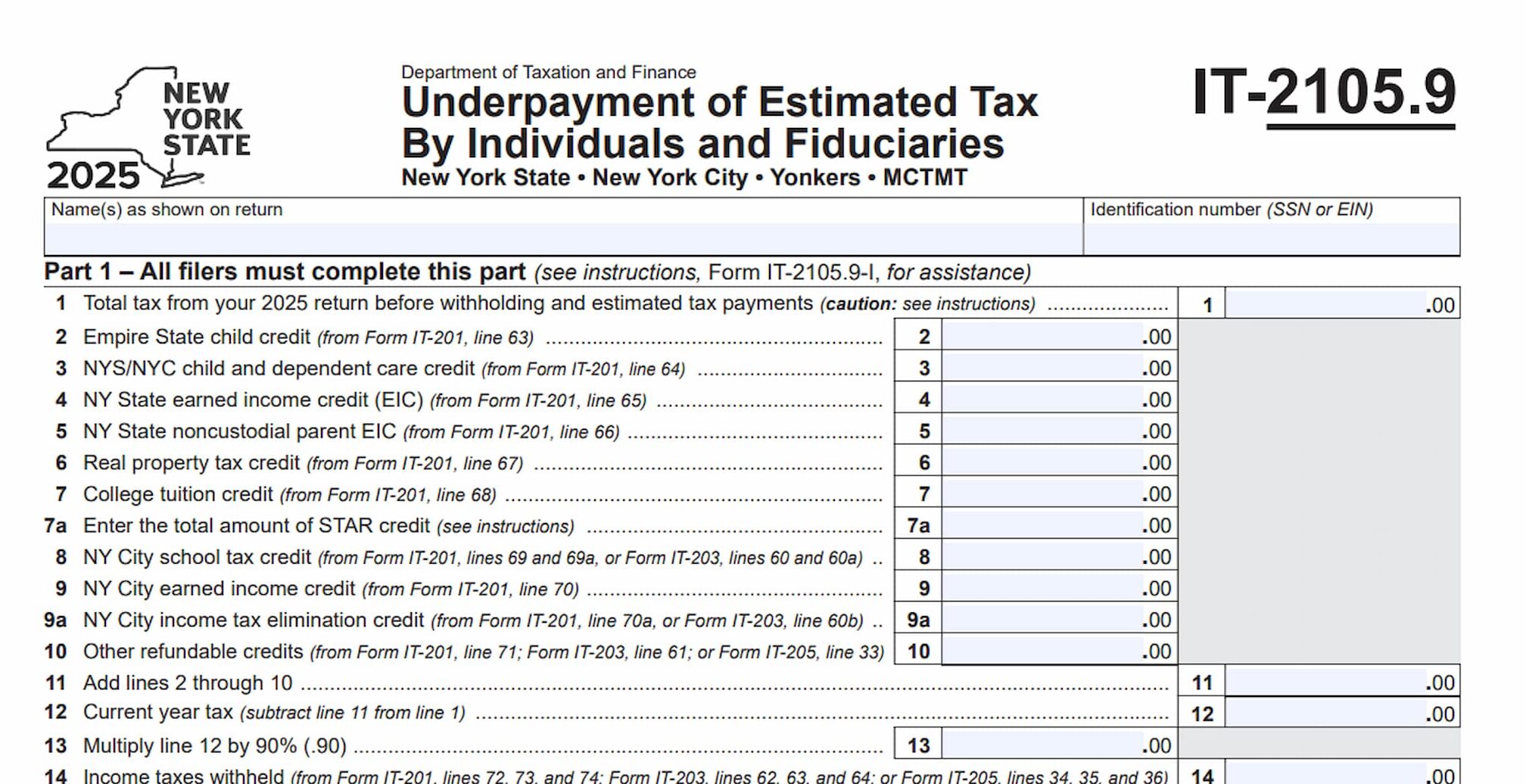
Form IT-2105.9, Underpayment of Estimated Tax by Individuals and Fiduciaries, is a New York State tax form used to determine whether an individual or fiduciary owes a penalty for failing to pay enough income tax throughout the tax year. The form applies to taxpayers filing New York State, New York City, Yonkers, and Metropolitan Commuter Transportation Mobility Tax (MCTMT) returns. It helps determine whether the taxpayer made sufficient estimated tax payments and had enough income tax withheld to meet the applicable payment requirements.
Form IT-2105.9 collects information about the taxpayer’s total tax liability, refundable credits, STAR credit, income tax withholding, and estimated tax payments. It also considers the previous year’s tax liability when determining the required payment amount.
The form contains three main parts. Part 1 calculates the required annual payment and determines whether the taxpayer has an underpayment. Part 2 provides a short method for calculating the penalty, while Part 3 contains the regular method, which uses separate payment periods and installment calculations.
The short method is available to taxpayers who meet specific payment conditions, including those who paid withholding tax and/or made four equal estimated tax installments on their due dates, or those who made no estimated tax payments. Taxpayers who do not qualify for the short method must use Part 3.
Completing Form IT-2105.9 correctly is important because the resulting penalty must be reported on the applicable New York income tax return. The form provides different calculations depending on the taxpayer’s payment history, and the regular method accounts for the timing of underpayments throughout the year.
How To File Form IT-2105.9
Form IT-2105.9 is completed by individuals and fiduciaries who need to determine whether they owe a penalty for underpaying estimated income taxes.
The form must be submitted with the applicable New York State income tax return. Depending on the taxpayer’s filing status, the penalty calculated on Form IT-2105.9 is transferred to one of the following returns:
- Form IT-201: New York State Resident Income Tax Return, Line 81.
- Form IT-203: New York State Nonresident and Part-Year Resident Income Tax Return, Line 71.
- Form IT-205: New York State Fiduciary Income Tax Return, Line 42.
Before completing Form IT-2105.9, gather the following information:
- Your completed 2025 New York income tax return.
- Your name as shown on the return.
- Your Social Security Number (SSN) or Employer Identification Number (EIN).
- Your total 2025 tax before withholding and estimated tax payments.
- Information about applicable refundable credits.
- Your total STAR credit amount, if applicable.
- Your income tax withholding for the year.
- Your total estimated tax payments.
- Your 2024 tax liability.
- The dates on which estimated tax payments were made.
- Any information needed to determine underpayments from previous installment periods.
You should also review Form IT-2105.9-I, Instructions for Form IT-2105.9, for additional guidance on the calculations and payment requirements.
Choosing the Calculation Method
Form IT-2105.9 provides two methods for calculating the underpayment penalty.
Short Method (Part 2)
You can use the short method if you meet one of the following conditions:
- You paid withholding tax and/or made four equal estimated tax installments on their respective due dates.
- You made no estimated tax payments during the year.
If neither condition applies, you must complete Part 3 using the regular method.
Regular Method (Part 3)
The regular method is used by taxpayers who do not qualify for the short method.
It calculates underpayments separately for four installment periods and determines the applicable penalty based on the amount and duration of each underpayment.
The regular method consists of Schedule A on the first page and Schedule B on the back of the form.

How To Complete Form IT-21059
The 2025 Form IT-2105.9 contains two pages and three main parts.
Part 1 is required for all filers. Part 2 provides the short penalty calculation, while Part 3 provides the regular penalty calculation for taxpayers who must account for individual installment periods.
Complete the taxpayer identification fields first, then follow the instructions for the applicable calculation method.
Taxpayer Information
At the top of the form, enter the identifying information associated with your New York income tax return.
Name(s) as Shown on Return
Enter your name exactly as it appears on your applicable income tax return.
If you are filing jointly, include the names shown on the return.
Identification Number (SSN or EIN)
Enter the taxpayer’s identifying number.
Individuals generally provide their Social Security Number (SSN), while fiduciaries use the applicable Employer Identification Number (EIN).
Make sure the identifying number matches the information reported on your associated tax return.
Part 1: All Filers Must Complete This Part
Part 1 calculates the taxpayer’s current-year tax after applicable credits and determines the required annual payment.
All taxpayers completing Form IT-2105.9 must fill out this section, regardless of whether they use the short or regular method.
The calculation uses the taxpayer’s total tax, applicable refundable credits, income tax withholding, and previous-year tax liability.
Line 1: Total Tax from Your 2025 Return Before Withholding and Estimated Tax Payments
Enter the total tax reported on your 2025 New York income tax return before subtracting withholding and estimated tax payments.
Use the applicable tax amount from your return.
The form includes a caution directing taxpayers to consult the instructions before determining this amount.
Line 2: Empire State Child Credit
Enter the Empire State child credit reported on Form IT-201, Line 63.
Use the amount shown on your New York resident income tax return.
Line 3: NYS/NYC Child and Dependent Care Credit
Enter the New York State and New York City child and dependent care credit reported on Form IT-201, Line 64.
Use the applicable amount from your return.
Line 4: NY State Earned Income Credit (EIC)
Enter the New York State Earned Income Credit reported on Form IT-201, Line 65.
Use the amount shown on the applicable tax return.
Line 5: NY State Noncustodial Parent EIC
Enter the New York State Noncustodial Parent Earned Income Credit reported on Form IT-201, Line 66.
Line 6: Real Property Tax Credit
Enter the Real Property Tax Credit reported on Form IT-201, Line 67.
Line 7: College Tuition Credit
Enter the College Tuition Credit reported on Form IT-201, Line 68.
Line 7a: STAR Credit
Enter the total amount of the STAR credit.
Consult Form IT-2105.9-I for the instructions on determining the applicable amount.
Line 8: NY City School Tax Credit
Enter the New York City School Tax Credit from the applicable income tax return.
Use one of the following sources:
- Form IT-201, Lines 69 and 69a.
- Form IT-203, Lines 60 and 60a.
Line 9: NY City Earned Income Credit
Enter the New York City Earned Income Credit reported on Form IT-201, Line 70.
Line 9a: NY City Income Tax Elimination Credit
Enter the New York City Income Tax Elimination Credit reported on the applicable return.
Use Form IT-201, Line 70a, or Form IT-203, Line 60b.
Line 10: Other Refundable Credits
Enter the total of other refundable credits reported on the applicable income tax return.
The form identifies the following sources:
- Form IT-201, Line 71.
- Form IT-203, Line 61.
- Form IT-205, Line 33.
Use the applicable amount for your filing type.
Line 11: Total Credits
Add the amounts reported on Lines 2 through 10, including Lines 7a and 9a.
Enter the combined amount on Line 11.
This represents the total applicable credits used in the current-year tax calculation.
Line 12: Current Year Tax
Subtract Line 11 from Line 1.
Enter the resulting amount on Line 12.
This calculation determines the current-year tax after accounting for the credits listed in Part 1.
Line 13: 90% of Current Year Tax
Multiply Line 12 by 90%, or 0.90.
Enter the resulting amount on Line 13.
This figure is used to determine the required annual payment.
Line 14: Income Taxes Withheld
Enter the total income taxes withheld during the tax year.
Use the applicable withholding amounts from:
- Form IT-201, Lines 72, 73, and 74.
- Form IT-203, Lines 62, 63, and 64.
- Form IT-205, Lines 34, 35, and 36.
Report the applicable total on Line 14.
Line 15: Tax After Withholding
Subtract Line 14 from Line 12.
Enter the resulting amount on Line 15.
If the result is less than $300, do not complete the rest of the form, as instructed on the schedule.
Line 16: 2024 Tax
Enter your 2024 tax amount.
Use the applicable tax liability from your previous year’s return. The form includes a caution directing taxpayers to consult the instructions when determining this figure.
Line 17: Required Annual Payment
Compare the amounts on Line 13 and Line 16.
Enter whichever amount is smaller.
This amount represents the required annual payment used in the subsequent penalty calculations.
Part 2: Short Method for Computing the Penalty
Part 2 provides a simplified calculation for determining the underpayment penalty.
Complete Lines 18 through 24 if you paid withholding tax and/or made four equal estimated tax installments on their due dates, or if you made no estimated tax payments.
If you do not meet these conditions, you must complete Part 3 instead.
Line 18: Income Taxes Withheld
Enter the amount from Line 14.
This is the total income tax withheld during the year.
Line 19: Total Estimated Tax Payments
Enter the total estimated tax payments you made during the year.
Use the applicable payment records and follow Form IT-2105.9-I when determining the amount.
Line 20: Total Payments
Add the amounts on Lines 18 and 19.
Enter the combined total on Line 20.
This represents the total withholding and estimated tax payments included in the short-method calculation.
Line 21: Total Underpayment for Year
Subtract Line 20 from Line 17.
Enter the difference on Line 21.
If the result is zero or less, you do not owe the penalty under this calculation.
Line 22: Preliminary Penalty Calculation
Multiply the amount on Line 21 by 0.06313.
Enter the resulting amount on Line 22.
This calculation uses the penalty factor printed on the 2025 form.
Line 23: Early Payment Adjustment
This line determines whether an adjustment applies based on when the underpayment amount was paid.
If the amount on Line 21 was paid on or after April 15, 2026, enter zero.
If the amount was paid before April 15, 2026, calculate the adjustment using the following formula:
Amount on Line 21 × Number of days paid before April 15, 2026 × 0.00026
Enter the resulting amount on Line 23.
Use the applicable payment date to determine the number of days.
Line 24: Final Penalty
Subtract Line 23 from Line 22.
Enter the resulting amount on Line 24.
This is the final penalty calculated using the short method.
Transfer the amount on Line 24 to the applicable income tax return:
- Form IT-201, Line 81.
- Form IT-203, Line 71.
- Form IT-205, Line 42.
Part 3: Regular Method – Schedule A and Schedule B
Part 3 provides the regular method for calculating the underpayment penalty.
This method determines whether the taxpayer made the required payments by each installment deadline. It also accounts for overpayments and underpayments carried from one installment period to another.
The regular method consists of two schedules:
- Schedule A: Computes the underpayment or overpayment for each installment period.
- Schedule B: Calculates the penalty based on the amount and duration of each underpayment.
Schedule A: Computing Your Underpayment
Schedule A appears on the first page of Form IT-2105.9.
It contains four columns representing the estimated tax payment due dates for the 2025 tax year:
- Column A: April 15, 2025.
- Column B: June 15, 2025.
- Column C: September 15, 2025.
- Column D: January 15, 2026.
Complete the calculations one column at a time, beginning with Column A.
Line 25: Required Installments
Enter one-quarter of the amount reported on Line 17 in each column.
Divide Line 17 by four and enter the result in Columns A, B, C, and D.
If you used the annualized income installment method, consult the instructions for the applicable calculation.
Line 26: Estimated Tax Paid and Tax Withheld
Enter the estimated tax payments and tax withholding applicable to each installment period.
Use your payment records and withholding information to determine the amounts attributable to each column.
The form directs taxpayers to consult the instructions for additional details.
Line 27: Overpayment or Underpayment from Prior Period
Enter any overpayment or underpayment carried forward from the previous installment period.
Begin with Column A and use the applicable result when completing the subsequent columns.
An overpayment or underpayment from one period affects the payment calculation for the next period.
Line 28: Adjusted Payments
Calculate the adjusted payment amount based on the result reported on Line 27.
The form provides two different calculations:
- If Line 27 represents an overpayment, add Lines 26 and 27.
- If Line 27 represents an underpayment, subtract Line 27 from Line 26.
Enter the resulting amount in the applicable column.
Complete this calculation separately for each installment period.
Line 29: Underpayment or Overpayment
Compare the amount on Line 28 with the required installment amount on Line 25.
The form provides two possible calculations:
- If Line 28 is less than Line 25, subtract Line 28 from Line 25 to determine the underpayment.
- If Line 28 is greater than Line 25, subtract Line 25 from Line 28 to determine the overpayment.
Enter the resulting amount in the applicable column.
The amounts reported on Line 29 are transferred to Schedule B, Line 30, for the penalty calculation.
Schedule B: Computing the Penalty
Schedule B appears on the second page of Form IT-2105.9.
It calculates the penalty associated with underpayments reported on Schedule A. The calculation uses the applicable penalty periods and annual interest rate shown on the form.
The schedule contains four installment columns corresponding to the payment due dates:
- Column A: April 15, 2025.
- Column B: June 15, 2025.
- Column C: September 15, 2025.
- Column D: January 15, 2026.
Line 30: Amount of Underpayment
Enter the underpayment amount from Line 29 for each installment period.
Transfer the applicable amounts from Columns A through D of Schedule A.
The amounts on this line are used to calculate the penalty for each installment period.
Line 31: First Installment Penalty Period
This calculation applies to the first installment period, April 15 through June 15, 2025.
The form provides the following calculation:
(61 ÷ 365) × 9.5% = 0.01587
Multiply the applicable underpayment period by the penalty factor shown on the form.
The schedule also provides an alternative calculation for taxpayers whose payment date differs from the standard period. Use the applicable dates and consult Form IT-2105.9-I when completing the alternative calculation.
Line 32: First Installment Penalty
Multiply the amount on Line 30, Column A, by the penalty factor calculated on Line 31.
Enter the resulting amount on Line 32.
Line 33: Second Installment Penalty Period
This calculation applies to the second installment period, June 15 through September 15, 2025.
The form provides the following calculation:
(92 ÷ 365) × 9.5% = 0.02394
Use this factor to calculate the penalty for the second installment period.
The schedule also provides an alternative calculation for taxpayers who made payments on a different date.
Line 34: Second Installment Penalty
Multiply the amount on Line 30, Column B, by the penalty factor calculated on Line 33.
Enter the resulting amount on Line 34.
Line 35: Third Installment Penalty Period
This calculation applies to the third installment period, September 15, 2025, through January 15, 2026.
The form divides this period into two parts:
- September 15 through December 31: (107 ÷ 365) × 9.5% = 0.02784.
- January 1 through January 15: (15 ÷ 365) × 9.5% = 0.00389.
Add the two calculated factors to obtain the total penalty factor:
0.02784 + 0.00389 = 0.03173
The form also provides an alternative calculation for taxpayers who made payments on dates different from the standard installment dates.
Line 36: Third Installment Penalty
Multiply the amount on Line 30, Column C, by the penalty factor calculated on Line 35.
Enter the resulting amount on Line 36.
Line 37: Fourth Installment Penalty Period
This calculation applies to the fourth installment period, January 15 through April 15, 2026.
The form provides the following calculation:
(90 ÷ 365) × 9.5% = 0.02341
Use this factor to calculate the penalty for the fourth installment period.
An alternative calculation is also provided for taxpayers whose payment date differs from the standard period.
Line 38: Fourth Installment Penalty
Multiply the amount on Line 30, Column D, by the penalty factor calculated on Line 37.
Enter the resulting amount on Line 38.
Line 39: Total Penalty
Add the amounts reported on Lines 32, 34, 36, and 38.
Enter the combined total on Line 39.
This represents the final underpayment penalty calculated using the regular method.
Transfer the amount on Line 39 to the applicable income tax return:
- Form IT-201, Line 81.
- Form IT-203, Line 71.
- Form IT-205, Line 42.
Additional Form Instructions and Controls
The electronic version of Form IT-2105.9 includes instructions for navigating and completing its fillable fields.
Moving Between Fields
Use your mouse or the Tab key to move through the available fields.
This allows you to navigate the form without manually selecting every entry box.
Enabling Checkboxes
Use your mouse or the space bar to enable checkboxes where applicable.
Submitting the Form
The second page of the 2025 form states that Form IT-2105.9 must be submitted with your New York State return.
Make sure the completed form is included with the applicable return.
Final Review Before Filing
Before submitting Form IT-2105.9 with your New York income tax return, review the following checklist to ensure that all information and calculations are complete.
- Correct tax year: Confirm that you are using the 2025 Form IT-2105.9.
- Taxpayer information: Verify that your name matches the applicable income tax return.
- Identification number: Check that your SSN or EIN is entered correctly.
- Part 1: Complete all required calculations.
- Lines 2 through 10: Verify that applicable credits match the corresponding lines on your income tax return.
- Line 7a: Include the applicable STAR credit amount.
- Line 11: Confirm that Lines 2 through 10 are added correctly.
- Line 12: Verify that Line 11 is subtracted from Line 1.
- Line 13: Confirm that Line 12 is multiplied by 90%.
- Line 14: Verify the total income taxes withheld.
- Line 15: Check that Line 14 is subtracted from Line 12. If the result is less than $300, do not complete the remaining calculations.
- Line 16: Enter the applicable 2024 tax amount.
- Line 17: Enter the smaller of Line 13 or Line 16.
- Calculation method: Determine whether you qualify for Part 2 or must complete Part 3.
- Part 2, Line 18: Confirm that the amount matches Line 14.
- Line 19: Verify the total estimated tax payments.
- Line 20: Add Lines 18 and 19.
- Line 21: Subtract Line 20 from Line 17.
- Line 22: Multiply Line 21 by 0.06313.
- Line 23: Apply the early payment adjustment when applicable.
- Line 24: Subtract Line 23 from Line 22 and transfer the resulting penalty to the applicable return.
- Part 3, Schedule A: Verify that all four installment periods are completed.
- Line 25: Confirm that one-quarter of Line 17 is entered in each column, unless the annualized income installment method applies.
- Line 26: Check the estimated tax payments and withholding allocated to each installment period.
- Lines 27 and 28: Verify the overpayment or underpayment carryforward calculations.
- Line 29: Confirm the underpayment or overpayment for each installment period.
- Schedule B, Line 30: Transfer the applicable underpayment amounts from Schedule A.
- Lines 31 through 38: Verify the penalty factors and calculations for all four installment periods.
- Line 39: Add Lines 32, 34, 36, and 38 to determine the total penalty.
- Return transfer: Enter the final penalty on Form IT-201, Line 81, Form IT-203, Line 71, or Form IT-205, Line 42, as applicable.
- Final review: Check all payment dates, tax amounts, credits, installment calculations, and penalty figures before submitting the form.
Review the applicable calculation method carefully before filing. The short method provides a simplified annual calculation for qualifying taxpayers, while the regular method accounts for individual installment periods and the timing of payments. Make sure the final penalty is transferred to the correct line of your New York income tax return.