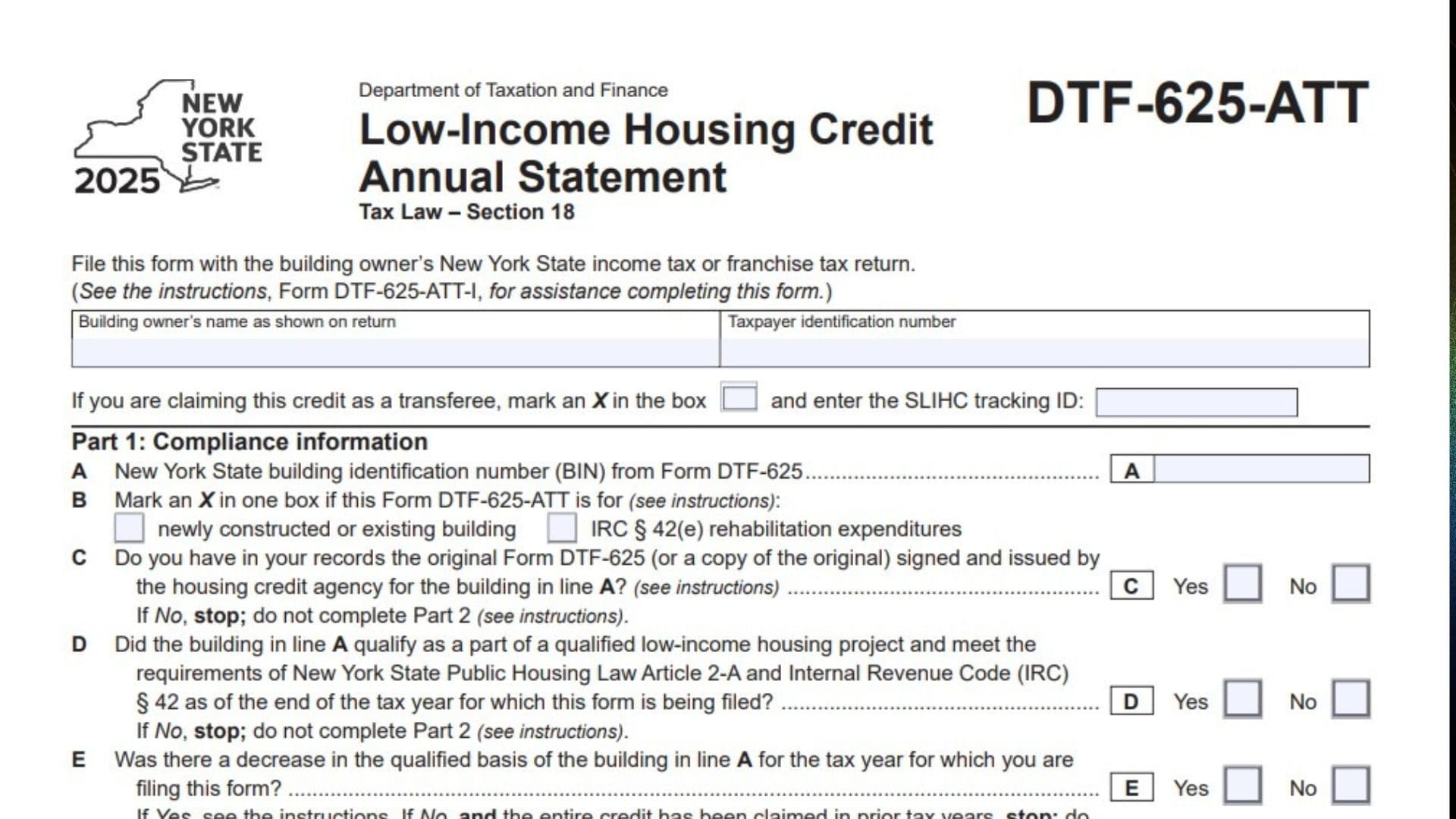
New York Form DTF-625-ATT, Low-Income Housing Credit Annual Statement, is a tax form issued by the New York State Department of Taxation and Finance. It is used by owners of qualifying low-income housing buildings to calculate and report the annual Low-Income Housing Credit available for a building during a particular tax year. The form is based on New York Tax Law Section 18 and collects information about the building’s eligibility, qualified basis, low-income portion, applicable credit percentage, and the taxpayer’s allowable share of the credit.
The purpose of Form DTF-625-ATT is to establish the amount of low-income housing credit that can be claimed for a qualifying building during the tax year. It requires the building owner to provide information about the New York State building identification number (BIN), the building’s original credit certification, its compliance with applicable housing requirements, and any changes in its qualified basis. The form also considers additions to qualified basis, property acquisitions or dispositions during the year, federal grant reductions, and adjustments to deferred first-year credits.
The form contains two main parts. Part 1, Compliance Information, verifies that the building meets the applicable requirements for the Low-Income Housing Credit. It includes questions about the original Form DTF-625, the building’s qualification as part of a qualified low-income housing project, and any decrease in qualified basis. Part 2, Calculation of Credit, calculates the building’s credit using eligible basis, the low-income portion, qualified basis, credit percentages, and other applicable adjustments.
Form DTF-625-ATT also includes special provisions for taxpayers claiming the credit as transferees. A transferee must identify the applicable SLIHC tracking ID. The form calculates the credit allowed for the building, applies any disallowed credit resulting from federal grants, determines the taxpayer’s proportionate share, and accounts for deferred first-year credit adjustments. The final taxpayer credit is reported on Line 19 and transferred to Form DTF-624, Part 1, Line 3.
The completed form must be filed with the building owner’s New York State income tax or franchise tax return. The information must be consistent with the building’s original credit certification and supporting records. Completing the form accurately is important because errors in qualified basis, credit percentages, ownership shares, or applicable reductions can affect the amount of credit claimed. Taxpayers should review the building’s compliance records and applicable instructions before calculating the annual credit.
Who Must Complete New York Form DTF-625-ATT?
Form DTF-625-ATT is intended for building owners claiming the New York Low-Income Housing Credit for a qualifying low-income housing building.
The building must satisfy the applicable requirements under New York State Public Housing Law Article 2-A and Internal Revenue Code Section 42.
Owners of Qualifying Low-Income Housing Buildings
Building owners must complete the annual statement when claiming the applicable Low-Income Housing Credit.
The building must be part of a qualified low-income housing project and must meet the relevant requirements as of the end of the tax year.
Owners of Newly Constructed or Existing Buildings
The form covers qualifying newly constructed or existing buildings.
Part 1 requires the taxpayer to identify whether the statement relates to a newly constructed or existing building or to rehabilitation expenditures under IRC Section 42(e).
Owners Reporting Rehabilitation Expenditures
Taxpayers claiming the credit in connection with qualifying rehabilitation expenditures must identify that category in Part 1.
The form provides a separate checkbox for IRC Section 42(e) rehabilitation expenditures.
Transferees Claiming the Credit
A taxpayer claiming the credit as a transferee must check the applicable box at the top of the form and enter the SLIHC tracking ID.
This identifies the credit claim associated with the transfer.
Taxpayers Reporting a Decrease in Qualified Basis
Building owners must answer the question about whether the qualified basis decreased during the tax year.
If a decrease occurred, the taxpayer must review the applicable instructions and account for the required adjustments.
How To File New York Form DTF-625-ATT
Form DTF-625-ATT must be filed with the building owner’s New York State income tax or franchise tax return.
It is an annual statement used to calculate the building’s Low-Income Housing Credit. It is not intended to replace the owner’s primary tax return.
Where To Submit Form DTF-625-ATT
Attach the completed Form DTF-625-ATT to the building owner’s applicable New York State income tax or franchise tax return.
Follow the filing requirements for the relevant tax return and taxpayer type.
Information To Prepare Before Completing Form DTF-625-ATT
Gather the following information before starting:
- Building owner’s legal name as shown on the tax return.
- Taxpayer identification number.
- New York State building identification number (BIN).
- Original Form DTF-625 or a copy signed and issued by the housing credit agency.
- SLIHC tracking ID, if claiming the credit as a transferee.
- Information identifying whether the building is newly constructed, existing, or associated with IRC Section 42(e) rehabilitation expenditures.
- Eligible basis of the building.
- Unit fraction and floor-space fraction information.
- Qualified basis information.
- Applicable credit percentage.
- Records of property acquisitions or dispositions during the tax year.
- Information about additions to qualified basis.
- IRC Section 42(f)(3)(B) modification information, if applicable.
- Federal grant information affecting the credit.
- Taxpayer’s proportionate share of the credit.
- Deferred first-year credit adjustment information, if applicable.
- Form DTF-625 information, including Part 1, Line 1b.
Review the applicable instructions, Form DTF-625-ATT-I, before entering the calculations.

How To Complete New York Form DTF-625-ATT
Form DTF-625-ATT contains two pages divided into two main parts.
- Part 1: Compliance Information.
- Part 2: Calculation of Credit.
The first part establishes whether the building meets the required conditions for claiming the credit. The second part calculates the allowable credit and determines the taxpayer’s final share.
Building Owner and Taxpayer Information
The top section of page 1 identifies the building owner and the taxpayer associated with the credit claim.
Building Owner’s Name as Shown on Return
Enter the building owner’s full name exactly as it appears on the applicable New York State income tax or franchise tax return.
If the building is owned by an entity, use the entity’s name as shown on its tax return.
Taxpayer Identification Number
Enter the taxpayer identification number associated with the building owner.
Use the identification number reported on the applicable New York State tax return.
Transferee Checkbox
If you are claiming the Low-Income Housing Credit as a transferee, mark an X in the designated box.
Select this option only when the credit is being claimed as a transferee.
SLIHC Tracking ID
If you checked the transferee box, enter the applicable SLIHC tracking identification number.
Use the tracking ID associated with the transferred credit.
Part 1: Compliance Information
Part 1 establishes whether the building meets the requirements for claiming the Low-Income Housing Credit during the tax year.
Complete the building identification information and answer each compliance question.
Line A: New York State Building Identification Number (BIN)
Enter the New York State building identification number assigned to the building.
Use the BIN reported on Form DTF-625.
Make sure the number identifies the same building for which you are claiming the annual credit.
Line B: Building or Rehabilitation Category
Mark an X in one of the available boxes to identify the type of credit claim.
The form provides two choices:
- Newly constructed or existing building.
- IRC Section 42(e) rehabilitation expenditures.
Select the category that applies to the building and credit claim.
Do not mark both boxes unless the applicable instructions specifically permit it.
Line C: Original Form DTF-625 in Your Records
Answer Yes or No to indicate whether you have the original Form DTF-625, or a copy of the original, signed and issued by the housing credit agency for the building identified on Line A.
Select Yes if you have the required signed and issued document in your records.
Select No if you do not have the original form or an eligible copy.
If you answer No, stop completing the form. The instructions specifically state that you must not complete Part 2.
Line D: Building’s Qualification and Compliance Status
Answer Yes or No to indicate whether the building qualified as part of a qualified low-income housing project and met the requirements of New York State Public Housing Law Article 2-A and Internal Revenue Code Section 42 as of the end of the tax year.
Select Yes if the building satisfied the applicable requirements at the end of the tax year.
Select No if the building did not meet those requirements.
If you answer No, stop completing the form. Do not complete Part 2.
Line E: Decrease in Qualified Basis
Answer Yes or No to indicate whether the qualified basis of the building identified on Line A decreased during the tax year for which you are filing the statement.
Select Yes if the building experienced a decrease in qualified basis during the tax year.
If you answer Yes, review the applicable instructions to determine how the decrease affects the credit calculation.
Select No if there was no decrease in qualified basis.
If you answer No and the entire credit has already been claimed in prior tax years, stop completing the form. Do not complete Part 2.
Part 2: Calculation of Credit
Part 2 calculates the Low-Income Housing Credit for the building.
It uses eligible basis, the low-income portion, qualified basis, applicable credit percentages, and other adjustments to determine the credit available for the tax year.
Complete this part only when the compliance requirements in Part 1 allow you to proceed.
Line 1: Eligible Basis of Building
Enter the eligible basis of the building.
This amount represents the eligible building basis used in calculating the Low-Income Housing Credit.
Use the applicable building records and Form DTF-625-ATT-I instructions to determine the correct amount.
Line 2: Low-Income Portion
Enter the low-income portion of the building.
The form defines this amount as the smaller of the unit fraction or the floor-space fraction.
Determine both fractions using the applicable building information, then enter the smaller amount.
Line 3: Qualified Basis of Low-Income Building
Multiply the eligible basis on Line 1 by the low-income portion on Line 2.
Use this calculation:
Line 1 × Line 2 = Line 3
Enter the resulting qualified basis.
The form refers taxpayers to the instructions for applicable exceptions.
Line 4: Part-Year Adjustment for Disposition or Acquisition During the Tax Year
Enter the applicable adjustment when the building was acquired or disposed of during the tax year.
The adjustment accounts for the portion of the year during which the taxpayer owned the building.
Use the applicable instructions to determine the correct amount.
Line 5: Credit Percentage
Enter the applicable credit percentage.
Express the percentage as a decimal rounded to four places.
Use the credit percentage determined under the applicable instructions.
Line 6: Initial Credit Calculation
Multiply the amount on Line 3 or Line 4, as applicable, by the credit percentage entered on Line 5.
Use this calculation:
Applicable amount from Line 3 or Line 4 × Line 5 = Line 6
Enter the resulting amount.
Follow the instructions to determine whether Line 3 or Line 4 applies to your situation.
Line 7: Additions to Qualified Basis
Enter any additions to the building’s qualified basis during the applicable tax year.
Use the applicable records and instructions to determine which additions qualify.
If there were no qualifying additions, enter zero.
Line 8: Part-Year Adjustment for Disposition or Acquisition During the Tax Year
Enter the applicable part-year adjustment relating to a building acquisition or disposition during the tax year.
Use the applicable instructions to determine the correct adjusted amount.
Line 9: Credit Percentage for Additions to Qualified Basis
Enter one-third of the credit percentage reported on Line 5.
Round the resulting decimal to four places.
Use this calculation:
Line 5 ÷ 3 = Line 9
Enter the resulting percentage.
Line 10: Credit for Additions to Qualified Basis
Multiply the amount on Line 7 or Line 8, as applicable, by the percentage entered on Line 9.
Use this calculation:
Applicable amount from Line 7 or Line 8 × Line 9 = Line 10
Enter the resulting amount.
Follow the instructions to determine whether Line 7 or Line 8 applies.
Line 11: IRC Section 42(f)(3)(B) Modification
Enter the applicable modification required under Internal Revenue Code Section 42(f)(3)(B).
Use the calculation and adjustment rules provided in Form DTF-625-ATT-I.
If no modification applies, follow the instructions for reporting this line.
Line 12: Total Additional Credit Amount
Add the amounts reported on Lines 10 and 11.
Use this calculation:
Line 10 + Line 11 = Line 12
Enter the combined amount.
Line 13: Credit for Building Before Line 15 Reduction
Subtract the amount on Line 12 from the amount on Line 6.
Use this calculation:
Line 6 − Line 12 = Line 13
Enter the resulting credit amount.
This represents the building’s credit before applying the reduction for disallowed credit due to federal grants.
The form continues with the remaining credit calculations on page 2.
Line 14: Amount From Line 13 on the Front Page
Enter the amount reported on Line 13 from the front page of Form DTF-625-ATT.
This transfers the calculated building credit to the second page for the remaining adjustments.
Line 15: Disallowed Credit Due to Federal Grants
Enter the amount of credit disallowed because of federal grants.
Use the applicable federal grant information and the Form DTF-625-ATT-I instructions to calculate the required reduction.
The amount entered reduces the credit available for the building during the tax year.
Line 16: Credit Allowed for Building for the Tax Year
Subtract Line 15 from Line 14.
The resulting amount must not exceed the amount shown on Form DTF-625, Part 1, Line 1b.
Use this calculation:
Line 14 − Line 15 = Line 16
Compare the result with Form DTF-625, Part 1, Line 1b, and do not enter more than that amount.
This line establishes the credit allowed for the building for the tax year after the applicable federal grant reduction.
Line 17: Taxpayer’s Proportionate Share of Credit for the Tax Year
Enter the taxpayer’s proportionate share of the credit allowed for the building during the tax year.
Use the applicable ownership or allocation information and follow the instructions for determining the taxpayer’s share.
The amount should represent the portion of the building’s allowed credit attributable to the taxpayer.
Line 18: Adjustments for Deferred First-Year Credit
Enter any applicable adjustment for deferred first-year credit.
Use the applicable instructions and prior-year credit information to determine the adjustment.
If no deferred first-year credit adjustment applies, follow the instructions for reporting this line.
Line 19: Taxpayer’s Credit
Add the amounts reported on Lines 17 and 18.
Use this calculation:
Line 17 + Line 18 = Line 19
Enter the resulting taxpayer credit on Line 19.
Include this amount on Form DTF-624, Part 1, Line 3, as instructed by the form.
Important Rules and Reporting Considerations for Form DTF-625-ATT
Maintain the Original Form DTF-625
Part 1, Line C requires the building owner to have the original Form DTF-625 or a copy of the original signed and issued by the housing credit agency.
If you do not have the required document, the form instructs you to stop and not complete Part 2.
Verify the Building’s Qualification
The building must qualify as part of a qualified low-income housing project and meet the applicable New York State Public Housing Law Article 2-A and Internal Revenue Code Section 42 requirements as of the end of the tax year.
If the building does not satisfy these requirements, do not complete Part 2.
Review Decreases in Qualified Basis
A decrease in qualified basis can affect the annual credit calculation.
Answer Line E accurately and follow the instructions when a decrease occurs.
If there is no decrease and the entire credit has already been claimed in prior tax years, the form instructs you to stop.
Use the Smaller Low-Income Fraction
Line 2 requires the smaller of the unit fraction or floor-space fraction.
Do not automatically use the larger fraction when calculating qualified basis.
Apply the Correct Credit Percentages
Line 5 requires the applicable credit percentage, while Line 9 requires one-third of the percentage reported on Line 5.
Both percentages must be entered as decimals rounded to four places.
Account for Acquisitions and Dispositions
Lines 4 and 8 address part-year adjustments involving acquisitions or dispositions during the tax year.
Use the applicable instructions to determine the correct adjustment.
Consider Federal Grant Reductions
Line 15 accounts for credit disallowed due to federal grants.
Make sure the applicable reduction is included before determining the final credit allowed for the building.
Follow the Building Credit Limitation
Line 16 cannot exceed the amount shown on Form DTF-625, Part 1, Line 1b.
Check this amount before finalizing the calculation.
Line 17 requires the taxpayer’s proportionate share of the credit.
Use the applicable allocation or ownership information rather than automatically claiming the entire building credit.
Account for Deferred First-Year Credit
Line 18 provides for adjustments involving deferred first-year credit.
Review the applicable instructions and prior-year credit records before completing this line.
Transfer the Final Credit to Form DTF-624
Line 19 is the final taxpayer credit.
The amount must be included on Form DTF-624, Part 1, Line 3.
Final Review Before Filing
Before submitting New York Form DTF-625-ATT with the building owner’s tax return, review the following checklist to ensure that all required information and calculations are accurate.
Building Owner Information
- The building owner’s name matches the applicable tax return.
- The taxpayer identification number is correct.
- The transferee checkbox is selected when applicable.
- The SLIHC tracking ID is entered when claiming the credit as a transferee.
Part 1: Compliance Information
- Line A contains the correct New York State building identification number.
- Line B identifies the correct building or rehabilitation category.
- Line C confirms that the original Form DTF-625 or an eligible signed copy is available.
- Line D confirms that the building meets the applicable low-income housing project requirements.
- Line E correctly identifies whether qualified basis decreased during the tax year.
- The instructions to stop completing Part 2 have been followed when applicable.
Part 2: Calculation of Credit
- Line 1 reports the eligible basis of the building.
- Line 2 reports the smaller of the unit fraction or floor-space fraction.
- Line 3 correctly calculates qualified basis.
- Line 4 includes the applicable acquisition or disposition adjustment.
- Line 5 reports the correct credit percentage rounded to four decimal places.
- Line 6 correctly calculates the initial credit amount.
- Line 7 includes additions to qualified basis, if applicable.
- Line 8 includes the applicable part-year adjustment.
- Line 9 reports one-third of the percentage on Line 5.
- Line 10 correctly calculates the credit for additions to qualified basis.
- Line 11 includes the applicable IRC Section 42(f)(3)(B) modification.
- Line 12 correctly adds Lines 10 and 11.
- Line 13 correctly subtracts Line 12 from Line 6.
- Line 14 carries forward the amount from Line 13.
- Line 15 includes the applicable federal grant reduction.
- Line 16 correctly calculates the credit allowed for the building and respects the Form DTF-625, Part 1, Line 1b limitation.
- Line 17 reports the taxpayer’s proportionate share.
- Line 18 includes the applicable deferred first-year credit adjustment.
- Line 19 correctly adds Lines 17 and 18.
Final Submission
- The applicable Form DTF-625-ATT-I instructions have been reviewed.
- The building’s supporting credit records are available.
- All applicable calculations have been checked.
- The completed statement is filed with the building owner’s New York State income tax or franchise tax return.
- The amount from Line 19 is included on Form DTF-624, Part 1, Line 3.
- A copy of the completed statement and supporting records is retained.
Completing New York Form DTF-625-ATT accurately helps building owners calculate and report their annual Low-Income Housing Credit. Review the building’s compliance status, verify the eligible and qualified basis amounts, apply the correct credit percentages, and account for all required reductions and adjustments before transferring the final credit to Form DTF-624, Part 1, Line 3.