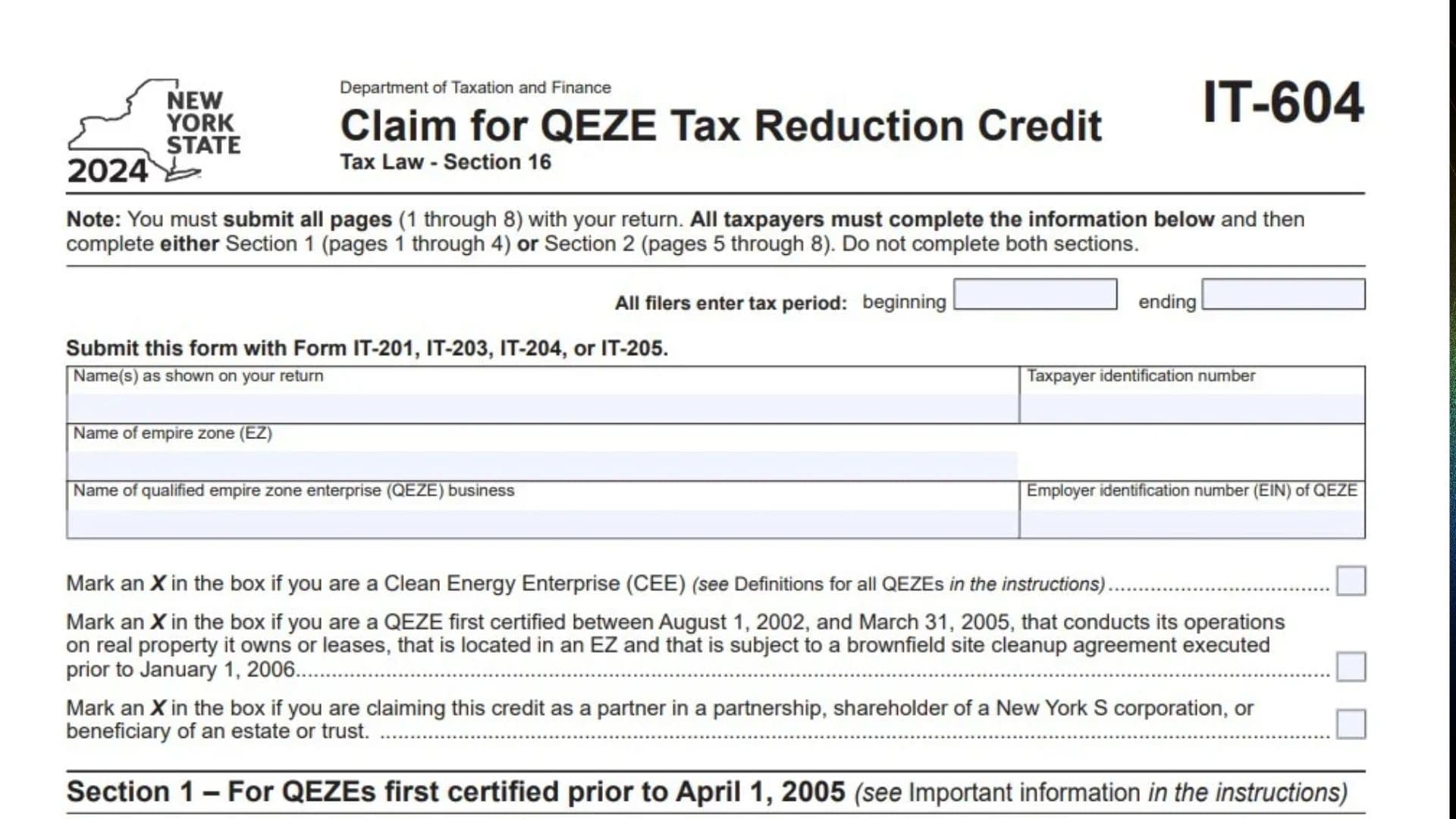
New York Form IT-604, officially titled Claim for QEZE Tax Reduction Credit, is a tax form issued by the New York State Department of Taxation and Finance. It is used to calculate and claim the Qualified Empire Zone Enterprise (QEZE) Tax Reduction Credit under Section 16 of the New York Tax Law. The credit is designed for qualifying businesses that have received certification as Qualified Empire Zone Enterprises and meet the applicable employment, business activity, and other program requirements. The form evaluates the business’s employment levels, the location of its employees and business activities, property values, payroll, New York State income, and applicable tax amounts to determine the available credit. It also considers when the business received its initial certification because different eligibility tests and calculation methods apply depending on whether the QEZE was first certified before April 1, 2005, or on or after that date. Form IT-604 contains two alternative sections. Section 1, covering pages 1 through 4, applies to QEZEs first certified before April 1, 2005. Section 2, covering pages 5 through 8, applies to QEZEs first certified on or after April 1, 2005. Taxpayers must complete the general identification information and only one of these sections. Completing both sections is not permitted. Section 1 includes Schedules A through I, while Section 2 includes Schedules J through Q. Both sections examine employment growth, employment within New York State and Empire Zones, zone allocation factors, tax factors, and the resulting credit calculation. Depending on the taxpayer’s filing situation, the form may also require information about beneficiaries, fiduciaries, related business entities, and valid business purposes. The form collects the taxpayer’s name, identification number, tax period, Empire Zone information, QEZE business details, employer identification number, certification date, employment information, property and payroll values, and applicable tax calculations. It must be submitted with the appropriate New York State tax return, which may be Form IT-201, IT-203, IT-204, or IT-205. All eight pages must accompany the return, even though only one of the two main sections is completed. Completing the form accurately is important because employment tests, certification dates, allocation factors, and tax calculations determine whether the business qualifies for the credit and how much credit can be applied against its tax liability. Errors in employment figures, certification information, property calculations, or credit allocations may affect the amount of credit claimed.
How To File Form IT-604
Form IT-604 must be submitted with the applicable New York State tax return. It is not intended to be filed as an independent tax return.
Which Tax Returns Must Include Form IT-604?
Submit Form IT-604 with the applicable return:
- Form IT-201: New York State Resident Income Tax Return.
- Form IT-203: Nonresident and Part-Year Resident Income Tax Return.
- Form IT-204: Partnership Return.
- Form IT-205: Fiduciary Income Tax Return.
Choose the return that corresponds to the taxpayer’s filing situation.
Which Section Should You Complete?
The section you complete depends on the date the QEZE first received certification from Empire State Development.
- Section 1 (Pages 1–4): Complete this section if the QEZE was first certified before April 1, 2005.
- Section 2 (Pages 5–8): Complete this section if the QEZE was first certified on or after April 1, 2005.
Do not complete both sections.
All taxpayers must complete the general identification information on Page 1 before proceeding to the applicable section.
Information To Prepare Before Completing Form IT-604
Gather the following information:
- Taxpayer’s name as shown on the applicable New York tax return.
- Taxpayer identification number.
- Beginning and ending dates of the tax period.
- Name of the Empire Zone.
- Legal name of the qualified Empire Zone enterprise.
- QEZE employer identification number (EIN).
- Date of first certification by Empire State Development.
- Copies of all certificates of eligibility.
- Copies of applicable Empire Zone retention certificates.
- Quarterly full-time employee counts for the current tax year.
- Quarterly employee counts for the applicable base years.
- Employment information for the test year.
- Property values within the Empire Zone and New York State.
- Employee wages and other compensation.
- QEZE income allocated within New York State.
- New York adjusted gross income.
- Applicable tax amounts from the relevant New York tax return.
- Information about credits applied before the QEZE credit.
- Beneficiary and fiduciary information, when applicable.
- Names and EINs of related business entities, when applicable.
- Documentation supporting any applicable valid business purpose claim.
The employment records and financial information should be organized according to the applicable tax year and reporting period.

How To Complete Form IT-604
Form IT-604 contains two alternative sections with separate schedules and line numbering.
- Section 1: Schedules A through I, Lines 1–33.
- Section 2: Schedules J through Q, Lines 34–66.
Begin by completing the general identification information. Then select the section that corresponds to the QEZE’s first certification date.
General Information: All Filers
The identification section appears on Page 1 and is repeated on Page 5 for taxpayers completing Section 2.
Tax Period: Beginning
Enter the starting date of the tax period covered by the return.
Use the beginning date applicable to the tax year for which you are claiming the QEZE Tax Reduction Credit.
Tax Period: Ending
Enter the ending date of the tax period.
The beginning and ending dates should correspond to the tax period reported on the accompanying New York tax return.
Name(s) As Shown On Your Return
Enter the taxpayer’s complete name exactly as it appears on the applicable New York State tax return.
If filing jointly, enter the names as shown on the joint return.
For a business or fiduciary, use the appropriate legal name reported on the corresponding return.
Taxpayer Identification Number
Enter the taxpayer’s applicable identification number.
Use the identification number associated with the New York tax return accompanying Form IT-604.
Name Of Empire Zone (EZ)
Enter the name of the Empire Zone in which the QEZE operates.
Use the applicable Empire Zone name associated with the enterprise’s certification.
Name Of Qualified Empire Zone Enterprise (QEZE) Business
Enter the complete legal name of the qualified Empire Zone enterprise claiming the credit.
Make sure the name corresponds to the business identified in the certification documents.
Employer Identification Number (EIN) Of QEZE
Enter the federal employer identification number assigned to the QEZE.
Verify the EIN against the business’s official tax records.
Clean Energy Enterprise (CEE) Checkbox
Mark an X in this box if the QEZE qualifies as a Clean Energy Enterprise under the applicable definition.
The form directs taxpayers to the definitions in the instructions for determining whether the enterprise meets this classification.
Leave the box unmarked if the business does not qualify.
Special Brownfield Site Certification Checkbox
Mark an X if the QEZE meets all the conditions described in this section:
- It was first certified between August 1, 2002, and March 31, 2005.
- It conducts its operations on real property that it owns or leases.
- The real property is located in an Empire Zone.
- The property is subject to a brownfield site cleanup agreement executed before January 1, 2006.
Mark the box only when the applicable conditions are satisfied.
Partner, Shareholder, Or Beneficiary Checkbox
Mark an X if you are claiming the QEZE Tax Reduction Credit as:
- A partner in a partnership.
- A shareholder of a New York S corporation.
- A beneficiary of an estate or trust.
This checkbox identifies taxpayers claiming the credit through an eligible pass-through entity rather than directly as the QEZE business.
Section 1: For QEZEs First Certified Before April 1, 2005
Complete Section 1 if the QEZE received its first certification from Empire State Development before April 1, 2005.
This section covers Pages 1 through 4 and includes Schedules A through I.
First Certification Information
Date Of First Certification By Empire State Development
Enter the date the QEZE first received certification from Empire State Development.
Use the MM-DD-YYYY format.
The date determines whether the business belongs in Section 1 or Section 2.
Submit copies of all certificates of eligibility and applicable Empire Zone retention certificates with the return.
Schedule A: Employment Test For QEZEs First Certified Before April 1, 2005
Schedule A determines whether the QEZE meets the required employment tests.
It contains two employment comparisons:
- Part 1 measures employment within all Empire Zones.
- Part 2 measures employment within New York State but outside all Empire Zones.
Both parts compare the current tax year with a five-year base period.
Include employees within all Empire Zones, even if the QEZE is not certified in every zone.
Part 1: EZ Employment
This part calculates the number of full-time employees working within all Empire Zones during the current tax year and the five-year base period.
The employment table includes four reporting dates:
- March 31.
- June 30.
- September 30.
- December 31.
Current Tax Year Employment Number: Number Of Full-Time Employees Within All EZs
Enter the number of full-time employees within all Empire Zones for each of the four reporting dates.
Complete the March 31, June 30, September 30, and December 31 columns.
Enter the total in the final column.
Include employees within all Empire Zones, regardless of whether the QEZE is certified in every zone.
Base Period Employment Number: Tax Year Ending
For each of the five base years, enter the applicable tax year ending in MM-YYYY format.
Use a separate row for each base year.
Base Year One: Number Of Full-Time Employees
Enter the number of full-time employees within all Empire Zones for each quarterly reporting date in the first base year.
Calculate the total for that year.
Base Year Two: Number Of Full-Time Employees
Enter the corresponding quarterly employee counts for the second base year.
Calculate the annual total.
Base Year Three: Number Of Full-Time Employees
Enter the quarterly employee counts for the third base year.
Calculate the annual total.
Base Year Four: Number Of Full-Time Employees
Enter the quarterly employee counts for the fourth base year.
Calculate the annual total.
Base Year Five: Number Of Full-Time Employees
Enter the quarterly employee counts for the fifth base year.
Calculate the annual total.
Total Number Of Full-Time Employees Within All EZs In The Base Period
Add the total employee counts for all five base years.
Enter the combined amount in the total field.
Line 1: Current Tax Year Employment Number Within All EZs
Enter the current tax year employment number calculated from the quarterly employee information above.
Use the total shown in the current-year employment table.
Do not round the employment number.
Line 2: Base Period Employment Number Within All EZs
Enter the employment number for the five-year base period.
Use the amount calculated from the five base-year totals.
Do not round the employment number.
Line 3: Employment Test Comparison
Determine whether the amount on Line 1 equals or exceeds the amount on Line 2.
Select the appropriate checkbox:
- Yes: The current tax year employment number equals or exceeds the base period employment number. Continue to Part 2.
- No: The current tax year employment number is below the base period employment number.
If you select No, stop. The QEZE does not qualify for the QEZE Tax Reduction Credit under this employment test.
Part 2: New York State Employment Outside All EZs
This part calculates the number of full-time employees working inside New York State but outside all Empire Zones.
The calculation covers the current tax year and the same five-year base period.
Complete the quarterly reporting columns for March 31, June 30, September 30, and December 31.
Current Tax Year Employment Number: Number Of Full-Time Employees Inside NYS And Outside All EZs
Enter the number of full-time employees working within New York State but outside all Empire Zones for each quarterly reporting date.
Complete all four quarterly columns and calculate the total.
Base Period Employment Number: Tax Year Ending
Enter the tax year ending date for each of the five base years in MM-YYYY format.
Use the appropriate row for each year.
Base Year One: Number Of Full-Time Employees
Enter the number of full-time employees inside New York State and outside all Empire Zones for each quarterly reporting date in the first base year.
Calculate the annual total.
Base Year Two: Number Of Full-Time Employees
Enter the corresponding quarterly employee counts for the second base year.
Calculate the annual total.
Base Year Three: Number Of Full-Time Employees
Enter the quarterly employee counts for the third base year.
Calculate the annual total.
Base Year Four: Number Of Full-Time Employees
Enter the quarterly employee counts for the fourth base year.
Calculate the annual total.
Base Year Five: Number Of Full-Time Employees
Enter the quarterly employee counts for the fifth base year.
Calculate the annual total.
Total Number Of Full-Time Employees Inside NYS And Outside EZs In The Base Period
Add the employee totals from all five base years.
Enter the combined amount in the total field.
Line 4: Current Tax Year Employment Number Inside NYS And Outside All EZs
Enter the current tax year employment number calculated from the quarterly employee counts inside New York State but outside all Empire Zones.
Do not round the employment number.
Line 5: Base Period Employment Number Inside NYS And Outside All EZs
Enter the combined employment number for the five-year base period.
Use the total calculated from the five base-year employment figures.
Do not round the employment number.
Line 6: New York State Employment Test Comparison
Determine whether the amount on Line 4 equals or exceeds the amount on Line 5.
Select Yes or No.
- Yes: The current employment number equals or exceeds the base period employment number. Continue to Schedule B.
- No: The current employment number is lower than the base period employment number.
If you select No, stop. You are not eligible for the QEZE Tax Reduction Credit.
Schedule B: Computation Of Test Year Employment Number Within The Certified EZs
Schedule B calculates the employment number for the test year within the Empire Zones in which the QEZE is certified.
Test Year: From
Enter the beginning month and year of the test period in MM-YYYY format.
Test Year: To
Enter the ending month and year of the test period.
Use the test year applicable to the employment calculation.
Number Of Full-Time Employees Within The EZs
Enter the number of full-time employees within the certified Empire Zones for each of the four reporting dates:
- March 31.
- June 30.
- September 30.
- December 31.
Calculate the total in the final column.
Line 7: Test Year Employment Number Within The EZs In Which You Are Certified
Enter the test year employment number calculated from the quarterly employee information in Schedule B.
Use the applicable employment calculation described in the instructions.
Schedule C: Employment Increase Factor
Schedule C calculates the employment increase factor used in determining the QEZE Tax Reduction Credit.
Line 8: Current Tax Year Employment Number Within The EZs In Which You Are Certified
Enter the current tax year employment number within the Empire Zones where the QEZE holds certification.
Use the amount determined under the applicable employment calculation instructions.
Line 9: Test Year Employment Number Within The Certified EZs
Enter the amount from Line 7.
This represents the test year employment number within the certified Empire Zones.
Line 10: Difference Between Current And Test Year Employment
Subtract Line 9 from Line 8.
The calculation is:
Line 8 − Line 9 = Line 10.
Enter the resulting difference.
Line 11: Employment Increase Percentage
Divide Line 10 by Line 9.
The calculation is:
Line 10 ÷ Line 9 = Line 11.
Round the result to four decimal places.
If Line 9 is zero and Line 8 is greater than zero, enter 1 instead.
Line 12: Alternative Employment Increase Calculation
Divide Line 10 by 100.
The calculation is:
Line 10 ÷ 100 = Line 12.
Round the result to four decimal places.
Line 13: Employment Increase Factor
Enter the greater of the amounts on Line 11 or Line 12.
The amount entered cannot exceed 1.0.
This is the employment increase factor used in the subsequent credit calculation.
Transfer the amount as follows:
- Partnerships: Enter the Line 13 amount on Form IT-204, Line 133.
- All other taxpayers: Enter the Line 13 amount on Line 26 of Form IT-604.
Schedule D: Zone Allocation Factor
Schedule D determines the percentage of the QEZE’s applicable property and payroll attributable to the Empire Zone.
The schedule contains two columns:
- Column A: Empire Zone (EZ).
- Column B: New York State.
Enter the applicable property and payroll information in both columns.
Line 14: Average Value Of Property
Enter the average value of property in Column A for the Empire Zone and Column B for New York State.
Use the applicable property valuation method described in the form instructions.
Enter the amounts in dollars and cents.
Line 15: EZ Property Factor
Divide the amount in Column A on Line 14 by the amount in Column B on Line 14.
The calculation is:
Line 14, Column A ÷ Line 14, Column B = Line 15.
Round the result to four decimal places.
This factor represents the proportion of the applicable property value attributable to the Empire Zone.
Line 16: Wages And Other Compensation Of Employees
Enter the wages and other compensation of employees in the Empire Zone in Column A.
Enter the corresponding New York State amount in Column B.
Use the applicable employee compensation information required by the instructions.
Line 17: EZ Payroll Factor
Divide the amount in Column A on Line 16 by the amount in Column B on Line 16.
The calculation is:
Line 16, Column A ÷ Line 16, Column B = Line 17.
Round the result to four decimal places.
This factor represents the Empire Zone portion of the applicable payroll.
Line 18: Total EZ Factors
Add the property factor on Line 15 and the payroll factor on Line 17.
The calculation is:
Line 15 + Line 17 = Line 18.
Enter the resulting total.
Line 19: Zone Allocation Factor
Divide Line 18 by two.
The calculation is:
Line 18 ÷ 2 = Line 19.
Round the result to four decimal places.
This amount represents the zone allocation factor used in the QEZE tax reduction calculation.
Transfer the amount as follows:
- Partnerships: Enter the Line 19 amount on Form IT-204, Line 134. Also enter the applicable benefit period factor from the table on Page 3 on Form IT-204, Line 135.
- All other taxpayers: Enter the Line 19 amount on Line 27 of Form IT-604.
Schedule E: Tax Factor
Schedule E calculates the tax factor by comparing the QEZE income allocated within New York State with New York adjusted gross income.
Line 20: Tax From The Applicable New York Return
Enter the tax amount from the appropriate New York tax return.
Use the applicable source:
- Form IT-201 filers: Form IT-201, Line 39.
- Form IT-203 filers: Form IT-203, Line 38.
- Form IT-205 filers: Form IT-205, Line 6, for a full-year resident estate or trust.
- Form IT-205-A filers: Form IT-205-A, Line 11, for a nonresident estate or trust or part-year resident trust.
Enter the amount in dollars and cents.
Line 21: Income From The QEZE Allocated Within New York State
Enter the amount of income from the QEZE allocated within New York State.
Determine the applicable income amount using the allocation rules in the form instructions.
Line 22: New York Adjusted Gross Income
Enter the applicable New York adjusted gross income.
Use the amount determined under the instructions for this line.
Line 23: New York Income Allocation Ratio
Divide Line 21 by Line 22.
The calculation is:
Line 21 ÷ Line 22 = Line 23.
Round the result to four decimal places.
The result cannot exceed 1.0.
Line 24: Tax Factor
Multiply Line 20 by Line 23.
The calculation is:
Line 20 × Line 23 = Line 24.
Enter the resulting tax factor in dollars and cents.
Also transfer this amount to Line 28.
Schedule F: QEZE Tax Reduction Credit
Schedule F combines the benefit period factor, employment increase factor, zone allocation factor, and tax factor to calculate the available credit.
Line 25: Tax Year Of The Business Benefit Period And Benefit Period Factor
Enter the applicable tax year of the business benefit period in the designated year field.
Enter the corresponding benefit period factor in the adjoining field.
For sole proprietors and fiduciaries, use the benefit period factor table provided on Page 3.
The table contains the following factors:
| Tax Year Of Benefit Period | Benefit Period Factor |
|---|---|
| 1–10 | 1.0 |
| 11 | 0.8 |
| 12 | 0.6 |
| 13 | 0.4 |
| 14 | 0.2 |
| 15 | 0 |
For other taxpayers, follow the applicable benefit period instructions.
The form states that QEZEs first certified before April 1, 2005, may generally receive the credit for up to 14 years if they continue to qualify.
Line 26: Employment Increase Factor
Enter the employment increase factor from Line 13.
This amount reflects the employment increase calculation completed in Schedule C.
Line 27: Zone Allocation Factor
Enter the zone allocation factor from Line 19.
Use the amount calculated in Schedule D.
Line 28: Tax Factor
Enter the tax factor from Line 24.
This amount represents the tax attributable to the QEZE income allocation.
Line 29: QEZE Tax Reduction Credit Available For Use
Multiply Line 25 by Line 26, Line 27, and Line 28.
The calculation is:
Line 25 × Line 26 × Line 27 × Line 28 = Line 29.
Enter the resulting amount in dollars and cents.
This is the QEZE Tax Reduction Credit available for use before considering the remaining tax liability and other credits.
Line 30: Tax Due Before Credits
Enter the tax due before applying credits.
Use the applicable amount determined under the instructions for this line.
Line 31: Credits Applied Against The Tax Before This Credit
Enter the amount of other credits applied against the tax before the QEZE Tax Reduction Credit.
Use the applicable credit information and ordering rules.
Line 32: Net Tax Due
Subtract Line 31 from Line 30.
The calculation is:
Line 30 − Line 31 = Line 32.
Enter the remaining net tax due.
Line 33: QEZE Tax Reduction Credit Used For The Current Tax Year
Enter the portion of the QEZE Tax Reduction Credit used for the current tax year.
Determine the allowable amount using the credit calculation and applicable instructions.
The amount is subject to the available credit calculated on Line 29 and the applicable tax limitation.
Schedule G is used to report the allocation of QEZE income between beneficiaries and the fiduciary of an estate or trust.
Complete this schedule when the credit calculation involves a fiduciary and beneficiary allocation.
The schedule contains three columns.
Column A: Beneficiary’s Name
Enter the full name of each beneficiary receiving a share of QEZE income.
The name must match the beneficiary’s name on Form IT-205, Schedule C.
Column B: Identifying Number
Enter the applicable identifying number for each beneficiary.
Use the appropriate taxpayer identification number associated with the beneficiary.
Column C: Share Of QEZE Income
Enter the amount of QEZE income allocated to each beneficiary.
Use the applicable allocation information for the estate or trust.
Total: Beneficiaries’ Share Of QEZE Income
Add the amounts entered in Column C for all beneficiaries.
Enter the combined total in the Total row.
Fiduciary: Fiduciary’s Share Of QEZE Income
Enter the portion of QEZE income allocated to the fiduciary.
Use the applicable fiduciary income allocation information.
Schedule H: Related Entities
Schedule H collects information about business entities related to the QEZE.
List the names and employer identification numbers of all business entities that meet the applicable related-person definition.
Use additional sheets if the available spaces are insufficient.
Name
Enter the complete legal name of each related business entity.
List each related entity separately.
EIN
Enter the federal employer identification number of each related entity.
Make sure every EIN corresponds to the entity listed in the Name column.
Use the definition of related persons in the applicable instructions to determine which entities must be reported.
Schedule I: Valid Business Purpose For QEZEs First Certified Before August 1, 2002
Schedule I applies specifically to QEZEs first certified before August 1, 2002.
It addresses whether the QEZE was formed for a valid business purpose.
Valid Business Purpose Checkbox
If you are claiming that the QEZE was formed for a valid business purpose, mark an X in the checkbox.
You must also submit a notarized statement describing in detail how the QEZE meets the valid business purpose test.
The statement should provide the required explanation supporting the claim.
Do not mark the checkbox without providing the required notarized statement.
Section 2: For QEZEs First Certified On Or After April 1, 2005
Complete Section 2 if the QEZE was first certified on or after April 1, 2005.
This section covers Pages 5 through 8 and includes Schedules J through Q.
Do not complete Section 1 when using this section.
Enter the taxpayer, business, tax period, Empire Zone, and QEZE identification information as described in the General Information section.
First Certification Information
Date Of First Certification By Empire State Development
Enter the date the QEZE first received certification from Empire State Development.
Use the MM-DD-YYYY format.
Submit copies of all certificates of eligibility and applicable Empire Zone retention certificates.
Schedule J: Employment Test For QEZEs First Certified On Or After April 1, 2005
Schedule J determines whether the QEZE meets the employment requirements applicable to businesses first certified on or after April 1, 2005.
It contains two parts:
- Part 1 calculates employment within all Empire Zones.
- Part 2 calculates employment within New York State.
Unlike Section 1, the employment base period in Section 2 covers four years.
Part 1: EZ Employment
This part calculates the number of full-time employees within all Empire Zones for the current tax year and the four-year base period.
Include employees within all Empire Zones, even if the QEZE is not certified in every zone.
Current Tax Year Employment Number: Number Of Full-Time Employees Within All EZs
Enter the number of full-time employees within all Empire Zones for each reporting date:
- March 31.
- June 30.
- September 30.
- December 31.
Calculate the total for the current tax year.
Base Period Employment Number: Tax Year Ending
Enter the tax year ending in MM-YYYY format for each of the four base years.
Use a separate row for each base year.
Base Year One: Number Of Full-Time Employees
Enter the quarterly full-time employee counts within all Empire Zones for the first base year.
Calculate the annual total.
Base Year Two: Number Of Full-Time Employees
Enter the quarterly employee counts for the second base year.
Calculate the annual total.
Base Year Three: Number Of Full-Time Employees
Enter the quarterly employee counts for the third base year.
Calculate the annual total.
Base Year Four: Number Of Full-Time Employees
Enter the quarterly employee counts for the fourth base year.
Calculate the annual total.
Total Number Of Full-Time Employees Within All EZs In The Base Period
Add the total employment numbers from all four base years.
Enter the combined amount in the total field.
Line 34: Current Tax Year Employment Number Within All EZs
Enter the current tax year employment number within all Empire Zones.
Use the total calculated from the quarterly employment table.
Do not round the employment number.
Line 35: Base Period Employment Number Within All EZs
Enter the employment number for the four-year base period.
Use the combined total of the four base-year employment figures.
Do not round the employment number.
Line 36: Employment Test Comparison Within All EZs
Determine whether the amount on Line 34 exceeds the amount on Line 35.
Select the appropriate checkbox:
- Yes: Line 34 is greater than Line 35. Continue to Part 2.
- No: Line 34 does not exceed Line 35.
If you select No, stop. You are not eligible for the QEZE Tax Reduction Credit.
Part 2: New York State Employment
This part calculates the number of full-time employees working within New York State for the current tax year and the four-year base period.
Unlike Section 1, this part includes employees throughout New York State rather than separating employees inside and outside Empire Zones.
Current Tax Year Employment Number: Number Of Full-Time Employees Inside New York State
Enter the number of full-time employees within New York State for each of the four reporting dates:
- March 31.
- June 30.
- September 30.
- December 31.
Calculate the total for the current tax year.
Base Period Employment Number: Tax Year Ending
Enter the tax year ending in MM-YYYY format for each of the four base years.
Use the appropriate row for each year.
Base Year One: Number Of Full-Time Employees
Enter the quarterly employee counts within New York State for the first base year.
Calculate the annual total.
Base Year Two: Number Of Full-Time Employees
Enter the quarterly employee counts for the second base year.
Calculate the annual total.
Base Year Three: Number Of Full-Time Employees
Enter the quarterly employee counts for the third base year.
Calculate the annual total.
Base Year Four: Number Of Full-Time Employees
Enter the quarterly employee counts for the fourth base year.
Calculate the annual total.
Total Number Of Full-Time Employees In New York State For The Base Period
Add the employment totals from all four base years.
Enter the combined amount in the total field.
Line 37: Current Tax Year Employment Number In New York State
Enter the current tax year employment number calculated from the quarterly employee counts within New York State.
Do not round the employment number.
Line 38: Base Period Employment Number In New York State
Enter the total employment number for the four-year base period.
Use the combined total from the four base-year calculations.
Do not round the employment number.
Line 39: New York State Employment Test Comparison
Determine whether the amount on Line 37 exceeds the amount on Line 38.
Select Yes or No.
- Yes: Line 37 is greater than Line 38. Continue to Schedule K.
- No: Line 37 does not exceed Line 38.
If you select No, stop. You are not eligible for the QEZE Tax Reduction Credit.
Schedule K: Computation Of Test Year Employment Number Within The Certified EZs
Schedule K calculates the test year employment number within the Empire Zones where the QEZE is certified.
Test Year: From
Enter the beginning month and year of the test period in MM-YYYY format.
Test Year: To
Enter the ending month and year of the test period.
Use the applicable test year for the employment calculation.
Number Of Full-Time Employees Within The EZs
Enter the number of full-time employees within the certified Empire Zones for:
- March 31.
- June 30.
- September 30.
- December 31.
Calculate the total for the test year.
Line 40: Test Year Employment Number Within The Certified EZs
Enter the test year employment number calculated from the quarterly employee information in Schedule K.
Use the applicable employment calculation described in the instructions.
Schedule L: Employment Increase Factor
Schedule L calculates the employment increase factor used in the QEZE Tax Reduction Credit calculation.
Line 41: Current Year Employment Number Within The Certified EZs
Enter the current year employment number within the Empire Zones where the QEZE is certified.
Use the amount calculated under the applicable employment instructions.
Line 42: Test Year Employment Number Within The Certified EZs
Enter the amount from Line 40.
This is the employment number calculated for the test year.
Line 43: Difference Between Current And Test Year Employment
Subtract Line 42 from Line 41.
The calculation is:
Line 41 − Line 42 = Line 43.
Enter the resulting difference.
Line 44: Employment Increase Percentage
Divide Line 43 by Line 42.
The calculation is:
Line 43 ÷ Line 42 = Line 44.
Round the result to four decimal places.
If Line 42 is zero and Line 41 is greater than zero, enter 1.
Line 45: Alternative Employment Increase Calculation
Divide Line 43 by 100.
The calculation is:
Line 43 ÷ 100 = Line 45.
Round the result to four decimal places.
Line 46: Employment Increase Factor
Enter the greater of the amounts on Line 44 or Line 45.
The result cannot exceed 1.0.
Transfer the amount as follows:
- Partnerships: Enter the Line 46 amount on Form IT-204, Line 133.
- All other taxpayers: Enter the Line 46 amount on Line 59 of Form IT-604.
Schedule M: Zone Allocation Factor
Schedule M calculates the QEZE’s zone allocation factor using property and payroll information.
The schedule has two columns:
- Column A: Empire Zone (EZ).
- Column B: New York State.
Line 47: Average Value Of Property
Enter the average value of property in Column A for the Empire Zone and Column B for New York State.
Use the applicable property valuation method described in the instructions.
Enter the amounts in dollars and cents.
Line 48: EZ Property Factor
Divide the amount in Column A on Line 47 by the amount in Column B on Line 47.
The calculation is:
Line 47, Column A ÷ Line 47, Column B = Line 48.
Round the result to four decimal places.
Line 49: Wages And Other Compensation Of Employees
Enter the wages and other employee compensation attributable to the Empire Zone in Column A.
Enter the corresponding New York State amount in Column B.
Use the applicable payroll information.
Line 50: EZ Payroll Factor
Divide the amount in Column A on Line 49 by the amount in Column B on Line 49.
The calculation is:
Line 49, Column A ÷ Line 49, Column B = Line 50.
Round the result to four decimal places.
Line 51: Total EZ Factors
Add the amounts on Lines 48 and 50.
The calculation is:
Line 48 + Line 50 = Line 51.
Enter the resulting total.
Line 52: Zone Allocation Factor
Divide Line 51 by two.
The calculation is:
Line 51 ÷ 2 = Line 52.
Round the result to four decimal places.
This is the zone allocation factor used in the QEZE Tax Reduction Credit calculation.
Transfer the amount as follows:
- Partnerships: Enter the Line 52 amount on Form IT-204, Line 134. Also enter the applicable benefit period factor on Form IT-204, Line 135.
- All other taxpayers: Enter the Line 52 amount on Line 60 of Form IT-604.
Schedule N: Tax Factor
Schedule N calculates the tax factor using the QEZE income allocated within New York State and New York adjusted gross income.
Line 53: Tax From The Applicable New York Return
Enter the tax amount from the applicable New York tax return.
Use the appropriate source:
- Form IT-201 filers: Form IT-201, Line 39.
- Form IT-203 filers: Form IT-203, Line 38.
- Form IT-205 filers: Form IT-205, Line 6, for a full-year resident estate or trust.
- Form IT-205-A filers: Form IT-205-A, Line 11, for a nonresident estate or trust or part-year resident trust.
Enter the amount in dollars and cents.
Line 54: Income From The QEZE Allocated Within New York State
Enter the amount of income from the QEZE allocated within New York State.
Determine the applicable amount using the instructions for this line.
Line 55: New York Adjusted Gross Income
Enter the applicable New York adjusted gross income.
Use the amount determined under the instructions.
Line 56: New York Income Allocation Ratio
Divide Line 54 by Line 55.
The calculation is:
Line 54 ÷ Line 55 = Line 56.
Round the result to four decimal places.
The result cannot exceed 1.0.
Line 57: Tax Factor
Multiply Line 53 by Line 56.
The calculation is:
Line 53 × Line 56 = Line 57.
Enter the resulting amount in dollars and cents.
Also transfer this amount to Line 61.
Schedule O: QEZE Tax Reduction Credit
Schedule O combines the benefit period factor, employment increase factor, zone allocation factor, and tax factor to calculate the QEZE Tax Reduction Credit.
Line 58: Tax Year Of The Business Benefit Period And Benefit Period Factor
Enter the applicable tax year of the business benefit period.
Enter the corresponding benefit period factor in the adjoining field.
Use the applicable benefit period instructions to determine the correct factor for the QEZE.
Line 59: Employment Increase Factor
Enter the employment increase factor from Line 46.
This amount represents the employment increase calculation completed in Schedule L.
Line 60: Zone Allocation Factor
Enter the zone allocation factor from Line 52.
Use the amount calculated in Schedule M.
Line 61: Tax Factor
Enter the tax factor from Line 57.
This amount represents the tax attributable to the QEZE income allocation.
Line 62: QEZE Tax Reduction Credit
Multiply Lines 58, 59, 60, and 61.
The calculation is:
Line 58 × Line 59 × Line 60 × Line 61 = Line 62.
Enter the resulting credit amount in dollars and cents.
Line 63: Tax Due Before Credits
Enter the tax due before applying credits.
Use the applicable amount determined under the instructions for this line.
Line 64: Credits Applied Against The Tax Before This Credit
Enter the amount of other credits applied against the tax before the QEZE Tax Reduction Credit.
Follow the applicable credit ordering instructions.
Line 65: Net Tax Due
Subtract Line 64 from Line 63.
The calculation is:
Line 63 − Line 64 = Line 65.
Enter the remaining net tax due.
Line 66: QEZE Tax Reduction Credit Used For The Current Tax Year
Enter the amount of QEZE Tax Reduction Credit used for the current tax year.
Determine the allowable amount using the available credit and applicable tax limitations.
Schedule P collects information about the allocation of QEZE income between beneficiaries and the fiduciary of an estate or trust.
Complete this schedule when beneficiary and fiduciary allocations apply.
The schedule contains three columns.
Column A: Beneficiary’s Name
Enter the full name of each beneficiary receiving a share of QEZE income.
The name must match the name reported on Form IT-205, Schedule C.
Column B: Identifying Number
Enter the applicable identifying number for each beneficiary.
Verify the number against the beneficiary’s tax identification records.
Column C: Share Of QEZE Income
Enter the amount of QEZE income allocated to each beneficiary.
Use the applicable estate or trust income allocation information.
Total: Beneficiaries’ Share Of QEZE Income
Add all amounts entered in Column C for the beneficiaries.
Enter the combined amount on the Total line.
Fiduciary: Fiduciary’s Share Of QEZE Income
Enter the portion of QEZE income allocated to the fiduciary.
Use the applicable fiduciary allocation information.
Schedule Q: Related Entities
Schedule Q identifies business entities related to the QEZE.
List all applicable related business entities and their employer identification numbers.
Use additional sheets if the available spaces are insufficient.
Name
Enter the complete legal name of each related business entity.
List each entity separately.
EIN
Enter the federal employer identification number of each related entity.
Verify that the EIN corresponds to the business listed in the Name column.
Use the applicable related-person definition in the instructions to determine which business entities must be reported.
Important Employment And Credit Calculation Rules
Before finalizing Form IT-604, review the following calculation requirements.
Employment Comparison Requirements
Section 1 and Section 2 use different employment comparison periods.
| Employment Test | Section 1 | Section 2 |
|---|---|---|
| First certification | Before April 1, 2005 | On or after April 1, 2005 |
| Base period | Five years | Four years |
| All EZ employment test | Lines 1–3 | Lines 34–36 |
| NYS employment test | Lines 4–6 | Lines 37–39 |
| Test year employment | Line 7 | Line 40 |
| Employment increase factor | Line 13 | Line 46 |
The employment figures must be calculated using the applicable reporting periods and employment definitions.
Employment Increase Factor
Both sections calculate the employment increase factor using two alternative calculations.
The form requires you to use the greater of the two calculated results, subject to a maximum of 1.0.
For Section 1, use Lines 11 and 12 to determine Line 13.
For Section 2, use Lines 44 and 45 to determine Line 46.
Zone Allocation Factor
The zone allocation factor is calculated using two components:
- Property factor.
- Payroll factor.
Add the two factors and divide the total by two.
For Section 1, the calculation appears