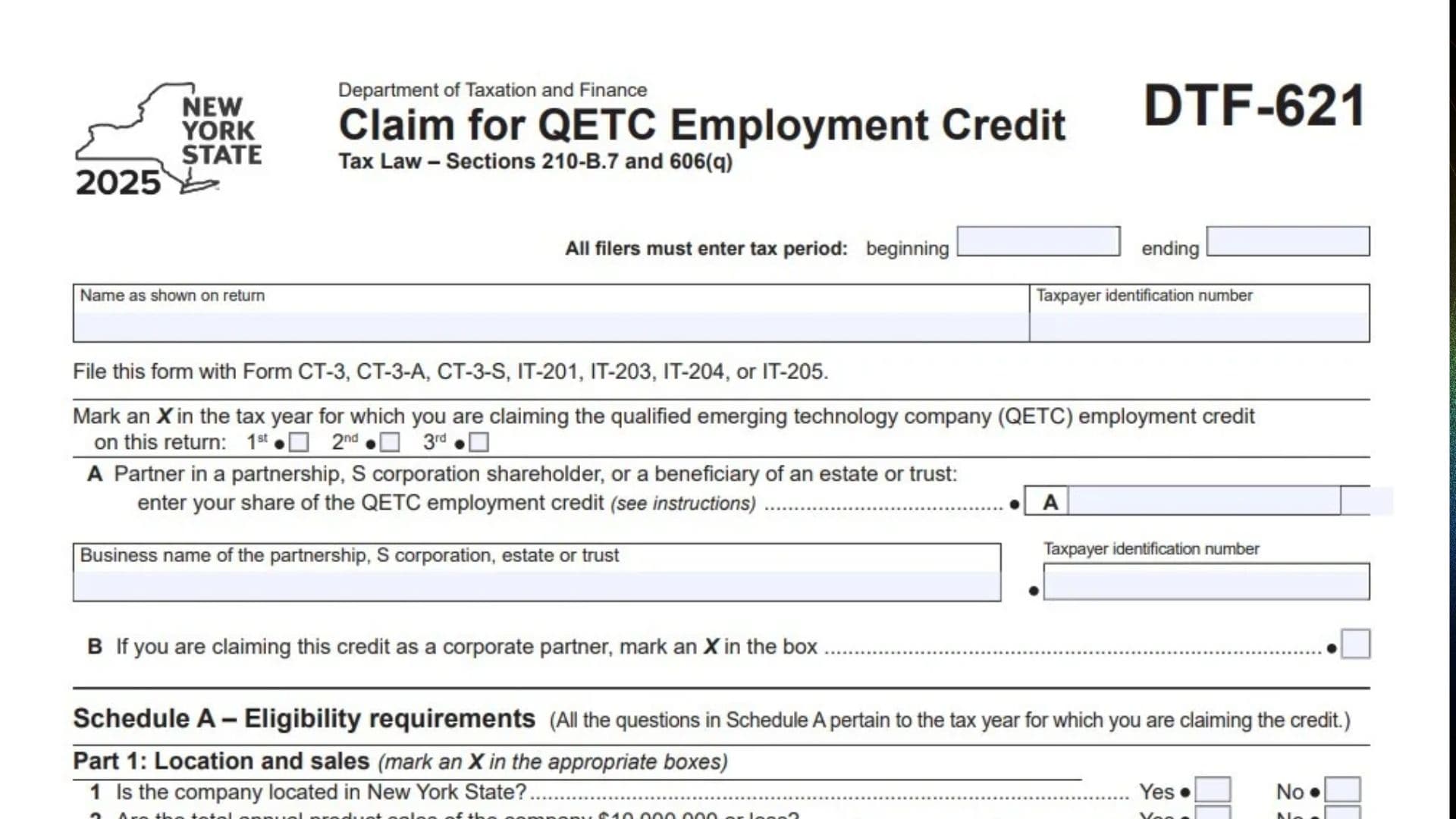
New York Form DTF-621, titled Claim for QETC Employment Credit, is a tax form used by qualifying emerging technology companies (QETCs) to claim an employment tax credit under New York Tax Law Sections 210-B.7 and 606(q). The credit is designed to provide tax relief to eligible businesses that develop emerging technology products or services and maintain or increase their employment levels in New York State. The form evaluates several eligibility requirements, including the company’s location, annual product sales, research and development activities, emerging technology business activities, and employment figures. It also calculates the average number of full-time employees in New York during the current tax year and compares that figure with the average employment level over a three-year base period. Businesses that satisfy the applicable requirements may calculate an employment credit based on the difference between these employment averages, using a credit amount of $1,000 per qualifying employee. The form contains four schedules covering eligibility, employment calculations, credit computation, and credit limitations. It also includes provisions for partners, S corporation shareholders, beneficiaries, fiduciaries, and corporate partners claiming their allocated shares of the credit. Depending on the taxpayer’s filing status, the completed form may be used with a New York corporate or individual income tax return. Certain Article 9-A taxpayers must also complete a separate credit limitation calculation to determine the amount that can be used, refunded, or carried forward. Completing Form DTF-621 accurately is important because the credit depends on meeting specific business activity and employment requirements, and incorrect calculations may affect the amount of credit claimed or carried into another tax year.
Who Needs To File Form DTF-621?
Form DTF-621 is intended for businesses that qualify as emerging technology companies under New York State requirements and wish to claim the QETC employment credit.
Depending on the business structure, the form may also be relevant to:
- Corporations claiming the QETC employment credit.
- Partnerships allocating QETC employment credits to partners.
- S corporation shareholders claiming their allocated credit.
- Beneficiaries receiving credit allocations from an estate or trust.
- Fiduciaries reporting eligible credit amounts.
- Corporate partners claiming an allocated QETC employment credit.
The company must satisfy the applicable location, sales, business activity, and employment requirements before claiming the credit.
How To File Form DTF-621
Form DTF-621 must be filed with the applicable New York State tax return.
The form identifies the following returns:
- Form CT-3, General Business Corporation Franchise Tax Return.
- Form CT-3-A, General Business Corporation Combined Franchise Tax Return.
- Form CT-3-S, New York S Corporation Franchise Tax Return.
- Form IT-201, Resident Income Tax Return.
- Form IT-203, Nonresident and Part-Year Resident Income Tax Return.
- Form IT-204, Partnership Return.
- Form IT-205, Fiduciary Income Tax Return.
Before completing the form, gather the following information:
- Taxpayer name and identification number.
- Beginning and ending dates of the tax period.
- Qualified emerging technology company information.
- Partnership, S corporation, estate, or trust information, if applicable.
- Annual product sales and net sales figures.
- Research and development expenditure records.
- Emerging technology product or service revenue.
- Total business expenditures.
- Federal income tax return figures.
- Quarterly full-time employee records.
- Employment information for the three-year base period.
- Employee names and Social Security numbers.
- Current-year tax liability and other credits used.
- Fixed dollar minimum tax information, when applicable.

How To Complete Form DTF-621
The form contains four schedules:
- Schedule A: Eligibility requirements.
- Schedule B: Calculation of credit for the current tax year.
- Schedule C: Calculation of QETC employment credit.
- Schedule D: Calculation of QETC employment credit limitation.
Complete each section using the applicable business, employment, and tax records.
Taxpayer And Tax Period Information
The top section of page 1 identifies the taxpayer and the reporting period.
Tax Period: Beginning
Enter the beginning date of the tax period covered by the return.
All filers must complete this field.
Tax Period: Ending
Enter the ending date of the applicable tax period.
Make sure the beginning and ending dates match the associated New York State tax return.
Name As Shown On Return
Enter the taxpayer’s name exactly as it appears on the related tax return.
For an individual, use the name reported on the individual income tax return. For a business, use the applicable legal business name.
Taxpayer Identification Number
Enter the taxpayer identification number associated with the return.
Use the same identification number reported on the corresponding New York tax return.
File This Form With The Applicable Return
Submit Form DTF-621 with the appropriate Form CT-3, CT-3-A, CT-3-S, IT-201, IT-203, IT-204, or IT-205.
Tax Year And Credit Allocation Information
This section identifies which year of the QETC employment credit is being claimed and provides information for taxpayers receiving an allocated credit.
Credit Year: First, Second, Or Third
Mark an X in the box identifying whether you are claiming the credit for the first, second, or third tax year.
Select the year applicable to your current credit claim.
Line A: Partner, S Corporation Shareholder, Or Beneficiary’s Share Of QETC Employment Credit
If you are a partner in a partnership, shareholder of an S corporation, or beneficiary of an estate or trust, enter your allocated share of the QETC employment credit.
Use the credit allocation information provided by the partnership, S corporation, estate, or trust.
Business Name Of Partnership, S Corporation, Estate, Or Trust
Enter the legal name of the partnership, S corporation, estate, or trust from which you received the credit allocation.
Taxpayer Identification Number
Enter the identification number of the partnership, S corporation, estate, or trust.
Use the identification number associated with the entity providing the credit allocation.
Box B: Corporate Partner Election
If you are claiming the QETC employment credit as a corporate partner, mark an X in the designated checkbox.
This identifies the applicable corporate partner filing situation.
Schedule A: Eligibility Requirements
Schedule A determines whether the company satisfies the requirements for claiming the QETC employment credit.
All questions in this schedule relate to the tax year for which the credit is being claimed.
The schedule contains three parts:
- Part 1: Location and sales.
- Part 2: QETC business activities.
- Part 3: Average full-time employee calculations.
Part 1: Location And Sales
This section evaluates the company’s New York location and annual product sales.
Question 1: Is The Company Located In New York State?
Select Yes if the company is located in New York State.
Select No if the company is not located in New York State.
If you answer No, the company does not qualify for the QETC employment credit for the current tax year.
Question 2: Are The Company’s Total Annual Product Sales $10,000,000 Or Less?
Enter Yes if the company’s total annual product sales are $10 million or less.
Enter No if the company’s total annual product sales exceed $10 million.
If you answer No, the company does not qualify for the credit for the current tax year.
Eligibility Decision After Questions 1 And 2
The company must answer Yes to both questions to continue to Part 2.
If either answer is No, stop completing the eligibility calculation because the company does not qualify under these requirements.
Part 2: QETC Business Activities
Part 2 evaluates the company’s research and development activities and its emerging technology products or services.
It contains two main areas:
- Research and development activities.
- Primary products and services.
Research And Development Activities
Question 3: Does The Company Have R&D Activities In New York State?
Select Yes if the company conducts research and development activities in New York State.
Select No if it does not.
If you answer No, skip lines 4 through 7 and continue to question 8.
If you answer Yes, continue to line 4.
Line 4: Amount Of R&D Funds
Enter the amount of funds attributable to the company’s research and development activities.
Use the applicable business financial records to determine the amount.
Line 5: Amount Of Net Sales
Enter the company’s net sales amount for the applicable reporting period.
Use the relevant sales information from the business records.
If the company has R&D funds but zero net sales, it qualifies as a QETC under this test. Skip lines 6a and 6b and mark Yes on line 7.
Line 6a: R&D Funds Percentage
Divide the R&D funds entered on line 4 by the net sales entered on line 5.
The calculation is:
Line 6a = Line 4 ÷ Line 5.
Enter the result as a percentage.
Line 6b: Most Recently Published Average Ratio
Enter the most recently published average ratio specified in the Form DTF-621 instructions.
Use the applicable published figure rather than calculating your own average.
Question 7: Does The Percentage On Line 6a Equal Or Exceed The Percentage On Line 6b?
Compare the percentages entered on lines 6a and 6b.
Select Yes if the R&D funds percentage on line 6a equals or exceeds the published average ratio on line 6b.
Select No if the percentage on line 6a is lower.
If you answer Yes, the company qualifies as a QETC under this test. Skip to Part 3.
If you answer No, continue to question 8 to evaluate the company’s primary products and services.
Primary Products And Services
This section evaluates whether the company develops emerging technology products or services and whether its revenue or expenditures meet the applicable percentage requirements.
Question 8: Does The Company Develop Or Create Emerging Technology Products Or Services?
Select Yes if the company develops or creates products or services classified as emerging technologies.
Select No if it does not.
If you answer Yes, describe the company’s emerging technology products or services in the space provided.
Continue to line 9.
If you answer No to both question 3 and question 8, the company cannot claim the credit.
Similarly, if you answered No to question 7 and question 8, the company cannot claim the credit.
Line 9: Gross Receipts Or Sales From Emerging Technology Products Or Services
Enter the gross receipts or sales generated by the emerging technology products or services described on line 8.
Use the amount included on the company’s federal income tax return.
Line 10: Gross Receipts Or Sales From All Company Products Or Services
Enter the total gross receipts or sales from all the company’s products or services.
Use the amount reported on the federal income tax return.
If line 10 is zero, skip line 11 and proceed to line 13.
If line 10 is greater than zero, continue to line 11.
Line 11: Percentage Of Emerging Technology Gross Receipts Or Sales
Divide line 9 by line 10.
The calculation is:
Line 11 = Line 9 ÷ Line 10.
Enter the result as a percentage.
This calculation determines the proportion of the company’s total gross receipts or sales attributable to emerging technology products or services.
Question 12: Is The Percentage On Line 11 Greater Than 50%?
Compare the percentage on line 11 with 50%.
Select Yes if the emerging technology percentage exceeds 50%.
Select No if it is 50% or less.
If you answer Yes, continue to Part 3.
If you answer No, the company cannot claim the credit.
Line 13: Total Expenditures Attributable To Emerging Technology Development Or Creation
Enter the total expenditures attributable to developing or creating emerging technology products or services.
Use the amount included on the company’s federal income tax return.
This calculation is particularly relevant when line 10 is zero and the gross receipts percentage test cannot be completed.
Line 14: Total Expenditures Included On The Federal Return
Enter the company’s total expenditures included on its federal income tax return.
Use the applicable federal return figures.
Line 15: Percentage Of Emerging Technology Expenditures
Divide the amount on line 13 by the amount on line 14.
The calculation is:
Line 15 = Line 13 ÷ Line 14.
Enter the result as a percentage.
Question 16: Is The Percentage On Line 15 Greater Than 50%?
Compare the percentage on line 15 with 50%.
Select Yes if the percentage exceeds 50%.
Select No if the percentage is 50% or less.
If you answer Yes, continue to Part 3.
If you answer No, stop. The company cannot claim the QETC employment credit.
Part 3: Calculation Of Average Number Of Full-Time Employees In New York State
Part 3 calculates the company’s average number of full-time employees in New York State during the current tax year and compares it with the three-year base period.
This calculation is important because the employment credit depends on the increase in the company’s average New York employment.
Current Tax Year Employment Information
The first table records the number of full-time employees in New York State on four reporting dates.
Enter the applicable employee counts for:
- March 31.
- June 30.
- September 30.
- December 31.
Calculate the total for the reporting period.
Line 17: Average Number Of Full-Time Employees In New York State For The Current Tax Year
Enter the average number of full-time employees in New York State for the current tax year.
Use the four reporting-date employee figures and follow the calculation method provided in the Form DTF-621 instructions.
Include only the employees who meet the applicable full-time employee requirements.
Three-Year Base Period Employment Information
The second table collects employee information for the three-year base period.
It contains three separate rows:
- First Year.
- Second Year.
- Third Year.
For each year, enter the number of full-time employees in New York State on:
- March 31.
- June 30.
- September 30.
- December 31.
Calculate the total employee count for each base year.
After completing all three years, calculate the combined total of the employee counts.
Line 18: Average Number Of Full-Time Employees In New York State For The Three-Year Base Period
Enter the average number of full-time employees in New York State for the three-year base period.
Use the employment figures from all three base years and follow the averaging method described in the form instructions.
Line 19: Percentage Of Employment For Full-Time Employees In New York State
Divide the current-year average employment number on line 17 by the three-year base period average on line 18.
The calculation is:
Line 19 = Line 17 ÷ Line 18.
Enter the result as a percentage.
This percentage measures the change in the company’s New York employment level compared with the three-year base period.
Important Employment Threshold
If the percentage on line 19 is less than 101%, do not complete Schedule B.
If the percentage is at least 101%, continue to Schedule B.
Schedule B: Calculation Of Credit For The Current Tax Year
Schedule B calculates the QETC employment credit based on the increase in the average number of full-time employees in New York State.
The calculation uses the current-year employment average, the three-year base period average, and the credit amount per employee.
Line 20: Current-Year Average Number Of Full-Time Employees
Enter the amount from line 17.
Include only employees listed in the employee information section on page 3.
Make sure the number agrees with the employee listing and the current-year employment calculation.
Line 21: Three-Year Base Period Average Employment
Enter the amount from line 18.
This represents the average number of full-time employees in New York State during the three-year base period.
Line 22: Increase In Average Employment
Subtract line 21 from line 20.
The calculation is:
Line 22 = Line 20 – Line 21.
Enter the difference.
This amount represents the increase in the average number of full-time employees in New York State.
Line 23: Credit Per Employee
The form provides a fixed credit amount of $1,000 per employee.
Enter the amount shown on the form.
Line 24: Credit Calculated For The Current Tax Year
Multiply line 22 by line 23.
The calculation is:
Line 24 = Line 22 × $1,000.
Enter the resulting QETC employment credit calculated for the current tax year.
Additional Information For Schedule B: Employee Listing
This section identifies the employees used to calculate the average number of full-time employees on line 17.
The table provides separate columns for employee names and Social Security numbers.
Employee’s Name
Enter the full name of each employee included in the current-year employment calculation on line 17.
List every applicable employee used in determining the average.
Social Security Number
Enter the corresponding employee’s Social Security number.
Make sure each number matches the employee’s employment records.
The table provides multiple rows and two side-by-side employee information sections. Use the available spaces to list all applicable employees.
Schedule C: Calculation Of QETC Employment Credit
Schedule C combines allocated credits with the credit calculated for the current tax year.
It contains three lines.
Line 25: Allocated QETC Employment Credit
Enter the amount from page 1, line A.
This applies to taxpayers claiming their share of a QETC employment credit received through a partnership, S corporation, estate, or trust.
Fiduciaries must follow the additional instructions applicable to their filing situation.
Line 26: QETC Employment Credit Calculated For The Current Tax Year
Enter the amount from Schedule B, line 24.
This is the credit calculated based on the increase in average full-time employment in New York State.
Line 27: Total QETC Employment Credit
Add lines 25 and 26.
The calculation is:
Line 27 = Line 25 + Line 26.
Enter the combined QETC employment credit amount.
Schedule D: Calculation Of QETC Employment Credit Limitation
Schedule D calculates the amount of QETC employment credit available for use, refund, or application to a future tax year.
This schedule applies to Article 9-A taxpayers only.
Other taxpayers should follow the applicable filing instructions rather than treating this schedule as a universal requirement.
Line 28: Current Year’s Tax
Enter the current year’s tax amount.
Use the applicable instructions for determining the tax figure for Article 9-A purposes.
Line 29: Other Credits Used
Enter the amount of other credits applied against the current year’s tax.
Use the applicable credit information from the associated tax return.
Line 30: Net Tax
Subtract line 29 from line 28.
The calculation is:
Line 30 = Line 28 – Line 29.
Enter the resulting net tax amount.
Line 31: Fixed Dollar Minimum Tax
Enter the applicable fixed dollar minimum tax.
Use the amount determined under the relevant Article 9-A tax requirements.
Line 32: Credit Limitation
Subtract line 31 from line 30.
The calculation is:
Line 32 = Line 30 – Line 31.
If the result is less than zero, enter zero.
This amount establishes the credit limitation for the current tax year.
Line 33: QETC Employment Credit To Be Used For The Current Tax Year
Enter the amount of QETC employment credit that can be used during the current tax year.
Follow the applicable instructions when determining the allowable amount.
The credit used must take the limitation calculated on line 32 into account.
Line 34: Unused QETC Employment Credit
Subtract line 33 from line 27.
The calculation is:
Line 34 = Line 27 – Line 33.
Enter the remaining unused credit amount.
This represents the portion of the total QETC employment credit that was not used during the current tax year.
Line 35: Amount Of Unused Credit To Be Refunded
Enter the portion of the unused credit on line 34 that qualifies for a refund.
Follow the applicable Form DTF-621 instructions to determine the refundable amount.
Do not automatically treat the entire unused credit as refundable.
Line 36: Unused, Nonrefunded Credit To Be Applied To Next Year’s Tax Return
Subtract line 35 from line 34.
The calculation is:
Line 36 = Line 34 – Line 35.
Enter the remaining unused credit that is not being refunded and is to be applied as an overpayment to the next year’s tax return.
Important Filing Instructions And Reminders
Before submitting Form DTF-621, review the following requirements:
Meet The Business Eligibility Requirements
The company must satisfy the applicable New York location, product sales, research and development, and emerging technology business activity tests.
Follow The Correct Eligibility Route
Depending on the company’s activities and financial figures, the eligibility determination may involve the R&D funds percentage test, emerging technology gross receipts test, or emerging technology expenditure test.
Maintain Accurate Employee Records
The employment calculations require quarterly employee information for the current tax year and the three-year base period.
Observe The 101% Employment Threshold
A company with an employment percentage below 101% on line 19 must not complete Schedule B.
Provide The Employee Listing
List the employees used to calculate line 17, including their names and Social Security numbers.
Apply The $1,000 Per-Employee Credit
Schedule B uses the $1,000 credit amount shown on line 23.
Complete Schedule D Only When Applicable
Schedule D is specifically identified for Article 9-A taxpayers.
Check Credit Refund And Carryforward Amounts
For applicable Article 9-A taxpayers, review lines 34 through 36 to distinguish the unused credit, refundable amount, and amount applied to the next year’s tax return.
Final Review Before Filing
Before submitting Form DTF-621, use the following checklist to verify that the form is complete:
- Enter the beginning and ending dates of the tax period.
- Enter the taxpayer’s name exactly as shown on the associated return.
- Provide the correct taxpayer identification number.
- Identify the applicable tax year, first, second, or third.
- Complete line A if claiming an allocated credit.
- Enter the partnership, S corporation, estate, or trust name and identification number when applicable.
- Mark box B if claiming the credit as a corporate partner.
- Answer questions 1 and 2 in Schedule A.
- Complete the applicable research and development questions.
- Enter R&D funds on line 4 when required.
- Enter net sales on line 5.
- Calculate the R&D funds percentage on line 6a.
- Enter the published average ratio on line 6b.
- Answer question 7.
- Describe emerging technology products or services on line 8 when applicable.
- Enter emerging technology gross receipts on line 9.
- Enter total gross receipts or sales on line 10.
- Calculate the percentage on line 11 when required.
- Answer question 12.
- Enter eligible emerging technology expenditures on line 13 when required.
- Enter total expenditures on line 14.
- Calculate the percentage on line 15.
- Answer question 16.
- Enter current-year quarterly employee counts.
- Calculate the average employment number on line 17.
- Complete the three-year base period employment table.
- Calculate the base period average on line 18.
- Calculate the employment percentage on line 19.
- Verify that the employment percentage is at least 101% before completing Schedule B.
- Enter line 17 on line 20.
- Enter line 18 on line 21.
- Calculate the employment increase on line 22.
- Verify the $1,000 credit per employee on line 23.
- Calculate the current-year credit on line 24.
- List all applicable employees and their Social Security numbers on page 3.
- Complete Schedule C, lines 25 through 27.
- Complete Schedule D if filing under Article 9-A.
- Verify the tax and other credit amounts on lines 28 and 29.
- Calculate net tax on line 30.
- Enter the fixed dollar minimum tax on line 31.
- Calculate the credit limitation on line 32.
- Determine the credit used on line 33.
- Calculate unused credit on line 34.
- Determine the refundable amount on line 35.
- Calculate the remaining credit applied to the next year’s return on line 36.
- Submit Form DTF-621 with the appropriate New York State tax return.
New York Form DTF-621 helps qualifying emerging technology companies claim employment credits based on their business activities and New York workforce growth. Carefully review the eligibility tests, quarterly employment records, three-year base period calculations, and applicable credit limitations before filing. Accurate information throughout the four-page form helps ensure that the claimed credit, refund, and future-year amounts are calculated and reported correctly.