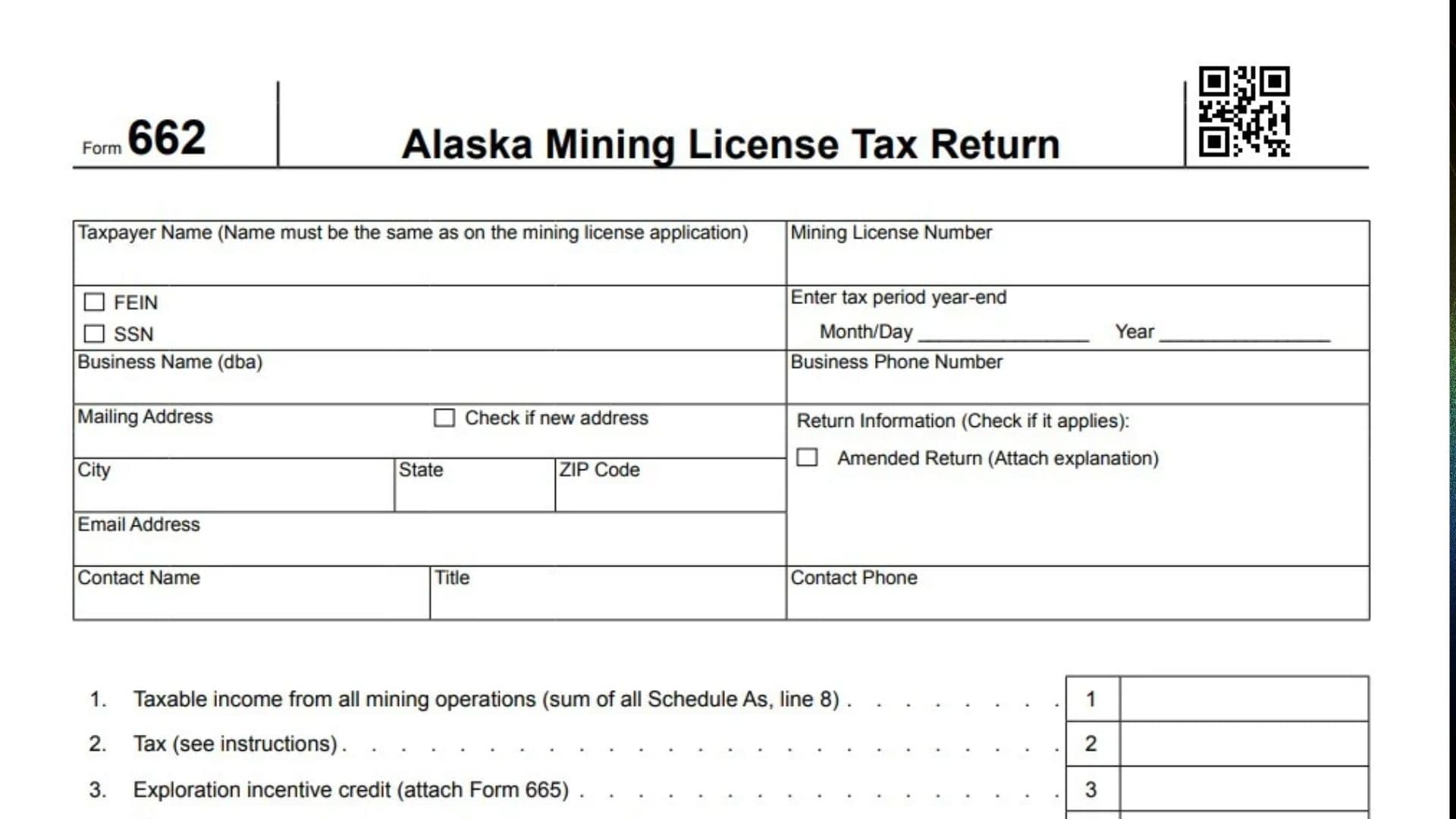
Alaska Form 662, also known as the Alaska Mining License Tax Return, is a tax document used to calculate and report taxable income generated from mining operations in Alaska. It collects financial information about mining activities, including gross mining income, royalties received, mining expenses, depletion deductions, and applicable tax credits. Businesses and individuals involved in mining operations use this form to determine their mining license tax liability and report the amount owed to the state. The form also accounts for different mining operations, allowing taxpayers to calculate income and expenses separately for each operation before combining the results on the main return. In addition to reporting mining income, Form 662 provides schedules for calculating cost depletion and percentage depletion, allocating direct and indirect business expenses, reporting royalties paid to property owners, and identifying royalties received from operators or lessees. It also includes a Mining Business Education Credit schedule for qualifying contributions to eligible educational institutions and programs in Alaska. Completing the return accurately is important because the information entered on each schedule affects the final taxable mining income, available deductions, tax credits, and net amount payable or overpaid. Taxpayers should maintain supporting financial records and ensure that the amounts transferred between schedules agree with the calculations reported on the main return.
Who Needs To Use Form 662?
Form 662 is intended for taxpayers who are subject to Alaska’s mining license tax requirements.
It is used to report income from mining operations and calculate the applicable mining tax. The form accommodates taxpayers who operate mining businesses, receive royalties from mining activities, or have multiple mining operations requiring separate income and expense calculations.
Depending on the taxpayer’s activities, the return may require information about:
- Gross income generated from mining operations.
- Royalties received from operators or lessees.
- Royalties paid to property owners or lessors.
- Direct mining expenses.
- Indirect business expenses.
- Cost depletion and percentage depletion.
- Exploration incentive credits.
- Mining business education credits.
- Film production tax credits.
Taxpayers operating multiple mining properties must generally prepare separate Schedule A and Schedule C calculations for each applicable mining operation.
How To File Form 662
Form 662 is the main Alaska Mining License Tax Return. The completed return should include the applicable schedules and supporting documents used to calculate the reported income, deductions, and credits.
Before completing the form, gather the following information:
- Your mining license number.
- Federal Employer Identification Number (FEIN) or Social Security Number (SSN).
- Mining operation income records.
- Royalty payment and receipt records.
- Mining property cost and basis information.
- Estimated recoverable mineral units.
- Production and sales records.
- Direct and indirect expense records.
- Depreciation information.
- Supporting documentation for eligible tax credits.
- Records of extension payments and previous payments, if applicable.
Complete the relevant schedules before transferring their totals to the main return.
The form includes an amended return checkbox. If you are filing an amended return, select that box and attach an explanation of the changes.
Important version note: The attached Form 662 displays a January 1, 2017 revision date on its main page. Its schedules display January 1, 2016 dates. Verify that this version is accepted for the tax period being reported and obtain the applicable current filing instructions and submission address before filing. The attached document does not specify a mailing address or filing deadline.

How To Complete Form 662
The main Form 662 collects taxpayer identification details and summarizes the mining income, deductions, credits, payments, and final tax calculation from the supporting schedules.
Taxpayer Information
Complete the identification section before entering any financial information.
Taxpayer Name
Enter the legal name of the individual or business responsible for the mining license tax return. The name must match the name provided on the mining license application.
Mining License Number
Enter the mining license number associated with the mining operation being reported.
FEIN
Check the FEIN box if you are identifying the taxpayer using a Federal Employer Identification Number.
SSN
Check the SSN box if the taxpayer is identified using a Social Security Number.
Select the appropriate identification type and provide the corresponding number.
Tax Period Year-End
Enter the ending date of the tax reporting period. Provide the month, day, and year in the designated spaces.
Business Name (DBA)
Enter the business name or trade name used for the mining operation if it differs from the taxpayer’s legal name.
Business Phone Number
Provide the primary telephone number associated with the mining business.
Mailing Address
Enter the complete mailing address where the taxpayer can receive correspondence.
Check If New Address
Select this checkbox if the mailing address has changed since the previous filing or the address on record.
City, State, And ZIP Code
Provide the city, state, and ZIP code associated with the mailing address.
Amended Return
Check this box if you are submitting a corrected or amended Form 662. Attach an explanation describing the changes made to the original return.
Email Address
Enter an active email address for correspondence relating to the return.
Contact Name
Provide the name of the individual the tax department can contact regarding the return.
Title
Enter the contact person’s professional title or position within the business.
Contact Phone
Provide the contact person’s direct telephone number.
Main Tax Calculation
After completing the applicable schedules, transfer the required totals to the main return.
Line 1: Taxable Income From All Mining Operations
Enter the combined taxable income from all mining operations. Add the amounts reported on Schedule A, line 8, for every mining operation included in the return.
If you operate several mining properties, make sure each applicable Schedule A is completed before calculating this total.
Line 2: Tax
Calculate the mining license tax using the taxable income reported on line 1. Enter the resulting tax amount based on the applicable Alaska mining tax instructions.
The attached form refers taxpayers to separate instructions for this calculation and does not provide the tax rate or calculation method.
Line 3: Exploration Incentive Credit
Enter the eligible exploration incentive credit claimed for the reporting period.
Attach the required Form 665 to support the credit claimed on this line.
Line 4: Mining Business Education Credit
Enter the allowable mining business education credit calculated on Schedule EC, line 6.
Complete Schedule EC before transferring the amount to this line.
Line 5: Tax Before Other Credits
Subtract the exploration incentive credit on line 3 and the mining business education credit on line 4 from the tax reported on line 2.
The result cannot be less than zero. If the credits exceed the tax amount, enter zero.
Line 6: Film Production Tax Credit
Enter the allowable film production tax credit.
The credit cannot exceed the amount reported on line 5. Attach the required certificate or an explanation supporting any credit carryforward.
Line 7: Amount Paid With Extension
Enter the amount already paid when requesting an extension to file the return.
Use the actual extension payment amount supported by your payment records.
Line 8: Amount Previously Paid
This line applies only to amended returns.
Enter the amount previously paid toward the tax liability reported on the original return.
Do not use this line when submitting an original return.
Line 9: Net Tax Due Or Overpayment
Calculate the final balance by subtracting lines 6, 7, and 8 from line 5.
- A positive result represents the remaining tax due.
- A negative result represents an overpayment.
Review the calculation carefully before completing the signature section.
Signature And Declaration
Signature
The individual authorized to sign the return must provide their signature.
Printed Name And Title
Enter the signer’s full printed name and professional title.
Date
Enter the date the return is signed.
By signing, the taxpayer or authorized signer declares under penalty of perjury that the return and accompanying schedules and statements have been examined and are true, correct, and complete to the best of their knowledge and belief.
Schedule A: Taxable Income From Mining Operation
Schedule A calculates taxable income separately for each mining operation.
A separate Schedule A must be prepared for every mining operation included in the return.
Complete the mining license number, taxpayer identification information, and description and location of the mining operation at the top of the schedule.
Line 1: Gross Income From Mining Operation
Enter the total gross income generated directly from the mining operation during the reporting period.
Use the applicable mining income records to determine the amount.
Line 2: Royalties Received
Enter the royalties received from operators or lessees for the mining operation.
Transfer this amount from Schedule F, line 6.
Line 3: Depletion Deduction
Enter the allowable depletion deduction calculated on Schedule B, line 16.
The amount should reflect the applicable cost or percentage depletion calculation.
Line 4: Direct Mining Expenses
Enter the direct mining expenses associated with the operation from Schedule C, line 10.
If the operation reports royalty income on line 2, enter zero on this line, as instructed by the form.
Line 5: Indirect Mining Expenses
Enter the indirect mining expenses allocated to the operation from Schedule C, line 22.
If the operation reports royalty income on line 2, enter zero on this line.
Line 6: Net Income From Mining Operation
Add the amounts on lines 1 and 2. Then subtract lines 3, 4, and 5.
The calculation is:
Net Income = Line 1 + Line 2 – Line 3 – Line 4 – Line 5.
Line 7: Exemption For New Mining Operation
Enter the applicable exemption for a qualifying new mining operation.
The form refers taxpayers to separate instructions for determining the exemption amount and eligibility requirements.
Line 8: Taxable Income From Mining Operation
Subtract line 7 from line 6.
Enter the resulting taxable income for the mining operation. Transfer this amount to the main Form 662, line 1, as part of the combined total for all operations.
Schedule B: Depletion Deduction
Schedule B calculates the depletion deduction attributable to the mining operation identified at the top of the schedule.
It provides two calculation methods: cost depletion and percentage depletion.
Cost Depletion Calculation
Line 1: Cost Or Basis Of Mining Property
Enter the original cost or applicable tax basis of the mining property after subtracting its residual value.
Line 2: Estimated Recoverable Units
Enter the estimated total recoverable mineral units at the beginning of the tax year.
Include units that were previously produced but had not yet been sold.
Line 3: Unit Cost
Divide line 1 by line 2.
This calculation determines the cost assigned to each recoverable unit of mineral production.
Line 4: Number Of Units Sold
Enter the total number of mineral units sold during the reporting period.
Use the appropriate production and sales records to determine this figure.
Line 5: Cost Depletion Deduction
Multiply line 3 by line 4.
The result represents the cost depletion deduction under this calculation method.
Percentage Depletion Calculation
Line 6: Gross Income And Royalties Received
Add Schedule A, line 1, and Schedule A, line 2.
Enter the combined gross mining income and royalties received.
Line 7: Royalties Paid
Enter the royalties paid to property owners or lessors.
Transfer this amount from Schedule E, line 6.
Line 8: Depletion Base
Subtract line 7 from line 6.
This produces the amount used to calculate percentage depletion.
Line 9: Applicable Depletion Percentage
Enter the percentage that applies to the type of mining operation.
The form provides the following percentages:
| Mining Property Or Mineral | Depletion Percentage |
|---|---|
| Coal mines | 10% |
| Metal mines | 15% |
| Flourspar, flake graphite, vermiculite, beryl, feldspar, mica, talc, lepidolite, spodumene, barite, ball and sagger clay, and rock asphalt mines | 15% |
| Potash mines or deposits | 15% |
| Sulphur mines or deposits | 23% |
Select the applicable percentage based on the mineral or mining operation.
Line 10: Percentage Depletion
Multiply line 8 by line 9.
Enter the calculated percentage depletion amount.
Line 11: Gross Income And Royalties Received
Enter the combined amount of gross mining income and royalties received.
Add Schedule A, line 1, and Schedule A, line 2.
Line 12: Allowable Deductions
Add Schedule A, line 4, and Schedule A, line 5.
Enter the combined direct and indirect mining expenses allowed for this calculation.
Line 13: Net Income Before Depletion
Subtract line 12 from line 11.
This calculates the mining income before applying depletion.
Line 14: Limitation
Multiply line 13 by 50%.
Enter the resulting limitation amount.
Line 15: Limited Percentage Depletion
Compare line 10 with line 14.
Enter the smaller of these two amounts. This ensures that the percentage depletion amount does not exceed the limitation calculated on line 14.
Line 16: Depletion Deduction
Compare the cost depletion amount on line 5 with the allowable percentage depletion amount on line 15.
Enter whichever amount is greater.
Transfer this final depletion deduction to Schedule A, line 3.
Schedule C: Mining Expenses
Schedule C records direct and indirect expenses associated with an individual mining operation.
A separate Schedule C must be completed for each mining operation.
The form also specifies that royalty recipients cannot claim expenses other than depletion.
Complete the mining license number, taxpayer identification details, and description and location of the operation before entering expense amounts.
Direct Expenses
Line 1: Royalties Paid
Enter royalties paid to property owners or lessors.
Transfer the amount from Schedule E, line 6.
Line 2: Fuel And Oil
Enter qualifying fuel and oil expenses associated with the mining operation.
Line 3: Current Development Costs
Enter eligible development costs incurred during the current reporting period.
Line 4: Extraction Costs
Enter expenses directly associated with extracting minerals from the mining property.
Line 5: Maintenance And Repairs
Enter maintenance and repair costs associated with mining equipment, property, and operational facilities.
Line 6: Salaries And Wages
Enter salaries and wages paid for employees working directly in the mining operation.
Line 7: Transportation Costs
Enter qualifying transportation expenses directly associated with mining activities.
Line 8: Depreciation
Enter the applicable depreciation expense for mining property and equipment.
Line 9: Other Expenses
Enter other eligible direct mining expenses that do not fit into the preceding categories.
Attach a separate schedule identifying the expenses included in this amount.
Line 10: Total Direct Mining Expenses For This Operation
Add lines 1 through 9.
Enter the total here and transfer it to Schedule A, line 4, for the corresponding mining operation.
Line 11: Direct Mining Expenses Of All Other Mining Operations
Add line 10 from every other Schedule C completed for the taxpayer’s additional mining operations.
Enter the combined amount here.
Line 12: Total Direct Mining Expenses Of All Mining Operations
Add lines 10 and 11.
This produces the total direct mining expenses across all mining operations.
Line 13: Total Direct Non-Mining Expenses
Enter the total direct expenses associated with all business activities that are not mining operations.
Line 14: Total Direct Mining And Non-Mining Expenses
Add lines 12 and 13.
This represents the combined direct expenses for mining and non-mining business activities.
Line 15: Direct Mining Expenses As A Percentage Of Total Direct Expenses
Divide line 12 by line 14.
Enter the resulting percentage. This percentage is used to allocate indirect expenses between mining and non-mining activities.
Indirect Expenses Allocation
If there are no indirect expenses to allocate, the form allows lines 16 through 22 to remain blank.
Line 16: Total Indirect Expenses
Enter the total indirect expenses from Schedule D, line 12.
Line 17: Indirect Expenses Allocated To Mining Operations
Multiply line 16 by line 15.
This determines the portion of total indirect expenses allocated to all mining operations.
Line 18: Total Current Year Production From This Mining Operation
Enter the total current-year production for the mining operation identified on the schedule.
Line 19: Total Current Year Production From All Other Mining Operations
Add line 18 from all other Schedule C forms completed for the taxpayer’s additional mining operations.
Line 20: Total Current Year Production Of All Mining Operations
Add lines 18 and 19.
This represents the total production across all mining operations.
Line 21: This Operation’s Percentage Of Total Current Year Production
Divide line 18 by line 20.
Enter the resulting percentage to determine the operation’s share of total mining production.
Line 22: Total Indirect Expenses Allocated To This Property
Multiply line 17 by line 21.
Enter the resulting amount here and transfer it to Schedule A, line 5, for the corresponding mining operation.
Schedule D: Indirect Expenses
Schedule D identifies indirect expenses incurred across all mining and non-mining business activities.
Only one Schedule D should be submitted with Form 662. Include indirect expenses from all mining and non-mining operations.
The form repeats the restriction that royalty recipients cannot claim expenses other than depletion.
Line 1: Advertising
Enter the total advertising expenses associated with the business.
Line 2: Insurance
Enter applicable business insurance expenses.
Line 3: Interest On Business Debt
Enter interest expenses associated with business borrowing and debt obligations.
Line 4: Legal And Professional Fees
Enter qualifying legal, accounting, consulting, and other professional service fees.
Line 5: Office Supplies, Repairs And Maintenance
Enter indirect expenses for office supplies, office repairs, and general business maintenance.
Line 6: Rent
Enter qualifying rental expenses associated with business operations.
Line 7: Taxes
Enter applicable business taxes other than federal income tax and Alaska mining tax.
Line 8: Travel And Entertainment
Enter applicable business travel and entertainment expenses.
Line 9: Utilities And Telephone
Enter business utility and telephone expenses.
Line 10: Depreciation
Enter applicable depreciation expenses associated with business property and equipment treated as indirect expenses.
Line 11: Other Expenses
Enter additional indirect expenses that do not fit into the categories listed above.
Attach a separate schedule explaining the expenses included in this amount.
Line 12: Total Indirect Expenses
Add lines 1 through 11.
Enter the total here and transfer the same amount to Schedule C, line 16, for each applicable mining operation.
Schedule E: Royalties Paid To Owner/Lessor
Schedule E reports royalty payments made to property owners or lessors.
Complete this schedule using U.S. dollars. The form provides space for up to five lessors.
For each lessor, complete the following information.
Federal ID: FEIN Or SSN
Select the appropriate identification type and enter the lessor’s Federal Employer Identification Number or Social Security Number.
Name
Enter the full legal name of the property owner or lessor receiving the royalty payment.
Mailing Address
Enter the lessor’s complete mailing address.
City, State, And ZIP Code
Provide the city, state, and ZIP code associated with the lessor’s mailing address.
Amount Paid
Enter the total royalty amount paid to that particular lessor during the reporting period.
Repeat these entries for lessors 1 through 5, as applicable.
Line 6: Total Royalties Paid
Add the royalty payments reported for all listed lessors.
Enter the total on line 6.
Transfer this amount to Schedule C, line 1, and Schedule B, line 7, for the appropriate mining operation.
Schedule F: Royalties Received From Operator/Lessee
Schedule F reports royalties received from operators or lessees during the reporting period.
Complete this schedule using U.S. dollars. The form provides five separate spaces for reporting lessees.
For each lessee, provide the following details.
Federal ID: FEIN Or SSN
Check the appropriate identification box and enter the lessee’s Federal Employer Identification Number or Social Security Number.
Name
Enter the legal name of the operator or lessee who paid the royalties.
Mailing Address
Provide the lessee’s complete mailing address.
City, State, And ZIP Code
Enter the city, state, and ZIP code associated with the lessee’s address.
Amount Received
Enter the total royalty payment received from the individual lessee during the tax period.
Repeat the process for each lessee who paid royalties.
Line 6: Total Royalties Received
Add all royalty amounts received from the listed lessees.
Enter the combined amount on line 6.
Transfer this amount to Schedule A, line 2, for the appropriate mining operation.
Schedule EC: Mining Business Education Credit
Schedule EC calculates the Mining Business Education Credit for qualifying contributions made to eligible educational institutions and programs in Alaska.
The schedule begins with a contribution information table.
Contribution Information
For each qualifying contribution, enter the following details:
Recipient
Enter the name of the university foundation, educational institution, nonprofit organization, school district, vocational education provider, or other eligible recipient receiving the contribution.
Date
Enter the date the contribution was made.
Amount
Enter the amount of the qualifying contribution in U.S. dollars.
Use the available rows to list the contributions included in the credit calculation.
Education Credit Calculation
Line 1: Total Qualified Contributions
Add all eligible contributions listed in the recipient information table.
Enter the combined amount on line 1.
Line 2: First Contribution Tier
Multiply the smaller of line 1 or $100,000 by 50%.
For example, if qualifying contributions total $80,000, the amount entered on this line would be $40,000.
If contributions exceed $100,000, this line is limited to $50,000.
Line 3: Next $200,000 Of Contributions
Enter 100% of the next $200,000 of qualifying contributions.
This calculation applies to the contribution amount above the first $100,000, up to the next $200,000.
Line 4: Contributions Exceeding $300,000
Calculate 50% of the qualifying contributions exceeding $300,000.
Enter the resulting amount on this line.
Line 5: Total Credit
Add lines 2, 3, and 4.
Enter the combined education credit before applying the overall limitations.
Line 6: Total Allowable Credit
Determine the allowable credit by comparing line 5 with the applicable limits.
The amount cannot exceed the lesser of:
- The credit calculated on line 5.
- The total tax remaining after reducing the tax by exploration incentive credits.
- The $5,000,000 credit limitation.
Enter the allowable amount on line 6.
Transfer this amount to Form 662, page 1, line 4.
Explanation Of Qualifying Education Contributions
The schedule describes the types of contributions that may qualify for the Mining Business Education Credit.
Eligible contributions include qualifying cash contributions accepted by:
- An Alaska university foundation.
- A qualifying nonprofit public or private two-year or four-year Alaska college accredited by a regional accreditation association for direct instruction, research, and educational support.
- Eligible institutions for library and museum acquisitions and endowment contributions.
- Qualifying nonprofit Alaska colleges for facilities or annual intercollegiate sports tournaments.
- Alaska school districts for secondary-level vocational education courses, programs, and facilities.
- State-operated vocational technical schools for vocational education courses, programs, and facilities.
- Eligible nonprofit agencies supporting Alaska Native cultural and heritage programs and educational assistance, including mentoring and tutoring for public school staff and students in kindergarten through grade 12.
- Qualifying coastal ecosystem learning centers located in Alaska for education, research, rehabilitation, and facilities.
Education Credit Limitations
The form establishes a tiered credit calculation:
| Contribution Amount | Allowable Credit Percentage |
|---|---|
| First $100,000 | 50% |
| Next $200,000 | 100% |
| Amount Above $300,000 | 50% |
The total allowable credit cannot exceed $5 million.
The form also states that contributions claimed as a credit on this return cannot be claimed as a credit against other Alaska taxes.
If the taxpayer belongs to an affiliated group, the $5 million limitation applies to the affiliated group as a whole.
Final Review Before Filing
Before submitting Alaska Form 662, review the completed return and all applicable schedules to ensure that the reported information is accurate and consistent.
Use this checklist to verify the important details:
- Confirm that the taxpayer’s legal name matches the mining license application.
- Verify the mining license number.
- Enter the correct FEIN or SSN and select the appropriate identification checkbox.
- Confirm the tax period year-end date.
- Review the business name, mailing address, telephone number, and contact information.
- Select the amended return checkbox when applicable and attach an explanation.
- Prepare a separate Schedule A for each mining operation.
- Verify gross mining income and royalties received.
- Check the cost depletion and percentage depletion calculations on Schedule B.
- Confirm that direct mining expenses are correctly reported on Schedule C.
- Verify the indirect expense allocation calculations.
- Complete only one Schedule D for all applicable mining and non-mining activities.
- Report royalty payments accurately on Schedule E.
- Report royalty receipts accurately on Schedule F.
- Complete Schedule EC if claiming the Mining Business Education Credit.
- Attach Form 665 when claiming the exploration incentive credit.
- Attach supporting schedules for other expenses when required.
- Verify the film production tax credit documentation, if applicable.
- Confirm extension payments and previous payments where applicable.
- Recheck the calculation on main Form 662, lines 1 through 9.
- Ensure the return is signed, dated, and includes the printed name and title of the signer.
- Verify the applicable filing instructions, submission address, and tax-year form version before sending the return.
Accurate completion of Form 662 requires careful coordination between the main return and its supporting schedules. Reviewing every calculation, supporting record, and transferred amount before filing can help reduce errors and ensure that the reported Alaska mining license tax liability is calculated correctly.