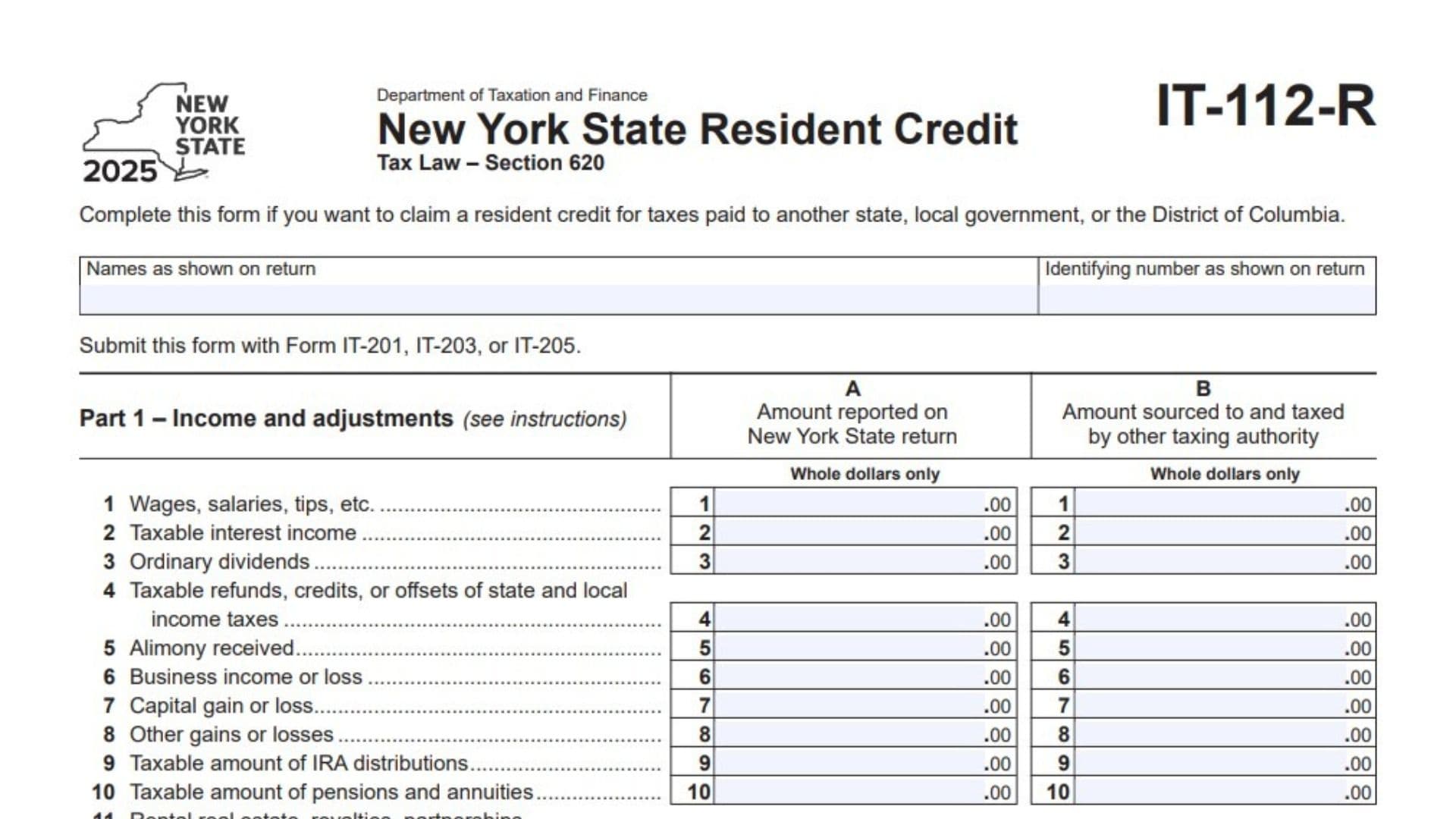
New York Form IT-112-R, officially titled New York State Resident Credit, is a tax form issued by the New York State Department of Taxation and Finance. It allows eligible New York residents to claim a credit against their New York State income tax for qualifying income taxes paid to another state, local government, or the District of Columbia. This credit is designed to reduce the possibility of the same income being taxed by both New York and another taxing jurisdiction. For example, a New York resident who earns wages while working in another state may have to pay income tax to that state while also reporting the income on their New York resident income tax return. Form IT-112-R helps calculate the amount of credit that may be available for the qualifying taxes paid outside New York. The form collects detailed information about the taxpayer’s income, federal adjustments, New York State adjustments, taxable income, and income attributable to the other taxing jurisdiction. It also records the income tax imposed by the other state or local government, payments made by the taxpayer, and qualifying taxes paid by an entity on the taxpayer’s behalf. The form is divided into four parts. Part 1 compares income reported on the New York State return with income sourced to and taxed by another jurisdiction. Part 2 calculates the potential resident credit using the other jurisdiction’s income tax liability and the portion of New York tax attributable to the income earned outside New York. Part 3 determines the final credit after accounting for other credits already applied to the taxpayer’s New York tax liability. Part 4 collects additional information about withholding, estimated payments, overpayments, and outstanding balances reported on the other jurisdiction’s income tax return. The completed form must accompany Form IT-201, Form IT-203, or Form IT-205, depending on the taxpayer’s filing situation. Although submitting a copy of the other state’s income tax return is optional, the taxpayer must complete Part 4 and may be required to provide the other return later if requested by the New York State Department of Taxation and Finance. Completing Form IT-112-R accurately is important because the allowable credit is subject to specific limitations. The final credit cannot exceed the applicable amount calculated under the form’s rules or the remaining New York tax liability after other credits have been applied.
Who Can Claim the New York Resident Credit?
Form IT-112-R is intended for taxpayers who want to claim a New York resident credit for qualifying income taxes paid to another taxing jurisdiction.
The form covers taxes paid to:
- Another U.S. state.
- A local government.
- The District of Columbia.
To claim the credit, the taxpayer must have income that is reported on the New York State return and is also sourced to and taxed by another qualifying jurisdiction.
Examples of Situations That May Qualify
The following situations illustrate circumstances in which a resident credit may be relevant:
- A New York resident earns wages while working in another state.
- A taxpayer receives business income that is subject to income tax in another state.
- A New York resident receives income from a partnership or S corporation that is taxed by another jurisdiction.
- A taxpayer earns income from rental properties or investments that is also subject to another state’s income tax.
- A taxpayer pays qualifying local income taxes on income also included in their New York return.
The actual availability and amount of the credit depend on the applicable tax rules and the calculations required by Form IT-112-R.
How To File Form IT-112-R
Form IT-112-R must be submitted with the applicable New York income tax return.
The form identifies three possible accompanying returns:
- Form IT-201: New York State Resident Income Tax Return.
- Form IT-203: Nonresident and Part-Year Resident Income Tax Return.
- Form IT-205: Fiduciary Income Tax Return.
Use the return that applies to your tax filing situation.
Information To Prepare Before Completing the Form
Gather the following information before starting:
- Your full name as shown on your New York income tax return.
- Your Social Security number or other identifying number shown on the return.
- Your completed New York income tax return.
- Your federal income information.
- Your New York State income adjustments.
- Your income sourced to and taxed by the other state or local government.
- The other jurisdiction’s income tax return.
- The amount of income tax imposed by the other jurisdiction.
- The amount paid directly by you.
- Any qualifying tax paid by an entity on your behalf.
- Information about composite return payments, if applicable.
- The other jurisdiction’s withholding and estimated tax payment information.
- Any overpayment or outstanding balance reported on the other jurisdiction’s return.
- Information about other credits already applied to your New York tax liability.
Do You Need to Attach the Other State’s Tax Return?
You are not required to submit a copy of the income tax return filed with the other state or local government when submitting Form IT-112-R with Form IT-201, IT-203, or IT-205.
Providing a copy is optional.
However, the New York State Department of Taxation and Finance may request a copy of that return at a later date.
Whether or not you attach the other jurisdiction’s return, you must complete Part 4 of Form IT-112-R.

How To Complete Form IT-112-R
Form IT-112-R contains four main parts:
- Part 1: Income and adjustments.
- Part 2: Calculation of the resident credit.
- Part 3: Application of the credit.
- Part 4: Information from the other jurisdiction’s income tax return.
Complete the taxpayer identification section first, followed by each part in numerical order.
Taxpayer Identification Information
Names as Shown on Return
Enter your full name exactly as it appears on the New York income tax return with which Form IT-112-R will be submitted.
If filing jointly, follow the name presentation used on the corresponding joint return.
Identifying Number as Shown on Return
Enter the Social Security number or other identifying number shown on your New York income tax return.
Verify that the number matches the accompanying return.
Part 1: Income and Adjustments
Part 1 compares two sets of income information.
- Column A: The amount reported on your New York State income tax return.
- Column B: The amount sourced to and taxed by the other state, local government, or the District of Columbia.
Enter whole dollars only in both columns.
The purpose of this section is to identify the portion of your income that is subject to taxation outside New York while also being included in your New York income tax calculation.
Line-By-Line Instructions for Part 1
Line 1: Wages, Salaries, Tips, Etc.
Enter the total wages, salaries, tips, and other applicable employment income reported on your New York State return in column A.
In column B, enter the portion of that employment income sourced to and taxed by the other jurisdiction.
Use your wage statements and applicable income tax records to determine the amounts.
Line 2: Taxable Interest Income
Enter your taxable interest income reported on your New York State return in column A.
In column B, report the portion of taxable interest income sourced to and taxed by the other jurisdiction.
Use your interest statements and applicable tax records to determine the correct amounts.
Line 3: Ordinary Dividends
Enter the ordinary dividends included in your New York State income tax return.
Report the full applicable amount in column A.
In column B, enter the portion of ordinary dividends sourced to and taxed by the other jurisdiction.
Line 4: Taxable Refunds, Credits, or Offsets of State and Local Income Taxes
Enter the taxable state and local income tax refunds, credits, or offsets included in your New York State income calculation.
Report the applicable amount in column A.
In column B, enter the portion attributable to the other taxing jurisdiction, when applicable.
Use the corresponding income tax records to determine the correct amounts.
Line 5: Alimony Received
Enter any taxable alimony received that is included in your New York State income tax return.
Report the applicable amount in column A.
In column B, enter the portion sourced to and taxed by the other jurisdiction, if applicable.
Use the applicable tax-year reporting rules when determining the amount.
Line 6: Business Income or Loss
Enter the business income or loss reported on your New York State income tax return.
In column A, report the applicable total.
In column B, enter the portion of business income or loss sourced to and taxed by the other jurisdiction.
Use the applicable business income schedules and allocation information to determine the correct amount.
Line 7: Capital Gain or Loss
Enter the capital gains or losses included in your New York State income calculation.
Report the applicable amount in column A.
In column B, enter the portion of capital gain or loss sourced to and taxed by the other jurisdiction.
Use the applicable capital gain records and tax schedules to determine the amount.
Line 8: Other Gains or Losses
Enter other gains or losses included in your New York State income tax return that are not reported on the preceding lines.
Report the amount in column A.
In column B, enter the portion sourced to and taxed by the other jurisdiction, if applicable.
Line 9: Taxable Amount of IRA Distributions
Enter the taxable portion of your Individual Retirement Account (IRA) distributions reported on your New York State return.
Do not enter the full distribution if only part of it is taxable.
In column B, report the portion sourced to and taxed by the other jurisdiction, when applicable.
Line 10: Taxable Amount of Pensions and Annuities
Enter the taxable amount of pensions and annuities included in your New York State income tax return.
Report the applicable amount in column A.
In column B, enter the portion sourced to and taxed by the other jurisdiction, if applicable.
Use your pension and annuity tax statements to determine the taxable amount.
Line 11: Rental Real Estate, Royalties, Partnerships, S Corporations, Trusts, Etc.
Enter income or losses from rental real estate, royalties, partnerships, S corporations, trusts, and similar sources included in your New York State return.
Report the applicable amount in column A.
In column B, enter the portion sourced to and taxed by the other jurisdiction.
Use the applicable schedules, ownership information, and income allocation records to determine the correct amount.
Line 12: Farm Income or Loss
Enter the farm income or loss reported on your New York State income tax return.
Report the applicable amount in column A.
In column B, enter the portion of farm income or loss sourced to and taxed by the other jurisdiction.
Line 13: Unemployment Compensation
Enter the unemployment compensation included in your New York State income tax calculation.
In column A, report the amount shown on your New York return.
In column B, enter the portion sourced to and taxed by the other jurisdiction, if applicable.
Line 14: Taxable Amount of Social Security Benefits
Enter the taxable portion of your Social Security benefits included in your New York State income tax return.
Do not enter the total benefits received if only a portion is taxable.
In column B, report the amount sourced to and taxed by the other jurisdiction, if applicable.
Line 15: Other Income
Enter other taxable income included in your New York State income tax return that is not already reported on lines 1 through 14.
Report the applicable amount in column A.
In column B, enter the portion sourced to and taxed by the other jurisdiction, when applicable.
Line 16: Add Lines 1 Through 15
Add the amounts reported on lines 1 through 15 separately in each column.
The calculations are:
- Column A: Lines 1 through 15 added together.
- Column B: Lines 1 through 15 added together.
Enter the respective totals on line 16.
Line 17: Total Federal Adjustments to Income
Enter the total federal adjustments to income reported on your New York State return in column A.
These adjustments are used to calculate federal adjusted gross income.
For column B, enter the applicable portion attributable to income sourced to and taxed by the other jurisdiction, following the relevant allocation instructions.
Line 18: Federal Adjusted Gross Income
Subtract line 17 from line 16.
The calculation is:
Line 16 − Line 17 = Line 18
Complete the calculation separately for columns A and B.
Column A represents federal adjusted gross income reported on the New York return.
Column B represents the corresponding amount attributable to the income sourced to and taxed by the other jurisdiction.
Line 19: New York State Adjustments
Enter the applicable New York State adjustments in column A.
These adjustments are used to calculate New York State adjusted gross income.
Refer to the applicable New York income tax return instructions to determine which adjustments apply and how they should be treated when determining the amount attributable to the other jurisdiction.
Do not automatically assume that every New York adjustment is allocated in the same way as federal income.
Line 20: New York State Adjusted Gross Income
Enter the New York State adjusted gross income after applying the applicable New York State adjustments.
Column A should reflect the amount reported on your New York State return.
Column B should reflect the corresponding amount sourced to and taxed by the other jurisdiction, determined under the applicable instructions.
Line 21: Capital Gain Portion of Lump-Sum Distributions
Enter the applicable capital gain portion of lump-sum distributions.
Report the amount in the appropriate column based on the income reported on your New York return and the portion attributable to the other jurisdiction.
Refer to the applicable New York instructions for the required calculation.
Line 22: Add Lines 20 and 21
Add the amounts reported on lines 20 and 21 separately for columns A and B.
The calculations are:
- Column A: Line 20 + Line 21.
- Column B: Line 20 + Line 21.
Enter both totals on line 22.
These amounts are important because they are used to calculate the proportion of New York income attributable to the other taxing jurisdiction.
Part 2: Calculating Your Resident Credit
Part 2 calculates the potential New York resident credit for income taxes paid to another state, local government, or the District of Columbia.
It compares the tax imposed by the other jurisdiction with the New York tax attributable to the income earned outside New York.
Complete each line using the applicable information from Part 1 and the other jurisdiction’s income tax records.
Line-By-Line Instructions for Part 2
Line 23: Other State or District of Columbia
Enter the two-letter abbreviation of the state or the District of Columbia where the qualifying income tax was paid.
For example, use the appropriate two-letter postal abbreviation for the applicable jurisdiction.
If the tax was paid to a local government, also enter the locality name in the designated space.
Make sure the jurisdiction and locality correspond to the tax being used to claim the credit.
Line 24a: Income Tax Paid by the Taxpayer
Enter the amount of income tax imposed on the other jurisdiction’s current-year tax return that was paid directly by the taxpayer.
Include qualifying amounts paid through a group or composite return on behalf of the taxpayer.
Use the other jurisdiction’s tax records to determine the amount.
Group or Composite Return Checkbox
If the income taxes were paid through a group or composite return, mark an X in the designated checkbox.
This identifies that the taxpayer’s tax was paid as part of a group filing arrangement.
Group’s EIN
If you marked the group or composite return checkbox, enter the group’s Employer Identification Number (EIN).
Use the EIN associated with the group that filed the composite return.
Line 24b: Tax Paid by an Entity on Behalf of the Taxpayer
Enter qualifying income tax paid by an entity on behalf of the taxpayer when the tax is substantially similar to New York State’s pass-through entity tax.
This may apply when a pass-through entity pays an income tax to another jurisdiction on behalf of its owners.
Enter only the amount that satisfies the applicable requirements for this credit.
Refer to the New York instructions for determining whether the other jurisdiction’s entity-level tax is substantially similar to New York’s pass-through entity tax.
Line 24: Total Income Tax Imposed
Add the amounts reported on lines 24a and 24b.
The calculation is:
Line 24a + Line 24b = Line 24
Enter the combined amount.
This represents the qualifying income tax imposed by the other jurisdiction and paid by the taxpayer or an eligible entity on the taxpayer’s behalf.
Line 25: New York State Tax Payable
Enter the New York State tax payable amount determined under the applicable New York income tax return instructions.
Use the appropriate tax calculation for the return being filed.
This amount is used to determine the portion of New York tax attributable to the income taxed by the other jurisdiction.
Line 26: Income Allocation Ratio
Divide the amount on line 22, column B, by the amount on line 22, column A.
The calculation is:
Line 22, Column B ÷ Line 22, Column A = Line 26
Round the result to four decimal places.
This ratio represents the proportion of the applicable New York income attributable to the other taxing jurisdiction.
Enter the calculated ratio on line 26.
Line 27: New York Tax Attributable to Other-State Income
Multiply the New York State tax payable on line 25 by the allocation ratio on line 26.
The calculation is:
Line 25 × Line 26 = Line 27
Enter the resulting amount.
This represents the portion of New York State tax attributable to the income sourced to and taxed by the other jurisdiction.
Line 28: Allowable Credit Before Additional Forms
Compare the amounts on line 24 and line 27.
Enter whichever amount is smaller.
The calculation is:
Smaller of Line 24 or Line 27 = Line 28
This amount represents the potential resident credit for the jurisdiction identified on line 23.
Line 29: Credits From Additional Forms
Enter the total of the applicable line 28 amounts from additional Forms IT-112-R and line 44 amounts from Forms IT-112-C, if any.
Include the amounts specified by the form’s instructions.
Make sure the totals are supported by the applicable additional credit forms.
Line 30: Total Resident Credit Amount
Add line 28 and line 29.
The calculation is:
Line 28 + Line 29 = Line 30
Enter the resulting total.
This amount is carried into Part 3 to determine the final credit that can be applied against your New York tax liability.
Part 3: Application of Credit
Part 3 determines how much of the resident credit calculated in Part 2 can actually be used against your New York tax liability.
The calculation considers tax due before credits and other credits already applied.
Line-By-Line Instructions for Part 3
Line 31: Tax Due Before Credits
Enter the amount of New York tax due before applying tax credits.
Use the applicable New York income tax return instructions to determine the correct amount.
Do not enter the final balance due after all credits and payments have been applied.
Line 32: Other Credits Applied Before This Credit
Enter the total amount of other tax credits that were applied before the resident credit.
Use the applicable credit information from your New York income tax return.
Include the credits that must be considered before applying the resident credit under the form’s instructions.
Line 33: Tax Remaining After Other Credits
Subtract line 32 from line 31.
The calculation is:
Line 31 − Line 32 = Line 33
Enter the resulting amount.
This represents the remaining New York tax liability available for the resident credit.
Line 34: Final Allowable Resident Credit
Compare line 30 with line 33.
Enter whichever amount is smaller.
The calculation is:
Smaller of Line 30 or Line 33 = Line 34
This is the final resident credit determined by Form IT-112-R.
Use the amount from line 34 when applying the credit to your accompanying New York income tax return, following the applicable return instructions.
Part 4: Information From Your Other State or Local Income Tax Return
Part 4 collects additional information about the income tax return filed with the other state, local government, or the District of Columbia.
You must complete this section whether or not you attach a copy of the other jurisdiction’s return.
The form states that submitting a copy is optional. However, the New York State Department of Taxation and Finance may request the other return later.
Line-By-Line Instructions for Part 4
Line 35: Total Tax Withheld and Estimated Tax Payments
Enter the total amount of income tax withheld for the other state, local government, or the District of Columbia.
Also include estimated income tax payments made to that jurisdiction for the applicable tax year.
Combine the applicable withholding and estimated payments.
Enter the total on line 35.
Use the other jurisdiction’s income tax return, wage statements, and estimated payment records to determine the correct amount.
Line 36: Overpayment From the Other Jurisdiction’s Return
Enter the amount of overpayment, if any, shown on the income tax return filed with the other state or local government.
Use the overpayment amount reported on that return.
If the other jurisdiction’s return does not show an overpayment, enter zero where applicable.
Line 37: Balance Due to the Other Jurisdiction
Enter the outstanding balance due, if any, shown on the other jurisdiction’s income tax return.
Use the balance due reported on that return.
If the return does not show an outstanding balance, enter zero where applicable.
Make sure the information on lines 35, 36, and 37 agrees with the corresponding return and payment records.
Important Filing and Calculation Considerations
Understand the Difference Between Tax Imposed and Tax Paid
Line 24 calculates qualifying income tax imposed by another jurisdiction and paid by the taxpayer or an eligible entity on the taxpayer’s behalf.
Part 4 separately reports withholding, estimated payments, overpayments, and outstanding balances.
These sections collect different information and should not be treated as interchangeable.
The Resident Credit Is Subject to Limitations
The credit is limited by the calculation in Part 2 and the remaining New York tax liability in Part 3.
Even when the other jurisdiction’s tax payment is substantial, the final credit cannot exceed the smaller amount determined on line 34.
Complete Part 4 Even Without Attaching the Other Return
A copy of the other state’s or local government’s income tax return is optional when submitting Form IT-112-R.
However, lines 35, 36, and 37 must still be completed.
Keep the other jurisdiction’s tax return and payment records available in case the New York State Department of Taxation and Finance requests them.
Use the Correct Accompanying New York Return
Submit Form IT-112-R with the applicable:
- Form IT-201.
- Form IT-203.
- Form IT-205.
Make sure the identifying information on Form IT-112-R matches the accompanying return.
Final Review Before Filing
Before submitting New York Form IT-112-R, review the following checklist to ensure that every section and calculation is complete.
Taxpayer Identification
- Enter your name as shown on the New York income tax return.
- Enter the correct identifying number.
- Confirm that the information matches the accompanying return.
Part 1: Income and Adjustments
- Complete column A using the amounts reported on the New York State return.
- Complete column B using the amounts sourced to and taxed by the other jurisdiction.
- Enter wages, salaries, and tips on line 1.
- Enter taxable interest on line 2.
- Enter ordinary dividends on line 3.
- Enter taxable state and local tax refunds, credits, or offsets on line 4.
- Enter alimony received on line 5, if applicable.
- Enter business income or loss on line 6.
- Enter capital gain or loss on line 7.
- Enter other gains or losses on line 8.
- Enter taxable IRA distributions on line 9.
- Enter taxable pensions and annuities on line 10.
- Enter rental real estate, royalty, partnership, S corporation, and trust income on line 11.
- Enter farm income or loss on line 12.
- Enter unemployment compensation on line 13.
- Enter taxable Social Security benefits on line 14.
- Enter other income on line 15.
- Add lines 1 through 15 on line 16.
- Enter total federal adjustments on line 17.
- Calculate federal adjusted gross income on line 18.
- Enter applicable New York State adjustments on line 19.
- Calculate New York State adjusted gross income on line 20.
- Enter the capital gain portion of lump-sum distributions on line 21, if applicable.
- Add lines 20 and 21 on line 22.
- Enter whole dollars only.
Part 2: Resident Credit Calculation
- Enter the correct state or District of Columbia abbreviation on line 23.
- Enter the locality name when applicable.
- Report qualifying taxpayer-paid income tax on line 24a.
- Mark the composite return checkbox when applicable.
- Enter the group’s EIN when applicable.
- Report qualifying entity-paid tax on line 24b.
- Calculate total income tax imposed on line 24.
- Enter New York State tax payable on line 25.
- Calculate the income allocation ratio on line 26.
- Round the ratio to four decimal places.
- Multiply lines 25 and 26 on line 27.
- Enter the smaller amount from lines 24 and 27 on line 28.
- Include applicable amounts from additional Forms IT-112-R and IT-112-C on line 29.
- Add lines 28 and 29 on line 30.
Part 3: Application of Credit
- Enter tax due before credits on line 31.
- Enter other credits applied before this credit on line 32.
- Subtract line 32 from line 31 on line 33.
- Compare lines 30 and 33.
- Enter the smaller amount on line 34.
- Apply the final allowable credit to the accompanying return according to its instructions.
Part 4: Other Jurisdiction Information
- Enter total withholding and estimated tax payments on line 35.
- Enter the overpayment reported on the other jurisdiction’s return on line 36.
- Enter the balance due reported on the other jurisdiction’s return on line 37.
- Complete all three lines even if you do not attach a copy of the other return.
- Keep the other jurisdiction’s return and payment records available.
Final Submission Checks
- Confirm that the income amounts agree with the applicable tax records.
- Verify that the amounts in column B relate to income sourced to and taxed by the other jurisdiction.
- Check all calculations in Parts 1, 2, and 3.
- Confirm that the final credit does not exceed the applicable limitations.
- Verify that your name and identifying number match the accompanying return.
- Attach Form IT-112-R to Form IT-201, IT-203, or IT-205, as applicable.
- Retain copies of the completed form and supporting tax documents.
Correctly completing New York Form IT-112-R helps eligible taxpayers claim a resident credit for qualifying income taxes paid to another state, local government, or the District of Columbia. Carefully compare your New York income with the income taxed elsewhere, verify the other jurisdiction’s tax information, complete all four parts, and check the final credit calculation before submitting your New York income tax return.