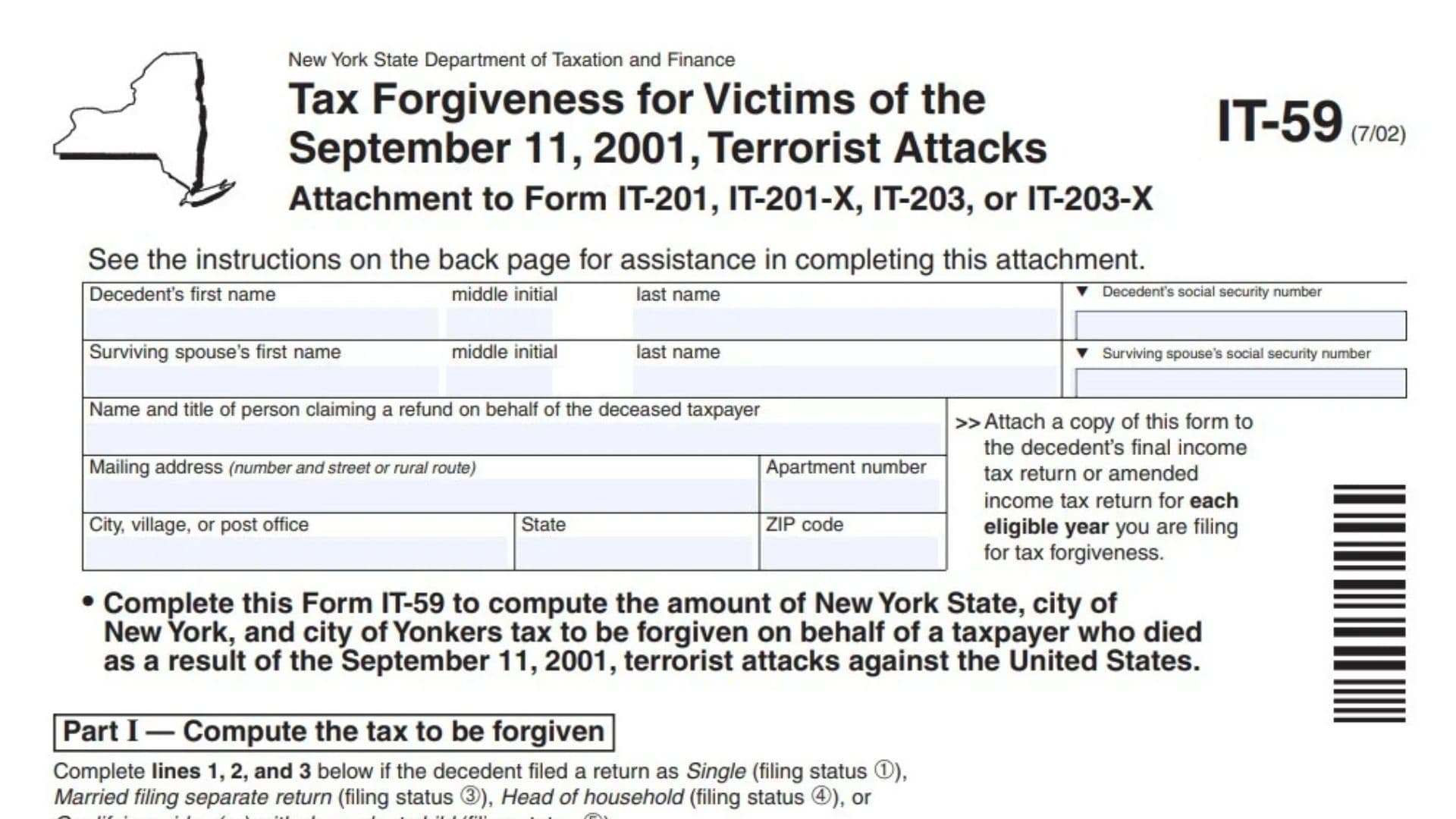
New York Form IT-59, officially titled Tax Forgiveness for Victims of the September 11, 2001, Terrorist Attacks, is a tax attachment issued by the New York State Department of Taxation and Finance. It was created under Chapter 85 of the Laws of 2002 to provide tax relief for individuals who died as a result of the September 11, 2001, terrorist attacks against the United States. The form allows an eligible person to calculate the New York State, New York City, and Yonkers income taxes that may be forgiven on behalf of a deceased taxpayer for the eligible tax years 2000 and 2001. It is not a separate income tax return. Instead, Form IT-59 must be attached to the deceased taxpayer’s original or amended New York personal income tax return for each eligible year for which tax forgiveness is being claimed. The form accommodates different filing statuses, including single, married filing separately, head of household, qualifying widow(er) with a dependent child, and married filing jointly. Depending on the deceased taxpayer’s filing status, the person claiming the relief must complete either Part I or Part II. Part I calculates the total tax to be forgiven by adding the deceased taxpayer’s New York State income tax and applicable New York City and Yonkers taxes. Part II applies when the deceased taxpayer filed a joint return and requires separate calculations of the deceased taxpayer’s and surviving spouse’s taxable income and tax liabilities. It then determines the deceased taxpayer’s proportionate share of the total tax reported on the joint return. Form IT-59 also collects identifying information about the deceased taxpayer, surviving spouse, and individual claiming the refund. Completing the attachment accurately is important because the calculated amount determines the tax reduction or refund that the New York State Tax Department may allow. For amended returns, the calculated tax forgiveness amount must be reported as a decrease in tax on the appropriate amended return. For original returns, the amount is not transferred to the original return because the Tax Department determines the refund. The form covers only the historical eligible years 2000 and 2001 and must be submitted with the corresponding eligible income tax return.
Who Can Use Form IT-59?
Form IT-59 is intended for individuals claiming tax forgiveness on behalf of a deceased taxpayer who died as a result of the September 11, 2001, terrorist attacks.
The tax relief applies to eligible New York income tax liabilities for:
- First Eligible Year: 2000.
- Second Eligible Year: 2001.
The form can be used when the deceased taxpayer filed an eligible New York income tax return and the person responsible for handling the deceased taxpayer’s tax affairs is claiming the applicable tax forgiveness.
Eligible Filing Statuses
The form provides two different calculation methods depending on the deceased taxpayer’s filing status.
Part I: Individual Filing Statuses
Complete Part I if the deceased taxpayer filed as:
- Single, filing status 1.
- Married filing separately, filing status 3.
- Head of household, filing status 4.
- Qualifying widow(er) with dependent child, filing status 5.
Part II: Married Filing Jointly
Complete Part II if the deceased taxpayer filed a joint income tax return with a surviving spouse, using filing status 2.
Part II determines the deceased taxpayer’s share of the total tax reported on the joint return.
Special Situation: Both Spouses Deceased
If both spouses died and filed a joint return for an eligible year, complete Part I using the total tax amounts reported on the joint return.
How To File Form IT-59
Form IT-59 must be attached to the deceased taxpayer’s applicable New York State personal income tax return.
The form identifies four possible accompanying returns:
- Form IT-201: Resident Income Tax Return.
- Form IT-201-X: Amended Resident Income Tax Return.
- Form IT-203: Nonresident and Part-Year Resident Income Tax Return.
- Form IT-203-X: Amended Nonresident and Part-Year Resident Income Tax Return.
You must attach a completed Form IT-59 to the applicable original or amended return for each eligible tax year for which you are claiming tax forgiveness.
Original Returns Versus Amended Returns
The procedure for reporting the calculated tax forgiveness depends on whether you are filing an original return or an amended return.
When Filing an Original Return
If you are filing an original Form IT-201 or Form IT-203 on behalf of the deceased taxpayer, do not transfer the amount calculated on Form IT-59 to the original return.
The New York State Tax Department will determine the amount of tax to be forgiven and the applicable refund.
When Filing an Amended Return
If you are filing Form IT-201-X or Form IT-203-X, transfer the applicable tax forgiveness amount from Form IT-59 to the amended return.
Enter the amount as a decrease in the Increase or decrease column and place the decrease amount in brackets.
The Tax Department will review the amended return and determine the amount to be refunded.
Information To Prepare Before Filing
Gather the following information before completing Form IT-59:
- The deceased taxpayer’s full legal name.
- The deceased taxpayer’s Social Security number.
- The surviving spouse’s name and Social Security number, if applicable.
- The name and title of the person claiming the refund.
- The claimant’s complete mailing address.
- The deceased taxpayer’s 2000 income tax return, if claiming relief for 2000.
- The deceased taxpayer’s 2001 income tax return, if claiming relief for 2001.
- The applicable New York State income tax amounts.
- New York City and Yonkers income tax amounts, when applicable.
- The surviving spouse’s income and tax information when completing Part II.
- The applicable tax information from Form IT-200, IT-201, or IT-203.
If the deceased taxpayer previously filed Form IT-100 for 2000 or 2001, use the statement sent by the Tax Department showing the calculation of total tax.

How To Complete Form IT-59
Form IT-59 contains taxpayer identification fields, a refund claimant information section, Part I for individual filing statuses, and Part II for married filing jointly.
Complete the identification information first. Then select the calculation method that corresponds to the deceased taxpayer’s filing status.
The form provides separate columns for the first eligible year, 2000, and the second eligible year, 2001.
Enter the applicable amounts in the corresponding year columns.
Taxpayer And Claimant Information
Decedent’s First Name
Enter the deceased taxpayer’s first legal name as shown on the applicable income tax return.
Decedent’s Middle Initial
Enter the deceased taxpayer’s middle initial, if applicable.
Decedent’s Last Name
Enter the deceased taxpayer’s complete last name.
Decedent’s Social Security Number
Enter the deceased taxpayer’s Social Security number in the designated field.
Verify that the number matches the deceased taxpayer’s income tax records.
Surviving Spouse’s First Name
If the deceased taxpayer filed jointly, enter the surviving spouse’s first name.
Surviving Spouse’s Middle Initial
Enter the surviving spouse’s middle initial, if applicable.
Surviving Spouse’s Last Name
Enter the surviving spouse’s complete last name.
Surviving Spouse’s Social Security Number
Enter the surviving spouse’s Social Security number when applicable.
Name and Title of Person Claiming a Refund
Enter the full name and official title of the individual claiming the tax forgiveness or refund on behalf of the deceased taxpayer.
This identifies the person responsible for submitting the claim.
Mailing Address
Enter the complete mailing address of the person claiming the refund.
Include the street number and street name or rural route.
The Tax Department uses this address to mail the refund check when applicable.
Apartment Number
If the claimant’s mailing address includes an apartment number, enter it in the designated space.
Leave it blank if it does not apply.
City, Village, or Post Office
Enter the city, village, or post office associated with the claimant’s mailing address.
State
Enter the two-letter abbreviation for the claimant’s state.
ZIP Code
Enter the ZIP Code associated with the mailing address.
Verify that the address is complete and accurate because it is used for refund correspondence.
Part I: Compute the Tax to Be Forgiven
Part I applies when the deceased taxpayer filed an income tax return using one of the following filing statuses:
- Single.
- Married filing separately.
- Head of household.
- Qualifying widow(er) with dependent child.
Complete lines 1, 2, and 3 separately for 2000 and 2001, depending on the eligible year for which you are claiming tax forgiveness.
Line-By-Line Instructions for Part I
Line 1: Total New York State Taxes
Enter the total New York State income taxes reported on the deceased taxpayer’s original income tax return.
Use the appropriate tax line from the corresponding year’s return.
The required line numbers depend on the type of New York income tax return filed:
- For Form IT-200, use line 21 for both 2000 and 2001.
- For Form IT-201, use line 42 for 2000 and line 44 for 2001.
- For Form IT-203, use line 48 for both 2000 and 2001.
Enter the applicable amount in the corresponding eligible-year column.
If the deceased taxpayer filed Form IT-100, use the Tax Department’s statement showing the total tax calculation.
Line 2: New York City and Yonkers Taxes
Enter the combined New York City and city of Yonkers taxes reported on the deceased taxpayer’s income tax return.
Use the applicable line number for the original return:
- For Form IT-200, use line 27 for both 2000 and 2001.
- For Form IT-201, use line 53 for 2000 and line 55 for 2001.
- For Form IT-203, use line 52 for both 2000 and 2001.
Enter the applicable amount in the corresponding eligible-year column.
If the taxpayer did not have applicable New York City or Yonkers taxes, use the amount shown on the corresponding return.
Line 3: Total Tax to Be Forgiven
Add the amounts reported on lines 1 and 2.
The calculation is:
Line 1 + Line 2 = Line 3
Complete this calculation separately for 2000 and 2001.
The result represents the total tax eligible for forgiveness under Part I.
If Filing an Amended Return
If you are filing Form IT-201-X or Form IT-203-X, transfer the amount from line 3 to:
- Form IT-201-X, line 26.
- Form IT-203-X, line 53.
Enter the amount as a decrease in the Increase or decrease column and place the decrease in brackets.
The Tax Department will determine the amount to be refunded.
If Filing an Original Return
If you are filing an original Form IT-201 or Form IT-203, do not transfer the amount from line 3 to the original return.
The Tax Department will determine the tax forgiveness and refund amount.
Part II: Compute the Tax to Be Forgiven
Part II applies when the deceased taxpayer filed a married filing jointly income tax return.
This section calculates the deceased taxpayer’s individual tax liability as if the spouses had filed separate returns. It then determines the deceased taxpayer’s share of the total tax reported on the joint return.
Complete lines 4 through 11 for each eligible year.
Calculating Separate Income and Tax
Before completing the calculations, use Form IT-201 or Form IT-203 and the corresponding instructions to determine each spouse’s taxable income separately.
Allocate income, deductions, and New York additions and subtraction modifications in the same manner they would have been allocated if the spouses had filed separate returns.
Follow these allocation rules:
- Wages and Salaries: Allocate wages and salaries to the spouse who performed the services and received the corresponding Form W-2.
- Business and Investment Income: Generally allocate income, including capital gains, to the spouse who owned the business or investment that generated the income.
- Jointly Owned Businesses or Investments: Allocate the income equally between the spouses unless evidence supports a different allocation.
- Business Deductions: Allocate business deductions to the spouse who owned the business.
- Personal Deductions: Allocate personal deductions, including itemized deductions for mortgage interest and taxes, equally between the spouses unless evidence supports a different allocation.
These allocation rules are important because Part II must reflect the income and tax that each spouse would have reported on a separate return.
Line-By-Line Instructions for Part II
Line 4: Decedent’s Taxable Income
Enter the deceased taxpayer’s taxable income calculated as if a separate income tax return had been filed.
Use Form IT-201 or Form IT-203 and the applicable instructions to calculate the amount.
Allocate income, deductions, and New York additions and subtraction modifications to the deceased taxpayer according to the separate-return allocation rules.
Enter the result in the applicable year column.
Line 5: Decedent’s Total Tax
Enter the deceased taxpayer’s total New York income tax calculated as if a separate return had been filed.
Use the taxable income from line 4 to determine the tax.
When calculating the amount, use the Single or Married filing separately column in the applicable New York State and City of New York tax tables.
For Form IT-201, use the New York State and City of New York Tax Tables in Form IT-201-I.
For Form IT-203, use the New York State Tax Table in Form IT-203-I.
Allocate any applicable credits and other taxes in the same manner they would have been allocated if the spouses had filed separate returns.
Enter the resulting tax amount.
Line 6: Surviving Spouse’s Taxable Income
Enter the surviving spouse’s taxable income calculated as if a separate income tax return had been filed.
Use Form IT-201 or Form IT-203 and the corresponding instructions.
Allocate the spouse’s income, deductions, and New York additions and subtraction modifications according to the separate-return rules.
Enter the result in the applicable year column.
Line 7: Surviving Spouse’s Total Tax
Enter the surviving spouse’s total New York income tax calculated as if a separate return had been filed.
Use the taxable income from line 6.
Apply the appropriate New York tax tables using the Single or Married filing separately column.
Allocate credits and other taxes in the same manner they would have been allocated if the spouses had filed separate returns.
Enter the resulting tax amount.
Line 8: Combined Separate Tax
Add the deceased taxpayer’s total tax on line 5 to the surviving spouse’s total tax on line 7.
The calculation is:
Line 5 + Line 7 = Line 8
Enter the combined amount.
This figure represents the total tax that both spouses would have owed if they had filed separate income tax returns.
Line 9: Total Tax From the Joint Return
Enter the total tax reported on the deceased taxpayer’s original joint income tax return.
Use the appropriate line number from the corresponding tax return:
- For Form IT-200, use line 21 for both 2000 and 2001.
- For Form IT-201, use line 42 for 2000 and line 44 for 2001.
- For Form IT-203, use line 48 for both 2000 and 2001.
If Form IT-100 was filed, use the statement sent by the Tax Department showing the total tax calculation.
Enter the amount in the applicable eligible-year column.
Line 10: Decedent’s Share of the Combined Separate Tax
Divide the deceased taxpayer’s total tax on line 5 by the combined separate tax on line 8.
The calculation is:
Line 5 ÷ Line 8 = Line 10
Carry the result to four decimal places.
Enter the calculated ratio in the appropriate year column.
This ratio represents the deceased taxpayer’s proportionate share of the combined tax calculated as if the spouses had filed separate returns.
Line 11: Total Tax to Be Forgiven
Multiply the total tax from the joint return on line 9 by the ratio calculated on line 10.
The calculation is:
Line 9 × Line 10 = Line 11
Enter the result in the applicable eligible-year column.
This amount represents the deceased taxpayer’s share of the total tax reported on the joint return and is the tax forgiveness amount calculated under Part II.
If Filing an Amended Return
If you are filing Form IT-201-X or Form IT-203-X, transfer the amount from line 11 to:
- Form IT-201-X, line 26.
- Form IT-203-X, line 53.
Enter the amount as a decrease in the Increase or decrease column and place the decrease in brackets.
The Tax Department will determine the amount to be refunded.
If Filing an Original Return
If you are filing an original Form IT-201 or Form IT-203 on behalf of the deceased taxpayer, do not transfer the amount from line 11 to the original return.
The Tax Department will determine the amount of tax forgiveness and the applicable refund.
Table 1: Previous-Year Tax Return Line References
Table 1 identifies the line numbers used to obtain the deceased taxpayer’s total New York State income tax and combined New York City and Yonkers taxes for 2000 and 2001.
Use the table to identify the correct amounts for Part I or Part II, depending on the deceased taxpayer’s filing status.
| Original Tax Return | Tax Year | Total New York State Tax | New York City and Yonkers Taxes |
|---|---|---|---|
| Form IT-200 | 2000 | Line 21 | Line 27 |
| Form IT-200 | 2001 | Line 21 | Line 27 |
| Form IT-201 | 2000 | Line 42 | Line 53 |
| Form IT-201 | 2001 | Line 44 | Line 55 |
| Form IT-203 | 2000 | Line 48 | Line 52 |
| Form IT-203 | 2001 | Line 48 | Line 52 |
Important: If the deceased taxpayer previously filed Form IT-100 for the 2000 or 2001 tax year, use the statement sent by the Tax Department showing the calculation of total tax instead of relying on the line references above.
Important Filing Instructions
Submit Form IT-59 for Each Eligible Year
Form IT-59 must accompany the applicable original or amended income tax return for each eligible year for which tax forgiveness is claimed.
The two eligible years are 2000 and 2001.
Make sure the amounts entered on the attachment correspond to the correct tax year.
Understand the Difference Between Part I and Part II
Do not complete both calculation sections simply because the form contains two parts.
- Complete Part I for Single, Married filing separately, Head of household, and Qualifying widow(er) with dependent child filing statuses.
- Complete Part II for Married filing jointly returns.
- If both spouses died and filed a joint return for an eligible year, use Part I with the total tax amounts from the joint return.
Use the Correct Amended Return Lines
When claiming tax forgiveness through an amended return, use the correct destination line:
- Form IT-201-X, line 26.
- Form IT-203-X, line 53.
Report the applicable amount as a decrease in the Increase or decrease column and place the decrease in brackets.
Filing Location
Form IT-59 does not provide a separate mailing address for submission.
The form directs taxpayers to consult the applicable New York tax relief filing instructions to determine where to send the original or amended personal income tax return claiming the relief.
Where To Get Help With Form IT-59
The New York State Department of Taxation and Finance provides telephone and online assistance for tax-related questions.
The form lists the following contact numbers:
| Type of Assistance | Telephone Number |
|---|---|
| Tax Information | 1-800-225-5829 |
| Forms and Publications | 1-800-462-8100 |
| Refund Status | 1-800-443-3200 |
| Electronically Filed Returns | 1-800-353-0708 |
| Direct Deposit Refunds | 1-800-321-3213 |
| Calls From Outside the U.S. and Canada | (518) 485-6800 |
| Fax-on-Demand Forms | 1-800-748-3676 |
| Hearing and Speech Impaired (TDD) | 1-800-634-2110 |
Online Assistance
Visit the New York State Department of Taxation and Finance website for tax information and forms:
The website also provides access to estimated tax account information, including balance checks and account reconciliation.
Final Review Before Filing
Before submitting Form IT-59 with the applicable New York income tax return, review the following checklist to make sure all required information and calculations are complete.
Taxpayer and Claimant Information
- Enter the deceased taxpayer’s first name, middle initial, and last name.
- Verify the deceased taxpayer’s Social Security number.
- Enter the surviving spouse’s name and Social Security number, if applicable.
- Provide the name and title of the person claiming the refund.
- Enter the complete mailing address.
- Verify the apartment number, if applicable.
- Enter the city, state, and ZIP Code.
- Confirm that the mailing address is correct for refund correspondence.
Part I: Individual Filing Status
- Confirm that the deceased taxpayer filed as Single, Married filing separately, Head of household, or Qualifying widow(er) with dependent child.
- Enter the correct New York State income tax amount on line 1.
- Enter the applicable New York City and Yonkers taxes on line 2.
- Verify the original return line numbers using Table 1.
- Add lines 1 and 2 correctly on line 3.
- Complete the appropriate column for 2000 or 2001.
Part II: Married Filing Jointly
- Confirm that the deceased taxpayer filed a joint return.
- Calculate the deceased taxpayer’s separate taxable income on line 4.
- Calculate the deceased taxpayer’s separate total tax on line 5.
- Calculate the surviving spouse’s separate taxable income on line 6.
- Calculate the surviving spouse’s separate total tax on line 7.
- Add lines 5 and 7 on line 8.
- Enter the total tax from the joint return on line 9.
- Divide line 5 by line 8 on line 10.
- Carry the line 10 result to four decimal places.
- Multiply line 9 by line 10 on line 11.
- Apply the correct income and deduction allocation rules.
- Use the appropriate Single or Married filing separately tax table when calculating separate tax liabilities.
Tax Return and Submission
- Confirm that the claim relates to the eligible tax year 2000 or 2001.
- Attach Form IT-59 to the applicable Form IT-201, IT-201-X, IT-203, or IT-203-X.
- Submit a separate attachment for each eligible year being claimed.
- If filing an amended return, transfer the applicable Part I or Part II amount to the correct amended return line.
- Enter the decrease in the Increase or decrease column and place it in brackets.
- If filing an original return, do not transfer the calculated forgiveness amount to the original return.
- Confirm that the correct filing instructions are followed for the accompanying return.
- Retain copies of the completed tax forms and supporting tax records.
Correctly completing New York Form IT-59 helps eligible individuals claim the tax forgiveness available for deceased victims of the September 11, 2001, terrorist attacks. Carefully identify the deceased taxpayer, use the appropriate calculation method, verify the historical tax return amounts, and attach the completed form to the corresponding original or amended New York income tax return for each eligible year.