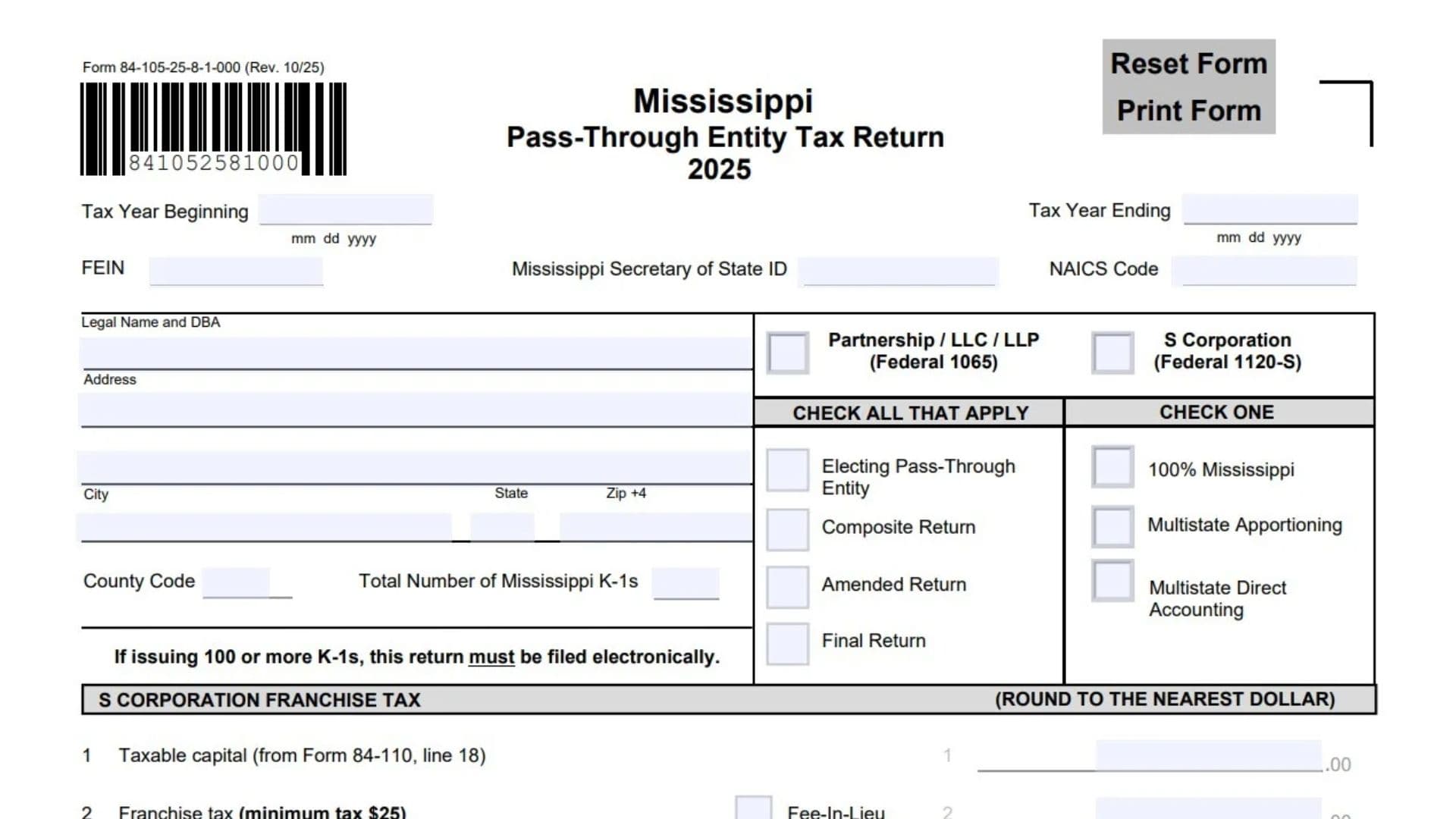
Mississippi Form 84-105, officially titled Pass-Through Entity Tax Return, is a tax return issued by the Mississippi Department of Revenue for qualifying pass-through entities, including partnerships, limited liability companies (LLCs), limited liability partnerships (LLPs), and S corporations. The 2025 form is used to report applicable Mississippi franchise tax, composite income tax, and electing pass-through entity income tax liabilities. It allows qualifying businesses to report their taxable capital, Mississippi net taxable income, available tax credits, estimated tax payments, previous-year overpayments, and any additional amounts owed. The return also provides information about the business structure, Mississippi operations, ownership, related pass-through entities, qualified Subchapter S subsidiaries, and disregarded entities. Depending on the entity’s tax status, the business may need to complete the S Corporation Franchise Tax section, the Composite or Electing Pass-Through Entity Income Tax section, or both. The form also includes calculations for total payments, outstanding tax balances, overpayments, refunds, and amounts credited toward the following tax year. Additional sections collect information about amended or final returns, business activities, IRS audits, entity investments, responsible officers, and paid tax preparers. Completing Form 84-105 accurately is important because it determines the entity’s Mississippi tax obligations and ensures that applicable payments, credits, and adjustments are properly reported. Businesses issuing 100 or more Mississippi Schedule K-1s must file this return electronically. The 2025 version also includes separate schedules for pass-through investments, qualified Subchapter S subsidiaries, disregarded entities, and entity officer information.
Who Needs to File Form 84-105?
Form 84-105 is intended for qualifying pass-through entities that must report applicable Mississippi franchise tax or income tax obligations.
The form identifies the following business classifications:
- Partnerships: Entities filing federal Form 1065.
- Limited Liability Companies (LLCs): Entities classified as partnerships for federal tax purposes or otherwise subject to the applicable Mississippi pass-through entity filing requirements.
- Limited Liability Partnerships (LLPs): Qualifying partnerships subject to Mississippi reporting requirements.
- S Corporations: Entities filing federal Form 1120-S.
The return also provides options for entities filing as:
- Electing Pass-Through Entities.
- Composite Returns.
- Amended Returns.
- Final Returns.
The applicable filing requirements depend on the entity’s federal classification, Mississippi activities, and tax elections.
How To File Form 84-105
Form 84-105 is submitted to the Mississippi Department of Revenue. The completed return should include the applicable schedules, supporting tax calculations, and required attachments.
The form provides the following mailing address:
Mississippi Department of Revenue
P.O. Box 23191
Jackson, MS 39225-3191
Electronic Filing Requirement
If your entity issues 100 or more Mississippi Schedule K-1s, you must file Form 84-105 electronically. The form specifically identifies this requirement in its entity information section.
Information To Prepare Before Filing
Gather the following information before completing the return:
- Federal Employer Identification Number (FEIN).
- Mississippi Secretary of State identification number.
- North American Industry Classification System (NAICS) code.
- Legal business name and DBA, if applicable.
- Complete business mailing address.
- Mississippi county code.
- Total number of Mississippi K-1s issued.
- Federal tax classification.
- Mississippi taxable capital information.
- Mississippi net taxable income.
- Franchise tax and income tax credit information.
- Estimated tax payments and extension payments.
- Previous-year overpayments.
- Information about pass-through entities in which the business invested.
- Information about qualified Subchapter S subsidiaries and disregarded entities.
- Names and ownership information of responsible officers, directors, owners, or partners.
You may also need the following supporting forms:
- Form 84-110, for taxable capital information.
- Form 84-122, for Mississippi net taxable income.
- Form 84-401, for franchise tax and income tax credits.
- Form 84-161, for credit involving tax paid on an electing pass-through entity tax return.
- Form 83-305, for interest and penalty on underestimated income tax payments.
- Form 80-320, when applicable to composite partnerships.

How To Complete Form 84-105
Form 84-105 contains the main tax calculation section, entity information, pass-through entity schedules, subsidiary information, officer details, and signature section.
Complete the identification information first, then calculate the applicable taxes and payments before moving to the additional schedules.
Taxpayer And Entity Identification Information
Tax Year Beginning
Enter the beginning date of the entity’s tax year using the MMDDYYYY format.
For calendar-year entities, enter January 1, 2025. Fiscal-year entities should enter the actual beginning date of their applicable reporting period.
Tax Year Ending
Enter the ending date of the tax year covered by the return.
For calendar-year entities, this will generally be December 31, 2025. Fiscal-year entities should enter their applicable fiscal-year ending date.
FEIN
Enter the federal Employer Identification Number assigned to the business.
Verify that the number belongs to the entity filing Form 84-105.
Mississippi Secretary of State ID
Enter the identification number assigned to the business by the Mississippi Secretary of State, when applicable.
NAICS Code
Enter the North American Industry Classification System code that identifies the entity’s principal business activity.
Use the appropriate code for the business’s actual operations.
Legal Name and DBA
Enter the entity’s complete legal business name.
If the business operates under a Doing Business As (DBA) name, include that name as applicable.
Entity Classification
Mark the appropriate checkbox to identify the entity’s federal tax classification.
- Partnership / LLC / LLP (Federal 1065): Select this option for an entity filing federal Form 1065.
- S Corporation (Federal 1120-S): Select this option for an entity filing federal Form 1120-S.
Choose the classification that corresponds to the entity’s federal income tax filing.
Address
Enter the complete mailing address of the business, including the street number and street name.
City
Enter the city where the business receives its official correspondence.
State
Enter the two-letter state abbreviation for the mailing address.
ZIP +4
Enter the ZIP Code and additional four-digit extension associated with the business address, when applicable.
County Code
Enter the applicable Mississippi county code associated with the entity’s business location.
Total Number of Mississippi K-1s
Enter the total number of Mississippi Schedule K-1s issued by the entity for the tax year.
Remember that entities issuing 100 or more Mississippi K-1s must file the return electronically.
Entity Filing Status And Elections
The form contains two groups of checkboxes. The first group allows multiple selections, while the second group requires only one selection.
Electing Pass-Through Entity
Mark this box if the entity is filing as an electing pass-through entity for Mississippi tax purposes.
This identifies the entity’s election status for the income tax calculation section.
Composite Return
Mark this box if the entity is filing a composite return for qualifying nonresident owners or members.
This identifies the composite income tax filing treatment.
Amended Return
Mark this box if the return is being submitted to correct or update a previously filed Form 84-105.
Complete Part I, line 3, to explain the reason for the amendment.
Final Return
Mark this box if the entity is filing its final Mississippi pass-through entity tax return.
Complete Part I, line 1, to provide the reason and effective date.
100% Mississippi
Select this option if the entity uses the 100% Mississippi allocation treatment.
Multistate Apportioning
Select this option if the entity conducts business in multiple states and uses apportionment to determine its Mississippi income.
Multistate Direct Accounting
Select this option if the entity uses direct accounting to determine its Mississippi income rather than multistate apportionment.
Mark only one of these three options.
S Corporation Franchise Tax
This section applies to S corporations subject to Mississippi franchise tax. The form instructs taxpayers to round the amounts in this section to the nearest dollar.
Line 1: Taxable Capital
Enter the entity’s taxable capital calculated on Form 84-110, line 18.
Use the amount from the supporting franchise tax calculation rather than independently estimating the taxable capital.
Line 2: Franchise Tax
Enter the franchise tax amount calculated for the entity.
The form identifies a minimum franchise tax of $25.
If the Fee-In-Lieu option applies, mark the corresponding checkbox beside line 2 and report the applicable amount.
Line 3: Franchise Tax Credit
Enter the franchise tax credit reported on Form 84-401, line 1.
Use the amount established on the supporting credit form.
Line 4: Net Franchise Tax Due
Subtract line 3 from line 2.
The calculation is:
Line 2 − Line 3 = Line 4
Enter the remaining franchise tax liability.
If the available franchise tax credit is greater than the franchise tax amount, follow the applicable Mississippi credit instructions.
Composite / Electing Pass-Through Entity Income Tax
This section calculates the Mississippi income tax liability associated with a composite return or an electing pass-through entity.
Line 5: Mississippi Net Taxable Income
Enter the Mississippi net taxable income reported on Form 84-122.
Use the appropriate line based on the entity’s filing status:
- Composite Return: Form 84-122, line 32.
- Electing Pass-Through Entity: Form 84-122, line 35.
Make sure the amount corresponds to the election or return type selected in the identification section.
Line 6: Income Tax
Enter the applicable Mississippi income tax calculated on the taxable income reported on line 5.
Use the applicable Mississippi income tax computation and supporting calculations to determine the amount.
Line 7: Income Tax Credits
Enter the income tax credits reported on Form 84-401, line 3.
Include the applicable credits determined through the supporting credit schedule.
Line 8: Net Income Tax Due
Subtract line 7 from line 6.
The calculation is:
Line 6 − Line 7 = Line 8
Enter the remaining income tax liability after applying the available income tax credits.
Payments And Tax Due
This section combines the franchise tax and income tax liabilities with previous payments, estimated payments, and applicable credits.
It determines whether the entity has an outstanding balance or an overpayment.
Line 9: Total Franchise Tax and/or Income Tax
Add line 4 and line 8.
The calculation is:
Line 4 + Line 8 = Line 9
For S corporations, include the applicable franchise tax. For composite or electing pass-through entities, include the applicable income tax.
This line represents the total tax liability before payments and credits reported in the payment section.
Line 10: Overpayments From Prior Year
Enter any overpayment from the previous tax year that was credited toward the current year’s Mississippi tax liability.
Use the amount established on the previous year’s return.
Line 11: Estimated Tax Payments and Payment With Extension
Enter the total estimated tax payments made during the tax year, together with any payment submitted with an extension.
Include the applicable payments credited to the entity’s current tax account.
Line 12: Credit for Tax Paid on an Electing Pass-Through Entity Tax Return
Enter the credit for tax paid on an electing Pass-Through Entity Tax Return.
Use the amount from Form 84-161, line 3D.
You must attach the Schedule K-1 forms received from the electing pass-through entities to support this credit.
Line 13: Total Payments
Add the amounts reported on lines 10, 11, and 12.
The calculation is:
Line 10 + Line 11 + Line 12 = Line 13
Enter the combined amount.
This represents the total payments and credits available to reduce the entity’s tax liability.
Line 14: Net Total Franchise Tax and/or Income Tax
Subtract line 13 from line 9.
The calculation is:
Line 9 − Line 13 = Line 14
Enter the difference.
A positive amount generally indicates that additional tax remains due before applicable interest and penalties. A negative amount may indicate an overpayment.
Line 15: Interest and Penalty on Underestimated Income Tax Payments
Enter the interest and penalty associated with underestimated income tax payments.
Use the applicable amount from:
- Form 83-305, line 19; or
- Form 80-320, line 11, for composite partnerships only.
Follow the applicable instructions to determine which supporting form applies to your entity.
Line 16: Late Payment Interest
Enter any interest due because the entity did not pay the required tax by the applicable payment deadline.
Use the applicable Mississippi interest calculation for the tax period.
Line 17: Late Payment Penalty
Enter the late payment penalty, if applicable.
This amount relates to tax payments that were not made by the required deadline.
Line 18: Late Filing Penalty
Enter the applicable late filing penalty, if the return is filed after the required deadline.
The form identifies a minimum income tax penalty of $100.
Follow the applicable Mississippi filing instructions when determining the penalty.
Line 19: Total Balance Due
Complete this line when line 9 is greater than line 13.
Add the amounts reported on lines 14, 15, 16, 17, and 18.
The calculation is:
Line 14 + Line 15 + Line 16 + Line 17 + Line 18 = Line 19
Enter the resulting total balance due.
Line 20: Total Overpayment
Complete this line when line 13 is greater than the combined amounts on line 9 and line 15.
Subtract line 9 and line 15 from line 13.
The calculation is:
Line 13 − Line 9 − Line 15 = Line 20
Enter the resulting overpayment.
Line 21: Overpayment Credited to Next Year
Enter the portion of the overpayment from line 20 that you want credited toward the following tax year.
This amount will be applied to the entity’s next-year tax account.
Line 22: Overpayment to Be Refunded
Subtract line 21 from line 20.
The calculation is:
Line 20 − Line 21 = Line 22
Enter the remaining overpayment requested as a refund.
The amount represents the portion of the overpayment that is not being carried forward to the next tax year.
Part I: Entity Information
Part I collects additional information about the entity’s legal status, business activities, ownership changes, tax elections, and contact details.
Complete each item according to the entity’s records.
Line 1: Final Return Reason and Effective Date
If you marked the Final Return checkbox in the identification section, explain why the entity is filing its final return.
Enter the effective date of the event that caused the entity to stop filing Mississippi pass-through entity returns.
Line 2: Entity Sale, Merger, Incorporation, QSSS Election, or SMLLC Conversion
Complete this section if the entity has been:
- Sold.
- Merged with another entity.
- Incorporated.
- Elected to become a Qualified Subchapter S Subsidiary (QSSS).
- Converted to a Single-Member LLC (SMLLC).
Enter the name and address of the new or existing corporation, the parent of the QSSS, or the owner of the SMLLC, as applicable.
Also enter the FEIN of the applicable new or existing corporation, parent entity, or SMLLC owner.
Line 3: Reason for Amended Return
If you marked the Amended Return checkbox, identify the reason for submitting the corrected return.
The form provides three choices:
- Mississippi Correction: Select this option when correcting information related to Mississippi tax reporting.
- Federal Correction: Select this option when the amendment results from a federal tax correction.
- Other: Select this option when the amendment is being made for another reason and provide an explanation in the space provided.
Choose the applicable reason.
Line 4: Federal Election to File as a Corporation
This question applies to partnerships and LLCs.
Select Yes if the entity has made a federal election to be taxed as a corporation.
Select No if no such federal election has been made.
Line 5: IRS Audit Information
Mark the checkbox if the company has been audited by the Internal Revenue Service (IRS).
If the entity has been audited, enter the tax year or years involved in the audit.
Provide the applicable years rather than entering the current year automatically.
Line 6: Principal Business Activity in Mississippi
Describe the entity’s primary business activity conducted in Mississippi.
Provide a clear description of the main activity that generates the entity’s business operations.
Line 6a: County Location in Mississippi
Enter the Mississippi county where the entity’s principal business activity is located.
Use the appropriate county name corresponding to the business location.
Line 7: Principal Product or Service in Mississippi
Describe the main product sold or service provided by the entity in Mississippi.
Keep the description specific enough to identify the business’s primary commercial offering.
Line 8: Contact Person for This Return
Enter the name of the individual responsible for handling questions about the submitted return.
This person should be familiar with the entity’s tax information and filing details.
Line 8a: Location and Phone Number
Enter the location and telephone number where the contact person can be reached.
Provide accurate contact information so the Mississippi Department of Revenue can communicate with the appropriate representative.
Part II: Pass-Through Entity Schedule
Part II identifies other pass-through entities in Mississippi in which the reporting S corporation or partnership invested during the tax year.
List every applicable pass-through entity in which the reporting business held an investment during the reporting period.
The schedule provides four columns.
Entity Name
Enter the legal name of each Mississippi pass-through entity in which the reporting business invested.
Provide a separate entry for each entity.
FEIN
Enter the federal Employer Identification Number of the pass-through entity listed in the corresponding row.
Verify the number against the entity’s tax documents.
Address
Enter the complete business address of the pass-through entity.
Include the street address, city, state, and ZIP Code.
Entity Type
Identify the legal or federal tax classification of the pass-through entity.
Examples may include a partnership, LLC, LLP, or S corporation, as applicable.
If you have more entities to report than the available rows allow, attach additional schedules using Form 84-105, page 4.
Part III: Q-Subs / Disregarded Entity Schedule
Part III is used to identify all qualified Subchapter S subsidiaries (Q-Subs) and disregarded entities associated with the reporting entity.
List each applicable subsidiary or disregarded entity, including its identification and Mississippi operating information.
The schedule provides four columns.
Entity Name
Enter the legal name of each qualified Subchapter S subsidiary or disregarded entity.
List each entity separately.
FEIN
Enter the federal Employer Identification Number associated with the subsidiary or disregarded entity.
Address
Enter the complete address of the listed entity.
Include the street address, city, state, and ZIP Code.
Mississippi Operations (Y/N)
Indicate whether the listed entity conducts operations in Mississippi.
Enter Y for Yes or N for No.
If there are more subsidiaries or disregarded entities than the available spaces allow, continue the schedule using Form 84-105, page 4.
Part IV: Entity Officer Information
Part IV collects information about the individuals responsible for the entity’s financial management.
The form requires the reporting entity to list owners, officers, directors, or partners who have responsibility for the organization’s fiscal management.
The schedule contains four columns.
Officer Name and Title
Enter the full name and official title of each individual with financial management responsibility.
Examples may include an owner, president, chief financial officer, director, or managing partner, depending on the entity’s organizational structure.
SSN
Enter the Social Security number of the individual identified in the corresponding row.
Make sure the number is accurate and associated with the correct person.
Address
Enter the complete mailing address of each listed officer, owner, director, or partner.
Ownership Percentage
Enter the individual’s ownership percentage in the entity, when applicable.
Provide the appropriate percentage for each person listed.
Complete all applicable rows. If the available spaces are insufficient, follow the applicable supplemental schedule instructions.
Return Discussion Authorization and Declaration
Check Box If Return May Be Discussed With Preparer
Mark this checkbox if you authorize the Mississippi Department of Revenue to discuss the return with the paid preparer.
This permission allows the department to communicate with the preparer about the submitted return.
Leave the box unmarked if you do not authorize this discussion.
Taxpayer Declaration
The declaration confirms that the responsible individual has examined the return, including the accompanying schedules and statements, and believes that the information is true, correct, and complete.
It also explains that a paid preparer’s declaration is based on the information available to that preparer.
Read the declaration carefully before signing.
Officer Signature and Title
The authorized officer must sign the return and enter their official title.
The signature confirms that the individual accepts responsibility for the accuracy of the reported information.
Date
Enter the date the authorized officer signs the return.
Business Phone
Enter the entity’s business telephone number where the responsible individual or business representative can be reached.
Paid Preparer Information
If a tax professional prepares the return on behalf of the entity, complete the applicable paid preparer fields.
Paid Preparer Signature
The individual who prepared the return must sign this field.
Date
Enter the date the paid preparer signs the return.
Paid Preparer Address
Enter the business mailing address of the tax preparer.
Paid Preparer PTIN
Enter the Preparer Tax Identification Number assigned to the individual who prepared the return.
Paid Preparer Phone
Enter the preparer’s business telephone number.
City
Enter the city associated with the preparer’s business address.
State
Enter the two-letter state abbreviation for the preparer’s address.
ZIP Code
Enter the ZIP Code associated with the preparer’s business address.
Page 4: Supplemental Pass-Through Entity Schedule
Page 4 is used when the reporting entity needs additional space to complete Part II or Part III.
Use this page when the available rows on the main return are insufficient to list all applicable entities.
Enter the entity’s FEIN at the top of the supplemental page and complete only the schedules that require additional entries.
Supplemental Pass-Through Entity Schedule
This section continues Part II from page 2.
Entity Name
Enter the legal name of each additional Mississippi pass-through entity in which the reporting S corporation or partnership invested during the tax year.
FEIN
Enter the federal Employer Identification Number of the additional pass-through entity.
Address
Provide the complete address of the additional entity, including its street address, city, state, and ZIP Code.
Entity Type
Identify the entity’s classification, such as a partnership, LLC, LLP, or S corporation, as applicable.
Make sure these entries continue the information reported in Part II rather than repeating entities already listed.
Supplemental Q-Subs / Disregarded Entity Schedule
This section continues Part III from page 3.
Entity Name
Enter the name of each additional qualified Subchapter S subsidiary or disregarded entity.
FEIN
Enter the corresponding federal Employer Identification Number.
Address
Provide the complete address of each additional entity.
Mississippi Operations (Y/N)
Indicate whether each additional entity conducts business operations in Mississippi.
Enter Y for Yes or N for No.
Supplemental Page Number
Supplemental Page ___ of ___
Enter the page number of the supplemental schedule and the total number of supplemental pages submitted.
For example, if you submit three supplemental pages, identify them in their appropriate sequence as page 1 of 3, page 2 of 3, and page 3 of 3.
Keep the entity information consistent across all supplemental pages.
Important Filing And Calculation Considerations
S Corporation Franchise Tax Versus Income Tax
The return contains separate tax calculation sections for franchise tax and income tax.
S corporations complete the applicable franchise tax calculations. Composite returns and electing pass-through entities complete the applicable income tax calculations.
The total tax liability is brought together on line 9 before payments and credits are applied.
Reporting Pass-Through Tax Credits
If the entity claims a credit for tax paid on an electing pass-through entity tax return, the amount must be supported by Form 84-161, line 3D.
The form specifically requires the entity to attach the Schedule K-1 forms received from the electing pass-through entities.
Amended And Final Returns
An amended return requires the entity to identify the reason for the correction in Part I, line 3.
A final return requires the entity to provide the reason for filing the final return and the effective date in Part I, line 1.
Make sure the appropriate identification checkbox is marked before completing the related information.
Electronic Filing Requirement
Entities issuing 100 or more Mississippi K-1s must file Form 84-105 electronically.
Do not submit a paper return if the entity meets this specific electronic filing requirement.
Final Review Before Filing
Before submitting Mississippi Form 84-105, review the following checklist to make sure all applicable sections and calculations are complete.
Entity Identification
- Enter the correct tax year beginning and ending dates.
- Verify the entity’s FEIN.
- Enter the Mississippi Secretary of State identification number.
- Provide the correct NAICS code.
- Enter the legal business name and DBA, if applicable.
- Complete the business address, city, state, and ZIP +4.
- Enter the applicable Mississippi county code.
- Report the total number of Mississippi K-1s issued.
- Select the correct federal entity classification.
- Mark all applicable filing status and election checkboxes.
- Select only one Mississippi allocation or accounting method.
Tax Calculations
- Verify taxable capital using Form 84-110, line 18.
- Complete the franchise tax calculation on lines 2 through 4, when applicable.
- Verify Mississippi net taxable income using Form 84-122.
- Calculate the applicable income tax on line 6.
- Include the correct income tax credits from Form 84-401.
- Verify the net income tax due on line 8.
- Calculate total tax liability on line 9.
- Enter previous-year overpayments on line 10.
- Include estimated payments and extension payments on line 11.
- Attach the required K-1 forms when claiming the credit on line 12.
- Verify total payments on line 13.
- Calculate net tax due or overpayment on line 14.
- Include applicable underestimated tax interest and penalties on line 15.
- Report late payment interest on line 16.
- Report late payment penalties on line 17.
- Check the late filing penalty on line 18.
- Calculate the total balance due on line 19 when applicable.
- Calculate the total overpayment on line 20 when applicable.
- Enter the amount credited to the next year on line 21.
- Calculate the refund amount on line 22.
Entity Information And Schedules
- Complete Part I, line 1, if filing a final return.
- Report applicable entity ownership changes or conversions on line 2.
- Identify the reason for an amended return on line 3.
- Answer the federal corporate election question on line 4.
- Report applicable IRS audit information on line 5.
- Describe the principal business activity and Mississippi county location.
- Enter the principal product or service.
- Provide the return contact person’s information.
- Complete Part II with all Mississippi pass-through entity investments.
- Complete Part III with all Q-Subs and disregarded entities.
- Indicate Mississippi operations for each listed subsidiary.
- Complete Part IV with responsible officers, owners, directors, or partners.
- Provide applicable ownership percentages.
- Attach additional schedules using page 4 when necessary.
- Number all supplemental pages correctly.
Signatures And Submission
- Mark the preparer discussion authorization checkbox if permission is granted.
- Obtain the authorized officer’s signature and title.
- Enter the signature date and business phone number.
- Complete paid preparer information when applicable.
- Verify the paid preparer’s PTIN and contact information.
- Confirm whether electronic filing is required.
- Attach all necessary supporting schedules and K-1 forms.
- Mail the completed return to the Mississippi Department of Revenue at the designated address when filing by mail.
- Retain a complete copy of the return and supporting records.
Accurately completing Mississippi Form 84-105 helps businesses report their franchise tax, composite income tax, or electing pass-through entity tax obligations. Review every calculation, identify all related entities, attach the required supporting schedules, and verify the signature information before submitting the 2025 return.