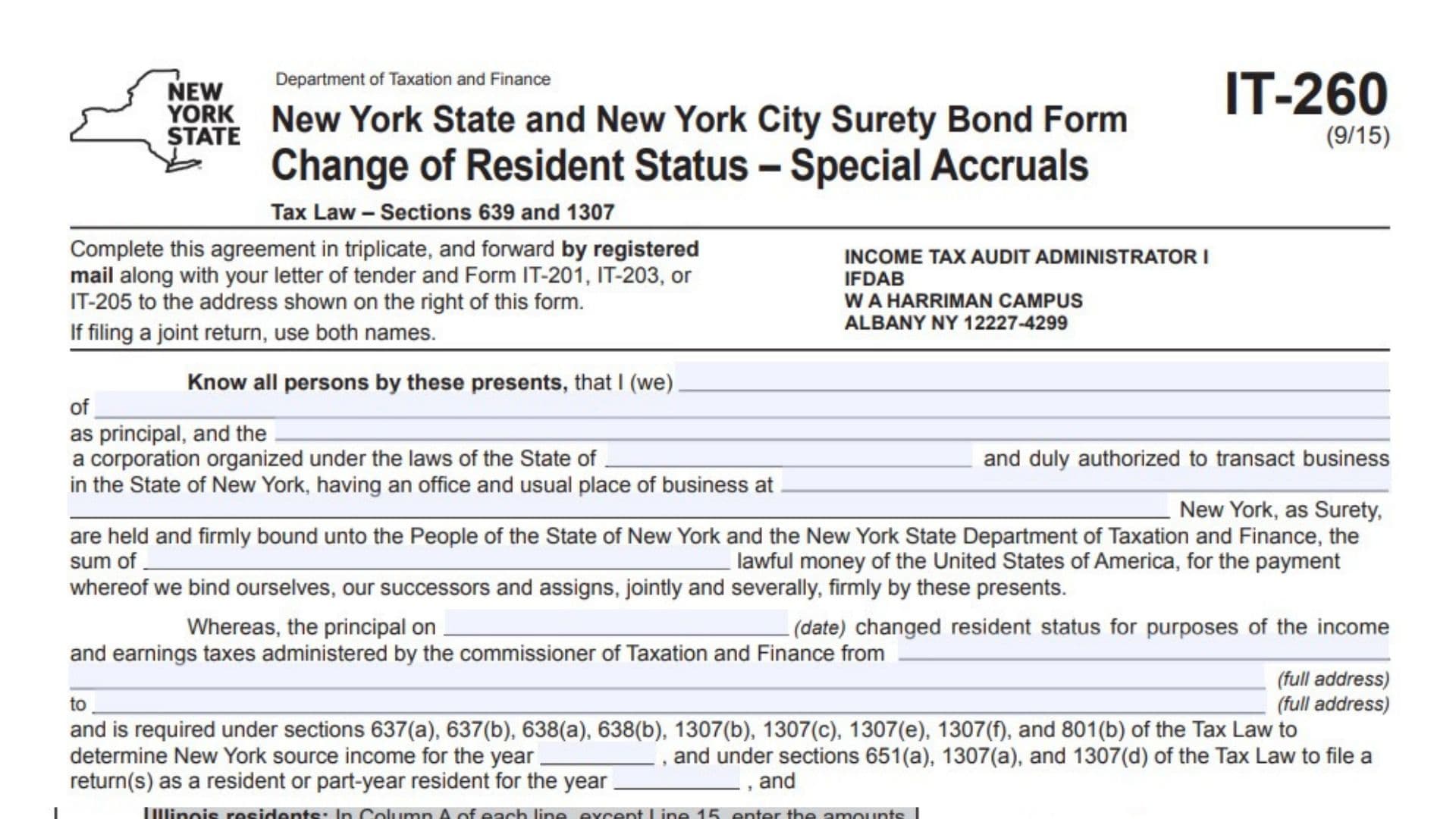
Form IT-260, titled New York State and New York City Surety Bond Form – Change of Resident Status – Special Accruals, is a legal surety bond agreement used by certain taxpayers who change their New York State or New York City residency status and elect to defer the reporting of specific income or tax items that would otherwise be included in their New York taxable income before the residency change. The form is associated with Sections 639 and 1307 of the New York Tax Law. It establishes a financial guarantee that the taxpayer, identified as the principal, will eventually pay the deferred taxes, including any applicable penalties and interest, or properly report the relevant income, gains, losses, and deductions in the applicable tax years. The agreement involves the taxpayer and a surety, which is generally a corporation authorized to conduct business in New York State. It collects information about the principal, the surety, the amount of the bond, the date and addresses associated with the residency change, the relevant tax years, and the estimated tax increase that would have occurred if the special accrual election had not been made. It also includes legally binding obligations, signatures, and acknowledgments from the principal and surety. Taxpayers use this agreement to secure future payment obligations associated with deferred income following a change in residency status. Completing Form IT-260 correctly is important because it establishes the terms of the bond and protects the New York State Department of Taxation and Finance’s ability to collect the deferred tax liability. The form must be completed in triplicate and submitted with the required letter of tender and applicable income tax return.
How To File Form IT-260
Form IT-260 must be completed and submitted to the New York State Department of Taxation and Finance using the filing procedure specified on the form.
Unlike an ordinary income tax form, IT-260 is a surety bond agreement. It requires information and signatures from both the principal and the surety.
Where to Submit Form IT-260
Complete the agreement in three copies (triplicate).
Send the completed agreement by registered mail together with:
- Your letter of tender.
- Form IT-201, IT-203, or IT-205, as applicable.
Mail the documents to:
Income Tax Audit Administrator I
IFDAB
W A Harriman Campus
Albany, NY 12227-4299
Information to Prepare Before Completing Form IT-260
Gather the following information before filling out the agreement:
- The taxpayer’s full legal name.
- The taxpayer’s address.
- The surety corporation’s legal name.
- The state under whose laws the surety corporation was organized.
- Confirmation that the surety is authorized to conduct business in New York State.
- The surety’s New York business address.
- The amount of the surety bond.
- The date the taxpayer changed residency status.
- The taxpayer’s complete previous address.
- The taxpayer’s complete new address.
- The applicable tax years.
- The estimated tax increase associated with the special accrual election.
- The names and signatures of the principal, spouse (if applicable), surety, and attorney-in-fact.
- Acknowledgments from both the principal and surety.
- The surety’s financial statement and other supporting documentation.
Important: If you are filing a joint income tax return, include both taxpayers’ names in the agreement. The form also requires acknowledgments from the principal and surety, along with the surety’s financial statement and other supporting information.

How To Complete Form IT-260
Form IT-260 contains several identification fields, legal statements, residency details, tax information, and signature requirements. Follow the instructions below to complete each section accurately.
Form Identification and Filing Instructions
Form Number: IT-260
This is the identification number of the New York State and New York City Surety Bond Form. Make sure you are completing the correct form for a change of resident status involving special accruals.
Form Revision Date: 9/15
The form displays a revision date of September 2015. This identifies the version of the document.
Tax Law References: Sections 639 and 1307
These sections identify the New York Tax Law provisions associated with the surety bond and the special accrual treatment covered by the agreement.
Triplicate Submission Requirement
Prepare three copies of the completed surety bond agreement. The form must be completed in triplicate before submission.
Registered Mail Requirement
Send the completed agreement by registered mail. Include your letter of tender and the applicable Form IT-201, IT-203, or IT-205.
Mailing Address
Enter no separate mailing address in this field. Follow the designated recipient and address printed on the form:
Income Tax Audit Administrator I
IFDAB
W A Harriman Campus
Albany, NY 12227-4299
Joint Return Name Requirement
If you are filing a joint income tax return, include both taxpayers’ names in the agreement. Make sure the names correspond to the applicable tax return.
Principal and Surety Information
This section identifies the taxpayer who is responsible for the deferred tax obligations and the surety corporation that guarantees the bond.
Principal: Full Legal Name
Enter the full legal name of the taxpayer who is entering into the surety bond agreement.
The principal is the taxpayer whose change in residency status and deferred tax obligations are covered by the agreement.
If the agreement relates to a joint return, include both spouses’ names as required.
Principal: Address
Enter the principal’s address in the designated space following the taxpayer’s name.
Use the address information applicable to the taxpayer and the residency change described in the agreement.
Surety: Corporation Name
Enter the full legal name of the surety corporation that is providing the bond.
The surety is the organization that guarantees the principal’s financial obligation under the agreement.
Surety: State of Incorporation
Enter the name of the state under whose laws the surety corporation was organized.
Use the corporation’s actual state of organization rather than assuming it is New York.
Surety: New York Authorization
The agreement requires the surety corporation to be authorized to conduct business in New York State.
Ensure that the corporation meets this requirement before completing the agreement.
Surety: Business Address
Enter the surety corporation’s office and usual place of business in New York.
Provide the complete business address in the designated space, including the city and other applicable address details.
Bond Amount
Enter the amount of money guaranteed under the surety bond.
This amount represents the financial obligation secured by the agreement. Make sure the amount is consistent with the applicable deferred tax obligation and supporting calculations.
The bond amount is expressed in lawful United States currency.
Change of Resident Status and Special Accrual Information
This section explains the principal’s change of residency, the relevant tax periods, and the reason the surety bond is required.
Residency Change Date
Enter the exact date on which the principal changed residency status for purposes of the income and earnings taxes administered by the New York State Commissioner of Taxation and Finance.
Use the actual date of the residency change.
Previous Residential Address
Enter the principal’s complete address before the residency change.
Include the full address in the designated space so that the previous place of residence can be clearly identified.
New Residential Address
Enter the principal’s complete new address after changing residency status.
Make sure the new address is accurate and corresponds to the residency change described in the agreement.
New York Source Income Tax Year
Enter the tax year for which the principal must determine New York source income following the change in residency status.
The agreement refers to Sections 637(a), 637(b), 638(a), 638(b), 1307(b), 1307(c), 1307(e), 1307(f), and 801(b) of the New York Tax Law.
Use the applicable tax year associated with the principal’s New York source income determination.
Resident or Part-Year Resident Return Year
Enter the tax year for which the principal is required to file an income tax return as a resident or part-year resident.
The agreement refers to Sections 651(a), 1307(a), and 1307(d) of the New York Tax Law.
Make sure the year entered corresponds to the applicable resident or part-year resident filing requirement.
Special Accruals and Deferred Income Explanation
The following statements establish the legal background and financial obligations associated with the surety bond.
They explain why certain income items are deferred and what the principal must eventually do to satisfy the agreement.
Additional Income Included on an Accrual Basis
The agreement recognizes that changing residency status may result in certain additional income amounts becoming includable in the principal’s New York taxable income on an accrual basis for the taxable period immediately before the residency change.
This provision refers to Sections 639(a), 639(h), 1307(c), and 1307(f) of the New York Tax Law.
The principal should understand which income amounts are affected by the special accrual provisions.
Election Not to Report Certain Accrued Amounts Immediately
The agreement explains that the principal wishes to avoid reporting the specified accrued income amounts on the tax return for the taxable period immediately before the change of residency.
These amounts would otherwise be included under the applicable special accrual provisions.
The purpose of this election is to defer the reporting of those amounts under the conditions established by the relevant tax law provisions.
Estimated Tax Increase Without the Election
Enter the dollar amount of the additional tax that would have been due for the taxable period before the residency change if the principal had not made the special accrual election.
This amount represents the tax increase associated with including the deferred income in the earlier tax period.
Use the appropriate tax calculation to determine the amount. Enter the figure in the designated dollar field.
Requirement to File a Surety Bond
The agreement explains that a bond is required to secure future payment of the tax associated with the deferred income.
This requirement is connected to Sections 639(d), 639(h), 1307(c), and 1307(f) of the New York Tax Law.
The bond protects the state’s ability to collect the deferred tax liability as if the residency change had not occurred.
Surety Bond Conditions and Payment Obligations
This section establishes the conditions under which the surety bond remains effective or becomes void.
Deferred Tax Payment Obligation
The principal agrees to pay the full amount of tax deferred because of the special accrual election.
The obligation also covers any applicable penalties and interest associated with the deferred tax.
The payment must relate to the applicable tax year identified in the agreement.
Deferred Tax Year
Enter the tax year for which the tax payment obligation has been deferred.
This is the year associated with the special accrual election and the future tax payment obligation.
Make sure the year is consistent with the applicable tax information and the residency change described earlier.
Reporting Deferred Income, Gains, Losses, and Deductions
The agreement provides an alternative way to satisfy the bond obligation.
The principal must report, for the applicable taxable years, all items of income, gain, loss, or deduction that accrued during the taxable period immediately before the residency change and would otherwise have been required to appear on the principal’s tax return for that period.
These items must be reported in the applicable tax years as required by the agreement.
Condition for Release of the Bond
The bond becomes void when the principal fulfills the obligations described in the agreement.
This can occur when the principal pays the full deferred tax, including applicable penalties and interest, or properly reports the relevant accrued income, gains, losses, and deductions for the applicable taxable years.
If the principal does not fulfill these obligations, the bond remains in full force and effect.
Restriction on Changing or Terminating the Bond Orally
The agreement states that the obligations of the principal and surety cannot be changed or terminated through an oral agreement.
Any changes or termination must therefore follow the applicable formal requirements rather than relying on a verbal understanding.
Execution Date and Signatures
The final section records when the agreement is signed and identifies the parties legally responsible for it.
Execution: Day
Enter the day of the month on which the principal and surety sign the agreement.
Use the actual signing date.
Execution: Month
Enter the month in which the agreement is signed.
Make sure it matches the day and year recorded in the execution section.
Execution: Year
Enter the calendar year in which the agreement is executed.
All date fields should reflect the actual date of signing.
Principal Signature
The principal must sign the agreement in the designated signature area.
The signature confirms that the principal accepts the obligations and conditions established by the surety bond.
Principal (Spouse) Signature
The form includes a separate signature line for the principal’s spouse.
Complete this field when applicable to the joint filing arrangement. Make sure both taxpayers’ names and signatures are included where required.
Surety Signature
The authorized representative of the surety corporation must sign the agreement in the designated space.
This signature confirms the surety’s participation in the bond agreement.
Attorney-in-Fact: Signature
The form provides a separate signature field for the attorney-in-fact acting on behalf of the surety.
The attorney-in-fact signs in the space labeled for this purpose.
Ensure the person signing has the appropriate authority to execute the bond on behalf of the surety corporation.
Additional Acknowledgments and Supporting Documents
Principal Acknowledgment
The agreement requires an acknowledgment from the principal.
Include the appropriate acknowledgment documentation to establish the principal’s execution of the surety bond.
Surety Acknowledgment
An acknowledgment from the surety is also required.
Provide the appropriate documentation confirming the surety’s execution of the agreement.
Surety Financial Statement
Attach the financial statement of the surety corporation as required by the form.
This document provides supporting financial information about the organization guaranteeing the bond.
Other Supporting Documentation
Include any additional supporting documents required for the surety bond agreement, including the applicable acknowledgments and related financial information.
The form does not provide a detailed list of every supporting document or its specific format. Confirm the applicable requirements before submission.
Final Review Before Filing
Before sending Form IT-260 to the New York State Department of Taxation and Finance, review the agreement carefully to ensure that all information, signatures, and supporting documents are complete.
Use this checklist:
- Correct Form: Confirm that you are completing Form IT-260 for a change of resident status involving special accruals.
- Principal Information: Verify that the principal’s full legal name and address are correct.
- Joint Filing: If filing a joint return, make sure both taxpayers’ names are included.
- Surety Information: Confirm the surety corporation’s legal name and state of incorporation.
- New York Authorization: Verify that the surety is authorized to conduct business in New York State.
- Surety Address: Check that the surety’s New York business address is complete.
- Bond Amount: Confirm that the bond amount is accurate and supported by the relevant tax calculations.
- Residency Change Date: Verify the date on which the principal changed residency status.
- Previous Address: Make sure the former residential address is complete.
- New Address: Check that the new residential address is accurate.
- Tax Years: Verify the tax years associated with New York source income, resident or part-year resident filing, and deferred tax obligations.
- Tax Increase: Confirm the additional tax amount that would have applied without the special accrual election.
- Deferred Tax Obligations: Review the agreement’s requirements for paying deferred taxes, penalties, and interest or reporting the applicable income items.
- Execution Date: Make sure the signing day, month, and year are completed correctly.
- Principal Signature: Confirm that the principal has signed the agreement.
- Spouse Signature: Include the principal spouse’s signature when applicable.
- Surety Signature: Confirm that the surety’s authorized representative has signed.
- Attorney-in-Fact Signature: Verify that the attorney-in-fact has signed where applicable.
- Acknowledgments: Include the required acknowledgments from both the principal and surety.
- Surety Financial Statement: Attach the surety’s financial statement.
- Triplicate Copies: Prepare three completed copies of the agreement.
- Letter of Tender: Include the required letter of tender.
- Income Tax Return: Attach the applicable Form IT-201, IT-203, or IT-205.
- Registered Mail: Send the complete submission by registered mail.
- Mailing Address: Verify that the package is addressed to the Income Tax Audit Administrator I at the W A Harriman Campus in Albany, New York.
Final Reminder: Form IT-260 is a legally binding surety bond agreement, not a regular income tax return. The principal and surety should carefully review the bond conditions, deferred tax obligations, supporting documentation, and signature requirements before submission. Make sure all three copies are complete and that the required letter of tender and applicable income tax return are included with the agreement.