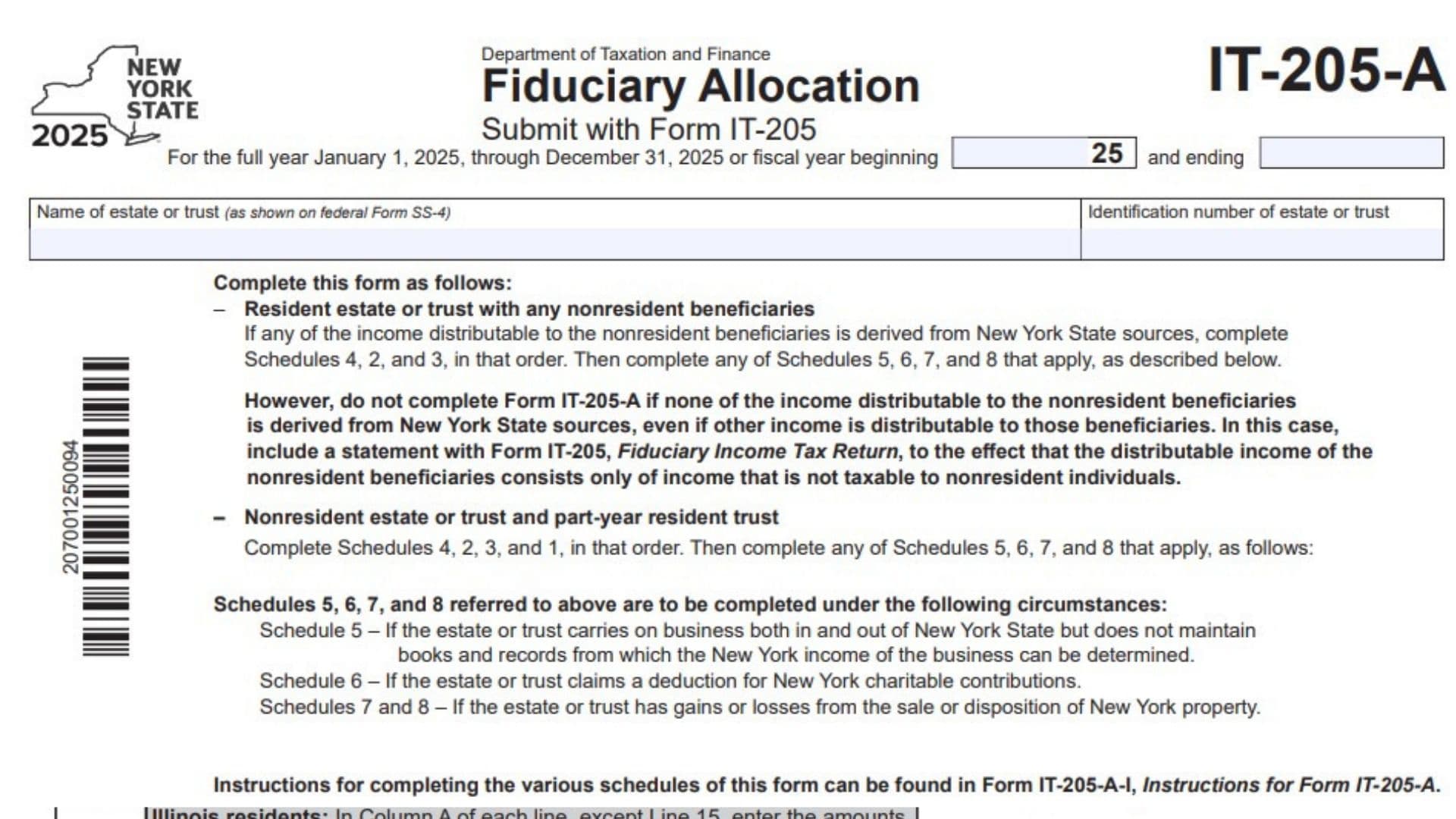
Form IT-205-A, officially known as the Fiduciary Allocation form, is a New York State tax document used by estates and trusts to allocate income between New York and non-New York sources. It exists to ensure that nonresident estates, trusts, and beneficiaries are only taxed on the portion of their income derived from New York State. Resident estates and trusts with nonresident beneficiaries use this form to report New York-source income distributions, while nonresident and part-year resident trusts use it to calculate their overall New York tax liability. Completing this form correctly is critical because it dictates the exact amount of state tax owed and ensures accurate reporting on the beneficiaries’ individual returns.
How To File Form IT-205-A
Form IT-205-A is not a standalone return; it must be submitted as an attachment to your Form IT-205 (Fiduciary Income Tax Return). You will need your federal Form 1041 and its accompanying schedules (such as Schedule K-1, Schedule C, Schedule D, Schedule E, and Schedule F) to complete the allocation accurately. When you are preparing to file, you can use the file named it205a_fill_in.pdf to draft your entries.

General Information
Tax Year and Entity Details Enter the specific dates if you are filing for a fiscal year. Provide the exact name of the estate or trust exactly as it appears on your federal Form SS-4, followed by your federal employer identification number.
Filing Requirements Checkboxes Review the instructions at the top to determine your filing path based on whether you are a resident estate/trust with nonresident beneficiaries, or a nonresident/part-year resident entity. You must complete the schedules in the specific order outlined in the header instructions.
Schedule 1: Computation of New York tax of a nonresident estate or trust or part-year resident trust
Line 1: Adjusted total income (or loss) Enter the adjusted total income from Schedule 4, line 30, column a. Include the total federal amount in column a and the New York City resident period amount in column b.
Line 2: Income distribution deduction Provide the deduction amount directly from your federal Form 1041, Schedule B, line 15. You must also submit a copy of each federal Schedule K-1.
Line 3: Estate tax deduction Enter any allowable estate tax deduction and include your calculation sheet.
Line 4: Exemption (federal) Input your federal exemption amount.
Line 5: Total Add the amounts from lines 2, 3, and 4 together to determine your total deductions and exemptions.
Line 6: Federal taxable income of fiduciary Subtract line 5 from line 1. The amount in column a must also be reported on page 1, line 1 of Form IT-205.
Line 7: New York modifications relating to amounts allocated to principal Enter any required New York state modifications that apply to your principal amounts.
Line 8: Balance Take the amount on line 6 and either add or subtract the modification on line 7 as applicable.
Line 9: Fiduciary’s share of New York fiduciary adjustment Provide the fiduciary’s share of the adjustment, pulling this figure from your main Form IT-205.
Line 10: New York taxable income of fiduciary Adjust the balance on line 8 by adding or subtracting the adjustment from line 9.
Line 11: New York State base tax on line 10 amount Calculate and enter the base tax on the taxable income shown on line 10.
Line 12: Income percentage Enter your income percentage as a decimal. This figure may exceed 100% depending on your calculations.
Line 13: Allocated New York State tax Multiply line 11 by the decimal on line 12. This final amount is your allocated tax and must also be entered on Form IT-205, line 9.
Beneficiary Name List each beneficiary exactly as they appear on Schedule C of Form IT-205.
Column 1: Shares of federal distributable net income Amount Enter each beneficiary’s dollar amount share of the distributable net income. The total must match Schedule 4, line 38, column a.
Column 2: Shares of federal distributable net income Percentage Indicate the percentage of the federal distributable net income that belongs to each beneficiary. The total must equal 100%.
Column 3: Shares of income from New York sources Enter the portion of income for each beneficiary that comes from New York State. The totals line must match Schedule 4, line 38, column b.
Column 4: Shares of fiduciary adjustment Allocate the fiduciary adjustment among the beneficiaries. Positive amounts are added to income, while negative amounts are subtracted.
Beneficiary Name Ensure these names match those on Form IT-205, Schedule C.
Column 1: Dividends from New York sources Report the New York-sourced dividend income for each nonresident beneficiary.
Column 2: Short-term capital gain from New York property Enter any short-term gains realized from New York assets.
Column 3: Long-term capital gain from New York property Report any long-term gains from property located in New York.
Column 4: Other taxable income from New York sources Provide any additional New York taxable income not covered in the previous columns.
Column 5: Other deductions from New York sources List allowable deductions connected to New York income and attach a supporting schedule.
Schedule 4: Details of federal distributable net income and amounts from New York State sources
Line 14: Interest income Report interest across the four columns: federal amount, New York sources, New York City period, and Yonkers period.
Line 15: Dividends Enter all applicable dividend income across the columns.
Line 16: Business income (or loss) Provide the net business income or loss and attach your federal Schedule C.
Line 17: Capital gain (or loss) Enter capital gains or losses and attach federal Schedule D.
Line 18: Rents, royalties, partnerships, other estates and trusts, etc. Report income from these sources and include federal Schedule E.
Line 19: Farm income (or loss) Report agricultural income and attach federal Schedule F.
Line 20: Ordinary gain (or loss) Include ordinary gains or losses and submit federal Form 4797.
Line 21: Other income Describe the nature of any other income and enter the amounts.
Line 22: Total income Add lines 14 through 21. The column a total goes to Form IT-205, page 1, item A.
Line 23: Interest Enter deductible interest expenses.
Line 24: Taxes Report allowable tax deductions.
Line 25: Fiduciary fees Enter fees paid to the fiduciary.
Line 26: Charitable deduction Provide any allowable charitable deductions.
Line 27: Attorney, accountant, and return preparer fees List professional fees related to the administration.
Line 28: Other deductions Enter any remaining deductions and attach a supporting schedule.
Line 29: Total deductions Add lines 23 through 28 to get your total deductions.
Line 30: Adjusted total income (or loss) Subtract line 29 from line 22 to calculate the adjusted total income.
Line 31: Adjusted tax-exempt interest Enter your adjusted tax-exempt interest amounts.
Line 32: Net gain shown on Schedule 7, line 75, column 1 Transfer the gain from Schedule 7. Enter 0 if it is a net loss.
Line 33: Enter the amount from Schedule 6, line 55 Transfer the corpus capital gains set aside for charity from Schedule 6.
Line 34: Short-term capital gain included on Schedule 6, line 47 Enter the short-term portion of charitable capital gains.
Line 35: If amount on line 17 above is a capital loss If line 17 resulted in a loss, enter that exact amount here as a positive number.
Line 36: Total Sum up the amounts from lines 30 through 35.
Line 37: If amount on line 17 above is a capital gain If line 17 was a gain, enter it here.
Line 38: Distributable net income Subtract line 37 from line 36. Transfer column a to Schedule 2, column 1, and column b to Schedule 2, column 3.
Schedule 5: Formula basis allocation of business income
Line 39: Real property owned Enter the value of real property everywhere in column 1 and inside New York in column 2.
Line 40: Real property rented from others Report the value of rented real estate.
Line 41: Tangible personal property owned List the value of owned tangible personal property.
Line 41a: Tangible personal property rented from others Provide the value of rented tangible personal property.
Line 42: Property percentage Add lines 39 through 41a to find the property percentage.
Line 43: Payroll percentage Calculate the percentage of New York payroll compared to total payroll.
Line 44: Gross income percentage Determine the percentage of New York gross income relative to the total.
Line 45: Total of percentages Add the percentages from lines 42, 43, and 44 together in column 3.
Line 46: Business allocation percentage Divide the total on line 45 by 3 (or the actual number of factors used) to find the final allocation percentage. Apply this percentage to applicable business items.
Schedule 6: Computation of New York charitable deduction
Line 47: Amounts paid or permanently set aside for New York charitable purposes from gross income Enter the gross amount dedicated to qualifying New York charities.
Line 48: Tax-exempt income from sources outside New York State allocable to New York charitable contribution Determine the out-of-state tax-exempt income that applies to this deduction.
Lines 49 through 53 These lines are intentionally left blank by the tax department.
Line 54: Balance Subtract line 48 from line 47.
Line 55: Capital gains for the tax year allocated to corpus and paid or permanently set aside for New York charitable purposes Report any principal-level capital gains dedicated to charity.
Line 56: Total Add lines 54 and 55 together.
Line 57: Section 1202 exclusion allocable to capital gains paid or permanently set aside for New York charitable purposes Input the portion of the Section 1202 exclusion that applies.
Line 58: Total Subtract line 57 from line 56 to finalize your charitable deduction.
Schedule 7: Capital gains and losses from sales or exchanges of New York capital assets
Part 1: Short-term capital gains and losses
Line 59: Asset descriptions and calculations Describe each short-term asset, acquisition and sale dates, gross price, basis/expenses, and resulting gain or loss.
Line 60: Short-term capital gain (or loss) from installment sales and like-kind exchanges of New York property Report gains or losses from specific exchanges and installments.
Line 61: Net short-term gain (or loss) from New York property derived from partnerships, S corporations, and other estates or trusts Include your share of short-term flow-through gains or losses.
Line 62: Net gain (or loss) Combine lines 59 through 61.
Line 63: Short-term capital loss carryover Enter any short-term carryover losses and submit your computation.
Line 64: Net short-term gain (or loss) Combine lines 62 and 63. Carry this total to line 73.
Part 2: Long-term capital gains and losses
Line 65: Asset descriptions and calculations List long-term assets, dates, gross price, basis/expenses, and the final gain or loss.
Line 66: Long-term capital gain (or loss) from installment sales and like-kind exchanges of New York property Report long-term gains from these specific transaction types.
Line 67: Net long-term gain (or loss) from New York property derived from partnerships, S corporations, and other estates or trusts Enter your share of long-term flow-through gains.
Line 68: Capital gain distributions Report any distributions categorized as capital gains.
Line 69: Enter gain, if any, from Schedule 8, line 81 Transfer any applicable business property gain from Schedule 8.
Line 70: Net gain (or loss) Combine lines 65 through 69.
Line 71: Long-term capital loss carryover from 2024 Input your long-term carryover from the prior year and include the computation.
Line 72: Net long-term gain (or loss) Combine lines 70 and 71. Enter this amount here and on line 74.
Part 3: Summary of Parts 1 and 2
Line 73: Net short-term gain (or loss) from line 64, column f Bring down your short-term total, allocating it between beneficiaries and the fiduciary.
Line 74: Net long-term gain (or loss) from line 72, column f Bring down your long-term total and allocate it appropriately.
Line 75: Total net gain (or loss) Add or subtract line 74 from line 73. Transfer the column 3 total to Schedule 4, line 17, column b.
Schedule 8: Supplemental schedule of gains and losses from New York property
Part 1: Sales or exchanges of New York property used in a trade or business and involuntary conversions
Line 76: Property descriptions and calculations Provide the property kind, dates, gross price, depreciation, basis, and calculate the loss or gain for business assets held over one year.
Line 77: Gain, if any, from federal Form 4684, line 39 Enter casualty or theft gains from the federal form.
Line 78: Section 1231 gain from installment sales from federal Form 6252, line 26 or line 37, or both Report installment sale gains for business property.
Line 78a: Section 1231 gain (or loss) from like-kind exchanges from federal Form 8824 Record gains or losses from like-kind exchanges.
Line 79: Gain, if any, from federal Form 4797, line 32, from other than casualty or theft Enter non-casualty ordinary gains.
Line 80: Total lines 76 through 79 Sum the loss column (g) and gain column (h) for the previous lines.
Line 81: Combine columns g and h of line 80 Net the totals. If it is a gain, enter it on Schedule 7, line 69. If it is a loss or zero, carry it to line 83.
Part 2: Ordinary gains and losses from New York property
Line 82: Ordinary gains and losses not included on lines 83 through 87 Calculate gains or losses for assets held one year or less.
Line 83: Loss, if any, from line 81 Carry down the loss calculated in Part 1, if applicable.
Line 84: Gain, if any, from federal Form 4797, line 31 Enter ordinary gains from the federal form.
Line 85: Net gain (or loss) from federal Form 4684, lines 31 and 38(a) Report net gains or losses from casualty and theft.
Line 86: Ordinary gain from installment sales from federal Form 6252, line 25 or line 36, or both Include ordinary installment gains.
Line 86a: Ordinary gain (or loss) from like-kind exchanges from federal Form 8824 Enter ordinary results from like-kind exchanges.
Line 87: Recapture of section 179 deduction Report any recaptured Section 179 business deductions.
Line 88: Add lines 82, 83, 85, and 86a, column g amounts, and line 82 and lines 84 through 87, column h amounts Total the ordinary losses and gains separately.
Line 89: Combine columns g and h of line 88 Determine your net ordinary gain or loss. Enter this final figure here and on Schedule 4, line 20, column b.
Final Review Before Filing
Before you submit your Fiduciary Allocation, double-check these important items:
- Ensure the estate or trust name and EIN perfectly match your federal filings.
- Verify that your federal Schedule K-1s, Schedule C, D, E, and F are attached if required.
- Confirm that all math allocating the New York-sourced income to the beneficiaries equals the total distribution pool.
- Ensure that Form IT-205-A is firmly attached to your main Form IT-205 prior to submission.