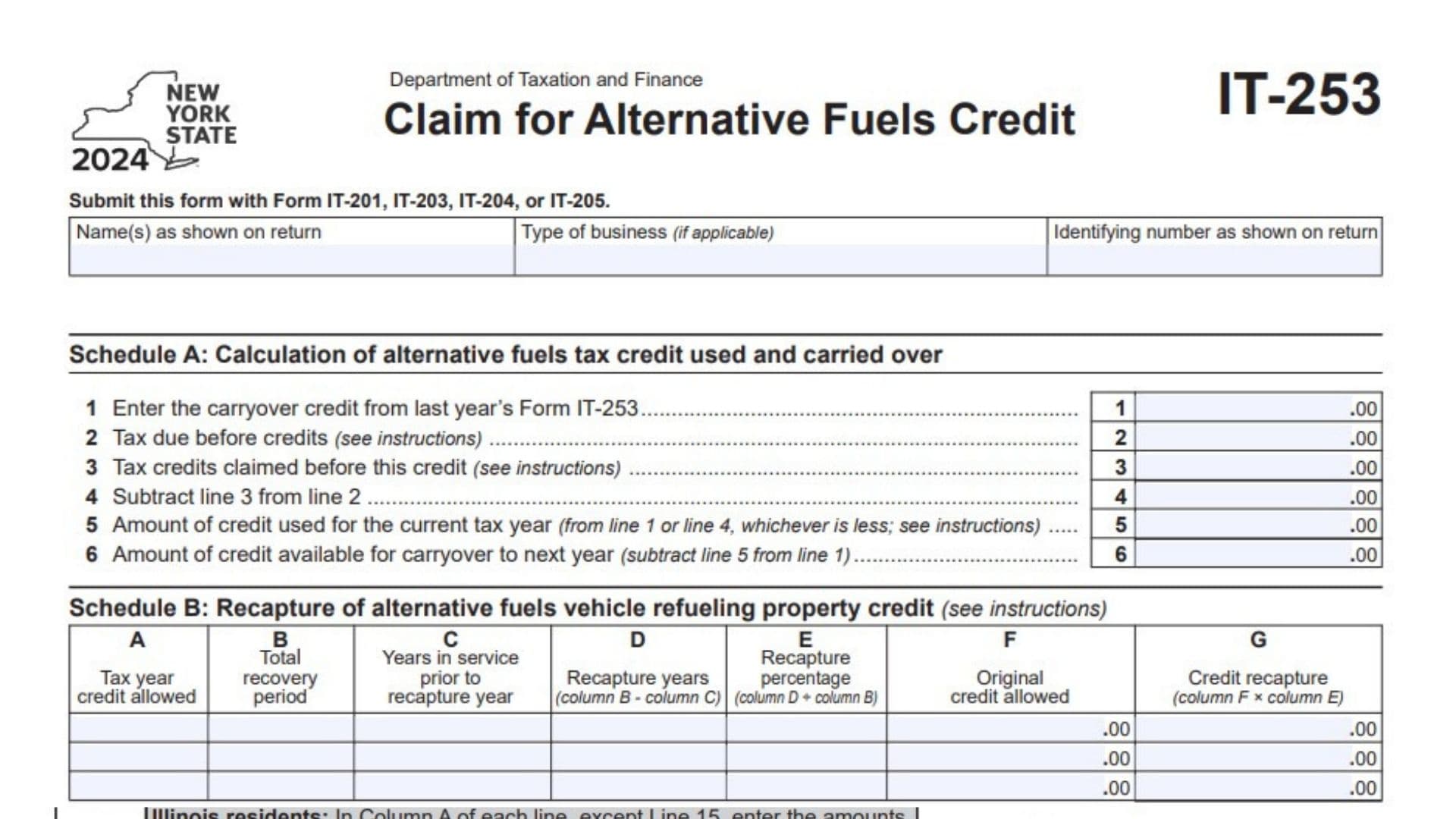
New York Form IT-253, officially titled Claim for Alternative Fuels Credit, is a tax form used by eligible taxpayers to calculate and report the use of the New York Alternative Fuels Credit and any required recapture of previously claimed alternative-fuel vehicle refueling property credits. The form is administered by the New York State Department of Taxation and Finance and applies to the relevant provisions of New York tax law. It allows taxpayers to report unused credits carried forward from previous years, calculate how much credit can be applied against the current year’s tax liability, and determine the amount available for future tax years. It also provides a separate schedule for reporting the recapture of previously allowed credits related to alternative-fuel vehicle refueling property. The form is relevant to individuals, partnerships, S corporation shareholders, and beneficiaries of estates or trusts, depending on how the original credit was claimed or allocated. It collects the taxpayer’s name, business type when applicable, identifying number, previous-year credit carryover, tax liability, other credits claimed, and information about previously allowed vehicle refueling property credits. Schedule A calculates the amount of alternative fuels tax credit used during the current tax year and the remaining amount available for carryforward. Schedule B calculates the recapture of previously claimed alternative-fuel vehicle refueling property credits using the original credit amount, recovery period, years the property was in service, and applicable recapture percentage. It also accounts for credit recapture allocated through partnerships, S corporations, estates, and trusts. Depending on the taxpayer’s filing status, the calculated recapture must be reported on the appropriate New York tax return or additional tax credit schedule. Form IT-253 must be submitted with Form IT-201, IT-203, IT-204, or IT-205. Completing the form accurately is important because the amount of credit used, remaining carryforward, and recaptured credit must be calculated correctly and reported according to the taxpayer’s filing circumstances.
How To File Form IT-253
Form IT-253 must be submitted with the appropriate New York State income tax or partnership return. The applicable return depends on whether the taxpayer is an individual, partnership, or fiduciary.
The form contains two schedules. Schedule A calculates the credit used and carried forward, while Schedule B determines whether previously claimed alternative-fuel vehicle refueling property credits must be recaptured.
Where to File Form IT-253
Submit Form IT-253 with one of the following New York tax returns:
- Form IT-201: New York State Resident Income Tax Return.
- Form IT-203: New York State Nonresident and Part-Year Resident Income Tax Return.
- Form IT-204: Partnership Return.
- Form IT-205: Fiduciary Income Tax Return.
The appropriate return depends on the taxpayer’s filing status and the way the credit or recapture is reported.
What Information to Prepare Before Completing Form IT-253
Gather the following information before starting the form:
- Taxpayer’s name as shown on the applicable tax return.
- Type of business, if applicable.
- Taxpayer identification number.
- Unused alternative fuels credit carried forward from the previous year’s Form IT-253.
- Tax due before credits.
- Other tax credits claimed before the alternative fuels credit.
- Information needed to calculate the credit available for the current year.
- Original tax year in which the alternative-fuel vehicle refueling property credit was allowed.
- Total recovery period of the property.
- Number of years the property was in service before the recapture year.
- Applicable recapture period.
- Original credit amount allowed.
- Any recapture amounts allocated through a partnership, S corporation, estate, or trust.
- Beneficiary allocation information, if applicable.
- Supporting records showing previously claimed credits and any applicable recapture calculations.
Having these details available will help ensure that both schedules are completed accurately.

How To Complete Form IT-253
Form IT-253 contains a taxpayer identification section and two main schedules:
- Schedule A: Calculation of Alternative Fuels Tax Credit Used and Carried Over.
- Schedule B: Recapture of Alternative Fuels Vehicle Refueling Property Credit.
Complete the taxpayer information first, then work through each schedule according to the applicable credit and recapture circumstances.
Taxpayer Identification Information
The top section of Form IT-253 identifies the individual or business claiming the credit or reporting a recapture amount.
Name(s) as Shown on Return
Enter the taxpayer’s full name exactly as it appears on the corresponding New York tax return.
For joint filers, use the names reported on the applicable return.
Type of Business (If Applicable)
Enter the type of business associated with the taxpayer, if applicable.
This field is relevant when the credit is being claimed or reported through a business entity.
Provide the appropriate business classification or description.
Identifying Number as Shown on Return
Enter the taxpayer identification number associated with the corresponding New York tax return.
Use the identification number shown on Form IT-201, IT-203, IT-204, or IT-205, as applicable.
Schedule A: Calculation of Alternative Fuels Tax Credit Used and Carried Over
Schedule A determines how much alternative fuels tax credit can be used during the current tax year and how much remains available for carryforward.
It considers the previous year’s unused credit, current tax liability, and other credits claimed before the alternative fuels credit.
Line 1: Carryover Credit From Last Year’s Form IT-253
Enter the unused alternative fuels tax credit carried forward from the previous year’s Form IT-253.
Use the carryover amount reported on the prior-year form.
This line ensures that eligible unused credit from an earlier tax year is included in the current-year calculation.
If no credit is available from the previous year, follow the applicable instructions for completing this line.
Line 2: Tax Due Before Credits
Enter the taxpayer’s tax due before applying tax credits.
Determine the amount using the applicable New York tax return and the instructions for Form IT-253.
This amount establishes the tax liability available for the credit calculation.
Line 3: Tax Credits Claimed Before This Credit
Enter the total amount of other tax credits claimed before applying the alternative fuels credit.
Use the applicable tax return information and the instructions for Form IT-253 to determine which credits must be included.
This amount reduces the tax liability available for the alternative fuels credit.
Line 4: Subtract Line 3 From Line 2
Subtract the amount reported on Line 3 from the amount on Line 2.
Enter the resulting amount on Line 4.
Calculation:
Line 4 = Line 2 − Line 3.
This amount represents the tax remaining after accounting for the credits claimed before the alternative fuels credit.
Line 5: Amount of Credit Used for the Current Tax Year
Enter the amount of alternative fuels tax credit that can be used during the current tax year.
Compare the amount on Line 1 with the amount on Line 4.
Enter whichever amount is smaller.
Calculation:
Line 5 = Lesser of Line 1 or Line 4.
This calculation limits the credit used during the current year to the smaller of the available carryover credit and the remaining tax liability.
Line 6: Amount of Credit Available for Carryover to Next Year
Subtract the amount reported on Line 5 from the amount on Line 1.
Enter the remaining credit on Line 6.
Calculation:
Line 6 = Line 1 − Line 5.
This amount represents the unused alternative fuels tax credit available to be carried forward to the following tax year.
Schedule B: Recapture of Alternative Fuels Vehicle Refueling Property Credit
Schedule B calculates the recapture of previously claimed alternative-fuel vehicle refueling property credits.
Complete this schedule when a previously allowed credit is subject to recapture under the applicable rules.
The schedule provides seven columns for reporting the original credit information and calculating the amount that must be recaptured.
If more than three property entries are required, attach additional information as needed to report the applicable amounts.
Schedule B: Property and Recapture Information
Complete Columns A through G separately for each property subject to recapture.
Column A: Tax Year Credit Allowed
Enter the tax year in which the original alternative-fuel vehicle refueling property credit was allowed.
This identifies the year associated with the previously claimed credit.
Use the original tax year shown in the relevant credit records.
Column B: Total Recovery Period
Enter the total recovery period of the property.
Use the recovery period applicable to the property under the relevant credit provisions.
This amount is used to calculate the remaining recapture period.
Column C: Years in Service Prior to Recapture Year
Enter the number of years the property was in service before the recapture year.
Use the actual number of applicable years in service.
This amount is subtracted from the total recovery period in Column B.
Column D: Recapture Years
Subtract the number of years in service reported in Column C from the total recovery period reported in Column B.
Enter the resulting number in Column D.
Calculation:
Column D = Column B − Column C.
This amount represents the remaining years used in determining the recapture percentage.
Column E: Recapture Percentage
Calculate the recapture percentage by dividing the amount in Column D by the amount in Column B.
Enter the resulting percentage in Column E.
Calculation:
Column E = Column D ÷ Column B.
This percentage is used to calculate the amount of the original credit that must be recaptured.
Column F: Original Credit Allowed
Enter the original amount of alternative-fuel vehicle refueling property credit allowed for the property.
Use the amount previously claimed or allowed for the applicable tax year.
The original credit amount is the basis for calculating the recapture in Column G.
Column G: Credit Recapture
Multiply the original credit amount in Column F by the recapture percentage in Column E.
Enter the resulting recapture amount in Column G.
Calculation:
Column G = Column F × Column E.
Complete this calculation separately for each property subject to recapture.
Schedule B: Total Recapture Calculation
After completing the property information in Columns A through G, calculate the total recapture and any applicable allocated recapture.
Line 7: Recaptured Alternative-Fuel Vehicle Refueling Property Credit
Add together all credit recapture amounts reported in Column G.
Enter the total on Line 7.
Calculation:
Line 7 = Total of all Column G amounts.
This amount represents the total recaptured alternative-fuel vehicle refueling property credit calculated for the listed properties.
Line 8: Partner, Shareholder, or Beneficiary Share of the Recapture of the Credit
If you are a partner in a partnership, shareholder of an S corporation, or beneficiary of an estate or trust, enter your allocated share of the credit recapture.
Use the amount allocated to you by the applicable partnership, S corporation, estate, or trust.
Refer to the relevant allocation information and instructions for Form IT-253 to determine the correct amount.
Line 9: Total Recaptured Alternative Fuels Credit
Add the amounts reported on Line 7 and Line 8.
Enter the combined amount on Line 9.
Calculation:
Line 9 = Line 7 + Line 8.
This amount represents the total alternative fuels credit recapture to be reported according to the taxpayer’s filing status.
Reporting Line 9 Based on Filing Status
The form provides different reporting instructions for individuals, partnerships, and fiduciaries.
For Individuals
Enter the Line 9 amount and code 253 on the appropriate additional tax credit schedule:
- Form IT-201-ATT, line 20; or
- Form IT-203-ATT, line 19.
Use the schedule corresponding to the taxpayer’s income tax return.
For Partnerships
Enter the Line 9 amount and code 253 on Form IT-204, line 148.
This reports the total recaptured alternative fuels credit on the partnership return.
For Fiduciaries
Fiduciaries must continue to Lines 10 and 11 to determine the portion of the recapture allocated to beneficiaries and the amount attributable to the fiduciary.
Line 10: Amount of Recapture Allocated to Beneficiaries
This line applies to fiduciaries.
Enter the amount of alternative fuels credit recapture allocated to beneficiaries.
Use the applicable allocation information to determine the total recapture passed through to beneficiaries.
Line 11: Fiduciary Share of Recapture
Subtract the amount reported on Line 10 from the amount on Line 9.
Enter the resulting amount on Line 11.
Calculation:
Line 11 = Line 9 − Line 10.
This amount represents the portion of the total recapture attributable to the fiduciary after accounting for beneficiary allocations.
Additional Filing Considerations
Before submitting Form IT-253, taxpayers should understand the difference between the current-year credit calculation and the recapture of previously allowed credits.
Alternative Fuels Credit Carryforward
Schedule A accounts for unused alternative fuels tax credit from the previous tax year.
Line 5 determines how much of that credit can be used during the current tax year based on the remaining tax liability.
Line 6 identifies the unused amount available for carryforward to the next year.
Alternative-Fuel Vehicle Refueling Property Credit Recapture
Schedule B addresses the recapture of previously claimed alternative-fuel vehicle refueling property credits.
The calculation depends on:
- The original tax year in which the credit was allowed.
- The total recovery period of the property.
- The number of years the property was in service before the recapture year.
- The remaining recapture years.
- The applicable recapture percentage.
- The original credit amount allowed.
The final recapture amount is calculated separately for each applicable property and combined on Line 7.
Partnership and S Corporation Allocations
Partners and S corporation shareholders may need to report their allocated share of the recaptured credit on Line 8.
The allocated amount is added to the property recapture calculated on Line 7 to determine the total recapture on Line 9.
Estate and Trust Allocations
Beneficiaries of estates and trusts may also have an allocated share of the credit recapture.
Fiduciaries must use Lines 10 and 11 to separate the amount allocated to beneficiaries from the amount attributable to the fiduciary.
Reporting the Recapture on the Appropriate Tax Return
The Line 9 amount is reported differently depending on the taxpayer’s filing status:
- Individuals report the amount with code 253 on Form IT-201-ATT, line 20, or Form IT-203-ATT, line 19.
- Partnerships report the amount with code 253 on Form IT-204, line 148.
- Fiduciaries complete Lines 10 and 11 to calculate the beneficiary and fiduciary portions.
Make sure the recapture amount is reported on the correct return or attachment.
Final Review Before Filing
Before submitting Form IT-253 with the applicable New York tax return, review all identifying information, carryforward calculations, property information, and recapture amounts.
Use the following checklist:
- Enter the taxpayer’s name exactly as shown on the tax return.
- Enter the applicable business type, if required.
- Provide the correct taxpayer identification number.
- Enter the previous year’s carryover credit on Line 1.
- Enter the tax due before credits on Line 2.
- Enter other tax credits claimed before this credit on Line 3.
- Calculate the remaining tax amount on Line 4.
- Determine the credit used for the current tax year on Line 5.
- Calculate the remaining carryforward credit on Line 6.
- Review whether any previously claimed alternative-fuel vehicle refueling property credit is subject to recapture.
- Complete Column A with the original tax year in which the credit was allowed.
- Enter the total recovery period in Column B.
- Enter the years in service before the recapture year in Column C.
- Calculate the recapture years in Column D.
- Calculate the recapture percentage in Column E.
- Enter the original credit allowed in Column F.
- Calculate the credit recapture in Column G.
- Add the Column G amounts and enter the total on Line 7.
- Enter any allocated recapture from a partnership, S corporation, estate, or trust on Line 8.
- Calculate total recaptured alternative fuels credit on Line 9.
- If filing as an individual, transfer the Line 9 amount and code 253 to the appropriate additional tax credit schedule.
- If filing as a partnership, transfer the Line 9 amount and code 253 to Form IT-204, line 148.
- If filing as a fiduciary, complete Line 10 with the amount allocated to beneficiaries.
- Calculate the fiduciary’s share of recapture on Line 11.
- Verify that all credit allocations and recapture calculations are supported by the relevant records.
- Attach Form IT-253 to the appropriate New York tax return.
Completing Form IT-253 accurately helps ensure that unused alternative fuels credits are properly calculated and carried forward and that any required recapture of previously claimed alternative-fuel vehicle refueling property credits is correctly reported. Review both schedules carefully, verify all calculations, and transfer the applicable amounts to the correct New York tax return or additional tax credit schedule.
Important: Several calculations on Form IT-253 refer to separate instructions, including tax due before credits, credits claimed before this credit, and the treatment of allocated recapture amounts. The form does not provide all eligibility requirements or detailed recapture rules. Consult the applicable Form IT-253 instructions for those details rather than assuming additional requirements or calculations.