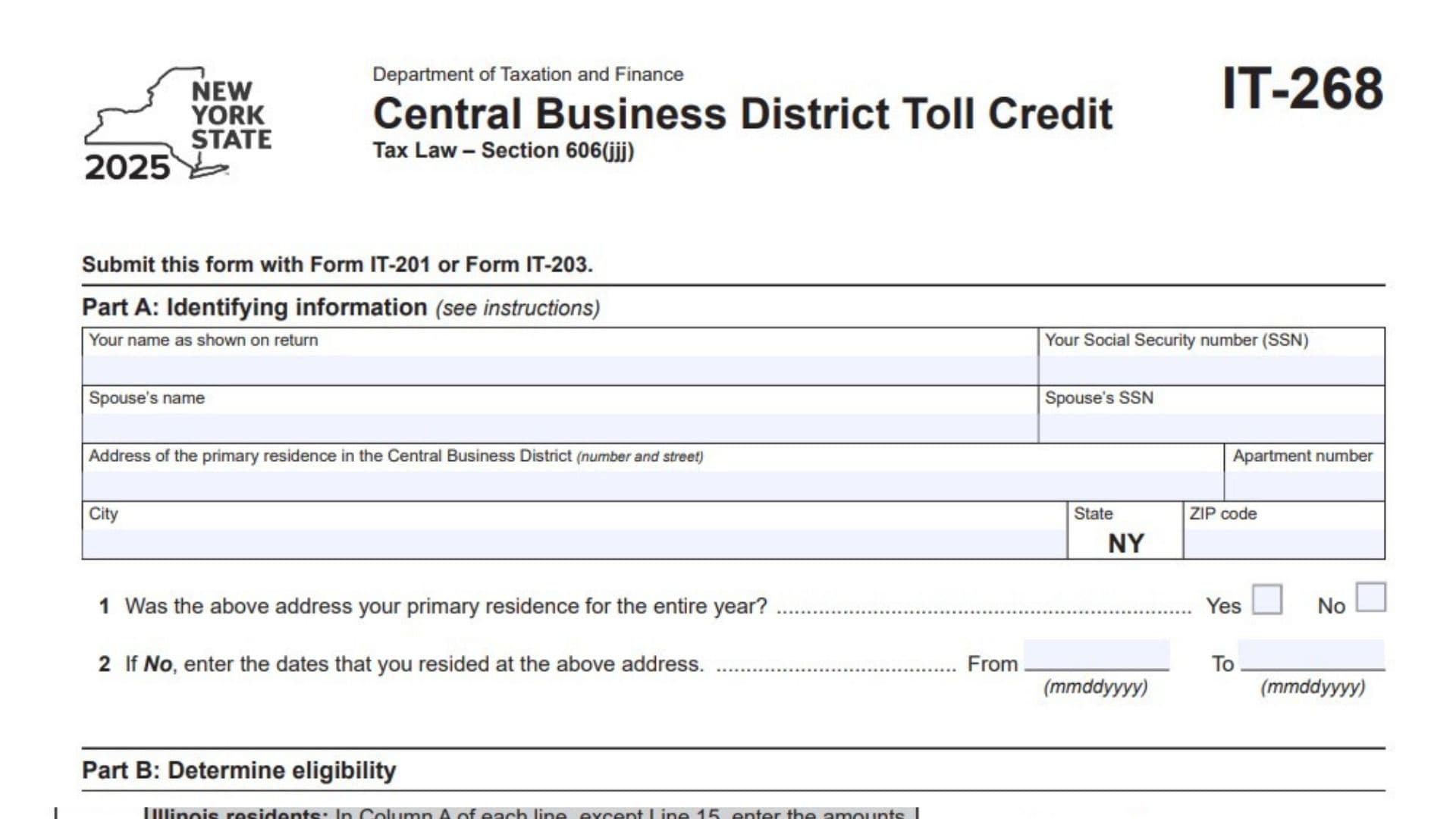
New York Form IT-268, officially titled Central Business District Toll Credit, is a tax form used by eligible New York residents to claim a credit for tolls paid while traveling through New York City’s Central Business District, also known as the Congestion Relief Zone. The credit is authorized under Section 606(jjj) of New York Tax Law and is available to qualifying taxpayers who maintained their primary residence within the designated Central Business District, had New York adjusted gross income of less than $60,000 for the tax year, and paid qualifying congestion relief zone tolls during that year. The form applies to toll payments made by eligible residents, excluding amounts treated as trade or business expenses. It collects the taxpayer’s name, Social Security number, spouse’s information, primary residential address within the Central Business District, residency dates, and New York adjusted gross income eligibility information. It also provides a calculation section for reporting the total qualifying toll expenses paid during the year. The credit is generally equal to the total amount of eligible Central Business District tolls paid while the taxpayer’s primary residence was within the designated zone. Taxpayers who lived in the Central Business District for only part of the year may claim the credit only for qualifying tolls paid during the period they maintained their primary residence there. Form IT-268 is relevant to individuals filing New York State resident or nonresident income tax returns, depending on their circumstances. The completed form must be submitted with Form IT-201 or Form IT-203. The calculated credit is transferred to the appropriate additional tax credit schedule using code 268. If the taxpayer cannot use the entire credit against their current-year tax liability, they may request a refund or apply the overpayment to the following tax year. The Tax Department does not pay interest on the refund or overpayment. Completing Form IT-268 accurately is important because eligibility depends on the taxpayer’s income, residential location, residency period, and actual qualifying toll payments.
How To File Form IT-268
Form IT-268 must be completed by individuals who meet the eligibility requirements for the Central Business District Toll Credit.
Taxpayers must provide their identifying information, confirm their qualifying residency and income status, and calculate the eligible toll payments made during the year.
Where to File Form IT-268
Submit Form IT-268 with one of the following New York income tax returns:
- Form IT-201: New York State Resident Income Tax Return.
- Form IT-203: New York State Nonresident and Part-Year Resident Income Tax Return.
The applicable return depends on the taxpayer’s residency and filing circumstances.
After calculating the credit on Line 4, transfer the amount and code 268 to:
- Form IT-201-ATT, line 12; or
- Form IT-203-ATT, line 12.
What Information to Prepare Before Completing Form IT-268
Gather the following information and documents before starting the form:
- Taxpayer’s name as shown on the income tax return.
- Taxpayer’s Social Security number.
- Spouse’s name and Social Security number, if applicable.
- Complete address of the primary residence within the Central Business District.
- Apartment number, city, state, and ZIP code.
- Information confirming whether the address was the primary residence for the entire tax year.
- Beginning and ending dates of residency if the taxpayer lived in the qualifying area for only part of the year.
- New York adjusted gross income from Form IT-201, line 33, or Form IT-203, line 32.
- Total qualifying Central Business District tolls paid during the year.
- EZ Pass statements, itemized toll bills, or qualifying fare receipts documenting toll payments.
- Records identifying tolls that were used as trade or business expenses.
Having these details available will make it easier to determine eligibility and calculate the correct credit amount.

How To Complete Form IT-268
Form IT-268 contains three main parts:
- Part A: Identifying Information.
- Part B: Determine Eligibility.
- Part C: Credit Amount.
Follow the instructions below to complete each section and individual field.
Part A: Identifying Information
Part A collects the taxpayer’s personal information and details about their primary residence within New York City’s Central Business District.
The residential information is particularly important because eligibility depends on maintaining a primary residence within the designated Congestion Relief Zone.
Your Name as Shown on Return
Enter your full name exactly as it appears on your New York income tax return.
Make sure the name matches the taxpayer information reported on Form IT-201 or Form IT-203.
Your Social Security Number (SSN)
Enter your Social Security number as shown on your New York income tax return.
Verify that the number is accurate and corresponds to the individual claiming the Central Business District Toll Credit.
Spouse’s Name
If filing jointly, enter your spouse’s name as shown on the corresponding income tax return.
Make sure the information agrees with the taxpayer details reported on the return.
Spouse’s SSN
Enter your spouse’s Social Security number in the designated field.
Use the number associated with your spouse’s tax identification information.
Address of the Primary Residence in the Central Business District (Number and Street)
Enter the street address of your primary residence located within New York City’s Central Business District.
The address must identify the residence where you primarily lived during the applicable tax year.
The qualifying area includes designated local streets and avenues in Manhattan south of, and including, 60th Street, subject to the geographic exclusions described in the instructions.
A residence outside the designated area does not satisfy this location requirement.
Apartment Number
If your primary residence is an apartment or other unit with a separate apartment number, enter that number in this field.
If the residence does not have an apartment number, follow the applicable form instructions.
City
Enter the city where your qualifying primary residence is located.
Provide the correct city name associated with the residential address.
State
The state field is prefilled with NY for New York.
Confirm that the address information corresponds to your New York primary residence.
ZIP Code
Enter the ZIP code associated with the qualifying primary residence.
Make sure it matches the residential address provided in the preceding fields.
Line 1: Primary Residence for the Entire Year
Answer Yes or No to indicate whether the address reported in Part A was your primary residence for the entire tax year.
- Select Yes if the address was your primary residence throughout the entire tax year.
- Select No if you lived at that address for only part of the tax year.
This question establishes the period during which your primary residence was located within the Central Business District.
Line 2: Dates of Residency at the Address
Complete this line only if you answered No to Line 1.
Enter the dates during which the reported address was your primary residence.
From: Enter the date you began residing at the qualifying address.
To: Enter the date you stopped residing at that address.
Use the month, day, and year format specified on the form (MMDDYYYY).
For example, if you moved into the qualifying residence during the year and later moved outside the Central Business District, report the applicable beginning and ending dates.
If you lived in the Central Business District for only part of the year, you may claim the credit only for qualifying tolls paid during the period when your primary residence was located in the designated area.
Part B: Determine Eligibility
Part B determines whether your income meets the eligibility requirement for the Central Business District Toll Credit.
The form uses your New York adjusted gross income to establish whether you can continue to the credit calculation.
Line 3: New York Adjusted Gross Income Less Than $60,000
Answer Yes or No to indicate whether your New York adjusted gross income was less than $60,000 for the tax year.
Use the amount reported on the appropriate New York income tax return:
- Form IT-201, line 33; or
- Form IT-203, line 32.
Select Yes if your New York adjusted gross income was below $60,000.
Select No if your adjusted gross income was $60,000 or more.
If you answer No, stop completing the form because you do not qualify for this credit.
If you answer Yes, continue to Part C and calculate your qualifying toll payments.
Important Eligibility Requirement
Meeting the income requirement alone does not automatically establish eligibility.
You must also satisfy the other requirements described in the form instructions:
- Your primary residence during the applicable period must have been within New York City’s Central Business District.
- Your New York adjusted gross income must have been less than $60,000.
- You must have paid qualifying Central Business District tolls during the year.
- The tolls claimed must not have been used as a trade or business expense.
All applicable requirements must be considered before claiming the credit.
Part C: Credit Amount
Part C calculates the amount of the Central Business District Toll Credit.
The credit is based on the total qualifying congestion relief zone tolls paid during the tax year while your primary residence was located within the designated area.
Line 4: Central Business District Toll Credit
Enter the total amount of qualifying Central Business District tolls paid during the year.
Include only tolls paid during the period when your primary residence was within the Central Business District.
Do not include toll payments that were used as trade or business expenses under Internal Revenue Code Section 162.
The credit is generally equal to the total eligible toll payments made during the qualifying residency period.
You can determine the amount of tolls paid using supporting records such as:
- EZ Pass account statements.
- Fare receipts from for-hire vehicles that separately identify the toll amount.
- Itemized Metropolitan Transportation Authority (MTA) toll bills.
Add together the qualifying toll payments and enter the total on Line 4.
If you lived within the Central Business District for only part of the year, include only the tolls paid during that residency period.
The Department of Taxation and Finance may require you to provide supporting documentation upon request.
Reporting the Line 4 Amount
After calculating Line 4, transfer the credit amount and code 268 to the appropriate additional tax credit schedule:
- Form IT-201-ATT, line 12; or
- Form IT-203-ATT, line 12.
Make sure the amount reported on the applicable attachment agrees with the credit calculated on Form IT-268.
Additional Information About the Central Business District Toll Credit
Understanding the qualifying geographic area, toll payment requirements, and refund treatment is important when claiming the credit.
Central Business District and Congestion Relief Zone
The Central Business District, also known as the Congestion Relief Zone, includes local streets and avenues in Manhattan south of, and including, 60th Street.
However, the designated area excludes:
- FDR Drive.
- West Side Highway (Route 9A).
- Hugh L. Carey Tunnel connections to West Street.
The qualifying residential address must be located within the designated area.
The form’s instructions also direct taxpayers to the Metropolitan Transportation Authority (MTA) website for additional program information. Search for Central Business District toll information.
Qualifying Toll Payments
The credit is calculated using the total amount of qualifying Central Business District tolls paid during the tax year.
Eligible toll payments must relate to the period when the taxpayer’s primary residence was within the Central Business District.
Tolls used as trade or business expenses must be excluded from the calculation.
Taxpayers should maintain documentation showing the toll amounts paid because the Department of Taxation and Finance may request supporting records.
Part-Year Residency
Taxpayers who lived in the Central Business District for only part of the tax year may still qualify for the credit if they meet the other eligibility requirements.
However, the credit is limited to qualifying toll payments made while their primary residence was within the designated area.
The beginning and ending residency dates must therefore be reported on Line 2 when Line 1 is answered No.
Refund or Overpayment Treatment
If the taxpayer cannot use the full amount of the credit against their tax liability for the current year, the unused amount may be requested as a refund or applied as an overpayment to the following tax year.
The Tax Department will not pay interest on the refund or overpayment.
Final Review Before Filing
Before submitting Form IT-268 with your New York income tax return, review all identifying information, eligibility answers, residency details, and toll calculations.
Use the following checklist:
- Enter your name exactly as shown on the income tax return.
- Enter your correct Social Security number.
- Provide your spouse’s name, if applicable.
- Enter your spouse’s Social Security number, if applicable.
- Provide the complete address of your primary residence within the Central Business District.
- Enter the apartment number, if applicable.
- Provide the correct city and ZIP code.
- Verify the New York state designation.
- Answer Line 1 regarding primary residence for the entire year.
- Complete Line 2 with the beginning and ending residency dates if Line 1 is answered No.
- Verify that your primary residence was within the designated Central Business District.
- Review your New York adjusted gross income from Form IT-201, line 33, or Form IT-203, line 32.
- Answer Line 3 regarding the income requirement of less than $60,000.
- Stop completing the form if your adjusted gross income is $60,000 or more.
- Confirm that you paid qualifying Central Business District tolls during the year.
- Exclude toll payments used as trade or business expenses.
- Review EZ Pass statements, itemized MTA toll bills, or qualifying for-hire vehicle receipts.
- Include only qualifying tolls paid during the period of Central Business District residency.
- Calculate the total qualifying toll payments on Line 4.
- Transfer the Line 4 amount and code 268 to Form IT-201-ATT, line 12, or Form IT-203-ATT, line 12.
- Attach Form IT-268 to the appropriate New York income tax return.
- Retain supporting toll payment and residency records in case the Department requests documentation.
Completing Form IT-268 correctly helps eligible taxpayers claim the Central Business District Toll Credit for qualifying toll payments made while maintaining a primary residence within New York City’s Congestion Relief Zone. Carefully verify the income requirement, residential address, applicable residency dates, and toll payment records before transferring the calculated credit to the appropriate New York income tax return.