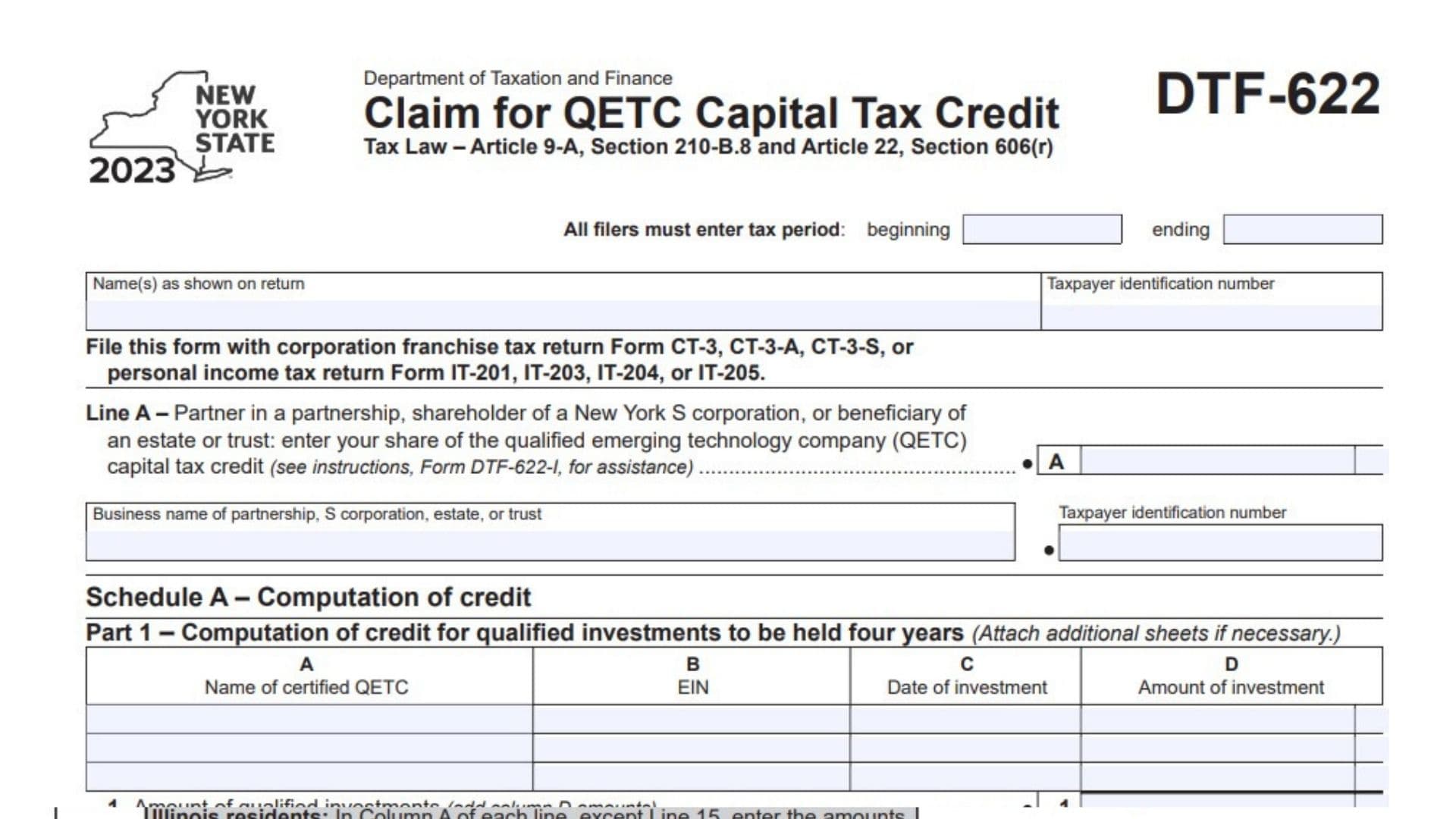
New York Form DTF-622, titled Claim for QETC Capital Tax Credit, is a tax form used by eligible taxpayers to calculate and claim a capital tax credit associated with investments in qualified emerging technology companies (QETCs). The credit is governed by Section 210-B.8 of Article 9-A and Section 606(r) of Article 22 of New York Tax Law. The form allows taxpayers to report qualifying investments in certified QETCs, calculate the applicable credit based on the required investment holding periods, apply statutory credit limitations, account for previously claimed credits, and determine the amount available for the current tax year and future carryforward. It provides separate calculations for qualified investments intended to be held for at least four years and those intended to be held for at least nine years. The applicable credit percentages shown on the form are 10% for four-year investments and 20% for nine-year investments. Form DTF-622 also includes limitations on the amount of credit that can be claimed, a calculation of the available credit based on tax liability, and a recapture schedule for situations in which previously claimed credits must be recovered. Taxpayers may also report unused QETC capital tax credits carried forward from the previous year. The form is relevant to corporations, individuals, partners, shareholders of New York S corporations, and beneficiaries of estates or trusts, depending on how the investment and credit are allocated. Completing the form accurately is important because the credit is subject to investment holding requirements, statutory dollar limitations, tax limitations, and potential recapture rules. The final calculation determines the net QETC capital tax credit, any applicable recapture amount, the credit used during the current tax year, and the remaining credit available for future years.
How To File Form DTF-622
Form DTF-622 must be filed with the applicable New York corporation franchise tax return or personal income tax return. The form should be completed using the taxpayer’s investment records, information about the certified QETC, prior-year credit information, and relevant tax return calculations.
Where to File Form DTF-622
Attach Form DTF-622 to the appropriate tax return:
- Form CT-3: General Business Corporation Franchise Tax Return.
- Form CT-3-A: Combined Franchise Tax Return.
- Form CT-3-S: New York S Corporation Franchise Tax Return.
- Form IT-201: Resident Income Tax Return.
- Form IT-203: Nonresident and Part-Year Resident Income Tax Return.
- Form IT-204: Partnership Return.
- Form IT-205: Fiduciary Income Tax Return.
The appropriate return depends on the taxpayer’s legal and tax filing status.
What Information to Prepare Before Completing Form DTF-622
Gather the following information before starting the form:
- Taxpayer’s legal name as shown on the applicable tax return.
- Taxpayer identification number.
- Beginning and ending dates of the tax period.
- Rental? No; investment records showing the names of certified QETCs.
- Employer Identification Numbers (EINs) of the certified QETCs.
- Dates and amounts of qualifying investments.
- Records identifying whether investments are intended to be held for four years or nine years.
- Previous QETC capital tax credits allowed.
- Any previous credit recapture amounts.
- Tax liability information from the applicable tax return.
- Other credits claimed during the tax year.
- Unused QETC capital tax credit carried forward from the previous year.
- Information needed to determine the applicable credit limitations.
Partners, S corporation shareholders, and beneficiaries of estates or trusts should also obtain the information necessary to report their allocated share of the QETC capital tax credit.

How To Complete Form DTF-622
Form DTF-622 contains the taxpayer identification section, an allocated-credit section, four schedules, and a final checkbox for certain corporate partners. Follow the instructions below to complete each section and individual line.
Taxpayer Information and Tax Period
Start by identifying the taxpayer and the period covered by the tax return.
Tax Period – Beginning
Enter the starting date of the tax period for which the QETC capital tax credit is being claimed.
The date should correspond to the beginning of the applicable tax year or fiscal period.
Tax Period – Ending
Enter the ending date of the tax period.
This date should match the end of the reporting period covered by the associated corporation franchise tax or personal income tax return.
Name(s) as Shown on Return
Enter the taxpayer’s name exactly as it appears on the corresponding tax return.
For an individual, use the name reported on the personal income tax return. For a corporation or other eligible entity, use the business or entity name shown on its tax return.
Taxpayer Identification Number
Enter the taxpayer identification number associated with the return.
Use the appropriate identification number for the taxpayer, such as an Employer Identification Number (EIN) for an entity or the applicable taxpayer identification number for an individual.
Line A – Allocated QETC Capital Tax Credit
This section applies to individuals or entities claiming a share of the QETC capital tax credit through a partnership, New York S corporation, estate, or trust.
Line A: Share of QETC Capital Tax Credit
If you are a partner in a partnership, shareholder of a New York S corporation, or beneficiary of an estate or trust, enter your allocated share of the QETC capital tax credit.
The amount should represent the portion of the credit passed through to you by the relevant partnership, S corporation, estate, or trust.
Use the applicable supporting information and the instructions for Form DTF-622-I to determine the correct amount.
Business Name of Partnership, S Corporation, Estate, or Trust
Enter the complete legal name of the partnership, New York S corporation, estate, or trust through which you received the allocated credit.
The name should correspond to the entity that reported or allocated the QETC capital tax credit.
Taxpayer Identification Number
Enter the taxpayer identification number of the partnership, S corporation, estate, or trust identified in the preceding field.
Use the identification number associated with that entity rather than your own taxpayer identification number.
Schedule A: Computation of Credit
Schedule A calculates the QETC capital tax credit based on qualifying investments in certified emerging technology companies.
It contains two parts. Part 1 covers investments intended to be held for four years, while Part 2 covers investments intended to be held for nine years.
Part 1: Computation of Credit for Qualified Investments to Be Held Four Years
Use this section to report qualifying investments in certified QETCs that are intended to be held for four years.
The schedule provides four columns for identifying each investment. If there are more investments than the available spaces, attach additional sheets containing the required information.
Column A: Name of Certified QETC
Enter the full name of the certified Qualified Emerging Technology Company in which the investment was made.
Make sure the company is identified correctly so that the investment can be associated with the appropriate certified QETC.
Column B: EIN
Enter the Employer Identification Number (EIN) of the certified QETC.
Use the company’s official federal identification number.
Column C: Date of Investment
Enter the date on which the qualifying investment was made.
The investment date helps establish when the applicable holding period begins.
Column D: Amount of Investment
Enter the amount invested in the certified QETC.
Report each qualifying investment separately in the corresponding row.
Line 1: Amount of Qualified Investments
Add together all the amounts reported in Column D of Part 1.
Enter the combined amount of qualifying investments intended to be held for four years.
Calculation:
Line 1 = Total of all amounts in Column D.
Line 2: Credit Percentage (10%)
The form specifies a 10% credit percentage for qualifying investments intended to be held for four years.
The percentage is provided on the form. Use 10% when calculating the credit for this investment category.
Line 3: Credit for Qualified Investments to Be Held Four Years
Multiply the total qualified investment amount on Line 1 by the 10% credit percentage on Line 2.
Enter the resulting credit amount on Line 3.
Calculation:
Line 3 = Line 1 × 10%.
This amount represents the preliminary credit calculated for qualifying four-year investments before applying the limitations in Schedule B.
Part 2: Computation of Credit for Qualified Investments to Be Held Nine Years
Use this section to report qualifying investments in certified QETCs that are intended to be held for nine years.
As in Part 1, report each qualifying investment separately. Attach additional sheets if the available rows are insufficient.
Column A: Name of Certified QETC
Enter the complete name of the certified QETC receiving the investment.
Identify the company clearly so that the investment can be matched with the correct business.
Column B: EIN
Enter the Employer Identification Number of the certified QETC.
Use the company’s correct federal identification number.
Column C: Date of Investment
Enter the date the investment was made.
This information helps establish the investment’s applicable holding period.
Column D: Amount of Investment
Enter the amount of each qualifying investment intended to be held for nine years.
Report each investment in its corresponding row.
Line 4: Amount of Qualified Investments
Add all investment amounts reported in Column D of Part 2.
Enter the total qualifying investment amount for the nine-year investment category.
Calculation:
Line 4 = Total of all amounts in Column D.
Line 5: Credit Percentage (20%)
The form specifies a 20% credit percentage for qualifying investments intended to be held for nine years.
Use the 20% rate when calculating the credit for this investment category.
Line 6: Credit for Qualified Investments to Be Held Nine Years
Multiply the total qualifying investments reported on Line 4 by the 20% credit percentage on Line 5.
Enter the resulting amount on Line 6.
Calculation:
Line 6 = Line 4 × 20%.
This represents the preliminary QETC capital tax credit calculated for the nine-year investment category before applying the applicable limitations.
Schedule B: Limitations of QETC Capital Tax Credit
Schedule B determines how much of the calculated QETC capital tax credit can be allowed after applying the statutory limitations.
It contains three parts:
- Part 1 – Fifty Percent Limitation.
- Part 2 – $150,000/$300,000 Limitation.
- Part 3 – Credit Limitation.
Part 1: Fifty Percent Limitation
This section calculates the 50% limitation using the tax amount from the applicable corporation franchise tax or personal income tax return.
Line 7: Tax from Form CT-3, CT-3-A, IT-201, IT-203, or IT-205
Enter the tax amount from the applicable tax return.
Use the relevant tax information from Form CT-3, CT-3-A, IT-201, IT-203, or IT-205, depending on which return you are filing.
The amount entered on this line is used to calculate the 50% limitation.
Line 8: Multiply Line 7 by 50% (.5)
Multiply the amount reported on Line 7 by 50%, or 0.5.
Enter the resulting amount on Line 8.
Calculation:
Line 8 = Line 7 × 0.50.
This calculation establishes the amount associated with the fifty percent limitation.
Part 2: $150,000/$300,000 Limitation
This section calculates the applicable statutory limitations for four-year and nine-year qualified investments.
The form provides two separate columns:
- Column A: Qualified investments to be held at least four years.
- Column B: Qualified investments to be held at least nine years.
Complete both columns when applicable to the taxpayer’s investments.
Line 9: Limitation Under Section 210-B.8
This line provides the statutory dollar limitations for the two investment categories under Section 210-B.8.
The form specifies:
- Column A – $150,000 for qualified investments to be held at least four years.
- Column B – $300,000 for qualified investments to be held at least nine years.
These amounts are preprinted on the form.
Use the applicable amount in the corresponding column when calculating the remaining allowable credit.
Line 10: Limitations Under Section 606(r)
Enter the applicable limitation under Section 606(r) of New York Tax Law.
This line relates to the limitation applicable to the personal income tax credit calculation.
Complete the relevant columns based on the applicable statutory requirements and the instructions for Form DTF-622-I.
The exact calculation is not provided on the form itself, so consult the applicable instructions to determine the correct amount.
Line 11: QETC Capital Tax Credit Previously Allowed, Less Any Previous Recapture
Enter the amount of QETC capital tax credit previously allowed, reduced by any previous recapture amounts.
This line accounts for credit amounts already allowed in earlier tax years.
The amount should reflect the previous credit history associated with the applicable four-year or nine-year investment category.
Line 12: QETC Capital Tax Credit Still Allowable
Calculate the remaining QETC capital tax credit that is still available under the applicable statutory limitation.
For each column, subtract the amount on Line 11 from the applicable limitation on Line 9 or Line 10.
Calculation:
Line 12 = Line 9 or Line 10 − Line 11.
Use the appropriate limitation for each investment category.
Line 13: QETC Capital Tax Credit Allowable This Year
Enter the amount of QETC capital tax credit allowable for the current tax year.
Determine the allowable amount using the applicable limitations and the instructions for Form DTF-622-I.
Complete the calculation separately for four-year and nine-year investments in their respective columns.
Line 14: Total QETC Capital Tax Credit Available This Year
Add the amounts reported on Line 13 in Column A and Column B.
Enter the combined amount on Line 14.
Calculation:
Line 14 = Line 13, Column A + Line 13, Column B.
This amount represents the total QETC capital tax credit available for the current year before the additional credit limitation calculations and carryover adjustments.
Part 3: Credit Limitation
This section calculates the credit limitation using the taxpayer’s tax liability and other credits.
Line 15: Tax Due Before Credits
Enter the tax amount due before applying credits.
Use the applicable tax information and calculation instructions associated with the taxpayer’s corporation franchise tax or personal income tax return.
The amount represents the tax liability before credits are deducted.
Line 16: Other Credits Used
Enter the amount of other tax credits used for the tax year.
Include the applicable credits as directed by the Form DTF-622-I instructions.
This amount is used to determine the remaining net tax.
Line 17: Net Tax
Subtract the amount reported on Line 16 from the amount on Line 15.
Enter the resulting net tax on Line 17.
Calculation:
Line 17 = Line 15 − Line 16.
Line 18: Tax Limitation
Enter the tax limitation amount determined under the applicable instructions.
This line is used in the calculation of the credit limitation on Line 19.
Consult Form DTF-622-I for the specific calculation required for this amount.
Line 19: Credit Limitation
Subtract the amount on Line 18 from the amount on Line 17.
If Line 18 is greater than Line 17, enter zero on Line 19.
Calculation:
Line 19 = Line 17 − Line 18.
If the result is negative, enter 0.
This calculation establishes the credit limitation used in determining the allowable QETC capital tax credit.
Schedule C: Recapture of Credit
Schedule C is used to calculate the recapture of previously claimed QETC capital tax credits.
A recapture may be required when a previously claimed credit is subject to the applicable recapture rules.
The schedule has two parts based on the investment holding periods:
- Part 1 – Recapture of credit for qualified investments to be held four years.
- Part 2 – Recapture of credit for qualified investments to be held nine years.
Attach additional sheets if the available rows are insufficient.
Part 1: Recapture of Credit for Qualified Investments to Be Held Four Years
Use this section to report previously allowed QETC capital tax credits associated with four-year investments that are subject to recapture.
Each column collects information needed to calculate the amount of credit that must be recovered.
Column A: Tax Year QETC Capital Tax Credit Originally Allowed
Enter the tax year in which the original QETC capital tax credit was allowed.
This identifies the year associated with the previously claimed credit.
Column B: Amount of QETC Capital Tax Credit Originally Allowed
Enter the original amount of QETC capital tax credit allowed for the investment.
Use the amount previously claimed or allowed for the relevant tax year.
Column C: Recapture Percentage
Enter the applicable recapture percentage based on the circumstances requiring recapture.
Use the percentage provided by the applicable instructions for Form DTF-622-I.
Column D: Recapture of Credit
Calculate the amount of credit to be recaptured by multiplying Column B by Column C.
Calculation:
Column D = Column B × Column C.
Enter the resulting recapture amount in this column.
Line 20: Recapture of Credit for Qualified Investments to Be Held Four Years
Add all the recapture amounts reported in Column D of Part 1.
Enter the total on Line 20.
Calculation:
Line 20 = Total of all Column D amounts in Part 1.
This amount represents the total recapture associated with qualifying four-year investments.
Part 2: Recapture of Credit for Qualified Investments to Be Held Nine Years
Use this section to report previously allowed QETC capital tax credits associated with nine-year investments that are subject to recapture.
Complete the columns using the same general reporting structure as Part 1.
Column A: Tax Year QETC Capital Tax Credit Originally Allowed
Enter the tax year in which the original QETC capital tax credit was allowed for the nine-year investment.
Column B: Amount of QETC Capital Tax Credit Originally Allowed
Enter the original amount of QETC capital tax credit allowed for the investment.
Use the amount associated with the relevant tax year.
Column C: Recapture Percentage
Enter the applicable recapture percentage for the nine-year investment.
Determine the correct percentage using the instructions for Form DTF-622-I.
Column D: Recapture of Credit
Multiply the original credit amount in Column B by the applicable recapture percentage in Column C.
Calculation:
Column D = Column B × Column C.
Enter the calculated recapture amount in the appropriate row.
Line 21: Recapture of Credit for Qualified Investments to Be Held Nine Years
Add all recapture amounts reported in Column D of Part 2.
Enter the total on Line 21.
Calculation:
Line 21 = Total of all Column D amounts in Part 2.
This represents the total recapture associated with qualifying nine-year investments.
Line 22: Total Recapture of Credit
Add the amounts reported on Line 20 and Line 21.
Enter the combined amount on Line 22.
Calculation:
Line 22 = Line 20 + Line 21.
This amount represents the total QETC capital tax credit recapture for the tax year.
The form instructs taxpayers to enter this amount again on Line 26 in Schedule D.
S corporations, partnerships, and estates or trusts should consult the applicable instructions for additional reporting requirements.
Schedule D: Computation of QETC Capital Tax Credit and Carryover
Schedule D brings together the available credit, previous-year carryforward, current-year recapture, and credit used during the tax year.
This schedule determines the net QETC capital tax credit and the remaining credit available for future tax years.
Line 23: Total QETC Capital Tax Credit Available This Year
Enter the total QETC capital tax credit available for the current year from Line 14.
Calculation:
Line 23 = Line 14.
This amount includes the allowable credit calculated for four-year and nine-year investments.
Line 24: Unused QETC Capital Tax Credit from Last Year’s Form DTF-622, Line 30
Enter the unused QETC capital tax credit carried forward from the previous tax year.
Use the amount reported on Line 30 of the previous year’s Form DTF-622.
This line ensures that eligible unused credit from an earlier year is included in the current-year calculation.
Line 25: Total QETC Capital Tax Credit
Add the current-year credit on Line 23 to the unused credit carried forward on Line 24.
Enter the combined amount on Line 25.
Calculation:
Line 25 = Line 23 + Line 24.
This represents the total QETC capital tax credit available before accounting for recapture.
Line 26: Total Recapture of QETC Capital Tax Credit
Enter the total recapture amount calculated on Line 22.
Calculation:
Line 26 = Line 22.
This amount represents the credit that must be recaptured for the current tax year.
Line 27: Net QETC Capital Tax Credit
Calculate the net QETC capital tax credit using the amounts reported in the preceding lines and the applicable instructions.
This line determines the remaining net credit after accounting for the required recapture.
Use the calculation instructions for Form DTF-622-I to determine the correct amount.
Line 28: Net Recapture Amount
Enter the net recapture amount determined under the applicable instructions.
This line accounts for the recapture amount that must be reported after considering the relevant credit calculations.
Refer to Form DTF-622-I for the specific calculation and reporting requirements.
Line 29: QETC Capital Tax Credit Used This Year
Enter the amount of QETC capital tax credit used during the current tax year.
Determine the allowable amount using the applicable tax limitations and the instructions for Form DTF-622-I.
This amount represents the credit applied during the current tax year.
Line 30: QETC Capital Tax Credit Available for Carryforward
Calculate the remaining QETC capital tax credit available to carry forward to a future tax year.
Subtract the credit used on Line 29 from the net QETC capital tax credit reported on Line 27.
Calculation:
Line 30 = Line 27 − Line 29.
Enter the remaining amount on Line 30.
This amount represents the unused QETC capital tax credit available for carryforward, subject to the applicable rules.
Line B: Corporate Partner Identification
The final section of Form DTF-622 contains a checkbox for taxpayers claiming the QETC capital tax credit as a corporate partner.
Line B: Corporate Partner Checkbox
If you are claiming the QETC capital tax credit as a corporate partner, mark an X in the designated checkbox.
This identifies the taxpayer’s status as a corporate partner claiming the credit.
If you are not claiming the credit in this capacity, do not mark the box.
Additional Filing Considerations
Before submitting Form DTF-622, taxpayers should understand several important aspects of the credit calculation.
Four-Year and Nine-Year Investment Categories
The form separates qualified investments into two categories based on their intended holding periods.
- Four-year investments use a 10% credit percentage.
- Nine-year investments use a 20% credit percentage.
Each category has its own investment reporting section and statutory dollar limitation.
The investments should be reported in the appropriate part of Schedule A.
Statutory Credit Limitations
Schedule B applies separate limitations to the calculated QETC capital tax credit.
The form identifies a $150,000 limitation for qualified investments to be held at least four years and a $300,000 limitation for qualified investments to be held at least nine years under Section 210-B.8.
Additional limitations under Section 606(r), the 50% limitation, and the credit limitation calculation must also be considered where applicable.
Credit Recapture
Previously claimed QETC capital tax credits may need to be recaptured under applicable rules.
Schedule C separates recapture calculations for four-year and nine-year investments. The applicable recapture percentages must be determined using the Form DTF-622-I instructions.
Carryforward of Unused Credit
Taxpayers may include unused QETC capital tax credit from the previous year using Line 24.
After completing the current-year credit and recapture calculations, Line 30 determines the remaining credit available for carryforward.
Final Review Before Filing
Before attaching Form DTF-622 to the applicable New York tax return, review the completed form carefully.
Use the following checklist to verify that all required information and calculations have been addressed.
- Confirm that the correct tax period beginning and ending dates are entered.
- Enter the taxpayer’s name exactly as shown on the tax return.
- Verify the taxpayer identification number.
- Complete Line A if claiming an allocated credit through a partnership, S corporation, estate, or trust.
- Enter the correct business or entity name and taxpayer identification number for Line A.
- Report each certified QETC in the appropriate investment category.
- Verify the EIN of each certified QETC.
- Enter the correct investment dates and amounts.
- Calculate Line 1 using the total four-year investment amounts.
- Apply the 10% credit percentage on Line 2.
- Calculate the four-year investment credit on Line 3.
- Calculate Line 4 using the total nine-year investment amounts.
- Apply the 20% credit percentage on Line 5.
- Calculate the nine-year investment credit on Line 6.
- Complete Lines 7 and 8 for the 50% limitation.
- Verify the $150,000 and $300,000 statutory limitations on Line 9.
- Complete Line 10 using the applicable Section 606(r) limitation.
- Account for previously allowed credits and previous recapture on Line 11.
- Calculate the remaining allowable credit on Line 12.
- Determine the current-year allowable credit on Line 13.
- Calculate the total available credit on Line 14.
- Complete Lines 15 through 19 using the applicable tax liability and credit limitation calculations.
- Review Schedule C for any required credit recapture.
- Complete the four-year recapture calculation on Line 20.
- Complete the nine-year recapture calculation on Line 21.
- Calculate total recapture on Line 22.
- Transfer the current-year credit to Line 23.
- Enter the previous-year carryforward amount on Line 24, if applicable.
- Calculate the total credit on Line 25.
- Enter the total recapture amount on Line 26.
- Complete the net credit and recapture calculations on Lines 27 and 28.
- Enter the QETC capital tax credit used during the current year on Line 29.
- Calculate the remaining carryforward amount on Line 30.
- Mark the Line B checkbox if claiming the credit as a corporate partner.
- Attach Form DTF-622 to the appropriate corporation franchise tax or personal income tax return.
- Retain supporting investment and tax records for your records.
Important: Form DTF-622 references separate instructions identified as Form DTF-622-I for several calculations, including the Section 606(r) limitation, current-year allowable credit, recapture percentages, and net credit calculations. Those detailed instructions are not included in the form itself. Consult the applicable DTF-622-I instructions for these calculations rather than assuming a percentage or formula that is not specified on the form.