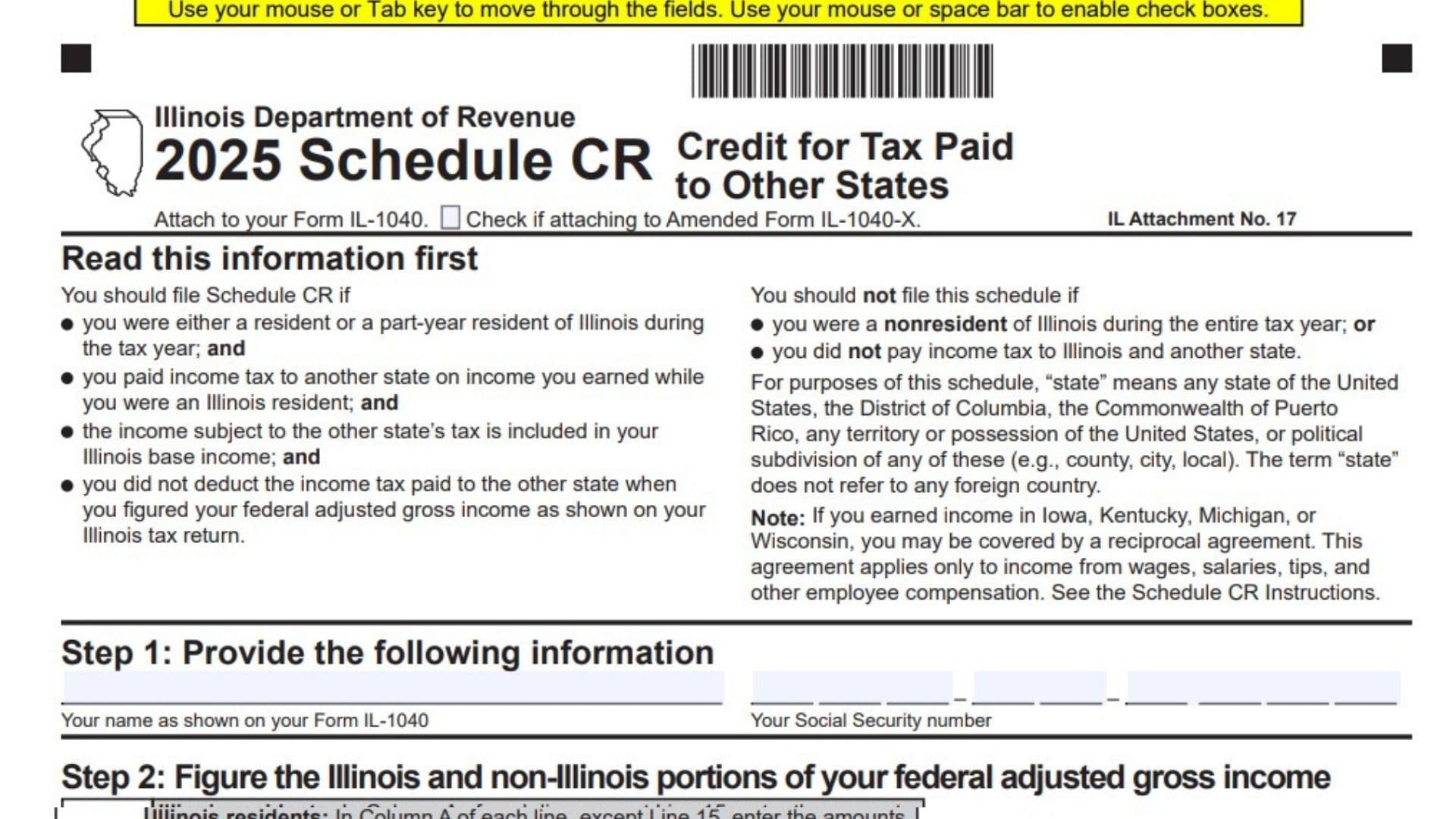
Illinois Schedule CR, officially titled Credit for Tax Paid to Other States, is a tax schedule issued by the Illinois Department of Revenue. It allows eligible Illinois residents and part-year residents to claim a credit for income taxes paid to another state or qualifying local government on income that is also included in their Illinois base income. The purpose of this credit is to prevent the same income from being taxed twice by Illinois and another qualifying jurisdiction.
The schedule is intended for individuals who lived in Illinois for all or part of the tax year, earned income that was subject to income tax in another state, and included that income in their Illinois tax calculation. To qualify, taxpayers must also ensure that they did not deduct the income tax paid to the other state when calculating their federal adjusted gross income reported on their Illinois return. The credit is subject to specific limitations and is generally restricted to the amount of Illinois tax attributable to the income taxed by another jurisdiction.
Schedule CR contains six steps. Step 1 collects the taxpayer’s identification information. Step 2 calculates the Illinois and non-Illinois portions of federal adjusted gross income using two columns. Step 3 reports Illinois additions and subtractions. Step 4 calculates the Schedule CR decimal, which measures the proportion of income attributable to sources outside Illinois. Step 5 applies an additional calculation for part-year residents. Step 6 determines the allowable credit for taxes paid to other states and calculates the final amount that can be transferred to Form IL-1040, Line 15.
The schedule includes income categories such as wages, salaries, interest, dividends, business income, capital gains, retirement distributions, rental income, farm income, unemployment compensation, and Social Security benefits. It also accounts for federal adjustments, Illinois additions, and Illinois subtractions. These calculations help determine the amount of income attributable to Illinois and the amount attributable to other jurisdictions.
For 2025, Schedule CR requires taxpayers to calculate the credit using the actual income tax paid to another state or qualifying local government, subject to the applicable Illinois tax limitation. The form specifically excludes state income tax withholding reported on Form W-2 from the tax-paid amount used on Line 51. However, qualifying city or local government withholding may be included when the taxpayer is not required to file a return with that jurisdiction. The final allowable credit is the smaller of the amount of qualifying taxes paid to other jurisdictions or the Illinois tax limitation calculated on Line 54.
Completing Schedule CR correctly is important because the credit reduces the Illinois income tax otherwise payable on income taxed by another jurisdiction. Incorrect income allocations, missing adjustments, or unsupported tax payment amounts can result in an incorrect credit calculation. The completed schedule must be attached to Form IL-1040, and the final credit from Schedule CR, Line 55, must be transferred to Form IL-1040, Line 15. Taxpayers should also retain their out-of-state tax returns and applicable Schedules K-1-P and K-1-T because the Illinois Department of Revenue may request them.
How To File Illinois Schedule CR
Illinois Schedule CR must be completed and attached to Form IL-1040, Illinois Individual Income Tax Return.
If you are filing an amended Illinois income tax return using Form IL-1040-X, check the designated amended-return box at the top of Schedule CR.
Who Should File Schedule CR?
You should generally file Schedule CR if all the following conditions apply:
- You were an Illinois resident or part-year resident during the tax year.
- You paid income tax to another state on income earned while you were an Illinois resident.
- The income taxed by the other state is included in your Illinois base income.
- You did not deduct the income tax paid to the other state when calculating your federal adjusted gross income reported on your Illinois return.
You must satisfy the applicable requirements before claiming the credit.
Who Should Not File Schedule CR?
The schedule identifies two circumstances in which you should not file it.
Nonresidents Of Illinois
Do not file Schedule CR if you were a nonresident of Illinois for the entire tax year.
No Income Tax Paid To Another Jurisdiction
Do not file Schedule CR if you did not pay income tax to both Illinois and another state.
What Does The Term State Mean?
For Schedule CR purposes, the term state includes:
- Any state of the United States.
- The District of Columbia.
- The Commonwealth of Puerto Rico.
- Any territory or possession of the United States.
- Political subdivisions of these jurisdictions, such as counties, cities, and local governments.
The term does not include foreign countries.
Reciprocal Agreements With Other States
Illinois has reciprocal agreements with Iowa, Kentucky, Michigan, and Wisconsin.
If you earned income in one of these states, you may be covered by a reciprocal agreement.
These agreements apply only to income from:
- Wages.
- Salaries.
- Tips.
- Other employee compensation.
If you earned income in one of these states, review the applicable Schedule CR instructions to determine whether the reciprocal agreement affects your eligibility to claim the credit.
Information To Prepare Before Completing Schedule CR
Gather the following information before starting:
- Completed or prepared Form IL-1040.
- Taxpayer’s full name.
- Social Security Number.
- Federal Form 1040 or Form 1040-SR.
- Federal Schedule 1.
- Federal income information for all applicable categories.
- Information about income earned outside Illinois.
- Schedule NR, if you are a part-year resident.
- Federal adjusted gross income information.
- Illinois additions and subtractions.
- Illinois tax due from Form IL-1040, Line 12.
- Illinois base income from Form IL-1040, Line 9, if you are a part-year resident.
- Illinois exemption amount from Form IL-1040, Line 10.
- Income tax returns filed with other states.
- Records of state and local income taxes paid.
- Applicable Schedules K-1-P and K-1-T.
Use the applicable federal and Illinois tax records to support the amounts entered throughout the schedule.

How To Complete Illinois Schedule CR
Illinois Schedule CR contains six steps divided into several income calculations and credit limitations.
The schedule uses two columns in its first three steps:
- Column A: Total income or adjustment amounts, depending on the applicable step and residency status.
- Column B: Non-Illinois portion of the applicable income or adjustment.
All amounts must be entered in whole dollars.
Follow the instructions below to complete each section and numbered line.
Step 1: Provide The Following Information
Step 1 appears on page 1 of Schedule CR and collects the taxpayer’s identification details.
Complete both fields using the information shown on your Form IL-1040.
Your Name As Shown On Your Form IL-1040
Enter your full name exactly as it appears on your Illinois Form IL-1040.
If you are filing jointly, use the taxpayer names in the same order as they appear on the main return.
Your Social Security Number
Enter your complete Social Security Number.
Make sure the number matches the identification information reported on Form IL-1040.
This information connects Schedule CR with your main Illinois income tax return.
Step 2: Figure The Illinois And Non-Illinois Portions Of Your Federal Adjusted Gross Income
Step 2 appears on pages 1 and 2 of the schedule.
Its purpose is to determine the portions of your federal income and adjustments attributable to Illinois and other jurisdictions.
The schedule provides two columns.
- Column A records the applicable total amounts.
- Column B records the non-Illinois portion of those amounts.
Column Instructions For Illinois Residents
If you were an Illinois resident for the entire tax year, enter the amounts in Column A exactly as reported on the corresponding lines of your federal income tax return, except for Line 15.
For Column B, report the applicable non-Illinois portion according to the detailed Schedule CR instructions.
Column Instructions For Part-Year Residents
If you were a part-year Illinois resident, enter the amounts in Column A using the corresponding figures from Schedule NR, Column B, as instructed on the form.
For Column B, enter the applicable non-Illinois portions using the detailed Schedule CR instructions.
Review the applicable instructions before allocating income between the two columns.
Income
The first group of lines reports different categories of income from your federal income tax return.
Line 1: Wages, Salaries, Tips, Etc.
Enter your wages, salaries, and tips.
Use the amount reported on federal Form 1040 or Form 1040-SR, Line 1z.
For Illinois residents, enter the amount exactly as reported on the federal return in Column A.
For part-year residents, use the corresponding amount from Schedule NR, Column B, as directed by the form.
Enter the applicable non-Illinois portion in Column B.
Line 2: Taxable Interest
Enter your taxable interest income.
Use the amount reported on federal Form 1040 or Form 1040-SR, Line 2b.
This may include taxable interest received from banks and other financial institutions.
Enter the applicable total in Column A and the non-Illinois portion in Column B.
Line 3: Ordinary Dividends
Enter your ordinary dividend income.
Use the amount reported on federal Form 1040 or Form 1040-SR, Line 3b.
Report the applicable total and non-Illinois portion in their respective columns.
Line 4: Taxable Refunds, Credits, Or Offsets Of State And Local Income Taxes
Enter the taxable refunds, credits, or offsets of state and local income taxes included in your federal income.
Use federal Form 1040 or Form 1040-SR, Schedule 1, Line 1.
Enter the applicable amounts in Columns A and B.
Line 5: Alimony Received
Enter taxable alimony received, when applicable.
Use the amount reported on federal Form 1040 or Form 1040-SR, Schedule 1, Line 2a.
Report the applicable total and non-Illinois portion.
Line 6: Business Income Or Loss
Enter your business income or loss.
Use the amount reported on federal Form 1040 or Form 1040-SR, Schedule 1, Line 3.
Include the applicable business income or loss in Column A and its non-Illinois portion in Column B.
Line 7: Capital Gain Or Loss
Enter your capital gain or loss.
Use the amount reported on federal Form 1040 or Form 1040-SR, Line 7a.
Report the applicable total and non-Illinois portion.
Line 8: Other Gains Or Losses
Enter other gains or losses reported on your federal income tax return.
Use federal Form 1040 or Form 1040-SR, Schedule 1, Line 4.
Enter the applicable amounts in Columns A and B.
Line 9: Taxable IRA Distributions
Enter the taxable portion of your individual retirement account distributions.
Use the amount reported on federal Form 1040 or Form 1040-SR, Line 4b.
Report the applicable total and non-Illinois portion.
Line 10: Pensions And Annuities
Enter the taxable amount of your pension and annuity income.
Use federal Form 1040 or Form 1040-SR, Line 5b.
Enter the applicable amount in Column A and its non-Illinois portion in Column B.
Line 11: Rental Real Estate, Royalties, Partnerships, S Corporations, Trusts, Etc.
Enter income or loss from rental real estate, royalties, partnerships, S corporations, trusts, and other activities included in this category.
Use federal Form 1040 or Form 1040-SR, Schedule 1, Line 5.
Report the applicable total and non-Illinois portion.
Line 12: Farm Income Or Loss
Enter your farm income or loss.
Use federal Form 1040 or Form 1040-SR, Schedule 1, Line 6.
Include the applicable total and non-Illinois portion.
Line 13: Unemployment Compensation
Enter your unemployment compensation included in federal income.
Use federal Form 1040 or Form 1040-SR, Schedule 1, Line 7.
Report the applicable amounts in Columns A and B.
Line 14: Taxable Social Security Benefits
Enter the taxable portion of your Social Security benefits.
Use federal Form 1040 or Form 1040-SR, Line 6b.
Enter the applicable total and non-Illinois portion.
Line 15: Other Income
Enter other income reported on your federal income tax return that is not separately identified on Lines 1 through 14.
Use federal Form 1040 or Form 1040-SR, Schedule 1, Line 9.
Identify each item of other income separately as required by the form.
Enter the applicable total in Column A and the non-Illinois portion in Column B.
Line 16: Total Income
Add the amounts in Lines 1 through 15 separately for Column A and Column B.
The calculation is:
- Column A, Line 16 = Sum of Column A, Lines 1 through 15.
- Column B, Line 16 = Sum of Column B, Lines 1 through 15.
Enter the respective totals.
These amounts are carried forward to Line 17 on page 2.
Adjustments To Income
The next group of lines reports adjustments to income used in calculating adjusted gross income.
Line 17: Income From Page 1
Enter the amounts from Page 1, Line 16.
Transfer the Column A amount to Column A, Line 17.
Transfer the Column B amount to Column B, Line 17.
Do not recalculate the amounts.
Line 18: Educator Expenses
Enter qualifying educator expenses reported on federal Form 1040 or Form 1040-SR, Schedule 1, Line 11.
Report the applicable total in Column A and the non-Illinois portion in Column B.
Line 19: Certain Business Expenses Of Reservists, Performing Artists, And Fee-Basis Government Officials
Enter qualifying business expenses reported on federal Schedule 1, Line 12.
Use the corresponding amount from federal Form 1040 or Form 1040-SR.
Report the applicable total and non-Illinois portion.
Line 20: Health Savings Account Deduction
Enter your health savings account deduction.
Use federal Form 1040 or Form 1040-SR, Schedule 1, Line 13.
Enter the applicable amounts in Columns A and B.
Line 21: Moving Expenses For Members Of The Armed Forces
Enter qualifying moving expenses for members of the Armed Forces.
Use federal Form 1040 or Form 1040-SR, Schedule 1, Line 14.
Report the applicable total and non-Illinois portion.
Line 22: Deductible Part Of Self-Employment Tax
Enter the deductible portion of your self-employment tax.
Use federal Form 1040 or Form 1040-SR, Schedule 1, Line 15.
Enter the applicable amounts in Columns A and B.
Line 23: Self-Employed SEP, SIMPLE, And Qualified Plans
Enter deductions for self-employed SEP, SIMPLE, and qualified retirement plans.
Use federal Form 1040 or Form 1040-SR, Schedule 1, Line 16.
Report the applicable total and non-Illinois portion.
Line 24: Self-Employed Health Insurance Deduction
Enter the deduction for self-employed health insurance.
Use federal Form 1040 or Form 1040-SR, Schedule 1, Line 17.
Enter the applicable amounts in Columns A and B.
Line 25: Penalty On Early Withdrawal Of Savings
Enter the penalty paid for early withdrawal of savings.
Use federal Form 1040 or Form 1040-SR, Schedule 1, Line 18.
Report the applicable total and non-Illinois portion.
Line 26: Alimony Paid
Enter deductible alimony paid, if applicable.
Use federal Form 1040 or Form 1040-SR, Schedule 1, Line 19a.
Enter the applicable amounts in Columns A and B.
Line 27: IRA Deduction
Enter your individual retirement account deduction.
Use federal Form 1040 or Form 1040-SR, Schedule 1, Line 20.
Report the applicable total and non-Illinois portion.
Line 28: Student Loan Interest Deduction
Enter your student loan interest deduction.
Use federal Form 1040 or Form 1040-SR, Schedule 1, Line 21.
Enter the applicable amounts in Columns A and B.
Line 29: Reserved
Line 29 is reserved for future use.
No income adjustment is reported on this line.
Leave it blank as instructed by the applicable form requirements.
Line 30: Archer MSA Deduction
Enter your Archer Medical Savings Account deduction, if applicable.
Use federal Form 1040 or Form 1040-SR, Schedule 1, Line 23.
Report the applicable total and non-Illinois portion.
Line 31: Other Adjustments
Enter other qualifying adjustments to income that are not separately identified on Lines 18 through 30.
Use the applicable information from your federal income tax return and follow the detailed Schedule CR instructions.
Report the applicable total in Column A and the non-Illinois portion in Column B.
Line 32: Total Adjustments To Income
Add Lines 18 through 31 separately for Columns A and B.
The calculation is:
- Column A, Line 32 = Sum of Column A, Lines 18 through 31.
- Column B, Line 32 = Sum of Column B, Lines 18 through 31.
Enter the corresponding totals.
Line 33: Adjusted Income After Adjustments
Subtract Line 32 from Line 17 separately for each column.
The calculation is:
- Column A, Line 33 = Column A, Line 17 − Column A, Line 32.
- Column B, Line 33 = Column B, Line 17 − Column B, Line 32.
Enter the results in their respective columns.
This completes Step 2.
Step 3: Figure Your Illinois Additions And Subtractions
Step 3 appears on page 2 and calculates the Illinois adjustments that must be considered when determining the income attributable to Illinois and other jurisdictions.
Unlike Step 2, Column A in this section uses amounts reported on Form IL-1040.
Column B represents the applicable non-Illinois portion and must be completed using the detailed Schedule CR instructions.
Illinois Additions
Line 34: Federally Tax-Exempt Interest And Dividend Income
Enter federally tax-exempt interest and dividend income.
Use Form IL-1040, Line 2.
Report the total amount in Column A and the applicable non-Illinois portion in Column B.
Line 35: Other Additions
Enter other additions to Illinois income reported on Form IL-1040, Line 3.
Include the applicable total and non-Illinois portion.
Line 36: Total Income After Illinois Additions
Add Lines 33, 34, and 35 separately for Columns A and B.
The calculation is:
- Column A, Line 36 = Column A, Line 33 + Column A, Line 34 + Column A, Line 35.
- Column B, Line 36 = Column B, Line 33 + Column B, Line 34 + Column B, Line 35.
Enter the corresponding totals.
Illinois Subtractions
Line 37: Federally Taxed Social Security And Retirement Income
Enter federally taxed Social Security and retirement income reported on Form IL-1040, Line 5.
Report the applicable total and non-Illinois portion.
Line 38: Illinois Income Tax Overpayment Included On Your Federal Return
Enter the Illinois income tax overpayment included in your federal income.
Use Form IL-1040, Line 6.
The form identifies this amount as the Illinois income tax overpayment included on federal Form 1040 or Form 1040-SR, Schedule 1, Line 1.
Enter the applicable amounts in Columns A and B.
Line 39: Other Subtractions
Enter other Illinois income subtractions reported on Form IL-1040, Line 7.
Report the total amount in Column A and the applicable non-Illinois portion in Column B.
Line 40: Total Illinois Subtractions
Add Lines 37, 38, and 39 separately for Columns A and B.
The calculation is:
- Column A, Line 40 = Column A, Line 37 + Column A, Line 38 + Column A, Line 39.
- Column B, Line 40 = Column B, Line 37 + Column B, Line 38 + Column B, Line 39.
Enter the corresponding totals.
Line 41: Illinois Income After Additions And Subtractions
Subtract Line 40 from Line 36 separately for Columns A and B.
The calculation is:
- Column A, Line 41 = Column A, Line 36 − Column A, Line 40.
- Column B, Line 41 = Column B, Line 36 − Column B, Line 40.
If Line 40 is greater than Line 36, enter zero.
Enter the resulting amounts in their respective columns.
These amounts are carried forward to Step 4.
Step 4: Figure Your Schedule CR Decimal
Step 4 appears on page 3.
This section calculates the proportion of your Illinois adjusted income represented by income from outside Illinois.
The resulting decimal is used to determine the maximum allowable credit for taxes paid to other states.
Line 42: Income From Step 3
Enter the amounts from Line 41.
- Column A: Transfer the amount from Column A, Line 41.
- Column B: Transfer the amount from Column B, Line 41.
Do not recalculate these figures.
Line 43: Schedule CR Decimal
Divide Column B, Line 42, by Column A, Line 42.
The calculation is:
Schedule CR Decimal = Column B, Line 42 ÷ Column A, Line 42.
Round the result to three decimal places.
If Column B, Line 42 is greater than Column A, Line 42, enter 1.000.
Enter the resulting decimal on Line 43.
You must also transfer this amount to Step 6, Line 53.
This decimal is used to calculate the portion of Illinois tax that can be considered when determining your credit for income taxes paid to other jurisdictions.
Step 5: Part-Year Residents Only
Step 5 appears on page 3.
This section applies only to taxpayers who were Illinois residents for part of the tax year.
If you were an Illinois resident for the entire year, skip Step 5 and proceed directly to Step 6.
Part-Year Resident Calculations
Line 44: Illinois Base Income
Enter your Illinois base income from Form IL-1040, Line 9.
Use the exact amount reported on the main Illinois income tax return.
Line 45: Part-Year Residency Percentage
Divide Column A, Line 42, by Line 44.
The calculation is:
Line 45 = Column A, Line 42 ÷ Line 44.
Round the result to three decimal places.
If Column A, Line 42 is greater than Line 44, enter 1.000.
Enter the resulting decimal on Line 45.
Line 46: Illinois Exemption Amount
Enter the exemption amount reported on Form IL-1040, Line 10.
Use the amount from the main Illinois income tax return.
Line 47: Prorated Exemption Amount
Multiply Line 45 by Line 46.
The calculation is:
Line 47 = Line 45 × Line 46.
Enter the resulting amount on Line 47.
This calculation adjusts the exemption amount based on the part-year residency percentage.
Line 48: Adjusted Illinois Income For Credit Calculation
Subtract Line 47 from Column A, Line 42.
The calculation is:
Line 48 = Column A, Line 42 − Line 47.
Enter the resulting amount on Line 48.
Line 49: Illinois Tax On Adjusted Part-Year Income
Multiply Line 48 by 4.95%, or 0.0495.
The calculation is:
Line 49 = Line 48 × 0.0495.
Enter the resulting amount on Line 49.
Transfer this amount to Step 6, Line 52.
Part-year residents must use this calculated amount when determining their credit limitation rather than directly using the Illinois tax due from Form IL-1040, Line 12.
Step 6: Figure Your Credit
Step 6 appears on page 3 and determines the final Credit for Tax Paid to Other States.
This section includes a state selection, the amount of qualifying taxes paid, the applicable Illinois tax limitation, and the final credit calculation.
Credit For Tax Paid To Other States
Line 50: Select The Applicable State
If you are claiming a credit for income taxes paid to any of the states listed on the schedule, check the corresponding box.
The available states are:
- Iowa.
- Kentucky.
- Michigan.
- Wisconsin.
Select the applicable state when claiming the credit for taxes paid to that jurisdiction.
Refer to the Schedule CR instructions for the treatment of taxes paid to these states and any applicable reciprocal agreement.
Line 51: Total Income Tax Paid To Other States
Enter the total qualifying income tax paid to other states on income included in your Illinois base income.
The schedule permits the following amounts:
- State income tax paid as reported on the tax return filed with that state.
- City income tax paid as reported on the return filed with that city.
- Local government income tax paid as reported on the return filed with that local government.
- City or local government withholding reported on Form W-2 when a tax return is not required to be filed with that jurisdiction.
The form specifically excludes state tax withholding reported on Form W-2.
Do not simply add all state income tax withholding amounts from your W-2.
Enter only the qualifying tax amounts paid on the income included in your Illinois base income.
Line 52: Illinois Tax Limitation
The amount entered on Line 52 depends on whether you are a full-year Illinois resident or a part-year resident.
For Illinois residents, enter your Illinois tax due from Form IL-1040, Line 12.
For part-year residents, enter the amount calculated on Step 5, Line 49.
Use the appropriate amount based on your residency status.
Line 53: Schedule CR Decimal
Enter the decimal calculated on Step 4, Line 43.
Use the same amount without recalculating it.
This decimal represents the applicable proportion of non-Illinois income used in the credit limitation.
Line 54: Maximum Allowable Credit
Multiply Line 52 by Line 53.
The calculation is:
Line 54 = Line 52 × Line 53.
Enter the resulting amount.
This represents the maximum Illinois tax credit allowed under the Schedule CR limitation.
Line 55: Final Credit For Tax Paid To Other States
Compare the amounts on Lines 51 and 54.
Enter the smaller amount.
The calculation is:
Final Credit = Smaller of Line 51 or Line 54.
Transfer this amount to Form IL-1040, Line 15.
This is your allowable Credit for Tax Paid to Other States.
Do not enter an amount greater than the qualifying taxes paid or the applicable Illinois tax limitation.
Important Recordkeeping Requirement
Keep the following documents with your tax records:
- Out-of-state income tax returns.
- Applicable Schedule K-1-P.
- Applicable Schedule K-1-T.
You do not need to send these documents with Schedule CR as a routine filing requirement. However, the Illinois Department of Revenue requires you to provide this information if requested.
Important Filing And Calculation Rules
Before submitting Schedule CR, review the following requirements to ensure the credit is calculated correctly.
Residency Requirement
Schedule CR is intended for full-year and part-year Illinois residents who meet the applicable requirements.
Full-year nonresidents should not file this schedule.
Income Must Be Included In Illinois Base Income
The income taxed by another state must also be included in your Illinois base income.
You cannot claim this credit simply because you paid taxes to another jurisdiction on income that is not included in your Illinois tax calculation.
No Federal Deduction For The Other-State Income Tax
The schedule requires that you did not deduct the income tax paid to the other state when calculating the federal adjusted gross income reported on your Illinois return.
State Withholding Is Not Automatically A Qualifying Tax Payment
Line 51 does not allow state income tax withholding reported on Form W-2.
However, qualifying city or local government withholding may be included when you are not required to file a return with that jurisdiction.
Separate Rules For Part-Year Residents
Part-year residents must complete Step 5 before calculating the credit on Step 6.
Full-year residents skip Step 5 and use Form IL-1040, Line 12, on Line 52.
Credit Limitation
The final credit cannot exceed the smaller of:
- Qualifying income taxes paid to other jurisdictions on Line 51.
- The allowable Illinois tax amount calculated on Line 54.
Supporting Documentation
Retain out-of-state tax returns and applicable Schedules K-1-P and K-1-T.
Provide these documents if the Illinois Department of Revenue requests them.
Where To Report The Schedule CR Credit
The final credit calculated on Schedule CR must be transferred to the main Illinois individual income tax return.
Schedule CR, Line 55 → Form IL-1040, Line 15
Enter the same amount on Form IL-1040, Line 15.
Verify that the amount on the main return matches the final credit reported on Schedule CR.
Final Review Before Filing
Before submitting Illinois Schedule CR for the 2025 tax year, review every applicable step, income allocation, adjustment, and credit calculation.
Use the following checklist:
- Confirm that you are using the correct 2025 Schedule CR.
- Determine whether you qualify as an Illinois resident or part-year resident.
- Confirm that you paid income tax to another qualifying state or local jurisdiction.
- Verify that the income taxed by the other jurisdiction is included in your Illinois base income.
- Confirm that the other-state income tax was not deducted when calculating your federal adjusted gross income.
- Check whether a reciprocal agreement applies to income earned in Iowa, Kentucky, Michigan, or Wisconsin.
- Enter your name exactly as shown on Form IL-1040.
- Enter your correct Social Security Number.
- Complete Step 2 using the applicable federal return or Schedule NR information.
- Enter wages, salaries, and tips on Line 1.
- Enter taxable interest on Line 2.
- Enter ordinary dividends on Line 3.
- Enter taxable state and local tax refunds on Line 4.
- Enter alimony received on Line 5, if applicable.
- Enter business income or loss on Line 6.
- Enter capital gain or loss on Line 7.
- Enter other gains or losses on Line 8.
- Enter taxable IRA distributions on Line 9.
- Enter pensions and annuities on Line 10.
- Enter rental, royalty, partnership, S corporation, and trust income on Line 11.
- Enter farm income or loss on Line 12.
- Enter unemployment compensation on Line 13.
- Enter taxable Social Security benefits on Line 14.
- Identify each item of other income on Line 15.
- Add Lines 1 through 15 on Line 16.
- Transfer the Line 16 amounts to Line 17.
- Enter educator expenses on Line 18.
- Enter qualifying reservist, performing artist, and government official expenses on Line 19.
- Enter the health savings account deduction on Line 20.
- Enter qualifying Armed Forces moving expenses on Line 21.
- Enter deductible self-employment tax on Line 22.
- Enter self-employed retirement plan deductions on Line 23.
- Enter the self-employed health insurance deduction on Line 24.
- Enter the early withdrawal penalty on Line 25.
- Enter deductible alimony paid on Line 26.
- Enter the IRA deduction on Line 27.
- Enter student loan interest on Line 28.
- Leave reserved Line 29 as instructed.
- Enter the Archer MSA deduction on Line 30.
- Enter other applicable adjustments on Line 31.
- Add Lines 18 through 31 on Line 32.
- Subtract Line 32 from Line 17 on Line 33.
- Complete Step 3 using Form IL-1040 information.
- Enter federally tax-exempt interest and dividends on Line 34.
- Enter other Illinois additions on Line 35.
- Add Lines 33, 34, and 35 on Line 36.
- Enter federally taxed Social Security and retirement income on Line 37.
- Enter the Illinois income tax overpayment on Line 38.
- Enter other Illinois subtractions on Line 39.
- Add Lines 37 through 39 on Line 40.
- Subtract Line 40 from Line 36 on Line 41, entering zero if Line 40 is greater.
- Transfer Line 41 to Line 42.
- Calculate the Schedule CR decimal on Line 43.
- Round the decimal to three places.
- Complete Step 5 if you are a part-year Illinois resident.
- Enter Illinois base income on Line 44.
- Calculate the part-year residency percentage on Line 45.
- Enter the exemption amount on Line 46.
- Calculate the prorated exemption on Line 47.
- Subtract Line 47 from Column A, Line 42, on Line 48.
- Calculate the Illinois tax amount on Line 49.
- Select the applicable state on Line 50, if required.
- Enter qualifying income taxes paid to other states on Line 51.
- Exclude state income tax withholding reported on Form W-2 from Line 51.
- Enter the correct Illinois tax limitation on Line 52.
- Transfer the decimal from Line 43 to Line 53.
- Multiply Lines 52 and 53 on Line 54.
- Compare Lines 51 and 54.
- Enter the smaller amount on Line 55.
- Transfer the Line 55 amount to Form IL-1040, Line 15.
- Retain out-of-state income tax returns and applicable Schedules K-1-P and K-1-T.
- Check the amended-return box if attaching the schedule to Form IL-1040-X.
- Attach the completed Schedule CR to Form IL-1040.
Final Note: Illinois Schedule CR allows eligible full-year and part-year residents to claim a credit for qualifying income taxes paid to other states or local jurisdictions on income also included in their Illinois base income. Accurate completion requires proper income allocation, correct federal and Illinois adjustments, and application of the Schedule CR decimal and tax limitation. Complete all six steps, retain the supporting tax records, and transfer the final allowable credit from Line 55 to Form IL-1040, Line 15, before filing.