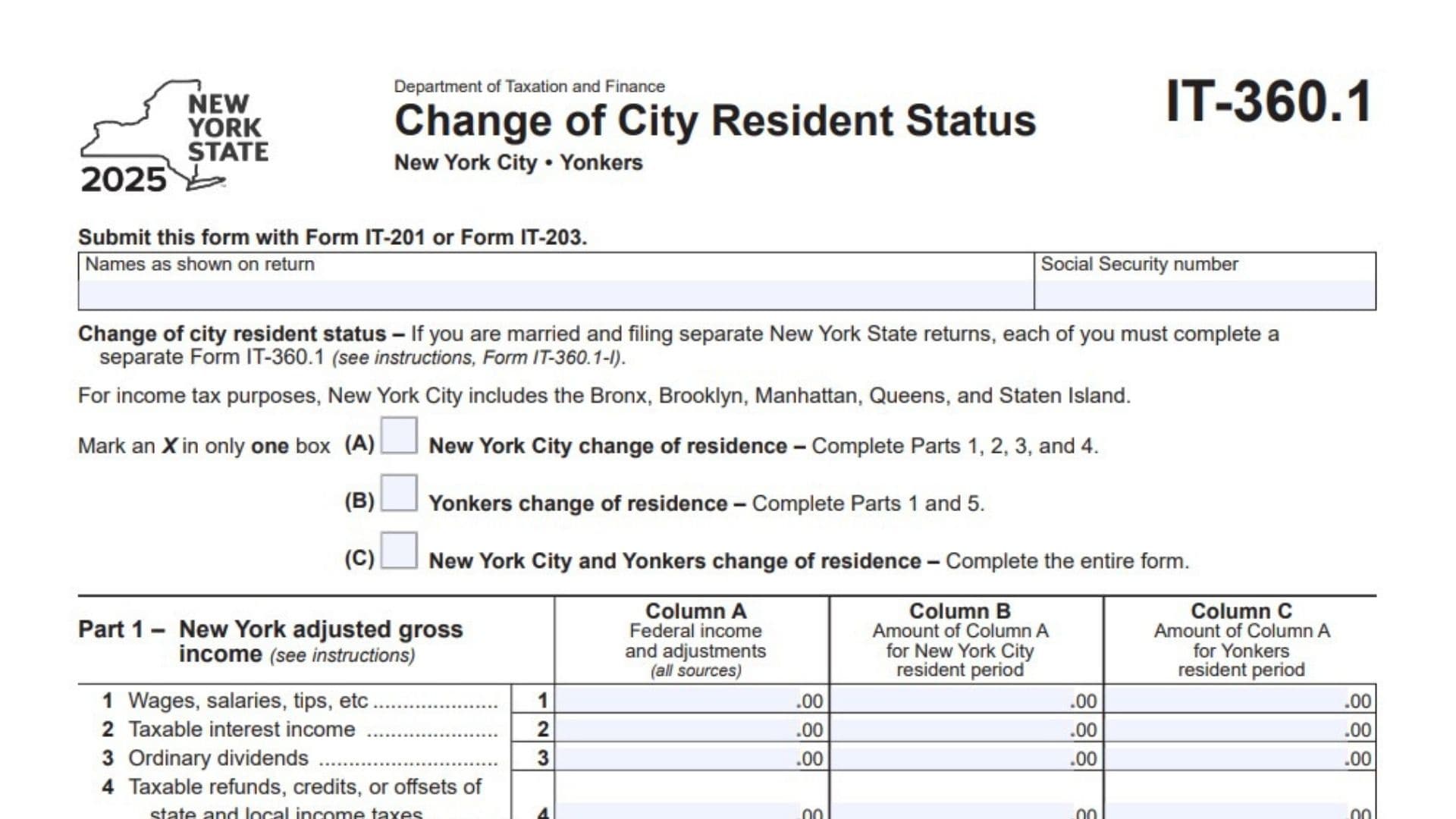
Form IT-360.1, titled Change of City Resident Status, is a New York State tax form used by individuals who change their residency status involving New York City or Yonkers during the tax year. It helps determine the portion of an individual’s income and applicable tax liability associated with the period they lived in either city. The form is issued by the New York State Department of Taxation and Finance and is designed for taxpayers who move into or out of New York City, Yonkers, or both during the year. For income tax purposes, New York City includes the Bronx, Brooklyn, Manhattan, Queens, and Staten Island. The form collects information about federal income, New York adjustments, itemized deductions, dependent exemptions, residency dates, applicable tax credits, and city-related tax calculations. It also distinguishes between income associated with the New York City resident period and income associated with the Yonkers resident period. Depending on the taxpayer’s circumstances, different sections of the form must be completed to calculate the appropriate part-year resident tax or Yonkers income tax surcharge. Completing Form IT-360.1 accurately is important because the residency period affects how income, deductions, exemptions, and tax liabilities are calculated. Incorrect residency dates, income allocations, or calculations may result in an incorrect tax amount being reported on the taxpayer’s New York State income tax return.
How To File Form IT-360.1
Form IT-360.1 must be submitted with the taxpayer’s New York State income tax return. It is not presented as a standalone return.
The form must be attached to one of the following:
- Form IT-201: New York State Resident Income Tax Return.
- Form IT-203: Nonresident and Part-Year Resident Income Tax Return.
The appropriate main tax return depends on the taxpayer’s overall New York State residency circumstances.
Information To Prepare Before Completing The Form
Gather the following information before starting:
- Your name exactly as it appears on your New York State income tax return.
- Your Social Security number.
- Your federal income and adjustment information.
- Your New York modifications to federal adjusted gross income.
- Your New York City residency dates during the tax year, if applicable.
- Your Yonkers residency information, if applicable.
- Your itemized deduction details, if you are claiming itemized deductions.
- Your dependent exemption information from your New York State income tax return.
- Applicable New York State tax credits and tax amounts.
- Supporting federal schedules and forms referenced in Part 1.
- Your completed Form IT-201 or Form IT-203, as applicable.
Selecting The Correct Residency Category
Before completing the numbered sections, identify which residency change applies to your situation. Mark an X in only one of the three available boxes.
Option A: New York City Change of Residence
Select this option if your residency change involves New York City. You must complete Parts 1, 2, 3, and 4.
Option B: Yonkers Change of Residence
Select this option if your residency change involves Yonkers. You must complete Parts 1 and 5.
Option C: New York City and Yonkers Change of Residence
Select this option if your circumstances involve residency changes affecting both New York City and Yonkers. You must complete the entire form, including Parts 1 through 5.
Special rule for married taxpayers filing separately: If you are married and filing separate New York State income tax returns, each spouse must prepare a separate Form IT-360.1.
How To Complete Form IT-360.1
The form contains five main parts covering income, deductions, dependent exemptions, New York City part-year resident tax, and the Yonkers part-year resident income tax surcharge.
Follow the instructions below in the order presented on the form.
Part 1: New York Adjusted Gross Income
Part 1 collects federal income and adjustment information and calculates New York adjusted gross income. It contains three columns that separate income according to its source and the taxpayer’s city residency periods.
Understanding The Three Columns
Column A: Federal Income and Adjustments (All Sources)
Enter the applicable federal income and adjustment amounts from all sources. This column provides the starting information for the remaining calculations.
Column B: New York City Resident Period
Enter the portion of each Column A amount attributable to the New York City resident period.
Column C: Yonkers Resident Period
Enter the portion of each Column A amount attributable to the Yonkers resident period.
Income Entries
Line 1: Wages, Salaries, Tips, and Other Compensation
Enter your income from employment, including wages, salaries, tips, and other taxable compensation. Use Column A for the total applicable federal amount, Column B for the amount attributable to your New York City residency period, and Column C for the amount attributable to your Yonkers residency period.
Line 2: Taxable Interest Income
Report taxable interest received from sources such as bank accounts and other interest-bearing investments. Enter the applicable total in Column A and allocate the corresponding amounts to Columns B and C.
Line 3: Ordinary Dividends
Enter ordinary dividends received from investments during the tax year. Include the applicable federal income amount and the portions attributable to the respective city residency periods.
Line 4: Taxable State and Local Tax Refunds, Credits, or Offsets
Report taxable refunds, credits, or offsets involving state and local income taxes. Enter the appropriate amounts in the three columns based on the applicable income and residency periods.
Line 5: Alimony Received
Enter taxable alimony received during the tax year, if applicable. Use the amount included in your federal income calculation and allocate the relevant portions to the New York City and Yonkers resident periods.
Line 6: Business Income or Loss
Enter income or loss from business activities as reported for federal tax purposes. If applicable, include a copy of federal Schedule C, Form 1040, with the tax return. Allocate the amounts among the columns as appropriate.
Line 7: Capital Gain or Loss
Report capital gains or losses from the sale or exchange of capital assets. Use the amount reported on federal Schedule D, Form 1040, and include a copy of that schedule when applicable. Enter the appropriate amounts for each column.
Line 8: Other Gains or Losses
Enter other gains or losses that are not included in the preceding income categories. Use federal Form 4797 as applicable and submit a copy of the form. Allocate the amounts to the relevant residency periods.
Line 9: Taxable Amount of IRA Distributions
Enter the taxable portion of distributions received from individual retirement arrangements (IRAs). Use the taxable amount included in your federal income calculation rather than the total distribution when the two amounts differ.
Line 10: Taxable Amount of Pensions and Annuities
Report the taxable portion of pension and annuity payments received during the tax year. Enter the relevant amount in Column A and allocate the applicable portions to Columns B and C.
Line 11: Rental Real Estate, Royalties, Partnerships, S Corporations, and Trusts
Enter applicable income or loss from rental real estate, royalties, partnerships, S corporations, and trusts. Use federal Schedule E, Form 1040, as applicable, and include a copy of the schedule. Allocate the relevant amounts among the three columns.
Line 12: Farm Income or Loss
Report income or loss from farming activities as included in your federal income calculation. Use federal Schedule F, Form 1040, and submit a copy when applicable. Enter the appropriate amounts for each residency period.
Line 13: Unemployment Compensation
Enter taxable unemployment compensation received during the tax year. Report the applicable total in Column A and the amounts associated with the New York City and Yonkers residency periods in Columns B and C.
Line 14: Taxable Amount of Social Security Benefits
Enter the taxable portion of Social Security benefits included in your federal income. Do not automatically enter the full amount of benefits received if only a portion is taxable.
Line 15: Other Income
Report taxable income that does not fit into any of the preceding categories. Identify the type of income in the space provided. Enter the applicable amount in Column A and allocate the corresponding amounts to Columns B and C.
Line 16: Total Income
Add the amounts reported on lines 1 through 15 separately for each column.
The calculation is:
Line 16 = Lines 1 + 2 + 3 + 4 + 5 + 6 + 7 + 8 + 9 + 10 + 11 + 12 + 13 + 14 + 15.
Enter the resulting totals in Columns A, B, and C.
Line 17: Total Federal Adjustments to Income
Enter the total applicable federal adjustments to income. Identify the adjustments in the space provided. These amounts should reflect the adjustments included in calculating federal adjusted gross income.
Enter the applicable amounts in Columns A, B, and C.
Line 18: Federal Adjusted Gross Income
Subtract the amount on line 17 from line 16 separately for each column.
Calculation:
Line 18 = Line 16 − Line 17.
This gives the federal adjusted gross income amounts used for the next calculation.
Line 19: New York Modifications
Enter the applicable New York modifications to federal adjusted gross income. These modifications are reported separately from the federal adjustments entered on line 17.
Submit the required supporting schedule for the New York modifications.
Line 20: New York Adjusted Gross Income
Combine line 18 and line 19 separately for each applicable column.
Calculation:
Line 20 = Line 18 + Line 19.
The resulting amounts represent New York adjusted gross income for the relevant income and residency categories. The Column B amount is also used in determining whether the itemized deduction adjustment on line 35 applies.
Part 2: Itemized Deductions for New York City
Part 2 calculates the itemized deductions applicable to the New York City resident period.
Important: If you are claiming the standard deduction, you must not complete Part 2. This section is intended for taxpayers claiming itemized deductions.
The section contains two columns:
- Column A: Total applicable itemized deduction amounts.
- Column B: The portion of each Column A amount attributable to the New York City resident period.
Itemized Deduction Entries
Line 21: Medical and Dental Expenses
Enter qualifying medical and dental expenses included in your itemized deduction calculation. Column B should reflect the portion attributable to the New York City resident period.
Line 22: Taxes Paid
Report qualifying taxes paid that are included in your itemized deductions. Enter the applicable total in Column A and the corresponding New York City resident-period amount in Column B.
Line 23: Interest Paid
Enter qualifying interest expenses included in your itemized deduction calculation. Allocate the applicable portion to the New York City resident period.
Line 24: Gifts to Charity
Report qualifying charitable contributions included in your itemized deductions. Enter the total amount in Column A and the appropriate resident-period amount in Column B.
Line 25: Casualty and Theft Losses
Enter qualifying casualty and theft losses included in your itemized deductions. Use the applicable amounts and identify the portion attributable to the New York City resident period.
Line 26: Job Expenses and Certain Miscellaneous Deductions
Report qualifying job-related expenses and miscellaneous deductions included in your itemized deduction calculation. Enter the relevant amounts in both columns.
Line 27: Other Itemized Deductions
Enter other qualifying itemized deductions that are not covered by lines 21 through 26. Include the appropriate amounts in Columns A and B.
Line 28: Total Itemized Deductions Before Limitation
Add the amounts reported on lines 21 through 27 separately for each column.
Calculation:
Line 28 = Lines 21 + 22 + 23 + 24 + 25 + 26 + 27.
Line 29: Reduction for Itemized Deduction Limitation
Enter the applicable reduction resulting from the itemized deduction limitation. Calculate this amount using the applicable instructions and enter the appropriate figures for both columns.
Line 30: Total Itemized Deductions
Subtract line 29 from line 28.
Calculation:
Line 30 = Line 28 − Line 29.
This amount represents itemized deductions after applying the applicable limitation.
Line 31: State, Local, and Foreign Income Taxes or General Sales Tax and Other Subtraction Adjustments
Enter the applicable state, local, and foreign income taxes or general sales tax, where applicable, along with other required subtraction adjustments. This line has a single amount entry rather than separate Column A and Column B entries.
Line 32: Itemized Deductions After Subtraction Adjustments
Subtract line 31 from line 30.
Calculation:
Line 32 = Line 30 − Line 31.
Enter the resulting amount in the designated space.
Line 33: Addition Adjustments and College Tuition Itemized Deduction
Enter applicable addition adjustments and the college tuition itemized deduction, if eligible. Determine the amount using the relevant instructions.
Line 34: Adjusted Itemized Deduction Amount Before Final Adjustment
Add line 32 and line 33.
Calculation:
Line 34 = Line 32 + Line 33.
Line 35: Itemized Deduction Adjustment
Determine whether an itemized deduction adjustment is required based on the amount reported on line 20, Column B.
If line 20, Column B, is more than $100,000, calculate the applicable adjustment using the instructions. All other taxpayers must enter zero on this line.
Line 36: Final Itemized Deduction
Enter the itemized deduction amount calculated under the applicable instructions. This amount is used again in Part 4 on line 44.
The amount reported on line 36 should also be entered in the corresponding resident-period deduction calculation in Part 4.
Part 3: Dependent Exemptions
Part 3 determines the dependent exemption amount applicable to the New York City resident period. It uses the taxpayer’s residency dates, the number of full months spent as a New York City resident, and the dependent exemptions claimed on the main New York State income tax return.
Line 37: New York City Residency Period
Enter the dates during which you were a New York City resident during the 2025 tax year.
The form requires both the starting and ending dates:
- From: Enter the starting month and day.
- To: Enter the ending month and day.
Use two digits for the month and two digits for the day. For example, enter a month as 01 rather than 1.
Line 38: Intentionally Blank
This line is intentionally left blank on the form. No amount or additional information is required.
Line 39: Number of Full Months as a New York City Resident
Enter the number of full months included in your New York City residency period.
Determine the number of complete months using the applicable form instructions. This figure is used to calculate the prorated dependent exemption on the next line.
Line 40: Prorated Value of One Dependent Exemption
Enter the prorated value of one dependent exemption using the proration chart provided in the form instructions.
The calculation is based on the length of your New York City residency period. Do not automatically enter the full-year exemption amount without applying the required proration.
Line 41: Number of Dependent Exemptions Claimed
Enter the number of dependent exemptions claimed on your main New York State income tax return.
Use the applicable reference:
- Form IT-201, line 36; or
- Form IT-203, line 35.
Make sure the number agrees with the dependent exemption information reported on your main return.
Line 42: Total Dependent Exemption Amount
Multiply the prorated exemption amount on line 40 by the number of dependent exemptions entered on line 41.
Calculation:
Line 42 = Line 40 × Line 41.
Enter the resulting amount on line 42 and carry the same figure to line 46 in Part 4.
Part 4: Part-Year New York City Resident Tax
Part 4 calculates the New York City income tax applicable to the taxpayer’s part-year residency period.
It uses the New York City adjusted gross income, applicable deductions, dependent exemptions, tax credits, and other relevant tax amounts to determine the final part-year New York City resident tax.
Line 43: New York City Adjusted Gross Income
Enter the New York City adjusted gross income amount determined using the applicable information and instructions.
This amount forms the starting point for calculating New York City taxable income.
Line 44: Standard or Itemized Deduction for the Resident Period
Enter the deduction applicable to your New York City residency period.
Use either:
- The standard deduction calculated for the resident period; or
- The itemized deduction from line 36.
Do not combine the standard and itemized deductions. Use the applicable deduction method.
Line 45: Income After Deduction
Subtract the deduction reported on line 44 from the New York City adjusted gross income on line 43.
Calculation:
Line 45 = Line 43 − Line 44.
The resulting amount is used to calculate New York City taxable income.
Line 46: Dependent Exemption Amount
Enter the dependent exemption amount calculated on line 42.
This amount represents the prorated dependent exemption applicable to your New York City resident period.
Line 47: New York City Taxable Income
Subtract line 46 from line 45.
Calculation:
Line 47 = Line 45 − Line 46.
The resulting amount represents New York City taxable income used to determine the city tax.
Line 48: New York City Tax
Calculate the New York City income tax on the taxable income reported on line 47.
Use the applicable New York City tax rates and calculation instructions for the tax year.
Line 49: New York City Household Credit and Accumulation Distribution Credit
Enter the combined applicable amounts for the New York City household credit and accumulation distribution credit.
Determine the eligible credit amounts using the relevant instructions and supporting tax information.
Line 50: New York City Tax After Credits
Subtract the credit amount on line 49 from the tax reported on line 48.
Calculation:
Line 50 = Line 48 − Line 49.
If line 49 is greater than line 48, enter zero rather than a negative amount.
Line 51: Part-Year New York City Separate Tax on Lump-Sum Distributions
Enter the applicable part-year New York City separate tax on lump-sum distributions.
Use the amount calculated on Form IT-230, where applicable.
Line 52: Part-Year New York City Tax on the Capital Gain Portion of Lump-Sum Distributions
Enter the applicable New York City resident tax associated with the capital gain portion of lump-sum distributions.
Transfer the amount from Form IT-230, if applicable.
Line 53: Total New York City Tax Before Unincorporated Business Tax Credit
Add the amounts reported on lines 50, 51, and 52.
Calculation:
Line 53 = Line 50 + Line 51 + Line 52.
This amount represents the combined tax before applying the credit on line 54.
Line 54: Credit for Part-Year New York City Unincorporated Business Tax Paid
Enter the eligible credit for New York City unincorporated business tax paid during the applicable period.
Calculate the amount using the relevant instructions and supporting tax information.
Line 55: Final Part-Year New York City Resident Tax
Subtract line 54 from line 53.
Calculation:
Line 55 = Line 53 − Line 54.
If line 54 is greater than line 53, enter zero.
Transfer the resulting amount to the appropriate line on your main New York State tax return:
- Form IT-201, line 50; or
- Form IT-203, line 51.
This completes the New York City part-year resident tax calculation.
Part 5: Part-Year Yonkers Resident Income Tax Surcharge
Part 5 calculates the income tax surcharge applicable to individuals who changed their Yonkers residency status during the tax year.
The calculation depends on whether the taxpayer was a full-year New York State resident or a part-year New York State resident.
The section contains separate columns for these two categories:
- Full-Year NYS Resident: Use the full-year resident column when calculating the surcharge for a taxpayer who maintained New York State residency throughout the tax year.
- Part-Year NYS Resident: Use the part-year resident column when calculating the surcharge for a taxpayer who was a New York State resident for only part of the year.
Complete the applicable column based on your New York State residency status.
Full-Year New York State Resident Calculation
Line 56: Total New York State Taxes
Enter the total New York State tax amount from Form IT-201, line 46.
This amount provides the starting figure for the full-year Yonkers surcharge calculation.
Line 57: Empire State Child Credit
Enter the Empire State child credit reported on Form IT-201, line 63.
Use the amount applicable to your tax return.
Line 58: New York State Child and Dependent Care Credit
Enter the applicable New York State child and dependent care credit from Form IT-216, line 14.
Line 59: Earned Income Credit
Enter the earned income credit reported on Form IT-201, line 65.
Line 60: Noncustodial Parent New York State Earned Income Credit
Enter the noncustodial parent New York State earned income credit reported on Form IT-201, line 66, if applicable.
Line 61: Real Property Tax Credit
Enter the real property tax credit reported on Form IT-201, line 67.
Line 61a: New York City School Tax Credit
Enter the New York City school tax credit reported on Form IT-201, lines 69 and 69a.
Line 62: College Tuition Credit
Enter the college tuition credit reported on Form IT-201, line 68.
Line 62a: Intentionally Blank
This line is intentionally left blank. No entry is required.
Line 63: New York State Refundable Credits
Enter the applicable New York State refundable credits using the relevant instructions.
Include the qualifying credit amounts applicable to your tax return.
Line 64: Total Applicable Credits
Add all amounts reported on lines 57 through 63.
Calculation:
Line 64 = Lines 57 + 58 + 59 + 60 + 61 + 61a + 62 + 63.
Line 62a is intentionally blank and is not included in the calculation.
Line 65: New York State Tax After Credits
Subtract line 64 from line 56.
Calculation:
Line 65 = Line 56 − Line 64.
If line 64 is greater than line 56, enter zero on this line and also enter zero on Form IT-201, line 57, as directed by the form.
Part-Year New York State Resident Calculation
The remaining lines distinguish between full-year and part-year New York State residency calculations. Complete the applicable column.
Line 66: Base Tax
For part-year New York State residents, enter the base tax amount reported on Form IT-203, line 44.
This amount provides the starting point for the part-year calculation.
Line 67: New York State Nonrefundable Credits
Enter the applicable New York State nonrefundable credits from Form IT-203-ATT, line 8.
Use the amount reported on the supporting tax schedule.
Line 68: New York State Tax After Nonrefundable Credits
Subtract line 67 from line 66.
Calculation:
Line 68 = Line 66 − Line 67.
If line 67 exceeds line 66, enter zero.
Line 69: Net Other New York State Taxes
Enter the net other New York State taxes reported on Form IT-203-ATT, line 33.
Use the amount from the referenced supporting form.
Line 70: Total Tax Before Refundable Credits
Add line 68 and line 69.
Calculation:
Line 70 = Line 68 + Line 69.
This amount is used in the next refundable credit calculation.
Line 71: New York State Refundable Credits
Enter the applicable New York State refundable credits using the relevant instructions.
Report the amount in the part-year New York State resident column.
Line 71a: Intentionally Blank
This line is intentionally left blank. No entry is required.
Line 71b: New York City School Tax Credit
Enter the New York City school tax credit reported on Form IT-203, lines 60 and 60a.
Use the applicable amount from the part-year resident tax return.
Line 71c: Total Refundable Credits and School Tax Credit
Add line 71 and line 71b.
Calculation:
Line 71c = Line 71 + Line 71b.
Enter the combined amount in the designated space.
Line 72: Net New York State Tax After Refundable Credits
Subtract line 71c from line 70.
Calculation:
Line 72 = Line 70 − Line 71c.
If line 71c is greater than line 70, enter zero.
Income Percentage and Yonkers Surcharge Calculation
Line 73: Income Percentage
Enter the income percentage calculated using the worksheet provided in the Form IT-360.1 instructions.
This percentage is used to determine the portion of the applicable New York State tax used in calculating the Yonkers resident surcharge.
Use the worksheet rather than estimating or entering an unsupported percentage.
Line 74: Net State Tax for Full-Year New York State Residents
Multiply line 65 by line 73.
Calculation:
Line 74 = Line 65 × Line 73.
This amount represents the net state tax used for the full-year New York State resident calculation.
Line 75: Net State Tax for Part-Year New York State Residents
Multiply line 72 by line 73.
Calculation:
Line 75 = Line 72 × Line 73.
This amount represents the net state tax used for the part-year New York State resident calculation.
Line 76: Yonkers Resident Tax Rate
The form provides a Yonkers resident tax rate of 0.1675.
Use this rate in the final surcharge calculation. It is a fixed rate printed on the 2025 form.
Line 77: Part-Year Yonkers Resident Income Tax Surcharge
Calculate the Yonkers resident income tax surcharge using the appropriate New York State residency category.
- Full-year New York State residents: Multiply line 74 by line 76.
- Part-year New York State residents: Multiply line 75 by line 76.
The calculation is:
Full-year NYS resident: Line 77 = Line 74 × 0.1675.
Part-year NYS resident: Line 77 = Line 75 × 0.1675.
Enter the final surcharge amount on line 77.
Transfer this amount to the appropriate line of your main New York State tax return:
- Form IT-201, line 57; or
- Form IT-203, line 54.
Additional Yonkers Nonresident Income Tax Information
If you received wages or net earnings from self-employment from Yonkers sources during a period when you were not a Yonkers resident, you should also review Form Y-203, Yonkers Nonresident Earnings Tax Return, and its instructions, Form Y-203-I.
This additional filing consideration applies to income earned from Yonkers sources during the nonresident period.
Final Review Before Filing
Before submitting Form IT-360.1 with your New York State income tax return, review the following checklist to ensure that all applicable information and calculations are complete.
Residency Information
- Your name matches the name on your New York State income tax return.
- Your Social Security number is entered correctly.
- You selected only one residency category: A, B, or C.
- You completed the parts required for your selected residency category.
- Your New York City and Yonkers residency dates are accurate.
- If married and filing separate New York State returns, each spouse has completed a separate form.
Income and Adjustments
- All applicable income categories from lines 1 through 15 have been reviewed.
- The appropriate federal income amounts are entered in Column A.
- New York City resident-period amounts are entered in Column B.
- Yonkers resident-period amounts are entered in Column C, where applicable.
- Lines 16 through 20 have been calculated correctly.
- Required federal schedules and supporting documents are included.
- New York modifications are reported correctly on line 19.
Deductions and Dependent Exemptions
- Part 2 is completed only if you are claiming itemized deductions.
- Lines 21 through 30 include the appropriate deduction amounts.
- Lines 31 through 36 have been calculated correctly.
- The applicable standard or itemized deduction is used in Part 4.
- New York City residency dates are entered correctly on line 37.
- The number of full resident months is entered on line 39.
- The prorated dependent exemption is calculated using the applicable instructions.
- Line 41 agrees with the dependent exemptions on Form IT-201 or Form IT-203.
- The dependent exemption calculation on line 42 agrees with the amount carried to line 46.
New York City Tax Calculation
- Lines 43 through 47 have been calculated correctly.
- Applicable New York City tax is entered on line 48.
- Eligible credits are reported on line 49.
- Lines 50 through 53 have been calculated correctly.
- Any eligible unincorporated business tax credit is included on line 54.
- The final part-year New York City resident tax is entered on line 55.
- The amount from line 55 is transferred to the correct line of Form IT-201 or Form IT-203.
Yonkers Surcharge Calculation
- The correct New York State residency category is used.
- Applicable tax credits from the referenced forms are entered correctly.
- Lines 56 through 65 are completed for the full-year resident calculation, where applicable.
- Lines 66 through 72 are completed for the part-year resident calculation, where applicable.
- Line 73 reflects the percentage calculated using the required worksheet.
- Lines 74 and 75 are calculated using the correct tax amounts.
- The Yonkers tax rate of 0.1675 is used on line 76.
- Line 77 reflects the correct surcharge calculation.
- The final surcharge is transferred to Form IT-201, line 57, or Form IT-203, line 54, as applicable.
Supporting Forms and Final Submission
- Required copies of federal Schedule C, Schedule D, Schedule E, Schedule F, or Form 4797 are included where applicable.
- Supporting schedules for New York modifications and applicable credits are available.
- Form IT-230 is reviewed if lump-sum distributions apply.
- Form IT-216 is reviewed if the child and dependent care credit applies.
- Form IT-203-ATT is reviewed if the applicable part-year tax calculations require it.
- Form Y-203 and its instructions are reviewed if you received Yonkers-source wages or self-employment earnings during your Yonkers nonresident period.
- All calculations have been checked for accuracy.
- Form IT-360.1 is attached to Form IT-201 or Form IT-203.
Final Reminder: Form IT-360.1 is a supporting form used to calculate New York City part-year resident tax and the Yonkers part-year resident income tax surcharge. The correct sections depend on your residency circumstances during the tax year. Review the applicable form instructions when determining eligibility, income allocation, deduction limitations, tax credits, and proration calculations before filing your New York State income tax return.