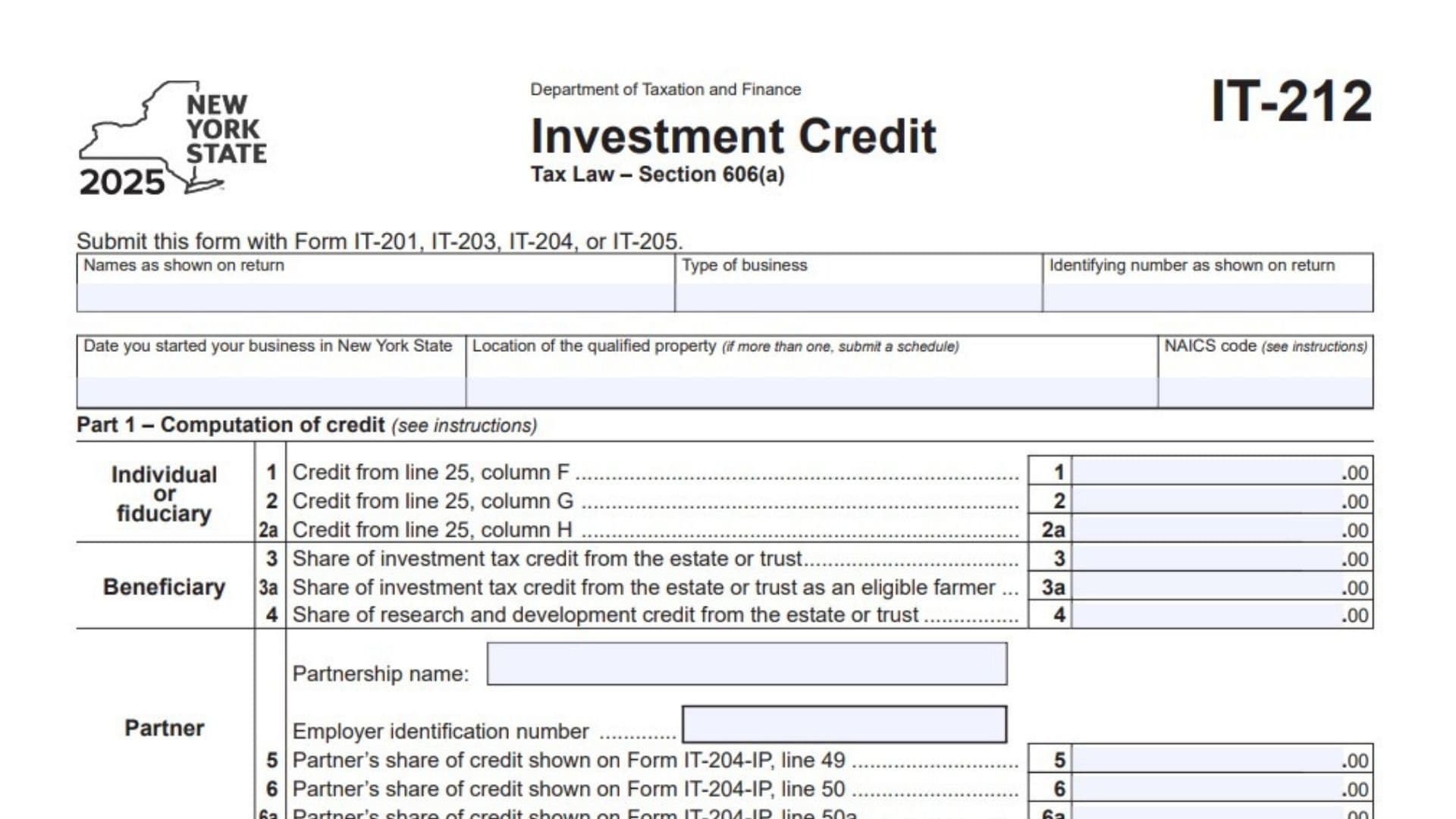
New York Form IT-212, officially titled Investment Credit, is a tax form used to calculate and claim investment tax credits under New York Tax Law Section 606(a). The 2025 form is designed for eligible individuals, sole proprietors, partnerships, fiduciaries, beneficiaries, partners, and shareholders of New York S corporations who have earned or received an allocation of an investment credit associated with qualified property.
The purpose of Form IT-212 is to determine the amount of investment credit available for qualifying business property and eligible investments. It collects information about the taxpayer’s business, the date the business started operating in New York State, the location and description of qualified property, the property’s principal business use, acquisition date, and useful life. It also calculates the applicable investment credit based on the investment credit base and the relevant credit percentage.
The form includes different credit calculations depending on the nature of the investment. The standard investment tax credit is calculated at 4% of the investment credit base. A separate research and development investment credit is calculated at 7%, while an additional calculation for eligible farmers uses 20% of the applicable investment credit base. Taxpayers must identify the appropriate property and credit category and report the corresponding amounts in the correct columns.
Form IT-212 also accommodates taxpayers who receive investment credits through partnerships, New York S corporations, estates, or trusts. Partners, shareholders, and beneficiaries must report their allocated shares using the information provided by the entity. Fiduciaries must separately report credit allocated to beneficiaries and the amount retained by the fiduciary.
Another important feature of the form is its treatment of early dispositions of qualified property. If qualifying property is disposed of or ceases to qualify before the end of its required useful life, a portion of the previously claimed credit may need to be added back. Part 4 calculates this addback using the property’s useful life, unused life, original investment credit, and applicable interest rate.
The form contains six parts. Part 1 calculates the investment credit, including directly earned and allocated credits. Part 2 summarizes credit addbacks resulting from early dispositions. Part 3 reports investments in qualified property and calculates the applicable investment credit percentages. Part 4 calculates the addback when qualified property is disposed of early or ceases to qualify. Part 5 reports the allocation of investment credit and early-disposition addbacks between beneficiaries and fiduciaries. Part 6 determines the amount of credit applied against current-year tax, the refundable amount where applicable, and the amount available for future carryover.
Form IT-212 is a supporting tax credit form rather than a standalone income tax return. It must be submitted with Form IT-201, IT-203, IT-204, or IT-205, depending on the taxpayer’s filing circumstances. Completing the form correctly is important because the credit depends on the property’s qualification, investment credit base, applicable credit rate, ownership or allocation arrangements, early disposition calculations, and available carryover amounts.
How To File Form IT-212
New York Form IT-212 must be submitted with the taxpayer’s applicable New York income tax return. It is not filed as an independent income tax return.
The 2025 form identifies four possible filing destinations:
- Form IT-201: For applicable New York State resident individual income tax filers.
- Form IT-203: For applicable nonresident and part-year resident individual income tax filers.
- Form IT-204: For applicable partnership filers.
- Form IT-205: For applicable fiduciary income tax filers.
Select the appropriate return based on the taxpayer’s filing status and circumstances.
Information To Prepare Before Completing Form IT-212
Gather the following information before starting:
- Taxpayer’s name as shown on the applicable income tax return.
- Type of business.
- Taxpayer’s identifying number.
- Date the business started operating in New York State.
- Location of the qualified property.
- Applicable North American Industry Classification System (NAICS) code.
- Description of each qualified property.
- Principal business use of each property.
- Date each property was acquired.
- Useful life of each property in years.
- Investment credit base for each qualifying property.
- Information about standard investment tax credits.
- Research and development investment credit information.
- Eligible farmer investment credit information, where applicable.
- Additional Forms IT-212, if required.
- Form IT-212-ATT information, where applicable.
- Partnership names and EINs.
- New York S corporation names and EINs.
- Credit allocation information from partnerships and S corporations.
- Estate or trust credit allocation information.
- Beneficiary names and identifying numbers.
- Previous-year investment credit carryover.
- Information about qualified property disposed of before the end of its useful life.
- Original investment credit allowed for affected property.
- Applicable interest rate for early-disposition calculations.
- Current-year New York tax liability.
- Information about credits applied before the investment credit.
- Details of unused or expired investment credit carryovers.
Important Filing Considerations
Qualified Property
Part 3 requires taxpayers to identify each property associated with the investment credit. The property must satisfy the applicable qualification requirements.
Investment Credit Rates
The form provides three different calculation categories:
- Standard investment tax credit: 4%.
- Research and development investment credit: 7%.
- Investment tax credit for eligible farmers on qualified property: 20%.
Use the applicable category when calculating each credit.
Credit Received Through Another Entity
Partners, New York S corporation shareholders, and beneficiaries must complete the relevant sections to report credits allocated by another entity.
Early Disposition Of Property
Part 4 applies when qualified property is disposed of early or ceases to qualify. The applicable credit addback must be calculated and included in the appropriate section.
Additional Forms IT-212
If the taxpayer has additional qualified properties or investment credit calculations that exceed the available spaces, additional Forms IT-212 may be required.
Previous-Year Carryover
Part 1 includes a separate line for the investment credit carried forward from the previous year’s Form IT-212.
New Business And Eligible Farmer Refunds
Part 6 provides separate checkboxes for new businesses and eligible farmers. These classifications are important when determining whether an amount of unused credit qualifies for a refund.

How To Complete New York Form IT212
Form IT-212 contains business identification fields and six parts covering investment credit calculations, credit addbacks, qualified property investments, beneficiary allocations, and the application of credit against tax liability.
Complete the identification section first, followed by the applicable parts based on the taxpayer’s business activities and credit eligibility.
Taxpayer And Business Identification Information
Names As Shown On Return
Enter the taxpayer’s full legal name exactly as it appears on the associated New York income tax return.
For joint returns, enter the names as shown on the main return.
Type Of Business
Enter the type of business associated with the investment credit claim.
Identify the business activity that relates to the qualified property.
Identifying Number As Shown On Return
Enter the taxpayer’s identifying number exactly as it appears on the associated income tax return.
Date You Started Your Business In New York State
Enter the date the taxpayer started conducting business in New York State.
Use the actual business commencement date supported by the taxpayer’s records.
Location Of The Qualified Property
Enter the location of the property associated with the investment credit.
If more than one qualified property location is involved, provide the additional locations on a separate schedule.
Ensure that each location corresponds to the qualified property being reported.
NAICS Code
Enter the applicable North American Industry Classification System (NAICS) code for the business.
Use the code corresponding to the taxpayer’s business activity and follow the applicable instructions for determining the correct classification.
Part 1: Computation Of Credit
Part 1 calculates the investment credit available to individuals, fiduciaries, beneficiaries, partners, and shareholders of New York S corporations.
The section contains separate entries for credits earned directly and credits received through other entities.
Complete the applicable lines based on the taxpayer’s classification.
Individual Or Fiduciary
Line 1: Credit From Line 25, Column F
Enter the amount from Part 3, line 25, column F.
This amount represents the standard investment tax credit calculated at 4% of the investment credit base.
Individuals and fiduciaries earning the credit directly must transfer the applicable amount from the qualified property calculation.
Line 2: Credit From Line 25, Column G
Enter the amount from Part 3, line 25, column G.
This amount represents the investment tax credit for research and development property, calculated at 7% of the investment credit base.
Use this line when the taxpayer qualifies for the applicable research and development investment credit.
Line 2a: Credit From Line 25, Column H
Enter the amount from Part 3, line 25, column H.
This amount represents the investment tax credit for eligible farmers on qualified property, calculated at 20% of the investment credit base.
Use this line when the taxpayer qualifies for the eligible farmer investment credit.
Beneficiary
Line 3: Share Of Investment Tax Credit From The Estate Or Trust
Beneficiaries must enter their allocated share of the investment tax credit received from an estate or trust.
Use the credit allocation information provided by the fiduciary.
Line 3a: Share Of Investment Tax Credit From The Estate Or Trust As An Eligible Farmer
Enter the beneficiary’s allocated share of the investment tax credit from an estate or trust when the beneficiary qualifies as an eligible farmer.
Use the eligible farmer credit amount reported in the applicable fiduciary allocation documentation.
Line 4: Share Of Research And Development Credit From The Estate Or Trust
Enter the beneficiary’s allocated share of the research and development investment credit received from an estate or trust.
Use the amount provided by the fiduciary and ensure that it corresponds to the research and development credit category.
Partner
The partnership section requires the partnership’s identifying information and the partner’s allocated share of the applicable credits.
Partnership Name
Enter the full legal name of the partnership from which the taxpayer received the investment credit.
Use the name shown in the partnership’s tax documentation.
Employer Identification Number
Enter the partnership’s federal Employer Identification Number (EIN).
Verify the number against the partnership’s tax records.
Line 5: Partner’s Share Of Credit Shown On Form IT-204-IP, Line 49
Enter the partner’s share of the investment credit reported on Form IT-204-IP, line 49.
Use the amount allocated to the partner by the partnership.
Line 6: Partner’s Share Of Credit Shown On Form IT-204-IP, Line 50
Enter the partner’s allocated credit amount reported on Form IT-204-IP, line 50.
Transfer the amount exactly as shown in the partnership’s applicable credit information.
Line 6a: Partner’s Share Of Credit Shown On Form IT-204-IP, Line 50a
Enter the partner’s share of the credit reported on Form IT-204-IP, line 50a.
Use the amount allocated to the partner for this specific credit category.
This section is used by shareholders who receive investment credits from New York S corporations.
S Corporation Name
Enter the full legal name of the New York S corporation from which the taxpayer received the investment credit.
Employer Identification Number
Enter the S corporation’s federal Employer Identification Number.
Verify the EIN against the corporation’s tax documentation.
Line 7: Shareholder’s Share Of Investment Tax Credit From The S Corporation
Enter the shareholder’s allocated share of the investment tax credit received from the New York S corporation.
Use the amount reported in the applicable shareholder credit documentation.
Line 7a: Shareholder’s Share Of Investment Tax Credit From The S Corporation As An Eligible Farmer
Enter the shareholder’s allocated share of the investment tax credit for eligible farmers on qualified property.
Use this line when the shareholder qualifies for the applicable eligible farmer credit.
Line 8: Shareholder’s Share Of Research And Development Credit From The S Corporation
Enter the shareholder’s allocated share of the research and development investment credit received from the New York S corporation.
Use the amount reported in the corporation’s applicable credit allocation information.
Additional Credit And Total Calculation
Line 8a: Enter The Total Amount From Any Additional Forms IT-212
If additional Forms IT-212 have been completed, enter the combined applicable credit amount from those forms on line 8a.
This line allows the taxpayer to include investment credits calculated on additional forms.
If no additional Forms IT-212 are used, no additional-form amount needs to be included.
Line 9: Total
Add the amounts reported on lines 1 through 8a.
The calculation is:
\[ \text{Line 9}=\sum \text{Lines 1 through 8a} \]
Enter the combined amount on line 9.
This represents the total investment credit before beneficiary allocations and subsequent credit adjustments.
Line 10: Fiduciaries — Enter Credit Allocated To Beneficiaries
Fiduciaries must enter the portion of the investment credit allocated to beneficiaries.
Use the total beneficiary allocation reported in Part 5.
This amount is deducted from the fiduciary’s available credit to determine the amount retained by the fiduciary.
Line 11: Subtract Line 10 From Line 9
Subtract the beneficiary credit allocation on line 10 from the total credit on line 9.
The calculation is:
\[ \text{Line 11}=\text{Line 9}-\text{Line 10} \]
Enter the resulting amount.
This represents the credit remaining after accounting for allocations to beneficiaries.
Line 12: Available Carryover Credit From Last Year’s Form IT-212
Enter the available investment credit carried forward from the previous year’s Form IT-212.
Use the unused credit amount recorded in the prior-year carryover calculation.
Line 13: Investment Tax Credit
Add lines 11 and 12.
The calculation is:
\[ \text{Line 13}=\text{Line 11}+\text{Line 12} \]
Enter the resulting amount.
This represents the investment credit available after including the previous-year carryover.
Line 14: Total Addback Of Credit From Line 21
Enter the total credit addback calculated on Part 2, line 21.
This amount represents the credit addback associated with early dispositions of qualified property.
Fiduciaries must follow the additional instructions applicable to their allocation responsibilities.
Line 15a: Total Investment Tax Credit
Enter the total investment tax credit determined under the applicable instructions.
This line reflects the investment credit after the required credit adjustments.
Use the applicable New York investment credit instructions to determine the amount.
Line 15b: Net Investment Tax Credit Recapture
Enter the net investment tax credit recapture amount calculated under the applicable instructions.
This line accounts for the relevant investment credit recapture adjustments.
Do not assume that this amount is automatically identical to the addback reported on line 14. Follow the applicable recapture calculation requirements.
Part 2: Summary Of Addback Of Credit On Early Dispositions
Part 2 summarizes the credit addback resulting from early dispositions of qualified property.
It collects the amounts attributable to individuals, partnerships, beneficiaries, partners, S corporation shareholders, and estates or trusts.
The amounts are transferred from the applicable calculations in Part 4 or the relevant allocation records.
Line 16: Individual’s And Partnership’s Addback Of Credit On Early Dispositions
Individuals and partnerships must enter the addback amount calculated on Part 4, line 31.
This represents the investment credit addback associated with qualified property disposed of early or property that ceased to qualify.
Line 17: Beneficiary’s Share Of Addback Of Credit On Early Dispositions
Beneficiaries must enter their allocated share of the early-disposition credit addback.
Use the amount reported in the applicable fiduciary allocation information.
Line 18: Partner’s Share Of Addback Of Credit On Early Dispositions
Partners must enter their allocated share of the investment credit addback resulting from early dispositions.
Use the amount provided by the partnership.
Line 19: S Corporation Shareholder’s Share Of Addback Of Credit On Early Dispositions
Shareholders of New York S corporations must enter their allocated share of the early-disposition credit addback.
Use the relevant credit adjustment information provided by the corporation.
Line 20: Estate’s Or Trust’s Addback Of Credits On Early Dispositions
Estates and trusts must enter the total addback amount from Part 4, line 31.
Use the amount calculated for the applicable qualified property.
Line 21: Total
Add lines 16 through 20.
The calculation is:
\[ \text{Line 21}= \text{Line 16}+\text{Line 17}+\text{Line 18}+\text{Line 19}+\text{Line 20} \]
Enter the combined amount on line 21.
This represents the total investment credit addback associated with early dispositions.
The form provides different transfer instructions:
- Fiduciaries: Enter the line 21 amount on Part 1, line 14, following the applicable fiduciary instructions.
- All Others: Enter the line 21 amount on Part 1, line 14.
Part 3: Investments In Qualified Property
Part 3 identifies the qualified property associated with the investment credit and calculates the applicable investment credit amounts.
For each property, taxpayers must complete columns A through D in the property information table and columns E through H in the corresponding investment credit calculation table.
The section uses the same property item number to connect the property details with its investment credit calculation.
The form provides space for qualified property under item 22.
Property Information
Column A: Description Of Property
Enter a clear description of the qualified property associated with the investment credit.
Identify the property sufficiently to distinguish it from other assets included in the business’s investment credit claim.
Column B: Principal Use Of Property
Describe the principal business use of the qualified property.
Explain how the property is primarily used in the taxpayer’s business operations.
Column C: Date Acquired
Enter the date the property was acquired.
Use the actual acquisition date supported by the purchase or ownership records.
Column D: Useful Life In Years
Enter the property’s useful life in years.
Use the applicable useful-life information required for the qualified property.
This information is important because the useful life is also relevant to the early-disposition calculation in Part 4.
Investment Credit Calculation
Column E: Investment Credit Base
Enter the investment credit base associated with the qualified property.
Use the amount determined under the applicable New York investment credit rules.
This is the amount used to calculate the standard investment credit, research and development credit, and eligible farmer credit.
Column F: Investment Tax Credit
Multiply the investment credit base in column E by 4%, or 0.04.
The calculation is:
\[ \text{Column F}=\text{Column E}\times0.04 \]
Enter the resulting standard investment tax credit.
Column G: Investment Tax Credit For Research And Development Property
Multiply the investment credit base in column E by 7%, or 0.07.
The calculation is:
\[ \text{Column G}=\text{Column E}\times0.07 \]
Enter the resulting research and development investment credit when applicable.
Column H: Investment Tax Credit For Eligible Farmers On Qualified Property
Multiply the investment credit base in column E by 20%, or 0.20.
The calculation is:
\[ \text{Column H}=\text{Column E}\times0.20 \]
Enter the resulting eligible farmer investment credit when applicable.
Additional Qualified Property Entries
Additional Property Entries
If the taxpayer has more qualified property than can be reported in the available spaces, use additional Forms IT-212 as applicable.
Ensure that each additional property is described and that its investment credit base and corresponding credit amounts are calculated.
Total Column F Through Column H Amounts From Any Additional Forms IT-212
Enter the combined amounts from columns F, G, and H of any additional Forms IT-212 in the corresponding additional-form total fields.
Keep the amounts separated by credit category.
This ensures that additional qualified property calculations are included in the final investment credit totals.
Additional Credit Adjustments
Line 23: Enter Amount From Form IT-212-ATT, Line 11
Enter the amount reported on Form IT-212-ATT, line 11.
Use the corresponding supporting schedule when completing this line.
Line 24: Enter Amount From Form IT-212-ATT, Line 19, Column C
Enter the amount reported on Form IT-212-ATT, line 19, column C.
Verify that the amount agrees with the applicable supporting calculation.
Total Investment Credit
Line 25: Total Investment Tax Credit
Add the applicable investment credit amounts from columns F through H, including the amounts reported for additional Forms IT-212 and the adjustments from Form IT-212-ATT where applicable.
The form presents three separate totals:
- Column F: Standard investment tax credit.
- Column G: Research and development investment tax credit.
- Column H: Investment tax credit for eligible farmers.
Enter each total in its corresponding column.
The form provides the following transfer instructions:
- Individuals: Transfer the line 25, column F amount to Part 1, line 1; column G to Part 1, line 2; and column H to Part 1, line 2a.
- Fiduciaries and Partnerships: Follow the applicable instructions for reporting the credit.
Part 4: Early Dispositions Of Qualified Property And Addback Of Credit On Early Dispositions
Part 4 calculates the investment credit addback when qualified property is disposed of before the end of its required useful life or otherwise ceases to qualify.
The section contains eight columns, covering property identification, acquisition information, useful life, unused life, the recapture percentage, the original investment credit, and the resulting addback.
Understanding The Columns In Part 4
Column A: Description Of Property
Enter a description of the qualified property associated with the early disposition or loss of qualification.
Use a description that matches the property reported in Part 3.
Column B: Date Acquired
Enter the date the property was originally acquired.
Use the acquisition date reported in the qualified property records.
Column C: Date Property Ceased To Qualify
Enter the date on which the property ceased to qualify for the investment credit.
This may be relevant when the property is disposed of before the end of its required useful life.
Column D: Life In Months
Enter the property’s applicable useful life expressed in months.
Convert the useful life reported in Part 3, column D, into months.
Column E: Unused Life In Months
Enter the remaining useful life of the property in months when it ceased to qualify.
Determine the unused portion by comparing the applicable useful life with the time the property was held or used before it ceased to qualify.
Column F: Percentage (E ÷ D)
Divide the unused life in months in column E by the total useful life in months in column D.
The calculation is:
\[ \text{Column F}=\frac{\text{Column E}}{\text{Column D}} \]
Enter the resulting percentage or ratio as required.
This figure represents the proportion of the property’s useful life that remained unused.
Column G: Total Investment Tax Credit Allowed
Enter the total investment tax credit originally allowed for the qualified property.
Use the original credit amount associated with the property.
Column H: Addback Of Credit On Early Dispositions
Multiply the percentage in column F by the total investment tax credit allowed in column G.
The calculation is:
\[ \text{Column H}=\text{Column F}\times\text{Column G} \]
Enter the resulting credit addback.
This amount represents the investment credit subject to addback because the property ceased to qualify before the end of its useful life.
Part 4: Additional Calculations
Line 26: Property-Level Early Disposition Calculation
Complete the property entries in line 26 using columns A through H.
Report each affected property’s description, acquisition date, date it ceased to qualify, useful life, unused life, recapture percentage, original credit, and calculated addback.
If more than one property is affected, use the additional available entry.
Line 27: Enter Amount From Form IT-212-ATT, Line 12
Enter the amount reported on Form IT-212-ATT, line 12.
Use the applicable supporting schedule to determine the amount.
Line 28: Total
Add the applicable early-disposition credit addback amounts from the property calculations and line 27.
Enter the combined amount on line 28.
This represents the total credit addback before applying the interest calculation.
Line 29: Interest Rate
Enter the applicable interest rate required for the early-disposition calculation.
Use the rate specified in the applicable New York tax instructions.
Line 30: Multiply Line 28 By Line 29
Multiply the total amount on line 28 by the interest rate on line 29.
The calculation is:
\[ \text{Line 30}=\text{Line 28}\times\text{Line 29} \]
Enter the resulting interest amount.
Line 31: Total Addback Of Credit On Early Dispositions
Add the amount on line 28 and the interest amount on line 30.
The calculation is:
\[ \text{Line 31}=\text{Line 28}+\text{Line 30} \]
Enter the total on line 31.
This is the final early-disposition credit addback.
The form provides different transfer instructions:
- Fiduciaries: Enter the line 31 amount on Part 2, line 20.
- All Others: Enter the line 31 amount on Part 2, line 16.
Part 5 is used by fiduciaries to report the distribution of investment credits and early-disposition credit addbacks between beneficiaries and the fiduciary.
The section contains six columns and separate rows for beneficiaries and the fiduciary.
Understanding The Columns In Part 5
Column A: Beneficiary’s Name
Enter the beneficiary’s name exactly as it appears on Form IT-205, Schedule C.
Use the same name shown on the applicable fiduciary income tax return.
Column B: Identifying Number
Enter the beneficiary’s identifying number.
Verify that the number corresponds to the beneficiary identified in column A.
Column C: Share Of Investment Tax Credit
Enter the amount of investment tax credit allocated to the beneficiary.
Use the applicable fiduciary allocation records.
Column D: Share Of Investment Tax Credit For Research And Development Property
Enter the beneficiary’s allocated share of the investment tax credit for research and development property.
Use the amount applicable to the research and development credit category.
Column E: Share Of Investment Tax Credit For Eligible Farmers On Qualified Property
Enter the beneficiary’s allocated share of the eligible farmer investment credit.
Complete this column when the beneficiary receives a share of the applicable credit.
Column F: Share Of Addback Of Credit On Early Dispositions
Enter the beneficiary’s allocated share of the investment credit addback resulting from early dispositions of qualified property.
Use the applicable fiduciary allocation information.
Part 5: Allocation Entries
Total: Beneficiary And Fiduciary Allocation
The Total row records the overall amounts available for allocation between beneficiaries and the fiduciary.
Enter the applicable totals in columns C, D, E, and F.
These amounts should reconcile with the relevant investment credit and early-disposition calculations.
Beneficiary Entry 1
Enter the first beneficiary’s name and identifying number.
Report the beneficiary’s allocated investment tax credit, research and development credit, eligible farmer credit, and early-disposition addback in the corresponding columns.
Beneficiary Entry 2
If another beneficiary receives an allocation, enter their identifying information and the applicable amounts.
Additional Beneficiary Entries
Use the remaining rows to report other beneficiaries receiving investment credits or early-disposition addbacks.
Fiduciary
Enter the portion of each applicable credit and early-disposition addback allocated to the fiduciary.
Report the fiduciary’s amounts in the corresponding columns C through F.
Ensure that the total beneficiary allocations and fiduciary allocation agree with the overall amounts available for distribution.
Part 6: Application Of Credit And Computation Of Refund And Carryover
Part 6 determines how much of the available investment credit can be applied against the current year’s New York tax liability.
It also calculates the refundable amount available to eligible taxpayers and the amount that can be carried forward to the next tax year.
This section contains lines 32a through 40.
Total Credit And Tax Liability
Line 32a: Total Credit
Enter the total investment credit amount from Part 1, line 15a.
This represents the investment credit available for the current-year calculation.
Line 32b: Tax Due Before Credits
Enter the taxpayer’s New York tax liability before applying credits.
Use the applicable amount from the taxpayer’s income tax return and follow the instructions for this line.
Line 33: Credits That You Applied Before This Credit
Enter the total amount of other credits already applied against the taxpayer’s tax liability before the investment credit.
Use the applicable credit information from the main income tax return.
Line 34: Net Tax
Subtract line 33 from line 32b.
The calculation is:
\[ \text{Line 34}=\text{Line 32b}-\text{Line 33} \]
Enter the resulting amount.
This represents the remaining tax liability after accounting for credits applied before the investment credit.
Current-Year Credit Application
Line 35: Amount Of Credit Used For The Current Tax Year
Enter the amount of investment credit applied against the current year’s tax liability.
Use the applicable instructions to determine the allowable amount.
This line records the portion of the available credit used during the current tax year.
Line 36: Amount Of Credit Available For Refund Or Carryover To Next Year
Subtract line 35 from line 32a.
The calculation is:
\[ \text{Line 36}=\text{Line 32a}-\text{Line 35} \]
Enter the resulting amount.
This represents the unused investment credit available for a potential refund or future carryover.
New Business And Eligible Farmer Classification
Line 37a: New Business
If the taxpayer qualifies as a new business under the applicable instructions, mark an X in the New Business checkbox.
This classification is relevant to the refund calculation in Part 6.
Line 37b: Eligible Farmer
If the taxpayer qualifies as an eligible farmer under the applicable instructions, mark an X in the Eligible Farmer checkbox.
This classification identifies taxpayers who may qualify for the applicable eligible farmer refund treatment.
Do not select either checkbox unless the taxpayer meets the relevant requirements.
Line 37c: Amount Of Credit To Be Refunded
Enter the amount of investment credit that qualifies for a refund under the applicable instructions.
The refundable amount must be determined using the taxpayer’s eligibility classification and the applicable credit limitations.
Carryover Calculation
Line 38: Amount Of Credit Available For Carryover To Next Year
Subtract line 37c from line 36.
The calculation is:
\[ \text{Line 38}=\text{Line 36}-\text{Line 37c} \]
Enter the resulting amount.
This represents the remaining investment credit available for carryforward before accounting for unused expired credits.
Line 39: Unused Expired Tax Credits
Enter the amount of unused investment tax credits that have expired, following the applicable instructions.
The form also requires the earliest year, in YYYY format, of the unused credit carryover included in the carryforward calculation.
Enter the appropriate year in the designated space.
This line ensures that expired credits are excluded from the amount carried forward.
Line 40: Amount Of Credit To Be Carried Over To Next Year
Subtract line 39 from line 38.
The calculation is:
\[ \text{Line 40}=\text{Line 38}-\text{Line 39} \]
Enter the resulting amount.
This is the final investment credit available to carry forward to the following tax year.
Retain this amount for the next year’s Form IT-212, subject to the applicable carryforward requirements.
Final Review Before Filing
Before submitting New York Form IT-212, review all six parts and verify that the qualified property details, investment credit calculations, allocated credits, early-disposition addbacks, beneficiary distributions, and final refund and carryover calculations are accurate.
Use the following checklist to conduct a final review.
Taxpayer And Business Identification
- Verify the taxpayer’s name as shown on the income tax return.
- Enter the correct business type.
- Confirm the taxpayer’s identifying number.
- Enter the date the business started operating in New York State.
- Provide the location of the qualified property.
- Include additional property locations on a separate schedule when required.
- Enter the correct NAICS code.
Part 1: Computation Of Credit
- Verify the standard investment credit on line 1.
- Confirm the research and development credit on line 2.
- Check the eligible farmer credit on line 2a.
- Verify beneficiary investment credit on line 3.
- Confirm eligible farmer beneficiary credit on line 3a.
- Check beneficiary research and development credit on line 4.
- Enter the partnership name and EIN.
- Verify partnership credit allocations on lines 5, 6, and 6a.
- Enter the S corporation name and EIN.
- Verify shareholder credit allocations on lines 7, 7a, and 8.
- Include additional Forms IT-212 on line 8a.
- Recalculate the total on line 9.
- Verify beneficiary allocations on line 10.
- Recalculate line 11.
- Confirm the previous-year carryover on line 12.
- Calculate the investment credit on line 13.
- Include the applicable addback on line 14.
- Verify total investment tax credit on line 15a.
- Confirm net investment tax credit recapture on line 15b.
Part 2: Early Disposition Addback Summary
- Verify the individual and partnership addback on line 16.
- Confirm the beneficiary allocation on line 17.
- Check the partner’s share on line 18.
- Verify the S corporation shareholder’s share on line 19.
- Confirm the estate or trust addback on line 20.
- Recalculate the total on line 21.
- Transfer the amount to Part 1, line 14.
Part 3: Qualified Property Investments
- Provide a description of each qualified property.
- Identify the principal business use.
- Verify the acquisition date.
- Enter the useful life in years.
- Confirm the investment credit base in column E.
- Calculate the standard 4% investment credit in column F.
- Calculate the 7% research and development credit in column G, where applicable.
- Calculate the 20% eligible farmer credit in column H, where applicable.
- Include additional Forms IT-212 where required.
- Verify Form IT-212-ATT amounts on lines 23 and 24.
- Recalculate the totals on line 25.
- Transfer the applicable credit amounts to Part 1.
Part 4: Early Disposition Of Qualified Property
- Identify each affected property.
- Verify the original acquisition date.
- Enter the date the property ceased to qualify.
- Confirm the useful life in months.
- Calculate the unused life in months.
- Divide unused life by total useful life.
- Verify the original investment tax credit allowed.
- Calculate the early-disposition addback.
- Include Form IT-212-ATT, line 12, on line 27 where applicable.
- Recalculate the total on line 28.
- Enter the applicable interest rate on line 29.
- Calculate interest on line 30.
- Recalculate the total addback on line 31.
- Transfer the amount to the correct line in Part 2.
Part 5: Beneficiary And Fiduciary Allocation
- Verify each beneficiary’s name against Form IT-205, Schedule C.
- Confirm beneficiary identifying numbers.
- Report the standard investment credit in column C.
- Report research and development credit in column D.
- Report eligible farmer credit in column E.
- Report early-disposition addbacks in column F.
- Verify the total beneficiary allocations.
- Confirm the fiduciary’s share in the final row.
- Reconcile the allocations with the fiduciary’s credit records.
Part 6: Refund And Carryover
- Confirm line 32a agrees with Part 1, line 15a.
- Enter the correct tax due before credits on line 32b.
- Verify other credits applied before this credit on line 33.
- Recalculate net tax on line 34.
- Verify the current-year credit used on line 35.
- Calculate unused credit on line 36.
- Select the New Business checkbox when applicable.
- Select the Eligible Farmer checkbox when applicable.
- Verify the refundable credit on line 37c.
- Recalculate the carryover amount on line 38.
- Identify unused expired credits on line 39.
- Enter the earliest applicable carryover year.
- Calculate the final carryover on line 40.
Final Filing Checks
- Ensure all applicable sections have been completed.
- Reconcile property details with business and acquisition records.
- Verify all investment credit base amounts.
- Check that the correct credit percentages have been applied.
- Confirm all partnership and S corporation allocations.
- Verify early-disposition calculations and interest.
- Check beneficiary and fiduciary distributions.
- Confirm previous-year carryover amounts.
- Verify refund and carryforward calculations.
- Attach Form IT-212 to Form IT-201, IT-203, IT-204, or IT-205, as applicable.
- Retain copies of the completed form and supporting business and property records.
Important Filing Reminder
New York Form IT-212 is used to calculate and claim the Investment Credit under Tax Law Section 606(a). It provides a structured process for reporting qualified property, determining the investment credit base, calculating applicable credit amounts, and accounting for credit allocations and early dispositions.
The most important calculations occur in Part 3, Part 4, and Part 6. Part 3 establishes the investment credit using the applicable 4%, 7%, or 20% rate. Part 4 calculates the credit addback when qualified property ceases to qualify before the end of its useful life. Part 6 determines how much credit can be applied against the current year’s tax liability, refunded where permitted, or carried forward.
Taxpayers should pay particular attention to the distinction between directly earned credits and credits received through partnerships, S corporations, estates, or trusts. They must also ensure that any early-disposition addback and expired carryover amounts are correctly reflected.
Accurate reporting of qualified property, investment credit bases, applicable credit percentages, allocated credits, early-disposition adjustments, and carryforward amounts is essential for correctly claiming the New York Investment Credit for the 2025 tax year.