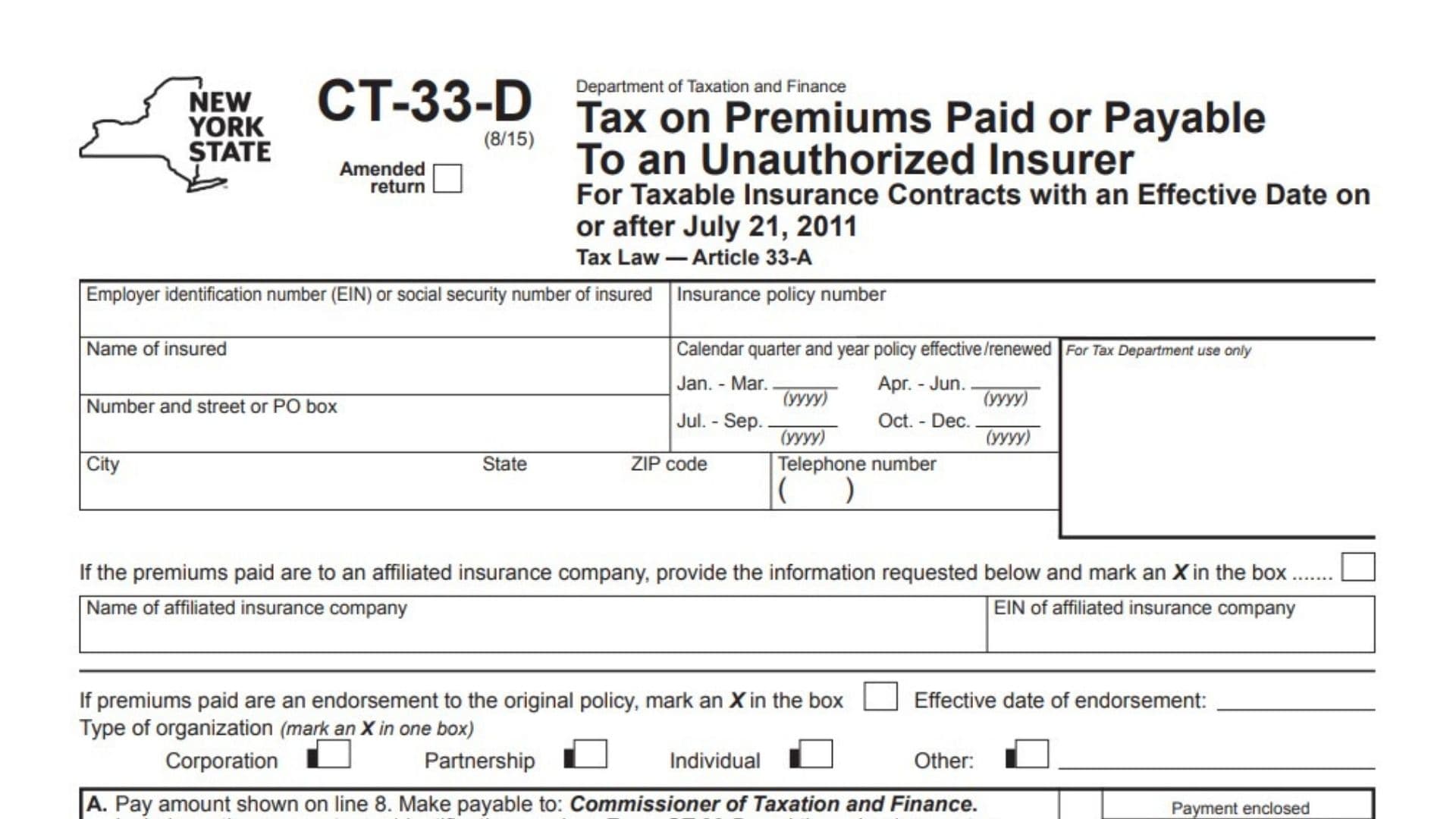
New York Form CT-33-D, Tax on Premiums Paid or Payable to an Unauthorized Insurer, is a tax return used to calculate and report tax on premiums paid or payable for certain taxable insurance contracts issued by unauthorized insurers. It applies to taxable insurance contracts with an effective date on or after July 21, 2011, under Article 33-A of the New York Tax Law. The form collects information about the insured individual or business, the insurance policy, the applicable calendar quarter, and the insurance company receiving the premiums. It also identifies whether the premiums were paid to an affiliated insurance company and whether the reported premiums relate to an endorsement of an existing policy. The return calculates the tax using a rate of 3.6% of the taxable premiums, accounts for any prepayments, and determines whether additional tax, interest, or penalties are due. If the prepayments exceed the calculated tax, the return also allows the taxpayer to request a refund or apply the overpayment to the next reporting period. Part 2 collects the insurance company’s identifying and address information, while the certification section requires an authorized representative to confirm that the return is accurate and complete. Paid preparers must also provide their professional and business identification details when applicable. Completing Form CT-33-D correctly is important because it establishes the taxable premium amount, determines the amount owed to New York State, and provides the information needed to process a payment, refund, or credit for a future reporting period.
Who Needs to File Form CT-33-D?
Form CT-33-D is intended for reporting tax on taxable insurance premiums paid or payable to an unauthorized insurer under New York Tax Law Article 33-A.
The form identifies the insured individual or business and requests information about the insurance policy and the insurer.
The information required generally includes:
- The insured’s Employer Identification Number (EIN) or Social Security number (SSN).
- The insured’s legal name and address.
- The insurance policy number.
- The calendar quarter and year the policy became effective or was renewed.
- The insurance company’s information.
- Any applicable affiliated insurance company details.
- The taxable insurance premiums paid or payable.
- Previous tax prepayments.
- Applicable interest and penalties.
- Information about the authorized representative and paid preparer, if applicable.
The form specifically covers taxable insurance contracts with effective dates on or after July 21, 2011.
How To File Form CT-33-D
Form CT-33-D is submitted to the New York State Department of Taxation and Finance. It is used to report the applicable insurance premiums and calculate the tax due under Article 33-A.
The form itself does not specify a mailing address, filing deadline, or a separate return to which it must be attached. Consult the applicable CT-33-D instructions for the correct filing method and submission requirements.
Information to Prepare Before Completing Form CT-33-D
Gather the following information before starting:
- Insured’s EIN or SSN.
- Insured’s full legal name.
- Insurance policy number.
- Policy effective or renewal date.
- Insured’s mailing address.
- Insured’s telephone number.
- Insurance company’s complete name and address.
- Affiliated insurance company’s name and EIN, if applicable.
- Endorsement information and effective date, if applicable.
- Type of organization.
- Total taxable insurance premiums paid or payable.
- Any prepayments already made.
- Information needed to calculate interest or penalties, if applicable.
- Payment information, if submitting payment.
- Authorized representative’s name, signature, title, email, and telephone number.
- Paid preparer’s information, if a tax professional prepared the return.
Keep the relevant insurance policy and premium payment records available to verify the information entered on the return.
How To Complete Form CT-33-D
Form CT-33-D contains an identification section, insurance policy details, organizational information, a tax payment section, two main parts, and a certification section.
Follow the instructions below to complete each field and calculate the amount due.
Top Section: Insured and Insurance Policy Information
Amended Return
Check this box if you are submitting an amended Form CT-33-D to correct or update a previously filed return.
Leave the box unchecked if this is the original return for the reporting period.
Employer Identification Number (EIN) or Social Security Number (SSN) of Insured
Enter the taxpayer identification number of the insured individual or business.
Select the appropriate identification type:
- EIN for a business or other entity with an Employer Identification Number.
- SSN for an individual using a Social Security number.
Enter the complete number and verify that it belongs to the insured identified on the return.
Insurance Policy Number
Enter the policy number assigned by the insurance company.
Use the exact number shown on the insurance policy or related insurance documentation. This helps identify the specific contract associated with the reported premiums.
Name of Insured
Enter the full legal name of the individual or business covered by the insurance policy.
Make sure the name corresponds to the EIN or SSN entered in the previous field.
Calendar Quarter and Year Policy Effective/Renewed
Identify the calendar quarter in which the insurance policy became effective or was renewed.
The form provides four reporting periods:
- January through March.
- April through June.
- July through September.
- October through December.
Select the applicable quarter and enter the corresponding year in the space provided.
For example, if the policy became effective in February 2025, select January through March and enter 2025.
If the policy became effective in August 2025, select July through September and enter 2025.
Use the actual policy effective or renewal date to determine the correct quarter.
For Tax Department Use Only
Leave this section blank.
It is reserved for the New York State Department of Taxation and Finance to record information during processing.
Number and Street or PO Box
Enter the insured’s complete mailing street address or post office box.
Use the address associated with the insured’s tax and insurance records.
City
Enter the city where the insured receives mail.
State
Enter the two-letter postal abbreviation for the insured’s state.
ZIP Code
Enter the ZIP code associated with the insured’s mailing address.
Telephone Number
Provide a telephone number where the insured or responsible representative can be contacted.
Include the appropriate area code.
Affiliated Insurance Company Information
This section applies when the insurance premiums were paid to an affiliated insurance company.
Affiliated Insurance Company Checkbox
Check this box if the premiums reported on the return were paid to an affiliated insurance company.
If the premiums were not paid to an affiliated insurance company, leave the box unchecked.
Name of Affiliated Insurance Company
Enter the complete legal name of the affiliated insurance company receiving the premiums.
Use the company’s official registered name.
EIN of Affiliated Insurance Company
Enter the affiliated insurance company’s complete Employer Identification Number.
Verify the EIN against the company’s official tax information.
Insurance Policy Endorsement Information
This section identifies whether the reported premiums relate to an endorsement of an original insurance policy.
Endorsement Checkbox
Check this box if the premiums being reported are associated with an endorsement to the original insurance policy.
An endorsement is an amendment or modification to an existing insurance policy.
If the premiums do not relate to an endorsement, leave this box unchecked.
Effective Date of Endorsement
If you checked the endorsement box, enter the date the endorsement became effective.
Use the actual effective date shown in the insurance endorsement documentation.
Type of Organization
Select one checkbox to identify the legal organization type of the insured.
Corporation
Select this option if the insured is a corporation.
Partnership
Select this option if the insured is organized as a partnership.
Individual
Select this option if the insured is an individual.
Other
Select this option if the insured’s organization type does not fit any of the listed categories.
Describe the applicable organization type in the space provided.
Select only one classification that accurately describes the insured.
Payment Section A: Payment Enclosed
The payment section appears before Part 1 and identifies how the tax payment should be submitted.
A: Payment Enclosed
Enter the amount being submitted with the return.
The payment should correspond to the total payment due calculated on Line 8.
Make your payment payable to:
Commissioner of Taxation and Finance.
When submitting payment, include the following information with it:
- Your identification number.
- Form CT-33-D.
- The calendar quarter for which you are reporting.
These details help the tax department identify and apply the payment to the correct return and reporting period.
Part 1: Tax Computation
Part 1 calculates the tax on taxable insurance premiums, accounts for prepayments, and determines whether additional payment or an overpayment exists.
The tax rate printed on the form is 3.6%.
Line 1: Premiums Paid or Payable on Taxable Insurance Contracts
Enter the total taxable insurance premiums paid or payable for the applicable insurance contracts.
Use the premium amount associated with the reporting period and insurance policy identified at the top of the return.
Include the premiums that are subject to the tax under the applicable instructions.
Check your insurance records to make sure the amount is accurate.
Line 2: Tax Rate of 3.6%
The tax rate is preprinted on the form as 0.036.
This represents 3.6% of the taxable insurance premiums.
You generally do not need to calculate or change this rate. Use the printed rate when determining the tax due on Line 3.
Line 3: Tax Due
Multiply the taxable premiums reported on Line 1 by the tax rate on Line 2.
Calculation:
Line 1 × 0.036 = Line 3.
For example, if the taxable insurance premiums are $10,000:
$10,000 × 0.036 = $360.
Enter $360 on Line 3.
This amount represents the tax calculated before accounting for any prepayments.
Line 4: Prepayment
Enter the amount of tax already prepaid for the applicable reporting period.
Use your payment records to determine the total qualifying prepayments.
Make sure the amount relates to the same insurance premiums and reporting period covered by the return.
Line 5: Balance
Determine whether the tax due on Line 3 is greater than the prepayment on Line 4.
If Line 3 is greater than Line 4, subtract Line 4 from Line 3.
Calculation:
Line 3 − Line 4 = Line 5.
Enter the difference on Line 5.
If Line 4 is equal to or greater than Line 3, the calculation does not produce an additional positive balance for this line.
Line 6: Interest on Late Payment
Enter the applicable interest on late tax payments.
If the tax was not paid by the required deadline, interest may apply.
Use the applicable CT-33-D instructions to determine how interest must be calculated.
Enter the resulting interest amount on Line 6.
Line 7: Penalties
Enter any applicable penalties associated with the tax payment or filing.
Consult the form instructions to determine whether a penalty applies and how the amount should be calculated.
Enter the applicable penalty on Line 7.
Line 8: Total Payment Due
Calculate the total amount payable by adding Lines 5, 6, and 7.
Calculation:
Line 5 + Line 6 + Line 7 = Line 8.
Enter the total on Line 8.
This is the amount you should pay with the return when a payment is due.
Transfer the Line 8 amount to the Payment Enclosed field in Section A above.
Make sure the payment amount agrees with the calculated total.
Line 9: Overpayment
Line 9 determines whether the prepayment exceeds the tax calculated on Line 3.
If Line 3 is less than Line 4, subtract Line 3 from Line 4.
Calculation:
Line 4 − Line 3 = Line 9.
Enter the difference on Line 9.
If an overpayment exists, select one of the following options:
- Credit to Next Period: Check this box if you want the overpayment applied to the next reporting period.
- Refund: Check this box if you want the overpayment refunded.
Select the option that reflects how you want the overpayment handled.
If Line 3 is equal to or greater than Line 4, there is no overpayment to report under this calculation.
Part 2: Insurer Information
Part 2 collects the identifying and mailing information of the insurance company associated with the premiums reported on Form CT-33-D.
Complete all fields using the insurance company’s official business information.
If additional space is needed, attach separate sheets containing the required information.
Name of Insurance Company
Enter the complete legal name of the insurance company associated with the taxable insurance contract.
Use the name shown on the insurance policy or relevant insurance documentation.
Number and Street or PO Box of Insurance Company
Enter the insurance company’s complete mailing address.
Provide its street address or post office box.
City
Enter the city where the insurance company receives mail.
State
Enter the two-letter postal abbreviation for the state associated with the insurance company’s address.
ZIP Code
Enter the ZIP code for the insurance company’s mailing address.
Additional Sheets
If you need to report additional insurer information and the available space is insufficient, attach separate sheets.
Make sure the additional information clearly identifies the insurance company and corresponds to the return.
Certification and Authorized Person Information
The certification section requires an authorized individual to confirm that the return and its attachments are accurate and complete to the best of their knowledge and belief.
The individual signing must be authorized to act on behalf of the insured or responsible organization.
Printed Name of Authorized Person
Enter the full name of the individual authorized to sign the return.
Print the name clearly and make sure it corresponds to the person who will sign the certification.
Signature of Authorized Person
The authorized representative must sign the return.
The signature confirms that the information submitted has been reviewed and is accurate and complete to the best of the signer’s knowledge and belief.
Official Title
Enter the authorized person’s official position within the organization.
Examples include Owner, President, Treasurer, Managing Director, or another appropriate business title.
Email Address of Authorized Person
Enter the email address of the person responsible for signing the return.
Use an active email address that can receive official correspondence.
Telephone Number
Provide the authorized person’s contact telephone number.
Include the area code so the tax department can contact the individual if necessary.
Date
Enter the date the authorized person signs the return.
Use the appropriate date format.
Paid Preparer Use Only
Complete this section if a paid tax professional prepared the return.
The section collects the preparer’s identity, business information, professional tax identification details, and contact information.
Firm’s Name (or Yours if Self-Employed)
Enter the legal name of the tax preparation firm.
If the preparer is self-employed and does not work through a separate firm, enter the preparer’s applicable business name or name as instructed.
Firm’s EIN
Enter the Federal Employer Identification Number of the tax preparation firm.
If applicable, use the EIN associated with the business preparing the return.
Preparer’s PTIN or SSN
Enter the paid preparer’s Preparer Tax Identification Number (PTIN) or Social Security number, as applicable.
Make sure the identification information belongs to the individual who prepared the return.
Signature of Individual Preparing This Return
The individual responsible for preparing the return must provide their signature.
This identifies the person who completed the tax return.
Address
Enter the complete business or mailing address of the tax preparer or preparation firm.
City
Enter the city associated with the preparer’s address.
State
Enter the applicable two-letter state abbreviation.
ZIP Code
Enter the ZIP code associated with the preparer’s address.
Email Address of Individual Preparing This Return
Provide the preparer’s active email address.
Preparer’s NYTPRIN
Enter the preparer’s New York Tax Preparer Registration Identification Number (NYTPRIN), if applicable.
Use the appropriate professional identification number associated with the preparer.
Excl. Code
If the preparer is using an applicable exclusion instead of a NYTPRIN, enter the appropriate exclusion code.
Follow the applicable instructions to determine which identification applies.
Date
Enter the date the paid preparer completed or signed the return.
If the taxpayer prepared the return without using a paid tax professional, the paid preparer section does not apply.
Important Things to Remember When Filing Form CT-33-D
Before submitting Form CT-33-D, keep these important points in mind.
The Tax Rate Is 3.6%
The form uses a tax rate of 3.6%, represented by 0.036. Multiply the taxable premiums on Line 1 by this rate to calculate the initial tax on Line 3.
Use the Correct Calendar Quarter
Identify the quarter in which the insurance policy became effective or was renewed. Enter the corresponding year in the appropriate quarter field.
Report Affiliated Insurance Companies When Applicable
If the premiums were paid to an affiliated insurance company, check the applicable box and provide the company’s name and EIN.
Identify Policy Endorsements
If the reported premiums relate to an endorsement of the original policy, check the endorsement box and provide its effective date.
Account for Previous Prepayments
Enter the applicable prepayment amount on Line 4. This amount reduces the balance calculated on Line 5 when the tax due exceeds the prepayment.
Calculate Interest and Penalties Separately
If interest or penalties apply, report them on Lines 6 and 7. Add these amounts to the balance on Line 5 when calculating the total payment due.
Choose How to Handle an Overpayment
If prepayments exceed the calculated tax, report the difference on Line 9 and select either a credit toward the next period or a refund.
Include the Required Payment Information
When sending payment, make it payable to Commissioner of Taxation and Finance. Include your identification number, Form CT-33-D, and the applicable calendar quarter.
Final Review Before Filing
Before submitting Form CT-33-D, review all sections to make sure the information is accurate, complete, and consistent with your insurance and payment records.
Use this checklist:
Insured and Policy Information
- The amended return box is checked if submitting a corrected return.
- The correct EIN or SSN identification type is selected.
- The insured’s identification number is accurate.
- The insurance policy number is entered correctly.
- The insured’s full legal name is provided.
- The correct calendar quarter and year are selected.
- The insured’s street address or PO Box is complete.
- The city, state, and ZIP code are correct.
- The telephone number is provided.
Insurance Company Information
- The affiliated insurance company box is checked when applicable.
- The affiliated company’s legal name is entered.
- The affiliated company’s EIN is correct.
- The endorsement box is checked when applicable.
- The endorsement effective date is entered when required.
- The correct organization type is selected.
- The Other organization type is described when applicable.
Tax Computation
- Line 1 includes the correct taxable insurance premiums.
- Line 2 reflects the 3.6% tax rate.
- Line 3 is calculated by multiplying Line 1 by 0.036.
- Line 4 includes applicable prepayments.
- Line 5 reflects the correct remaining balance.
- Line 6 includes applicable late payment interest.
- Line 7 includes applicable penalties.
- Line 8 correctly adds Lines 5, 6, and 7.
- The payment enclosed amount agrees with Line 8 when payment is submitted.
- Line 9 is completed correctly if an overpayment exists.
- The appropriate refund or next-period credit option is selected.
Insurer Information
- The insurance company’s complete name is entered.
- The insurance company’s street address or PO Box is provided.
- The city, state, and ZIP code are correct.
- Additional sheets are attached if more space is required.
Certification and Preparer Information
- The authorized person’s printed name is entered.
- The authorized person has signed the return.
- The official title is provided.
- The authorized person’s email address is correct.
- The telephone number is provided.
- The signature date is entered.
- The paid preparer’s information is complete when applicable.
- The firm’s EIN and preparer’s PTIN or SSN are correct.
- The preparer’s signature and date are included.
- The preparer’s address and contact details are complete.
- The NYTPRIN or applicable exclusion code is provided when required.
Final Submission
- All calculations have been checked.
- The correct insurance reporting period is identified.
- All required information and additional sheets are included.
- The payment is made payable to Commissioner of Taxation and Finance when applicable.
- The payment includes the insured’s identification number, Form CT-33-D, and the reporting quarter.
- The applicable filing instructions have been reviewed for the submission address and deadline.
Form CT-33-D helps insured individuals and businesses report tax on premiums paid or payable to unauthorized insurers under New York Tax Law Article 33-A. By accurately identifying the insured, reporting the correct insurance premiums, applying the 3.6% tax rate, and accounting for prepayments, interest, and penalties, you can determine the correct amount due or overpaid. Review the insurer information and certification carefully before submitting the completed return to the New York State Department of Taxation and Finance.