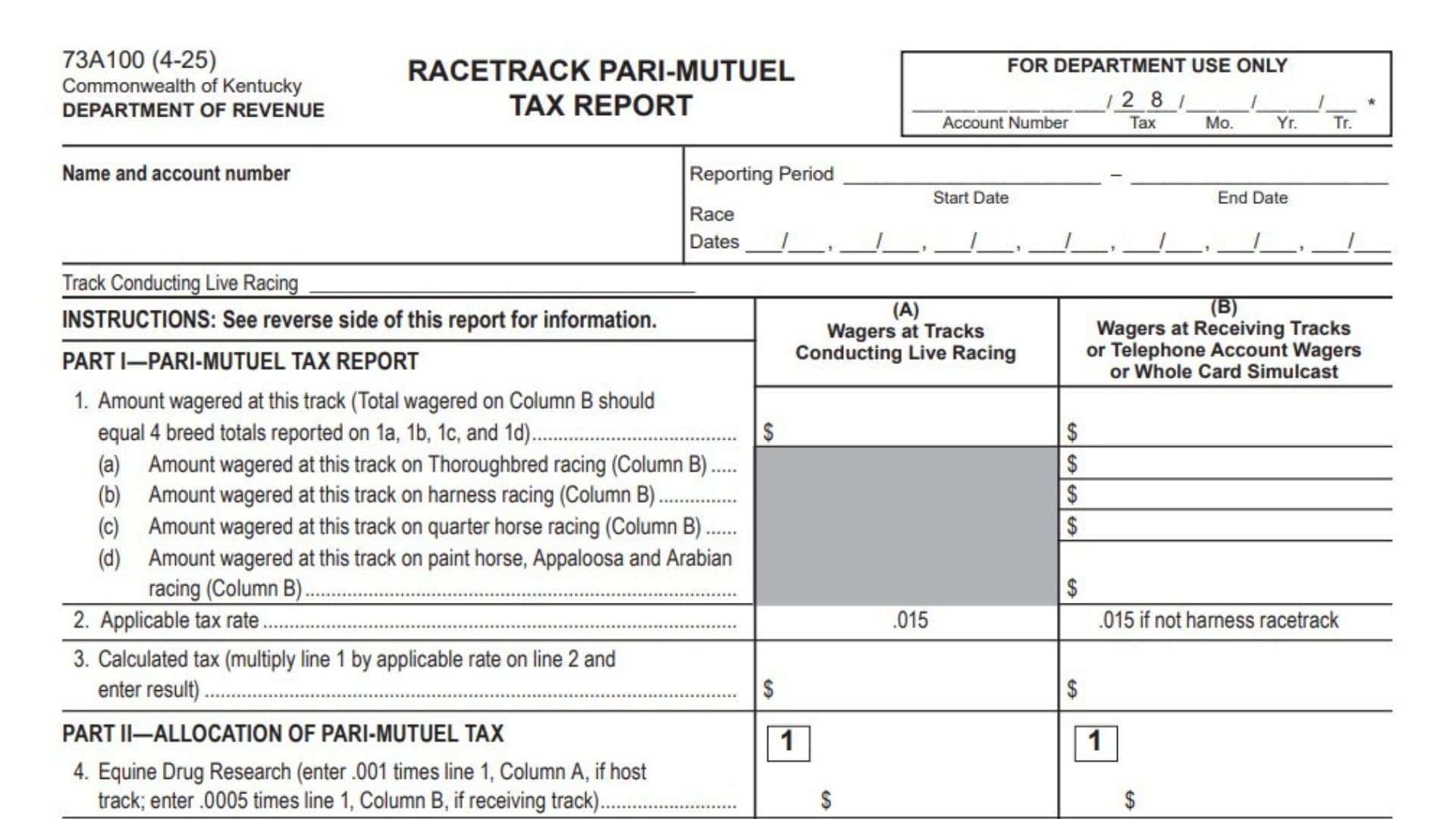
Kentucky Form 73A100, the Racetrack Pari-Mutuel Tax Report, is used to report pari-mutuel wagering activity and calculate the related Kentucky tax for racetracks conducting live racing and for certain wagers handled by receiving tracks, telephone wagering accounts, or whole-card simulcast operations. The return separates wagers into two main categories: wagers made at tracks conducting live racing and wagers associated with receiving tracks, telephone account wagering, or whole-card simulcasts. It then applies the appropriate tax rate and allocates the calculated pari-mutuel tax among several designated programs and funds, including equine drug research, equine industry programs, breed development funds, and the General Fund. The form also requires certain receiving-track wagers to be separated by Thoroughbred, harness, Quarter Horse, and Paint Horse, Appaloosa, or Arabian racing. Accurate completion matters because the allocation calculations must reconcile with the tax calculated on the return, and the final amount due must be properly paid and reported within the required filing period.
How To File Form 73A100
Prepare Form 73A100 in duplicate.
The original report, together with payment of any tax due, should be mailed to:
Kentucky Department of Revenue
Frankfort, Kentucky 40619
Make the check payable to the:
Kentucky State Treasurer
A copy of the report must also be submitted by email to the Kentucky Horse Racing Commission at:
The report must be filed no later than the fifth business day after the close of each racing week. Saturdays and Sundays are excluded when determining the fifth business day.
For purposes of this return, a racing week begins on Monday and ends on Sunday.
Before completing the return, gather:
- The racetrack’s name and tax account number.
- The reporting-period start and end dates.
- The dates on which racing took place during the reporting week.
- The name of the track conducting live racing.
- Total wagers at the track conducting live racing.
- Total wagers handled as a receiving track, telephone account wagers, or whole-card simulcast wagers.
- Receiving-track wagering totals separated by racing breed.
- The applicable pari-mutuel tax rate.
- Information needed to calculate each required allocation.
- Current fiscal-year deposit information for the Thoroughbred and Standardbred Development Funds when determining the applicable rate.
- Records supporting the calculations and any accompanying schedules.

How To Complete Form 73A100
Taxpayer And Reporting Information
Name and Account Number
Enter the legal name of the racetrack or reporting entity and the applicable Kentucky tax account number.
Make sure the account number belongs to the entity responsible for the pari-mutuel tax reported on this return.
Reporting Period — Start Date
Enter the first date covered by the return.
The reporting period should correspond with the applicable racing week.
Reporting Period — End Date
Enter the last date covered by the return.
Confirm that all wagers reported on the form fall within the stated reporting period.
Race Dates
Enter the individual dates on which races were conducted during the reporting period.
The form provides spaces for multiple race dates. Complete each applicable date for the week being reported.
Track Conducting Live Racing
Enter the name of the racetrack conducting live racing during the reporting period.
For Department Use Only
Do not complete the section marked for Department use. The account number and processing codes in this area are reserved for the Kentucky Department of Revenue.
Part I: Pari-Mutuel Tax Report
Part I determines the amount of taxable wagers and the related pari-mutuel tax.
The form uses two reporting columns.
Column A: Wagers at Tracks Conducting Live Racing
Column A is used for wagering that occurs at a track conducting live racing.
Column B: Receiving Tracks, Telephone Account Wagers, or Whole-Card Simulcast
Column B is used for wagers at receiving tracks, telephone account wagers, or whole-card simulcast wagers.
Unlike Column A, the form requires the Column B amount on line 1 to be separated into four breed categories on lines 1a through 1d.
Reporting Wagers
Line 1: Amount Wagered at This Track
Enter the applicable total amount wagered.
In Column A, enter the total wagers associated with the track conducting live racing.
In Column B, enter the total wagers handled as receiving-track wagers, telephone account wagers, or whole-card simulcast wagers.
The total entered in Column B must equal the combined amounts reported on lines 1a, 1b, 1c, and 1d.
Line 1a: Thoroughbred Racing
For Column B, enter the amount wagered on Thoroughbred racing.
This amount forms part of the Column B total reported on line 1 and is also used in the Thoroughbred Development Fund calculation later in Part II.
Line 1b: Harness Racing
For Column B, enter the amount wagered on harness racing.
This amount must be included in the total on line 1, Column B, and is used in calculating the Standardbred Development Fund allocation when applicable.
Line 1c: Quarter Horse Racing
Enter the Column B amount wagered on Quarter Horse racing.
Include this amount when reconciling the four breed categories with the total on line 1, Column B.
Line 1d: Paint Horse, Appaloosa, and Arabian Racing
Enter the Column B amount wagered on Paint Horse, Appaloosa, and Arabian racing.
This amount is also used in calculating the corresponding breed development fund allocation in Part II.
After completing lines 1a through 1d, verify that:
Line 1a + Line 1b + Line 1c + Line 1d = Line 1, Column B
The form does not request a corresponding breed-by-breed breakdown in Column A.
Line 2: Applicable Tax Rate
For Column A, the form provides a tax rate of:
0.015
For Column B, the form specifies:
0.015 if not a harness racetrack
Use the rate applicable to the wagering category being reported. The form itself does not provide a different Column B rate for a harness racetrack in this field.
Line 3: Calculated Tax
Multiply the amount on line 1 by the applicable tax rate shown on line 2.
For Column A:
Line 1, Column A × Applicable Rate = Line 3, Column A
For Column B:
Line 1, Column B × Applicable Rate = Line 3, Column B
Enter the calculated tax separately in the appropriate columns.
The line 3 amounts become the amounts that must be fully allocated in Part II.
Part II: Allocation of Pari-Mutuel Tax
Part II divides the calculated pari-mutuel tax among designated Kentucky programs and funds.
Column A generally applies to the host or live-racing track.
Column B applies to receiving-track wagering where indicated.
Not every allocation applies to both columns. Follow the instructions for each individual line.
Equine Research And Industry Allocations
Line 4: Equine Drug Research
For a host track in Column A, multiply line 1, Column A by 0.001.
Use:
Line 1, Column A × 0.001 = Line 4, Column A
For a receiving track in Column B, multiply line 1, Column B by 0.0005.
Use:
Line 1, Column B × 0.0005 = Line 4, Column B
Enter the resulting amounts in their respective columns.
Line 5: Equine Industry Program at UofL
For a host track in Column A, calculate 0.002 of line 1 and divide the result by 3.
Use:
Line 1, Column A × 0.002 ÷ 3 = Line 5, Column A
For a receiving track in Column B, multiply line 1, Column B by 0.00025.
Use:
Line 1, Column B × 0.00025 = Line 5, Column B
Enter the appropriate amounts.
Line 6: Equine Industry Program at UK
This allocation applies to Column A when the filer is the host track.
Multiply line 1, Column A by 0.002 and divide by 3:
Line 1, Column A × 0.002 ÷ 3 = Line 6
Enter the result in Column A.
The form does not provide a corresponding Column B calculation for this line.
Line 7: Equine Industry Program at BCTC
For a host track, multiply line 1, Column A by 0.002 and divide the result by 3:
Line 1, Column A × 0.002 ÷ 3 = Line 7
Enter the amount in Column A.
No Column B calculation is provided for this allocation.
Line 8: Higher Education Equine Trust and Revolving Fund
For a host track in Column A:
Line 1, Column A × 0.001 = Line 8, Column A
For a receiving track in Column B:
Line 1, Column B × 0.0005 = Line 8, Column B
Enter the calculated amount in each applicable column.
Breed Development Fund Allocations
Thoroughbred Development Fund
Line 9: Thoroughbred Development Fund
The Column A calculation depends on total fiscal-year deposits to the Thoroughbred Development Fund.
If fiscal-year deposits are $45 million or less, multiply line 1, Column A by 0.0075:
Line 1, Column A × 0.0075 = Line 9, Column A
Once fiscal-year deposits exceed $45 million, use 0.004:
Line 1, Column A × 0.004 = Line 9, Column A
For Column B receiving-track activity, use the Thoroughbred wager amount reported on line 1a:
Line 1a, Column B × 0.01 = Line 9, Column B
The reduced Column A rate applies once the specified fiscal-year deposit threshold has been exceeded.
Standardbred Development Fund
Line 10: Standardbred Development Fund
The Column A rate depends on fiscal-year deposits to the Standardbred Development Fund.
If fiscal-year deposits are $20 million or less, multiply line 1, Column A by 0.01:
Line 1, Column A × 0.01 = Line 10, Column A
Once fiscal-year deposits exceed $20 million, use the reduced rate of 0.004:
Line 1, Column A × 0.004 = Line 10, Column A
For Column B, use the harness-racing wager amount reported on line 1b:
Line 1b, Column B × 0.01 = Line 10, Column B
Quarter Horse Development Fund
Line 11: Quarter Horse Development Fund
For a host track in Column A, multiply line 1 by 0.01:
Line 1, Column A × 0.01 = Line 11, Column A
For a receiving track in Column B, use the Quarter Horse wagering amount reported on line 1c:
Line 1c, Column B × 0.01 = Line 11, Column B
Enter the applicable amounts.
Paint Horse, Appaloosa, And Arabian Development Fund
Line 12: Paint Horse, Appaloosa and Arabian Development Fund
This line uses the amount reported on line 1d in Column B.
Multiply that amount by 0.01:
Line 1d, Column B × 0.01 = Line 12, Column B
The form does not provide a Column A calculation for line 12.
General Fund Calculation
Line 13: General Fund
The General Fund amount is the remaining portion of the tax after subtracting the applicable allocations from line 3.
For a host track in Column A, subtract lines 4, 5, 6, 7, 8, 9, 10, 11, and 12 from line 3, as directed by the form:
Line 3 – Lines 4, 5, 6, 7, 8, 9, 10, 11, and 12 = Line 13, Column A
Where a listed line has no applicable Column A amount, only the amounts actually applicable to that column affect the calculation.
For a receiving track in Column B, subtract lines 4, 5, 8, 9, 10, 11, and 12 from line 3:
Line 3 – Lines 4, 5, 8, 9, 10, 11, and 12 = Line 13, Column B
Enter the resulting General Fund amount in the appropriate column.
Total Amount Due
Line 14: Total Amount Due
For a host track in Column A, add the applicable amounts on lines:
4, 5, 6, 7, 8, 9, 10, 11, 12, and 13.
The result must equal the tax calculated on line 3, Column A.
For a receiving track in Column B, add:
4, 5, 8, 9, 10, 11, 12, and 13.
The result must equal line 3, Column B.
This reconciliation is important:
Line 14, Column A must equal Line 3, Column A.
Line 14, Column B must equal Line 3, Column B.
If the amounts do not match, review the individual allocations and General Fund calculation before filing.
Certification And Signature Information
The form contains a certification that the report and any accompanying schedules are, to the best of the signer’s knowledge and belief, true and correct.
Complete the certification only after reviewing the return.
Day
Enter the numerical day on which the report is signed.
Month
Enter the month in which the report is signed.
Year
Enter the appropriate year.
Track Representative
The responsible track representative should provide his or her name or signature in the designated area.
Title
Enter the track representative’s official title.
Understanding Daily Average Live Handle
The instructions explain that daily average live handle is based only on amounts wagered at tracks conducting races that meet the applicable definition.
For this calculation, do not include amounts wagered through categories specifically excluded by the form’s instructions, such as:
- Wagers at receiving tracks.
- Wagers at simulcast facilities.
- Telephone account wagering.
- Advance deposit account wagering.
- Certain wagering where a track participates as a receiving track or simulcast facility.
- Historical horse race wagering beginning April 1, 2014.
This distinction is particularly important when determining license-tax obligations associated with live racing activity.
Racetrack License Tax Requirements
In addition to the pari-mutuel tax report, racetracks conducting live horse racing under the jurisdiction described in the form’s instructions must report and pay a separate license tax.
The license tax is due within 30 days after the end of each race meet.
The tax applies for each day of racing and is determined using the average daily mutuel handle from the preceding race year.
License Tax Based on Average Daily Live Mutuel Handle
The applicable daily license tax is:
| Average Daily Live Mutuel Handle | License Tax |
|---|---|
| $0 to $25,000 | $0 |
| $25,001 to $250,000 | $175 |
| $250,001 to $450,000 | $500 |
| $450,001 to $700,000 | $1,000 |
| $700,001 to $800,000 | $1,500 |
| $800,001 to $900,000 | $2,000 |
| $900,001 and above | $2,500 |
Use the average daily live mutuel handle from the applicable preceding race year to determine the appropriate tax level.
Annual Racetrack Report
Racetracks subject to this license-tax requirement must also file an annual report.
The annual report is due by December 31 each year.
It must summarize the average daily handle for the race year ending on the immediately preceding November 30.
Any additional license tax due must also be paid.
Thoroughbred Development Fund Threshold
The Thoroughbred Development Fund rate used on line 9 changes when the specified fiscal-year funding level is reached.
Until $45 million has been deposited into the fund during the fiscal year from live and historical horse race wagering, the Column A rate is 0.0075 of applicable live Thoroughbred wagers.
After the deposits reach the threshold described by the form, the rate decreases to 0.004.
Use the appropriate rate for the period being reported.
Standardbred Development Fund Threshold
The Standardbred Development Fund calculation on line 10 also has two rates.
Until $20 million has been deposited during the fiscal year from live wagering, the applicable Column A rate is 0.01.
After the specified threshold is reached, the rate decreases to 0.004.
Apply the rate that corresponds with the fiscal-year deposit status for the reporting period.
Interest And Penalties
Interest
Interest may be assessed on unpaid tax from the original due date of the return through the date the tax is paid.
The applicable tax interest rate is determined under Kentucky’s tax-interest provisions.
Late Payment Penalty
If the tax due on line 14 is not paid by the original due date, a late-payment penalty may be assessed.
The penalty is 2% of the tax due for each 30-day period or part of a 30-day period that the payment remains late.
The penalty cannot exceed 20% of the tax due.
The minimum penalty is $10.
Late Filing Penalty
A late-filing penalty may apply if the return is not filed by its original or extended due date.
The penalty is 2% of the total tax due for each 30-day period or fraction of a 30-day period that the return remains unfiled.
The maximum penalty is 20%, and the minimum penalty is $10.
Additional civil penalties may apply in circumstances involving negligence, failure to file, fraud, or similar violations.
The instructions state that penalties may be reduced or waived when reasonable cause is established. Interest, however, is not subject to this reduction or waiver provision.
Final Review Before Filing
- Enter the correct taxpayer name and account number.
- Verify the reporting-period start date.
- Verify the reporting-period end date.
- Enter every applicable race date for the reporting week.
- Identify the track conducting live racing.
- Leave the Department-use-only section blank.
- Report live-racing track wagers in Column A.
- Report receiving-track, telephone account, or whole-card simulcast wagers in Column B.
- Verify the total wagering amount on line 1.
- Enter Thoroughbred receiving-track wagers on line 1a.
- Enter harness receiving-track wagers on line 1b.
- Enter Quarter Horse receiving-track wagers on line 1c.
- Enter Paint Horse, Appaloosa, and Arabian receiving-track wagers on line 1d.
- Confirm that lines 1a through 1d equal line 1, Column B.
- Use the applicable tax rate shown on line 2.
- Verify the tax calculation on line 3.
- Calculate Equine Drug Research correctly on line 4.
- Calculate the UofL Equine Industry Program allocation correctly on line 5.
- Complete the UK Equine Industry Program allocation on line 6 when applicable.
- Complete the BCTC Equine Industry Program allocation on line 7 when applicable.
- Calculate the Higher Education Equine Trust and Revolving Fund amount on line 8.
- Determine the correct Thoroughbred Development Fund rate before completing line 9.
- Use the correct fiscal-year deposit threshold when calculating line 9.
- Determine the correct Standardbred Development Fund rate before completing line 10.
- Use the correct fiscal-year deposit threshold when calculating line 10.
- Calculate the Quarter Horse Development Fund allocation on line 11.
- Calculate the Paint Horse, Appaloosa, and Arabian Development Fund allocation on line 12 when applicable.
- Calculate the General Fund amount on line 13 using the correct set of allocations for Column A or Column B.
- Add the applicable allocations to calculate line 14.
- Confirm that line 14, Column A equals line 3, Column A.
- Confirm that line 14, Column B equals line 3, Column B.
- Review any accompanying schedules for accuracy.
- Complete the certification date.
- Have the track representative complete the certification.
- Enter the representative’s title.
- Prepare the report in duplicate.
- Make any tax payment payable to the Kentucky State Treasurer.
- Mail the original report and payment to the Kentucky Department of Revenue.
- Email a copy of the report to the Kentucky Horse Racing Commission.
- File the report no later than the fifth business day after the close of the applicable race week.
- Keep the separate race-meet license-tax and annual-report requirements in mind when they apply.